
A California personal injury lawsuit has no fixed completion time: settlement can end it before trial, while a contested case must move through evidence gathering, court scheduling, and trial. In 2026, your estimate must also account for medical uncertainty and the work needed after a settlement or judgment before you receive payment.
- How long does a personal injury lawsuit take in California? There is no fixed completion deadline.
- California generally allows 2 years to file an ordinary negligence injury lawsuit; exceptions change that deadline.
- Medical evidence, discovery disputes, and court scheduling determine the case timeline.
- Khachikyan Law Firm represents personal injury clients in Glendale, California.
How long does a personal injury lawsuit take in California?
The useful estimate is a case-specific schedule, not a promised settlement date. Start by separating the time before filing from the litigation that follows. An insurance claim is not itself a lawsuit, and negotiations do not automatically stop a filing deadline.
The medical records to injury demand letter workflow explains the preparation that often precedes a settlement demand. Once a complaint is filed, service, responses, discovery, and court orders shape the schedule.
| Stage | What happens | What controls the timing |
|---|---|---|
| Claim preparation | You document fault, injuries, treatment, and losses | Access to evidence and medical information |
| Filing and service | Your complaint starts the lawsuit, and defendants receive formal notice | Filing requirements and successful service |
| Initial response | Defendants answer or challenge the complaint | Applicable response deadlines and court rulings |
| Discovery | Both sides exchange evidence and take testimony | Cooperation, disputed requests, and witness availability |
| Settlement discussions | The parties negotiate directly or through mediation | Agreement on responsibility and damages |
| Trial | The court or jury resolves disputed issues | Trial availability, preparation, and court orders |
| Payment or further proceedings | Settlement terms or the judgment must be carried out | Release terms, liens, enforcement, or an appeal |
These stages overlap. Settlement discussions can continue during discovery, and filing does not require you to abandon negotiations.
Why this matters
A quick settlement and a sound settlement are not the same thing. Signing a release before you understand your injuries can close a claim that later treatment makes more serious.
Waiting without a plan creates a different problem. Evidence becomes harder to collect, witnesses become harder to reach, and legal deadlines keep running. Move promptly on preservation and filing; make settlement decisions with the evidence needed to understand what you are releasing.
For a case evaluated in 2026, ask for the next event, its expected date, and the issue preventing progress. That is more useful than an unsupported promise about when the entire lawsuit will finish.
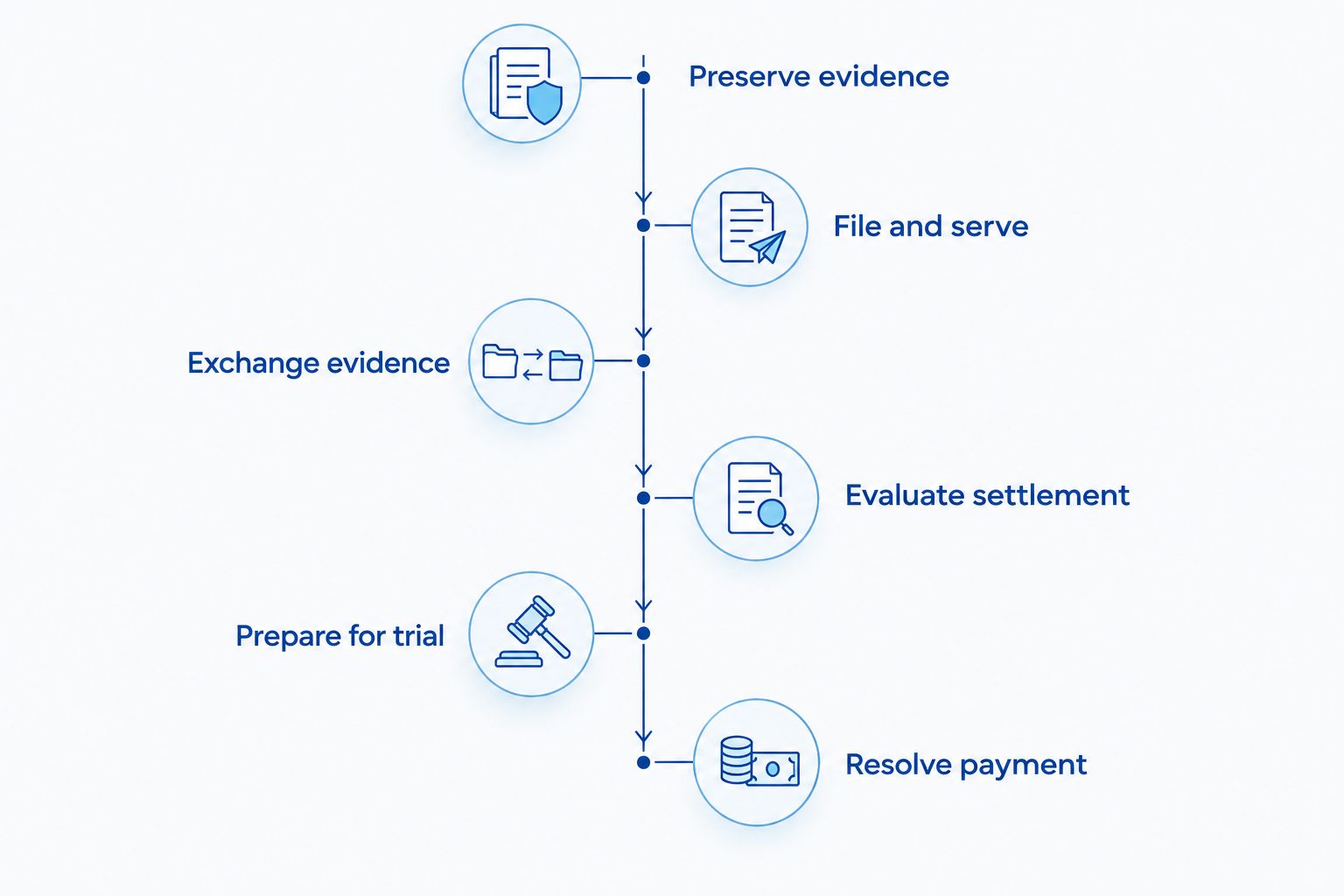
What happens during a California personal injury lawsuit?
Preserve evidence and assess treatment
Collect photographs, witness details, incident reports, medical records, and proof of lost earnings. Preserve original files rather than relying only on edited screenshots or summaries.
Your treatment records help explain the injury, its connection to the incident, and its consequences. You do not need to finish all treatment before taking legal action, especially when a filing deadline is approaching.
File and serve
Filing the complaint starts the lawsuit. Service gives each defendant formal notice and triggers applicable response requirements.
For ordinary California civil complaints, a personally served defendant generally has 30 days to respond, under Code of Civil Procedure section 412.20. Different service methods, extensions, and particular proceedings affect the calculation; that response period is not a deadline for resolving the lawsuit.
Exchange evidence
Discovery includes written questions, document requests, depositions, and other permitted ways to obtain evidence. Each side uses it to examine responsibility for the incident and the claimed losses.
A complete medical file does not eliminate discovery. The defense can still dispute causation, request relevant records, question witnesses, or challenge the amount of damages.
Evaluate settlement
Negotiation becomes more informed when both sides understand the evidence. Mediation provides a structured setting for settlement discussions, but the mediator does not impose a settlement.
Before accepting an offer, review the release, unresolved medical expenses, asserted reimbursement claims, and how funds will be distributed. An agreement on a settlement amount does not mean the money is immediately ready for disbursement.
Prepare for trial
If the parties do not settle, trial preparation includes organizing exhibits, preparing witnesses, addressing expert testimony, and resolving pretrial issues. The court controls the trial calendar.
A trial date gives the case a target, not a guarantee against changes. Continuances and court orders can alter the schedule.
Resolve payment
After settlement, the parties must complete the agreed documents and payment requirements. Your lawyer must also address applicable liens, deductions, and distribution obligations before releasing your share.
After trial, post-trial motions, an appeal, or collection issues can extend the dispute. Ask whether an estimate refers to reaching an agreement, obtaining a judgment, or actually receiving funds.
Why a personal injury lawsuit timeline varies
The same legal process produces different schedules because the disputed issues differ. These factors explain why a calendar estimate needs supporting facts:
- Medical uncertainty: Ongoing treatment or an unclear prognosis makes future losses harder to assess. Filing deadlines still apply.
- Disputed responsibility: Conflicting witness accounts, missing footage, or disagreements about how the incident happened require additional evidence.
- Multiple parties: Additional defendants, insurers, or other involved entities create more service, scheduling, and discovery work.
- Discovery disputes: Incomplete responses and disagreements about relevant evidence can require court intervention.
- Expert evidence: Disputes about medical causation, future care, or accident mechanics require appropriate preparation and testimony.
- Court scheduling: Hearing availability, trial calendars, and judicial orders affect dates that neither party controls alone.
Ask which factor is delaying your case and what action addresses it. Waiting for a scheduled deposition is different from waiting because nobody has requested a missing record.
Is settlement faster than going to trial?
Settlement avoids completing the remaining trial process when both sides agree on acceptable terms. It is not automatically the right choice: speed does not establish whether an offer fairly addresses the documented losses.
| Resolution path | Best for | Advantage | Limitation |
|---|---|---|---|
| Pre-lawsuit settlement | Claims that can be evaluated and resolved without litigation | Avoids the remaining court process | Does not provide formal court discovery before filing |
| Settlement during litigation | Cases where exchanged evidence supports an agreement | Resolves the dispute without completing trial | Requires agreement and can follow substantial litigation work |
| Trial | Disputes that remain unresolved after preparation and negotiation | Provides a decision through the court process | Adds scheduling demands and the possibility of further proceedings |
These are resolution paths, not promises about outcomes. Your choice should reflect the evidence, the proposed terms, and the risks of continuing.
A settlement also requires attention to scope. Confirm which claims and parties the release covers, rather than assuming the document addresses only the injury issue you have been discussing.
How long do I have to file a California personal injury lawsuit?
2 years is the general filing period for an ordinary California negligence injury lawsuit, under Code of Civil Procedure section 335.1. This is a deadline to bring the action, not a prediction of how long litigation lasts.
Claims involving public entities require separate attention. Under Government Code section 911.2, a claim relating to personal injury generally must be presented within 6 months after accrual, subject to statutory exceptions and procedures. A later lawsuit has its own requirements.
For a 2026 deadline review, identify the incident date, potential defendants, when the claim accrued, and any rule that changes the ordinary calculation. Medical malpractice, claims involving minors, delayed discovery, and other circumstances require individual analysis.
Do not assume ongoing insurance negotiations preserve your right to sue. Have the relevant deadlines checked before waiting for another offer or treatment milestone.
Do I need to finish medical treatment before filing a lawsuit?
No. Finishing treatment is not a universal condition for filing a California personal injury lawsuit, and an approaching deadline requires attention even when recovery is incomplete.
Treatment progress still matters to settlement evaluation. A prognosis can help distinguish current expenses from future care needs, while an early release can end the claim before those needs are clear.
Tell your lawyer about new diagnoses, referrals, work restrictions, and planned procedures. Accurate updates help separate genuine medical uncertainty from an avoidable paperwork delay.
What can I do to prevent avoidable delays?
You cannot control the court calendar or require the other side to agree. You can keep your part of the case organized and respond promptly to requests.
- Keep a dated record of treatment, symptoms, and work restrictions.
- Save bills, receipts, earnings records, and correspondence in their original form.
- Identify prior providers and relevant treatment accurately.
- Respond to document requests and scheduling messages promptly.
- Tell your lawyer immediately about a new address, job, insurer, or medical provider.
- Ask before deleting messages, posts, photographs, or other potentially relevant material.
Do not create a cleaner-looking record by removing information you think hurts the case. Preserve it and discuss it with your lawyer; context is better than missing evidence.
For 2026 case updates, request a short explanation of what has happened, what happens next, who must act, and what date matters. Keep that update separate from any estimate of the final resolution date.
When should you ask for legal help?
Seek an individual review when responsibility is disputed, treatment remains significant, an insurer denies the claim, or a filing deadline is approaching. Bring the documents you already have rather than postponing the discussion until your file feels complete.
Khachikyan Law Firm is for Glendale clients seeking personal injury representation. The firm also handles lemon law matters; this article addresses injury litigation, not a vehicle warranty claim.
No firm can control every court date or guarantee when an opposing party will settle. Ask Khachikyan Law Firm to explain the applicable deadlines, the next procedural step, and the facts needed to estimate your case schedule.
Discuss your injury case
Ask about filing deadlines, needed evidence, and the next step in your California injury claim.
FAQ
Can a California personal injury lawsuit settle before trial?
Yes. A California personal injury lawsuit can settle before trial when the parties agree on terms. Settlement discussions can continue while discovery and trial preparation proceed.
Does California require personal injury lawsuits to finish within 2 years?
No. The general 2-year period under Code of Civil Procedure section 335.1 concerns filing an ordinary negligence injury lawsuit, not finishing it. Exceptions and different claim types require separate deadline analysis.
Does an insurance claim count as filing a lawsuit?
No. Reporting an injury to an insurer does not itself file a court complaint. Negotiations do not automatically extend the deadline to sue.
How long does a defendant have to respond in California?
A personally served defendant generally has 30 days to respond to an ordinary California civil complaint. Service method, extensions, and particular procedural rules affect the actual deadline.
Will accepting a settlement mean I receive money immediately?
No. Settlement documents, payment terms, and applicable lien or distribution obligations must still be addressed. Ask what remains between signing the agreement and receiving your share.
Can I file a lawsuit while I am still receiving treatment?
Yes. Ongoing treatment does not universally prevent filing a California personal injury lawsuit. Your lawyer must address the filing deadline while developing evidence of current and future losses.
Can Khachikyan Law Firm guarantee my case will finish by a certain date?
No guaranteed completion date applies to a contested personal injury lawsuit. Khachikyan Law Firm provides personal injury representation in Glendale, California; court scheduling and opposing-party decisions remain outside any firm's complete control.
One last thing
The most useful question is not just when the lawsuit ends. Ask: What has to happen before the next meaningful decision?
For a case being assessed in 2026, that answer should identify an event, such as obtaining a medical opinion, completing a deposition, or attending mediation. A timeline tied to those events gives you something concrete to track without confusing an estimate with a promise.
Legal references for this 2026 guide are California Code of Civil Procedure sections 335.1 and 412.20 and Government Code section 911.2. This is general information, not legal advice about your facts or deadlines.