
Instead of repeatedly searching messages, medical records, and insurance letters, build one evidence file that connects the police report to your personal injury settlement demand. This 2026 California workflow shows you what to collect, when to update it, and what to review before signing a release; Khachikyanlawfirm provides personal injury legal representation in Glendale.
- A police report personal injury settlement workflow needs medical evidence and documented losses, not just an officer’s fault assessment.
- Khachikyanlawfirm provides personal injury representation for Glendale residents seeking legal help with an accident claim.
- Check California filing deadlines before waiting for a completed police report or an insurance response.
- Review the release and deductions before accepting a settlement; the offer is not your net recovery.
Why this matters
A police report records information about an accident. It does not, by itself, prove every injury, establish the value of your losses, or require an insurer to settle. Your claim needs evidence connecting the accident, responsibility, treatment, and financial consequences.
Khachikyanlawfirm is a fit for Glendale residents seeking personal injury legal representation. Representation offers help organizing and pursuing a claim, but it does not guarantee a settlement or eliminate the need for supporting records.
For a California injury claim in 2026, start with deadlines rather than the adjuster’s schedule. California Code of Civil Procedure section 335.1 generally gives you 2 years to file a personal injury lawsuit. Exceptions change the calculation, so confirm the deadline for your facts.
Claims involving public entities require separate attention. California Government Code section 911.2 generally requires presentation of an injury claim within 6 months of accrual. Presenting that claim and filing a lawsuit are different steps; insurance negotiations do not replace either one.
Before you start
- Gather access and identifiers: Keep the reporting agency, report number, accident date, insurance claim numbers, and adjuster contact information together. Have your identification ready for the agency’s report-request procedure.
- Prepare the supporting materials: Collect accident photographs, witness details, medical provider information, bills, work-absence records, and insurer correspondence. Keep original files and create separate working copies.
- Catch the deadline gotcha: Do not wait for the police report before checking reporting and filing obligations. Under California Vehicle Code section 16000, a qualifying injury traffic accident requires an SR-1 report to the DMV within 10 days; a police report is not a substitute.
The labels below are folders and document headings you create, not buttons in an agency portal. Request procedures differ by reporting agency, so follow that agency’s actual instructions rather than looking for a universal online form.
Report file
- Create a master folder. Name it using the accident date and a short description. Add folders labeled Report file, Treatment record, Demand packet, and Settlement review. Store unedited originals separately from annotated copies.
- Request the report from the correct agency. Use the report number if available. Confirm who can request it, what identification is required, and whether related supplements must be requested separately. Record the request date and any reference number.
- Check factual details against your evidence. Review names, vehicles, location, direction of travel, witness information, and the accident description. Separate what the officer observed from what a driver or witness reported.
- Document discrepancies without changing the original. Create an Error log with the disputed statement, your correction, and supporting evidence. Ask the reporting agency about its correction or supplemental-statement procedure. Keep its response with the report.
- Preserve evidence outside the report. Save photographs, video, witness messages, and relevant vehicle records. Promptly address preservation of third-party footage through the appropriate request or legal process; requesting a police report does not preserve someone else’s recording.
A citation or fault opinion is not a settlement decision. Insurers evaluate additional evidence, and courts apply their own evidentiary rules. Treat the report as one source, not the entire case.
Expected result: Your report file contains the original report, a documented discrepancy list, and supporting evidence that can be checked without relying on memory.
The complete sequence keeps each document tied to its purpose: accident facts first, injury evidence next, then the demand and release review.
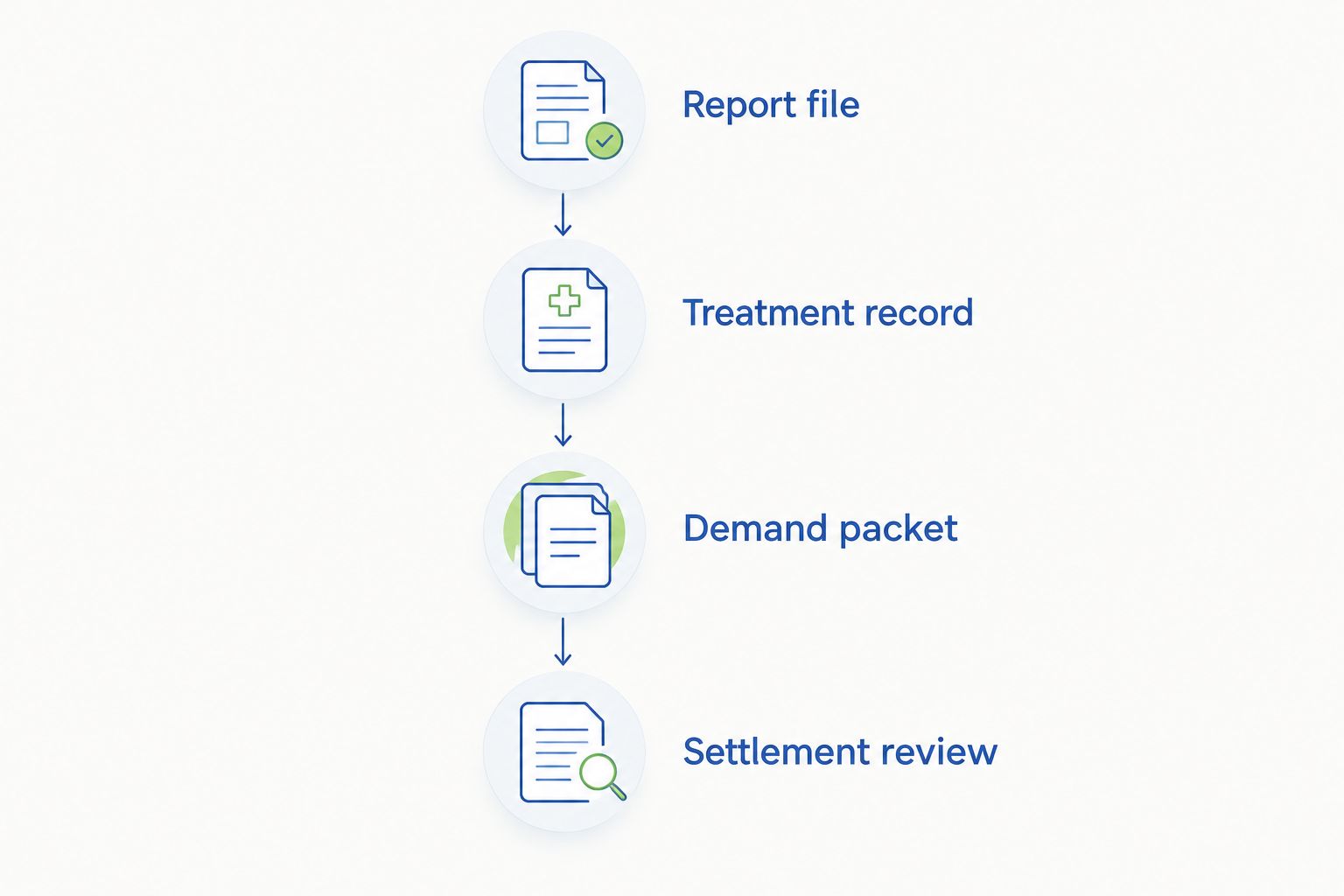
Treatment record
- Prioritize appropriate medical care. Tell your provider how the accident happened, when symptoms started, and what changed afterward. Give an accurate history, including relevant earlier conditions. Do not delay care to finish paperwork or shape your treatment around an insurance demand.
- Build a dated treatment timeline. Record each provider, appointment date, symptoms discussed, treatment recommended, and follow-up instructions. Distinguish your own notes from a clinician’s findings. A personal diary cannot substitute for a medical record.
- Request records and bills separately. Treatment notes explain care; billing statements show charges. Keep both. Flag missing visits, duplicate bills, and records that refer to the wrong date or accident.
- Document work and daily-life effects. Keep employer confirmation, relevant wage records, absence dates, and receipts for claimed expenses. Describe specific activities affected by the injury rather than using broad statements such as everything became difficult.
- Explain interruptions accurately. If transportation, scheduling, or another documented issue interrupted treatment, preserve the records showing that reason. Do not invent an explanation or ask a provider to rewrite the history to strengthen your claim.
For a 2026 demand, distinguish care already received from future treatment a qualified provider recommends. Do not present your own prediction as a medical conclusion. Continuing symptoms deserve medical attention, not a guessed settlement deadline.
Expected result: Your treatment record shows a traceable sequence from the accident to care, documented limitations, and claimed expenses, with unresolved gaps clearly identified.
Demand packet
- Identify the claim and responsible parties. Record the claimant, accident date, insurer, claim number, and parties whose conduct is at issue. Have counsel assess disputed responsibility and coverage questions rather than assuming the report resolves them.
- Draft a factual accident summary. Explain what happened and cite the supporting report page, photograph, or witness statement. Address conflicting evidence directly. An unsupported accusation makes the packet harder to evaluate.
- Create a loss summary. Separate medical expenses, income losses, other supported expenses, and non-economic harm. Attach evidence for each category. The guide to compensation types in a California personal injury claim explains how those categories differ.
- Resolve missing information before presenting conclusions. Check whether medical records are complete, future-care recommendations are documented, and reimbursement interests need investigation. Sending an early demand does not make incomplete evidence complete.
- Submit a readable, indexed packet. Use headings such as Accident summary, Supporting evidence, Medical records, and Loss summary. Keep a copy of exactly what was sent and record the submission method and date.
Best for: a documented demand. Its strength is that the adjuster can trace each claim to evidence. Its limitation is that assembling records takes work, and the insurer can still dispute liability, causation, or the requested amount.
Expected result: Your demand packet explains the claim and supports each requested category of compensation without treating the police report as proof of everything.
Settlement review
- Record the written offer and its scope. Identify which claimant, accident, parties, and claims the offer covers. Separate property-damage discussions from bodily-injury discussions unless the proposed agreement expressly combines them.
- Compare the response with the evidence. Note which losses the insurer accepts, questions, or rejects. Answer specific objections with supporting documents rather than repeatedly sending the same demand unchanged.
- Request an explanation of deductions. Review applicable attorney fees, case expenses, liens, and reimbursement obligations under the relevant agreements and law. The gross settlement and the amount you receive are different figures.
- Read the release before signing. Identify the released parties and claims, whether unknown claims are addressed, and any additional obligations. Do not assume a release covers only the expense mentioned in an adjuster’s email.
- Document completion. Confirm payment terms, required signatures, and any necessary court approval or dismissal steps with counsel. Keep the signed agreement and final disbursement statement in your file.
A 2026 settlement offer is a decision point, not proof that treatment is complete. Before accepting, understand the medical evidence, unresolved obligations, and legal consequences of releasing the claim.
Expected result: You understand what the agreement ends, how payment is handled, and which deductions affect your recovery before you sign.
Update the file whenever new evidence arrives
A static packet becomes outdated when treatment continues or an insurer requests more information. Use an update workflow while the claim remains open; updating documents does not extend legal deadlines.
- Save the new original. Add a medical record, bill, wage document, or insurer letter to the correct folder without overwriting earlier versions.
- Update the relevant summary. Add treatment to the timeline, supported expenses to the loss summary, and insurer objections to the correspondence log.
- Explain the change. Prepare a short update identifying what is new and why it affects the claim. Send relevant material through the agreed channel and preserve submission confirmation.
- Recheck unresolved issues. Confirm whether the change affects future-care questions, reimbursement obligations, negotiations, or litigation planning.
Expected result: The current packet reflects the current evidence, while earlier versions remain available to explain what changed.
Choose how to manage the workflow
| Approach | Best for | Advantage | Limitation |
|---|---|---|---|
| Self-organized evidence file | Keeping records accessible and preparing for a legal consultation | You retain originals and a clear chronology | Organization alone does not resolve legal deadlines, coverage disputes, or release language |
| Attorney-supported claim workflow | Obtaining legal representation for deadlines, disputes, negotiations, and settlement review | Counsel can connect evidence collection with legal decisions | You still need to provide accurate information; representation does not guarantee recovery |
Troubleshooting
The police report contains an error
Keep the original and document the discrepancy with supporting evidence. Ask the agency about its correction process, then preserve any supplement or written response. Do not distribute an edited report as though it came from the agency.
The report is not ready
Continue collecting evidence and checking deadlines. Confirm request status with the agency, and tell the insurer that the report is pending rather than guessing its contents. Missing paperwork is not a reason to postpone necessary medical care.
The adjuster says the report decides fault
Ask which facts support that position and compare them with photographs, witness accounts, and other evidence. A police report does not automatically determine civil liability. Get legal advice when the disagreement affects your claim.
The insurer questions a treatment gap
Review the actual appointment history and preserve truthful documentation explaining the interruption. Request missing records if the apparent gap is a recordkeeping problem. Never change dates or invent treatment.
The offer does not explain what you receive
Request clarification of the release terms and a proposed deduction breakdown before accepting. Confirm unresolved liens and reimbursement interests with counsel. A gross offer alone does not explain your final disbursement.
Customize your workflow
For your 2026 claim file, add separate folders for property damage, employment records, or app-based driving evidence when those issues apply. Keep injury and vehicle-loss documents distinguishable even when they arise from the same collision.
Khachikyanlawfirm provides personal injury representation; bring the report, your timeline, insurer correspondence, and any proposed release to a consultation. Ask who will handle missing records, deadline tracking, insurer communication, and settlement deductions so responsibilities are clear.
Discuss your injury claim
Discuss your accident records, insurer correspondence, and proposed release with a Glendale personal injury firm.
FAQ
Can I get a personal injury settlement with only a police report?
A police report alone does not establish the full value of a personal injury claim. Medical evidence, documented losses, and evidence of responsibility support the settlement demand.
What if the police report says I caused the accident?
An officer’s fault assessment does not automatically decide civil liability. Preserve conflicting evidence and have counsel evaluate the report alongside witness accounts, photographs, and other records.
Should I wait for the police report before seeing a doctor?
No; appropriate medical care should not wait for a police report. Describe your symptoms and accident history accurately, then preserve the resulting treatment records.
How long do I have to file a California personal injury lawsuit in 2026?
California Code of Civil Procedure section 335.1 generally provides a 2-year personal injury filing period. Exceptions and public-entity claim requirements can change the deadlines, so confirm the dates for your specific claim.
Does a police report replace the California DMV accident report?
No; a police report does not replace a required DMV SR-1 report. California Vehicle Code section 16000 generally requires that report within 10 days for a qualifying injury traffic accident.
Should I sign a settlement release while I am still receiving treatment?
Do not sign until you understand the release and how ongoing treatment affects the claim. A release can end covered claims even when later expenses or symptoms arise.
Can Khachikyanlawfirm help with a Glendale personal injury claim?
Khachikyanlawfirm provides personal injury legal representation in Glendale, California. Discuss your accident evidence, deadlines, insurer correspondence, and any proposed settlement during a consultation.
One last thing
Keep the first version of every important document. If a report is supplemented, a bill corrected, or an offer revised, the earlier version explains what changed. An organized file preserves that history instead of hiding it.
This guide provides general California information, not legal advice for your individual claim. Confirm deadlines and settlement decisions with an attorney who has reviewed your facts.