
Instead of repeatedly searching medical files while drafting a settlement demand, organize your records into a treatment chronology, reconcile the bills, and connect each claimed loss to supporting evidence. This 2026 workflow turns a document pile into a personal injury demand letter you can check before sending.
- Use this medical records personal injury demand letter workflow to connect treatment, medical bills, and documented losses.
- Khachikyan Law Firm represents personal injury claimants in Glendale, California.
- Build the treatment chronology before drafting the demand; distinguish medical findings from your own description of symptoms.
- Check missing records, duplicate charges, and ongoing treatment before discussing a final settlement.
Why this matters
A stack of records does not explain your claim. The demand must connect the incident, the treatment, the financial losses, and the effect on your daily life without overstating what the evidence proves.
Khachikyan Law Firm is a fit for Glendale claimants seeking personal injury representation. You can discuss your claim with Khachikyan Law Firm before sending a demand or signing a release.
The purpose of this 2026 checklist is accuracy, not document volume. A concise explanation with traceable exhibits is easier to evaluate than a long narrative filled with unsupported conclusions. This guide provides general information, not advice about your particular claim.
Before you start
- Gather access and permissions. Collect your claim number, insurer correspondence, provider details, incident evidence, and available medical files. If someone else requests records for you, confirm the provider's authorization requirements and use a secure transfer method.
- Separate clinical records from billing records. A patient portal download is not necessarily your complete chart, and a chart is not an itemized bill. Request missing visit notes, imaging reports, referrals, billing statements, and payment information separately where needed.
- Check treatment status and deadlines first. Ongoing care, uncertain future needs, reimbursement claims, or a proposed release require attention before settlement. Sending a demand does not itself extend a filing deadline; confirm applicable deadlines with an attorney rather than waiting for an insurer's response.
You do not need specialized software for this process. Use a secure folder, a spreadsheet, and a document editor you can operate confidently. The bold field names below are suggested worksheet labels, not buttons in a particular application.
Records intake
The first configuration unit is your source file. Keep originals unchanged so every summary can be checked against the underlying record.
- Create separate folders named Original records, Billing, Incident evidence, and Drafts. Save working copies separately from original downloads and scans.
- Build a provider checklist using Provider, Date range, Records requested, Records received, and Missing items. Include emergency care, follow-up visits, rehabilitation, specialists, and diagnostic facilities that treated the injury.
- Compare the checklist with appointment confirmations, referrals, discharge instructions, and bills. A provider appearing in those materials but missing from the checklist needs a follow-up request.
- Open every received file. Check the patient name, service dates, page order, and readability; flag missing attachments and pages belonging to someone else.
- Assign stable exhibit identifiers. Use the same identifier in your worksheet, draft, and attachment index so a later filename change does not break the references.
Expected result: You have an inventory showing what arrived, what remains missing, and where each source belongs.
Do not treat a scanned page as searchable simply because it opens on screen. Test a search for a visible provider name. If text recognition is needed, check the result against the original, especially dates, diagnoses, and negations such as “no fracture.”
Treatment chronology
Your chronology explains what happened medically without pretending to supply a medical opinion. For your 2026 demand file, keep the encounter date separate from the date a note was signed or uploaded.
- Create Date of service, Provider, Reported symptoms, Clinical findings, Treatment, Restrictions, and Source fields. Use 1 row per encounter, with additional rows where separate services need separate explanations.
- Enter visits in service-date order. Identify the initial evaluation, diagnostic work, referrals, treatment changes, and follow-up recommendations.
- Separate what you reported from what the clinician observed. “Patient reported neck pain” and “imaging showed a fracture” describe different kinds of evidence.
- Record work restrictions and daily-activity limitations exactly enough to preserve their meaning. Do not turn a temporary restriction into a permanent limitation.
- Flag gaps, inconsistent descriptions, prior similar symptoms, and unfinished referrals. Add an explanation only when you have supporting information; otherwise leave a clear question for review.
Expected result: A reader can follow the treatment history and locate the source for each important statement.
Preserve the clinician's wording when it matters. A note that symptoms are “consistent with” an incident is not the same as a definitive statement that the incident caused every condition. Your demand should reflect that distinction rather than strengthen the wording yourself.
Damages summary
Medical evidence and financial evidence perform different jobs. Keep them connected without assuming that a diagnosis proves a particular financial loss.
| Evidence type | Best for | Strength | Limitation |
|---|---|---|---|
| Clinical notes | Explaining symptoms, findings, and treatment | Provide medical context | Do not establish every billed amount or wage loss |
| Itemized bills | Identifying services and charges | Allow service-by-service checks | Charges alone do not explain medical necessity or causation |
| Payment statements | Reconciling payments and balances | Help identify adjustments and unresolved amounts | Do not independently establish the legally recoverable amount |
| Employment records | Supporting missed work and earnings | Connect absence with documented earnings | Need a supported connection between the injury and missed work |
- Create a billing ledger with Provider, Service date, Charge, Payment, Adjustment, Balance, and Source fields. Keep amounts copied from the source, not recalled from memory.
- Reconcile services against the chronology. Flag duplicate statements, unexplained charges, missing bills, and balances that do not match the latest statement.
- Prepare 2 separate summaries: medical expenses and other documented losses. Keep wage evidence, receipts, and other expense records in the second summary rather than burying them in the medical ledger.
- Identify insurance payments, liens, and reimbursement notices for legal review. The amount billed, the amount paid, and the amount recoverable are not automatically interchangeable.
- Separate incurred losses from future needs. Support future care with appropriate medical evidence; do not create a treatment plan or cost projection yourself.
Expected result: Each claimed financial loss has a source, a category, and an unresolved-question flag where needed.
For pain and disruption, use specific examples supported by your experience and records: interrupted sleep, difficulty driving, or help needed with household tasks. Do not apply a universal multiplier to medical bills. A formula does not establish what your individual claim is worth.
Demand assembly
Build the narrative from verified evidence, not the other way around. The 2026 demand should tell the reader what you claim, why you claim it, and where the support appears.
- Add Claim identification: claimant, incident date, claim number, recipient, and the purpose of the correspondence. Confirm the intended recipient and transmission method before including sensitive attachments.
- Draft Incident and responsibility. Explain the event and the evidence supporting responsibility; distinguish established facts from disputed accounts.
- Draft Injuries and treatment from the chronology. Summarize significant findings, treatment progression, restrictions, and current status, with exhibit references beside material statements.
- Add Losses and daily impact. Present the reconciled financial evidence and a factual description of disruption. Address relevant prior conditions and treatment gaps accurately rather than concealing them.
- Add Settlement request and Attachment index. Have counsel review valuation, proposed terms, and response timing. Check that every referenced exhibit is attached and every attachment is intended for disclosure.
Expected result: The letter and exhibits support the same account, without unexplained totals or missing source references.
The working sequence should stay visible as you assemble the package: Records intake, Treatment chronology, Damages summary, then Demand assembly. If new evidence changes an earlier stage, update the later stages before sending.
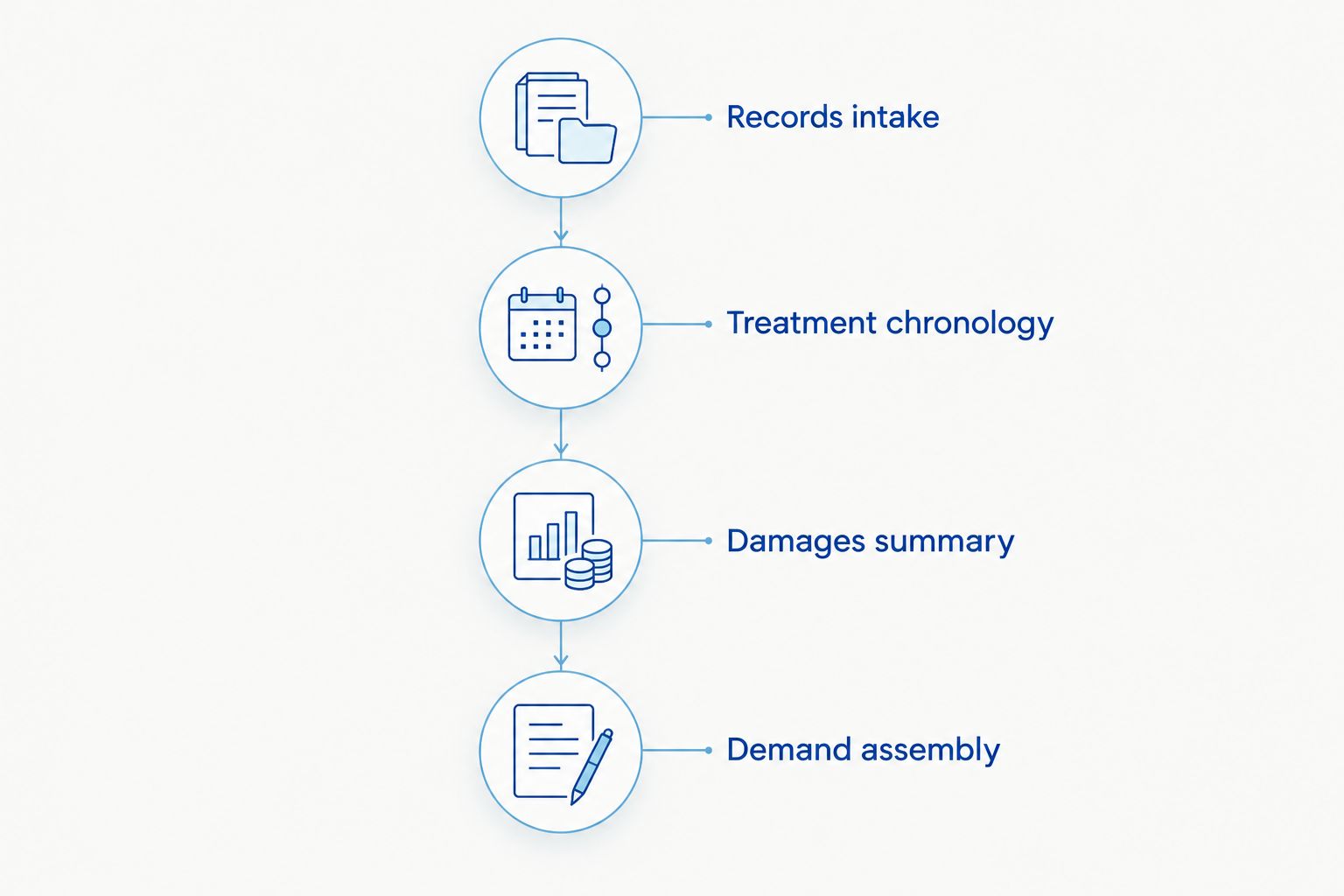
Before transmission, run 3 checks: factual accuracy, financial reconciliation, and attachment completeness. Confirm names and dates against source documents, recalculate the ledger, and open the final exported package rather than relying on the editable draft.
Discuss your injury claim
Ask Khachikyan Law Firm about personal injury representation before sending a settlement demand.
Update the demand when treatment changes
A supplemental demand is an adjacent workflow, not a reason to overwrite the package you already sent. Preserve the original transmission and track what changed.
- Save the new records in Original records and note their receipt date.
- Add the new encounters to the chronology and reconcile the related bills.
- Review whether the evidence changes treatment status, restrictions, financial losses, or the requested settlement terms.
- Prepare a dated supplement identifying new exhibits and corrected information. Explain whether any previous figures are replaced or supplemented to avoid double-counting.
- Retain the sent version and delivery confirmation, then update the correspondence log.
Expected result: The recipient can distinguish new evidence from previously submitted material.
If treatment remains uncertain, discuss whether a demand is premature. Do not describe an injury as resolved simply to make the package appear finished, and do not assume that settlement paperwork preserves a right to seek more compensation later.
Troubleshooting
The records and bills show different dates
Check whether one date is the service date and another is a posting or statement date. Match the provider and service description before treating the difference as an error. Ask the provider to clarify discrepancies that remain unresolved.
A record contains an inaccurate history
Use the provider's amendment process rather than editing the record yourself. Preserve the original and any response. In your working chronology, distinguish your correction request from a correction the provider actually accepted.
Treatment stopped before symptoms resolved
Document the reason using available evidence, such as scheduling correspondence or a referral history. Do not invent an explanation or ask a clinician to backdate care. An unexplained gap belongs on the review list, not behind a confident sentence.
The attachment file is too large
Confirm the recipient's accepted delivery method and file limits. Split the package into clearly indexed parts or use an approved secure transfer method, then verify receipt. Avoid removing relevant pages merely to reduce file size.
Sensitive information is unrelated to the injury
Have counsel review relevance, authorization, and any proposed redactions before disclosure. Keep an unchanged source copy. Do not silently alter records or assume that all prior medical history is irrelevant to the claim.
Customize your workflow
For a 2026 claim file, add fields for the issues actually in dispute. A disputed collision account needs an evidence reference beside the responsibility narrative; disputed work loss needs a clear connection between medical restrictions, missed time, and earnings records.
The police report to personal injury settlement workflow explains the adjacent incident-evidence process. Keep that evidence connected to the medical chronology without treating a police report as a medical opinion.
Choose your level of assistance deliberately. Organizing documents yourself gives you a useful command of the file, but it does not resolve legal valuation, causation disputes, reimbursement obligations, or release terms. Khachikyan Law Firm provides personal injury representation; asking for legal review does not replace obtaining complete records.
FAQ
What medical records do I need for a personal injury demand letter?
Collect records documenting the injury evaluation, relevant treatment, diagnostic findings, restrictions, and follow-up recommendations. Obtain itemized bills separately and identify missing providers or date ranges before drafting.
Can I use patient portal downloads instead of requesting records?
Patient portal downloads are a starting point, not proof that your file is complete. Compare them with your provider checklist and request missing notes, reports, and billing records.
Should I wait until treatment ends before sending a demand?
Review treatment status with an attorney before deciding when to send a demand. Ongoing care and uncertain future needs affect settlement decisions, while filing deadlines still require separate attention.
How do I explain a preexisting injury in my demand letter?
Describe the prior condition accurately and identify evidence of any new injury or worsening symptoms. Do not claim that every symptom began with the incident when the records show otherwise.
Do medical bills determine my settlement amount?
Medical bills do not determine the settlement amount by themselves. Responsibility, causation, recoverable losses, supporting evidence, and other claim-specific issues also require evaluation.
What should I do if more medical records arrive after my demand?
Preserve the original demand and prepare a clearly identified supplement when the new evidence warrants one. Reconcile updated bills and explain which figures or statements replace earlier information.
Does sending a demand letter stop the deadline to file a lawsuit?
Sending a demand letter does not itself stop or extend a filing deadline. Confirm the applicable deadline and any required claim procedures with an attorney rather than relying on settlement discussions.
One last thing
Audit the final attachment index against the actual files. A persuasive sentence pointing to a missing exhibit creates an avoidable credibility problem. Open the exact package you intend to send, follow each reference, and preserve that sent version with proof of delivery.


