
California premises liability claims include slip-and-falls, trip-and-falls, unsafe stairs, falling objects, negligent security, pool injuries, dog attacks, fires, elevator incidents, and construction-site hazards. Start with the condition that caused your injury, then identify who controlled it—not simply who owned the address.
- California premises liability claims turn on an unsafe condition, responsibility, causation, and documented harm.
- Slip-and-fall claims need evidence of the hazard and the responsible party’s knowledge.
- Dog bites and public-property injuries require separate legal analysis.
- Khachikyanlawfirm provides personal injury representation in Glendale; request an assessment before choosing a claim.
Why this matters
An injury on someone else’s property does not automatically establish liability. California’s general negligence rule, reflected in Civil Code section 1714 and Judicial Council instruction CACI 1000, requires proof connecting a responsible party’s lack of reasonable care to your injury.
Khachikyanlawfirm is a fit for Glendale readers seeking personal injury representation after a property-related injury. You can contact the firm to discuss the circumstances rather than trying to select a legal theory yourself.
For a 2026 injury, preserve evidence immediately. A repaired step, cleaned spill, or overwritten recording can remove the clearest explanation of what happened.
What makes a premises liability claim worth investigating?
Use these criteria to assess the facts—not to predict a settlement:
- Control: Identify who owned, leased, occupied, or controlled the relevant area.
- Unsafe condition: Describe the specific hazard rather than saying the property was unsafe.
- Knowledge: Establish whether the responsible party created, knew about, or reasonably should have discovered the condition.
- Causation: Connect the hazard to the mechanism of your injury.
- Documented harm: Preserve medical records, work restrictions, expenses, and evidence of daily limitations.
- Legal exceptions: Check public ownership, recreational use, employment relationships, and other rules that change the analysis.
These criteria guide this 2026 list. The order groups recognizable hazards; it does not rank claim frequency, severity, or potential recovery.
California premises liability claims at a glance
The “best fit” column identifies which facts belong in each category. It does not mean one injury claim is better than another.
| Claim type | Best fit for | Central evidence | Key limitation |
|---|---|---|---|
| Slip-and-fall | Loss of traction | Spill photos and inspection records | Proving notice of a temporary spill |
| Trip-and-fall | A foot catching an obstruction | Measurements and route photos | Trivial-defect and visibility arguments |
| Unsafe stairs | Falls involving steps or rails | Stair condition and maintenance records | Connecting the defect to the fall |
| Falling objects | Items striking someone | Display, storage, or attachment evidence | Identifying who caused the instability |
| Negligent security | Foreseeable third-party violence | Prior incidents and security records | Establishing the required protective duty |
| Pool injuries | Unsafe pool access or operation | Barriers, equipment, and incident evidence | Waivers and recreational-use issues |
| Dog attacks | Bites or animal-related falls | Ownership and attack circumstances | Different rules for owners and landlords |
| Fires and electrical hazards | Burns or smoke injuries | Origin investigation and repair history | Technical causation and multiple defendants |
| Elevator or escalator incidents | Equipment-related injuries | Service logs and inspection evidence | Separating maintenance from operational fault |
| Construction hazards | Injuries around active work | Site control and work records | Workers’ compensation and contractor rules |
1. Slip-and-falls: best fit for slippery walking surfaces
Slip-and-fall claims involve water, grease, tracked-in rain, cleaning residue, or another condition that reduces traction. The central question is not just whether the floor was wet, but whether a responsible party failed to address the danger reasonably.
Evidence advantages:
- Photos can document the substance and surrounding floor.
- Cleaning logs can establish inspection practices.
- Witnesses can describe how long the spill existed.
Limitations:
- A spill appearing immediately before a fall creates a notice problem.
- Footwear, warnings, and your route can affect fault arguments.
Best for: Falls caused by loss of traction rather than an obstruction. Photograph the wider area as well as the spill; a close-up alone rarely explains the walking route.
Verdict: Preserve inspection evidence before debating responsibility.
2. Trip-and-falls: best fit for obstructions and uneven surfaces
Trip-and-fall claims involve raised pavement, loose mats, cords, debris, or other interruptions in a walking surface. Sidewalk cases also require careful identification of the party legally responsible for the location.
Evidence advantages:
- Measurements establish the condition’s dimensions.
- Wide photos show the approach and surrounding distractions.
- Maintenance records can reveal earlier complaints.
Limitations:
- California’s trivial-defect doctrine can defeat some minor-defect claims.
- Visibility and surrounding circumstances affect the analysis.
Best for: Injuries caused by a foot catching an identifiable obstruction. There is no universal measurement that makes every uneven surface actionable; courts consider the surrounding circumstances.
Verdict: Document the whole setting, not just the height difference.
3. Unsafe stairs: best fit for defective steps or handrails
Stairway claims involve broken treads, loose rails, inadequate lighting, or other unsafe stair conditions. A building-code issue supports investigation, but you still need to connect the condition to the fall.
Evidence advantages:
- Photos can show missing or damaged components.
- Repair records can establish an ongoing problem.
- Witness accounts can identify where balance was lost.
Limitations:
- A defect elsewhere on the staircase does not prove causation.
- The applicable code depends on the building and circumstances.
Best for: Falls involving a specific stair or handrail problem. Record which direction you were traveling and where your foot or hand first lost support.
Verdict: Identify the exact failure point before repairs change it.
4. Falling objects: best fit for unsafe displays or storage
Falling-object claims arise when merchandise, fixtures, ceiling materials, or stored items strike someone. Responsibility can involve a property operator, vendor, installer, or another party controlling the object.
Evidence advantages:
- Photos show the object’s original position.
- Video can identify handling before the incident.
- Installation records can identify responsible contractors.
Limitations:
- Another customer’s recent actions can complicate notice.
- A product defect can require a separate liability theory.
Best for: Injuries from overhead or unstable items rather than floor hazards. Ask that the object and any broken mounting parts be preserved, without handling unsafe debris yourself.
Verdict: Investigate both the property condition and the object’s installation.
5. Negligent security: best fit for foreseeable third-party attacks
Negligent-security claims concern whether a property controller failed to take legally required precautions against foreseeable violence. A criminal attack alone does not establish property-owner negligence.
Evidence advantages:
- Prior incidents can inform foreseeability.
- Access-control records can reveal failures.
- Security policies can clarify assigned responsibilities.
Limitations:
- The required duty depends on foreseeability and the burden of precautions.
- Proving that a specific measure would have prevented the attack is difficult.
Best for: Assault-related injuries involving a concrete security failure, such as a reported broken entry lock. Preserve police information, witness contacts, and communications about the security problem.
Verdict: Focus on a specific preventable failure, not a general demand for more security.
6. Pool injuries: best fit for unsafe access or pool conditions
Pool-related claims include injuries involving defective barriers, dangerous drains, unsafe decks, or negligent pool operation. The legal analysis changes with the property’s use and the injured person’s circumstances.
Evidence advantages:
- Gate and latch conditions can be photographed.
- Maintenance records can identify unresolved hazards.
- Witnesses can explain access and supervision.
Limitations:
- Recreational-use rules or releases can affect liability.
- Pool incidents can involve several overlapping causes.
Best for: Injuries connected to a specific pool-access or operational hazard. Preserve any admission documents or releases for legal review rather than assuming they eliminate every claim.
Verdict: Separate unsafe access, unsafe equipment, and supervision issues.
7. Dog attacks: best fit for bites or animal-related falls
Dog bites require a separate analysis from ordinary premises negligence. California Civil Code section 3342 generally imposes liability on a dog owner for bites in public places or while the injured person is lawfully on private property, subject to exceptions and defenses.
Evidence advantages:
- Ownership records help identify the defendant.
- Medical records document bite injuries.
- Witnesses can establish the attack circumstances.
Limitations:
- The dog-owner statute does not automatically establish landlord liability.
- Knockdowns without a bite require a different analysis.
Best for: Bites or injuries caused by a dog on or near property. Identify both the animal’s owner and the property controller; they are not necessarily the same person.
Verdict: Do not treat every dog injury as a standard property-defect claim.
8. Fires and electrical hazards: best fit for unsafe building systems
Fire and electrical claims involve burns, smoke exposure, faulty wiring, or unsafe equipment connected to property conditions. Investigators must distinguish the fire’s origin from the separate question of legal responsibility.
Evidence advantages:
- Fire investigation reports can identify the origin.
- Repair complaints can establish prior warnings.
- Preserved components support technical examination.
Limitations:
- Destruction can erase important physical evidence.
- Product manufacturers and contractors can share responsibility.
Best for: Injuries linked to a specific electrical, maintenance, or fire-protection failure. Do not enter a damaged building or remove equipment to collect evidence yourself.
Verdict: Preserve the scene through qualified professionals before cleanup.
9. Elevator and escalator incidents: best fit for equipment failures
These claims involve unexpected movement, leveling problems, entrapment-related injuries, or defective moving components. Responsibility can extend beyond the building owner to a maintenance company or equipment manufacturer.
Evidence advantages:
- Service logs can show recurring faults.
- Inspection records identify reported conditions.
- Video can document movement and passenger positions.
Limitations:
- Technical evidence is often necessary to identify the failure.
- An injury during use does not itself establish a defect.
Best for: Injuries involving abnormal equipment operation. Record the unit’s location and identifying information so investigators request records for the correct equipment.
Verdict: Identify the unit and preserve its service history.
10. Construction hazards: best fit for injuries around active work
Construction-related premises claims involve open trenches, falling debris, missing barriers, or unsafe access around work areas. Whether you were a visitor, employee, or contractor changes which legal rules apply.
Evidence advantages:
- Site photos show barriers and access routes.
- Work records identify active contractors.
- Witness accounts clarify control over the hazard.
Limitations:
- Workers’ compensation restrictions affect employee claims.
- California’s contractor-liability rules can limit claims against a hirer.
Best for: Visitors and other injured people facing hazards connected to active construction. A worker should also investigate whether an independent third party bears responsibility.
Verdict: Establish your work status and site control before selecting defendants.
How these claim categories were ranked
This 2026 guide puts walking-surface hazards first, followed by distinct property risks and claims requiring specialized rules. Each category is assessed through control, knowledge, causation, evidence, and legal limitations—not promised results.
Which claim should you investigate first?
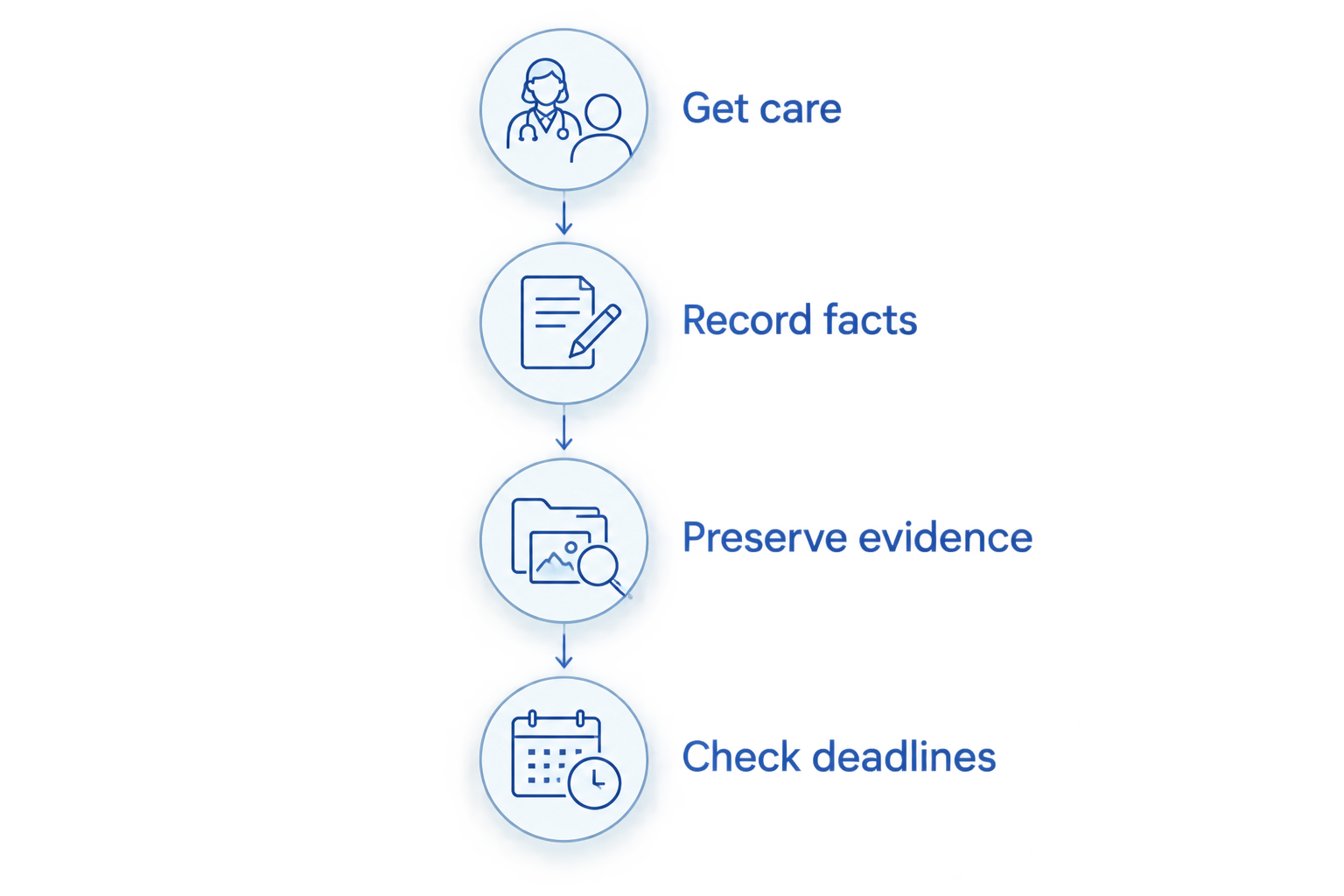
Choose the category that explains how the injury happened. Then preserve evidence and check the deadline before deciding whether to pursue a claim.
- Get care: Describe your symptoms and the incident accurately.
- Record facts: Save photos, witness details, and incident reports.
- Preserve evidence: Request retention of relevant video and records.
- Check deadlines: Identify private ownership, public ownership, and possible exceptions.
For 2026 claims, California Code of Civil Procedure section 335.1 generally allows 2 years for personal injury lawsuits. Government Code section 911.2 generally requires presentation of a personal injury claim against a public entity within 6 months; separate lawsuit deadlines and exceptions apply.
Khachikyanlawfirm handles personal injury representation in Glendale. For premises liability questions, bring the incident location, injury date, photographs, and any communications from the property operator.
Discuss your property injury
Explain the incident and ask about evidence, responsible parties, and applicable deadlines.
FAQ
What types of premises liability claims does California recognize?
California premises liability cases include injuries involving slippery floors, uneven walkways, unsafe stairs, falling objects, inadequate security, pools, and other property hazards. Dog bites and public-property injuries also involve separate legal rules.
Does a property owner automatically owe me compensation if I fall?
No, falling on someone else’s property does not automatically establish liability. You must prove the required duty, breach, causation, and harm; identifying the unsafe condition is only the starting point.
Can I bring a claim if I was partly at fault?
Yes, partial fault does not automatically bar a California negligence claim. California’s comparative-fault rules reduce recoverable damages according to your share of responsibility.
How long do I have to file a California premises liability lawsuit?
California generally allows 2 years for a personal injury lawsuit under Code of Civil Procedure section 335.1. Public-entity claims generally require claim presentation within 6 months, and exceptions or separate deadlines require individual review.
Can a tenant or store operator be responsible instead of the owner?
Yes, a tenant or operator can bear responsibility when its control and conduct establish the required duty and negligence. Ownership alone does not resolve who controlled the hazard or had repair obligations.
What evidence should I save after an injury on someone else’s property?
Save hazard photos, witness contacts, incident reports, medical records, and communications about the condition. Request preservation of relevant surveillance footage and maintenance records without delaying medical care.
Can Khachikyanlawfirm discuss a premises liability injury?
Khachikyanlawfirm provides personal injury representation in Glendale. Contact the firm with the incident details to discuss whether representation is appropriate for your circumstances.
One last thing
A property’s appearance after an accident does not establish its condition when you were injured. For a 2026 premises claim, record what changed, when it changed, and who witnessed the original hazard. This article provides general information, not advice about your specific case.