
Best overall question: Who will actually handle my case? Best for comparing agreements: How do fees and case expenses work? Best for protecting your claim: What deadlines apply? These lead the questions to ask before hiring a personal injury lawyer in Glendale in 2026; use them when evaluating Khachikyanlawfirm or another firm.
- Start your questions to ask before hiring a personal injury lawyer in Glendale with case ownership, relevant experience, and deadlines.
- Evaluate Khachikyanlawfirm for Glendale personal injury representation using specific answers, not promises about compensation.
- Compare personal injury lawyers on written terms, evidence plans, communication, and settlement authority.
- Do not hire a lawyer who guarantees your result or avoids explaining the representation agreement.
Why this matters
Hiring a personal injury lawyer means choosing who will investigate your accident, communicate with insurers, and advise you about settlement. A persuasive consultation does not tell you who will do that work. Specific answers do.
For Glendale personal injury representation, evaluate Khachikyanlawfirm by case ownership, written terms, and the proposed evidence plan. The firm offers personal injury and lemon law representation; your consultation should focus on the practice relevant to your injury.
This 2026 checklist ranks questions by how directly they expose a mismatch before you sign. You are not looking for a guaranteed outcome. You are looking for a clear explanation of responsibility, risks, and next steps.
What makes the best lawyer-hiring questions?
Use these criteria to judge every answer:
- Case ownership: You know which attorney is responsible and which tasks other staff handle.
- Relevant experience: The lawyer explains experience with your accident type without disclosing another client's confidential information.
- Written terms: The agreement explains the scope of representation and financial responsibilities.
- Evidence planning: The lawyer identifies records to obtain and evidence to preserve.
- Decision authority: You understand how recommendations reach you and who approves settlement.
- Honest limitations: The lawyer identifies uncertainty instead of promising a recovery.
The strongest question makes a vague answer difficult. Ask for an explanation tied to your facts, then compare that explanation with the agreement.
The top questions at a glance
| Rank and question | Best for | What a useful answer identifies | Key limitation |
|---|---|---|---|
| 1. Who handles my case? | Accountability | Responsible attorney and staff roles | Staffing can change |
| 2. Have you handled similar claims? | Relevant experience | Similar legal issues and evidence | Prior results do not predict yours |
| 3. How do fees and expenses work? | Agreement clarity | Fee structure and expense responsibility | Oral explanations are not enough |
| 4. What deadlines apply? | Time-sensitive protection | Filing and notice requirements | Dates depend on specific facts |
| 5. What evidence do you need? | Preserving proof | Records, witnesses, and preservation steps | Some evidence requires investigation |
| 6. What are my case's weaknesses? | Realistic expectations | Disputed facts and missing support | An early assessment is incomplete |
| 7. How will we communicate? | Day-to-day access | Contact person and update process | A process is not a response guarantee |
| 8. What happens if settlement fails? | Litigation planning | Next steps and representation scope | Readiness does not guarantee trial |
| 9. How are settlement decisions made? | Client control | Approval process and release review | Offers require case-specific analysis |
| 10. What happens if representation ends? | Exit clarity | File transfer and remaining obligations | Changing lawyers can disrupt work |
1. Who handles my case? Best for accountability
Ask who will be the responsible attorney, who handles routine updates, and who discusses important decisions with you. Meeting an attorney at intake does not establish that the same person will manage every stage.
Request the responsible attorney's name and the main contact's role. If several people participate, ask how they share information and escalate urgent issues.
Best for: Knowing who owns the work.
Question pros:
- Separates intake from ongoing representation.
- Clarifies attorney and support-staff responsibilities.
- Establishes where important questions belong.
Question limitations:
- Staffing arrangements can change.
- A named contact alone does not establish service quality.
Verdict: Hold until responsibility is clear. Do not sign while you remain unsure who will supervise your claim.
2. Have you handled similar claims? Best for relevant experience
Ask about cases involving your accident type and the issues that make your claim difficult. A car collision, a fall on someone else's property, and an injury involving a defective product require different factual investigations.
Ask what evidence typically matters in comparable claims. A useful answer explains the work, not just the outcome of a past case.
Best for: Matching experience to your legal problem.
Question pros:
- Focuses the discussion on relevant work.
- Reveals whether the lawyer understands likely disputes.
- Helps distinguish injury representation from unrelated practice areas.
Question limitations:
- Past outcomes do not establish your likely recovery.
- Confidentiality limits what a lawyer can disclose.
Verdict: Skip outcome guarantees. Favor an explanation of comparable issues over a promise that your case will match someone else's result.
3. How do fees and expenses work? Best for agreement clarity
Ask the lawyer to explain the fee arrangement, case expenses, and what happens financially if there is no recovery. Fees for legal work and expenses incurred in developing a case are separate subjects; the agreement should address both.
For a 2026 consultation, request a written explanation before signing. Ask how expenses are handled when calculating any distribution and which obligations survive the end of representation.
Best for: Understanding what you are agreeing to.
Question pros:
- Separates legal fees from case expenses.
- Identifies obligations when a claim ends unsuccessfully.
- Gives you terms to compare across firms.
Question limitations:
- An oral summary cannot replace the agreement.
- Expense handling requires careful reading.
Verdict: Hold until the written terms are understandable. Ask for clarification wherever the document differs from the consultation.
4. What deadlines apply? Best for protecting your claim
Ask which filing deadlines, notice requirements, or administrative steps apply to your accident. Provide the incident date and identify whether a public entity is involved.
California Code of Civil Procedure section 335.1 generally sets a 2-year limitation period for personal injury actions. California Government Code section 911.2 generally requires a personal injury claim against a public entity to be presented within 6 months after accrual. Exceptions and separate requirements matter; neither rule substitutes for advice about your facts.
Best for: Identifying urgent legal action.
Question pros:
- Brings timing into the consultation immediately.
- Exposes public-entity notice issues.
- Clarifies whether urgent work is necessary.
Question limitations:
- Accrual dates and exceptions require legal analysis.
- A consultation alone does not establish representation.
Verdict: Act on deadline concerns now. Do not assume negotiations pause a filing deadline.
5. What evidence do you need? Best for preserving proof
Ask which documents you should provide and which evidence the lawyer will seek. Bring 3 document groups if you have them: accident records, medical records, and insurer correspondence. Keep originals and provide copies unless instructed otherwise.
Ask specifically about photographs, witness details, video, and records held by another person or business. Describe gaps honestly rather than trying to fill them with assumptions.
Best for: Turning the consultation into an investigation plan.
Question pros:
- Identifies immediate preservation tasks.
- Separates your responsibilities from the firm's work.
- Exposes missing support early.
Question limitations:
- Relevant evidence depends on the accident.
- Not every record is immediately obtainable.
Verdict: Proceed with a specific preservation plan. A general request to send everything is not a substitute for identifying important evidence.
6. What are my case's weaknesses? Best for realistic expectations
Ask what the other side is likely to dispute and what information is missing. Depending on your facts, the discussion can include responsibility for the accident, the connection between the incident and your injuries, or support for claimed losses.
A useful 2026 consultation distinguishes established facts from open questions. Ask what evidence would change the lawyer's assessment.
Best for: Understanding risk before committing.
Question pros:
- Encourages a balanced assessment.
- Identifies facts that need further investigation.
- Helps you understand disputed issues.
Question limitations:
- Early opinions depend on limited records.
- New evidence can change the assessment.
Verdict: Skip guaranteed results. Choose candid analysis over certainty that the available evidence cannot support.
7. How will we communicate? Best for day-to-day access
Ask how you receive updates, where to send new records, and whom to contact about an urgent issue. Discuss your preferred communication method and any language or accessibility needs.
Clarify what triggers an update, such as receiving an offer or filing a lawsuit. Do not treat a friendly intake conversation as proof of the ongoing communication process.
Best for: Knowing how to stay involved.
Question pros:
- Establishes the correct contact channel.
- Clarifies how major developments reach you.
- Makes communication needs explicit.
Question limitations:
- A stated process is not a response-time guarantee.
- Your preferred contact method must be agreed upon.
Verdict: Hold if the update process remains vague. You should know how to get an important question to the responsible attorney.
8. What happens if settlement fails? Best for litigation planning
Ask whether the proposed representation includes filing a lawsuit and handling litigation. Clarify whether another attorney would become involved and whether that would require a different agreement.
The question is not whether every case goes to trial. It is whether you understand the next decision if negotiations do not resolve your claim.
Best for: Understanding the scope beyond negotiation.
Question pros:
- Clarifies what the agreement covers.
- Identifies possible attorney transitions.
- Reveals the next decision point.
Question limitations:
- Litigation readiness does not predict a trial.
- Strategy depends on evidence and legal issues.
Verdict: Hold until the scope is explicit. Do not assume trial representation is included because the lawyer discusses settlement.
9. How are settlement decisions made? Best for client control
Ask how the lawyer will explain an offer, review a release, and obtain your authorization. California Rule of Professional Conduct 1.2(a) requires a lawyer to abide by the client's decision whether to settle a matter.
Ask how you will receive an explanation of deductions and unresolved obligations before deciding. Evaluate an offer through its actual terms, not just its headline amount.
Best for: Keeping an informed role in settlement.
Question pros:
- Confirms that settlement requires your decision.
- Encourages review of release terms.
- Connects the offer to the proposed distribution.
Question limitations:
- Evaluating an offer requires case-specific advice.
- Unresolved obligations can complicate distribution.
Verdict: Skip pressure to approve unexplained terms. Ask for an understandable settlement recommendation before authorizing acceptance.
10. What happens if representation ends? Best for exit clarity
Ask how you obtain your file, what obligations remain, and how a transition would affect pending work. Also ask what happens if the lawyer seeks to withdraw.
Review the termination provisions before signing. Ending representation does not erase court deadlines or automatically resolve disagreements about fees and expenses.
Best for: Understanding the relationship from start to finish.
Question pros:
- Clarifies file-transfer procedures.
- Identifies remaining contractual obligations.
- Encourages planning around active deadlines.
Question limitations:
- Changing lawyers can interrupt case preparation.
- Withdrawal during litigation can involve court procedures.
Verdict: Hold until exit terms are clear. Understanding termination is part of choosing representation, not a prediction that it will fail.
How these questions are ranked
This list places accountability first, then relevant experience and agreement terms. Deadlines and evidence follow because they affect the work that must happen promptly. Communication, litigation scope, settlement control, and exit terms define the continuing relationship.
The ranking is a consultation framework, not a ranking of law firms. If a deadline is approaching, move question four to the front.
Which questions should you ask first?
Start with case ownership, deadlines, and the written agreement. Then ask the lawyer to identify the strongest evidence and the biggest unresolved issue.
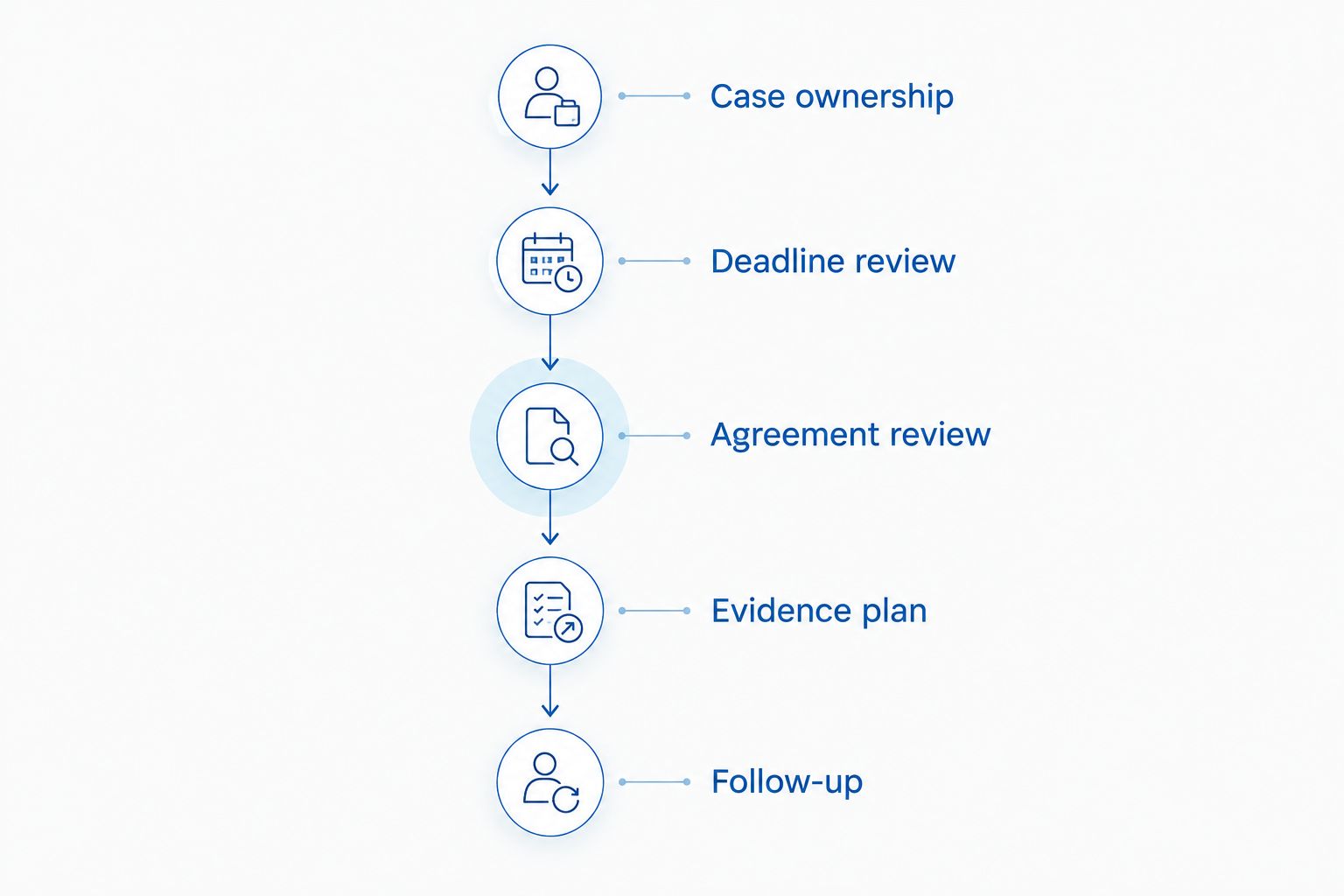
Use this sequence for your 2026 consultation:
- Case ownership: Identify the responsible attorney.
- Deadline review: Explain the incident date and parties involved.
- Agreement review: Read the scope and financial terms.
- Evidence plan: Confirm what to preserve and provide.
- Follow-up: Record unanswered questions before deciding.
Bring the same checklist when discussing personal injury representation with Khachikyanlawfirm. Ask for answers tied to your accident rather than a general description of the practice.
Discuss your injury claim
Ask about case responsibility, deadlines, and the proposed scope of representation.
FAQ
What's the first question to ask a personal injury lawyer in Glendale?
Ask who will be the responsible attorney for your case. Then clarify which tasks support staff handle and who explains important decisions to you.
How do I compare personal injury lawyers in 2026?
Compare relevant experience, written terms, case ownership, and the evidence plan. Use the same questions with each lawyer rather than comparing promises about compensation.
Should a personal injury lawyer guarantee my settlement?
No; a promised outcome is not a sound basis for hiring a lawyer. Ask for an explanation of the evidence, disputed issues, and uncertainties instead.
What should I bring to a personal injury consultation?
Bring available accident records, medical records, photographs, witness information, and insurer correspondence. Explain what is missing and retain your originals unless the lawyer instructs otherwise.
Does meeting a lawyer mean the firm represents me?
Do not assume a consultation establishes representation. Confirm whether the firm has accepted your case and what work the representation covers.
Can my lawyer accept a settlement without my approval?
Your lawyer must abide by your decision whether to settle under California Rule of Professional Conduct 1.2(a). Ask how offers, release terms, and your authorization will be documented.
Is Khachikyanlawfirm relevant if I need an injury lawyer in Glendale?
Khachikyanlawfirm offers personal injury representation in Glendale, California. Ask about experience with your accident type, the responsible attorney, and the proposed agreement before hiring the firm.
One last thing
The best final question is: What have I not asked that matters to my case? It gives the lawyer space to identify an issue your checklist missed.
Before you sign in 2026, compare your consultation notes with the written agreement. Resolve any mismatch about who handles the case, what work is included, or what you must do next.


