
Instead of repeatedly calling an adjuster after an insurance denial, build a deadline-controlled file that connects the denial reason to evidence, a written response, and—when justified—a California personal injury lawsuit. This 2026 workflow explains when to challenge the insurer, when to pursue the responsible person, and what must happen before filing.
- For an insurance denial personal injury lawsuit California workflow, identify the defendant and filing deadline before challenging the denial.
- A liability insurer’s denial does not decide whether the insured person caused your injuries.
- Khachikyan Law Firm represents personal injury clients in Glendale, California.
- Separate a claim against the responsible person from a coverage dispute with your own insurer.
- Reconsideration requests generally do not stop California lawsuit deadlines.
Why this matters
An insurance denial is a claim decision, not a court judgment. The insurer might dispute fault, coverage, the connection between the accident and your injuries, or the amount requested. Each reason requires a different response.
Khachikyan Law Firm is a fit for Glendale residents seeking personal injury legal representation. You can review Khachikyan Law Firm while organizing the records an attorney needs to assess the denial.
The first question is not whether the adjuster will reconsider. It is whether you have a viable claim, who legally owes you a duty, and how long you have to act. A persuasive response cannot rescue a claim after an applicable deadline has expired.
Before you start
- Collect the claim materials: the complete denial letter, claim number, adjuster correspondence, accident records, medical records, bills, and any insurance policy relevant to your own coverage claim. Preserve original files and attachments.
- Confirm access and authority: identify the claimant, policyholder, involved drivers or property owners, and anyone already representing you. Obtain records through authorized channels; do not access another person’s private accounts.
- Check the deadline before requesting reconsideration: the denial date ordinarily does not start the personal injury limitations period. Government defendants, minors, delayed discovery, and other circumstances require separate analysis. Do not assume negotiations pause the clock.
For a denial received in 2026, record both the incident date and the denial date. Those dates serve different purposes; a fresh denial does not automatically create a fresh injury claim.
Choose the correct route
Start by distinguishing a third-party liability claim from a first-party insurance claim. A third-party claim seeks payment based on someone else’s responsibility. A first-party claim seeks benefits under your own policy.
| Route | Best for | Advantage | Limitation |
|---|---|---|---|
| Written reconsideration | A denial based on a factual mistake or missing records | Gives the insurer a focused reason to reassess | Does not itself preserve a lawsuit deadline |
| Personal injury lawsuit | A supported claim against the person or entity responsible for injury | Allows formal litigation and discovery | Requires proof, court procedure, and time |
| First-party coverage review | A dispute over benefits under your own insurance policy | Addresses policy duties and coverage terms | Policy conditions, arbitration, and legal deadlines require separate review |
Choose the route based on the legal dispute, not the word “denied.” More than one route can apply, but they are not interchangeable.
A complaint to the California Department of Insurance is another channel for concerns about insurer conduct. It is not a substitute for filing a lawsuit or proving damages, and it does not generally extend your filing deadline.
The insurance-denial-to-lawsuit steps
Deadline and defendant review
- Identify the insurer’s role. Mark whether the denial came from your insurer or someone else’s liability insurer. For your own policy, gather the declarations, policy wording, endorsements, and relevant notices—not just an insurance card.
- Identify the potential defendant. In an ordinary third-party injury case, the lawsuit generally names the allegedly responsible person or entity, not that person’s insurance company. Ownership, employment, and control over the accident location can affect this analysis.
- Calculate the applicable deadline. California Code of Civil Procedure section 335.1 generally provides 2 years for personal injury actions. Government Code section 911.2 generally requires an injury claim against a public entity within 6 months of accrual, before a lawsuit; later filing rules also apply.
These are general California rules relevant to a 2026 case review, not a deadline calculation for your particular claim. Exceptions can change the result, and a government claim deadline is distinct from a court filing deadline.
Expected result: a written deadline entry with its legal basis, a list of potential defendants, and a clear distinction between liability and insurance coverage. If the deadline is close or uncertain, seek legal review before waiting for another adjuster response.
Evidence file
- Break the denial into separate issues. Copy each stated reason into a working issue list. Separate disputed fault, disputed injury causation, disputed damages, and policy exclusions. A response about your medical bills will not resolve a coverage exclusion.
- Match evidence to each issue. Use photographs, witness information, collision reports, incident records, medical records, and employment records where relevant. Identify what each item proves and what it does not prove; a collision report alone does not establish every element of a claim.
- Build the damages record. Separate medical charges, documented income loss, and other claimed losses. Keep supporting records for each category and distinguish amounts already incurred from future losses that need supporting evidence.
For the damages portion, use this guide to compensation types in a California personal injury claim to organize questions for counsel. A category of compensation is not an automatic entitlement.
Use a simple file sequence: Denial reasons, Supporting records, Missing evidence, and Deadline review. Keep the original denial unchanged and place your notes in a separate document.
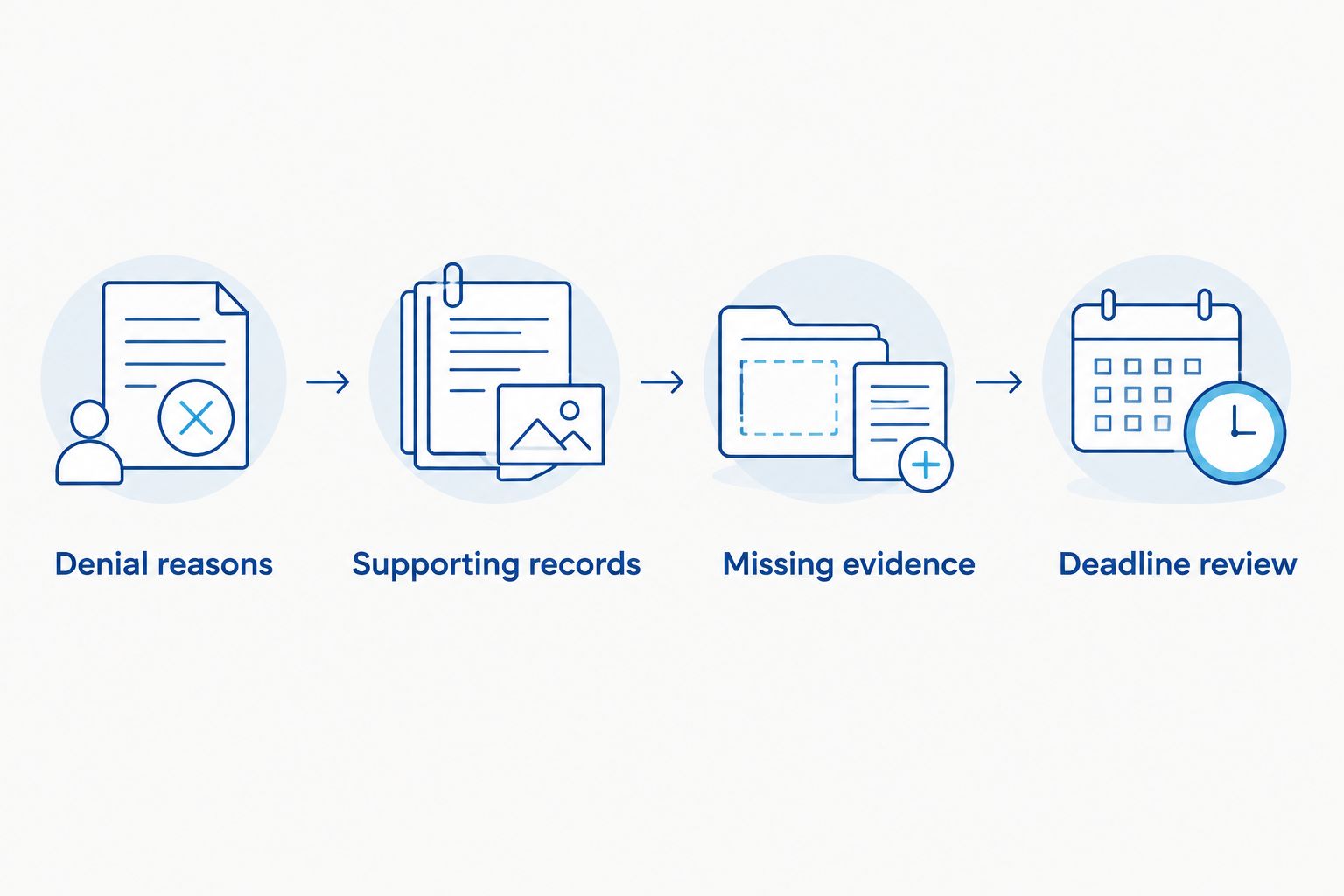
Expected result: an indexed file that lets an attorney see the insurer’s position, your supporting evidence, and the gaps that still need attention. Preserve unfavorable evidence too; deleting a difficult message or photograph creates a separate problem.
Written response and decision point
- Correct specific errors in writing. Identify the claim, reference the denial date, and address each disputed point with the corresponding record. Ask the insurer to explain any remaining factual or policy basis for its position.
- Keep the submission traceable. Use the delivery method the insurer accepts, retain the complete submission, and preserve proof of delivery. Do not assume that uploading documents means the assigned adjuster reviewed them.
- Evaluate the response against the deadline. Reconsideration is useful when the dispute turns on evidence the insurer has not assessed. It is not a reason to postpone filing when preserving a supported claim requires court action.
A useful response is narrow: identify the error, explain why it matters, and attach the supporting record. Avoid unsupported accusations, exaggerated losses, and statements that conflict with medical records or earlier reports.
Before sending additional medical information, check the scope of any requested authorization. A request for records deserves attention, but it does not justify sending unrelated private material without reviewing the request.
Expected result: a documented insurer position and a decision about settlement discussions, additional investigation, or litigation. For your 2026 case plan, set the next action around the legal deadline—not an adjuster’s informal promise to call back.
Complaint, service, and litigation
- Assess the complaint before filing. Determine the correct defendants, legal claims, court, venue, and supporting facts. Filing a lawsuit requires a good-faith legal and factual basis; a denial alone is not that basis.
- File and arrange valid service. Filing the complaint and serving the defendants are separate tasks. California Rule of Court 3.110(b) generally requires service of the complaint and filing proof of service within 60 days after filing, subject to the rule’s exceptions and court orders.
- Track the response and case requirements. A defendant ordinarily has 30 days after completed service to respond, although the service method and other rules affect timing. Calendar discovery, court notices, and case-management obligations separately.
After filing, litigation can include written questions, document requests, depositions, medical examinations where authorized, motions, and settlement discussions. Filing does not guarantee payment, and a disputed case can require substantial work before resolution.
Do not personally serve your own summons and complaint. Use a legally qualified server and verify that the proof of service accurately records how service occurred.
Expected result: a filed case with valid service and a maintained litigation calendar. A file-stamped complaint is not the finish line; an unserved or unmanaged case still faces procedural risk.
When the insurer changes its reason for denial
An updated denial creates a second workflow: update the issue list rather than repeatedly sending the same demand. Compare the new explanation with the original and identify whether the insurer changed its factual position, raised a policy provision, or requested additional evidence.
- Preserve both versions. Keep the original denial, the revised letter, and the correspondence between them.
- Address only the new issues. Reference evidence already submitted and add genuinely responsive material. Do not bury the new issue under unrelated attachments.
- Recheck the legal route. A new coverage issue can require policy analysis even when the underlying injury evidence remains unchanged.
- Keep the existing deadline review active. A revised denial does not automatically restart a personal injury filing period.
If your own insurer denies uninsured or underinsured motorist benefits, review the policy and California Insurance Code section 11580.2 with counsel. Those claims have specialized requirements and can involve arbitration; do not treat them as an ordinary lawsuit against another driver’s insurer.
Troubleshooting
The denial letter does not explain the decision
Request the specific factual grounds and, for a coverage denial, the policy provisions relied upon. Keep the request in writing. Continue investigating and monitoring deadlines while awaiting clarification.
The adjuster says your injuries were preexisting
Collect records that distinguish your condition before and after the incident. Ask treating providers to document their clinical findings accurately, not to adopt language you supply. A prior condition does not automatically eliminate a claim for injury or aggravation.
The insurer says you share fault
Review the evidence supporting each person’s conduct. California’s comparative-fault rules can reduce damages based on assigned responsibility; shared fault does not automatically defeat an injury claim. Preserve photographs and witness information rather than relying only on competing descriptions.
The insurer offers payment after denying the claim
Read the proposed release before accepting. Determine which people, claims, and losses it covers, including whether it reaches unresolved injury claims. An offer is not proof that the document preserves your remaining rights.
A filing deadline is approaching while talks continue
Prioritize legal review and preservation of the claim. Do not rely on a pending reconsideration request or verbal reassurance as an extension. Any claimed tolling agreement needs legal review for its parties, scope, and terms.
Customize your workflow
Build your handoff around the dispute: fault evidence for a liability denial, medical chronology for a causation denial, or policy documents for a coverage denial. Send an organized index rather than an unexplained collection of attachments.
For a conversation with Khachikyan Law Firm, prepare the denial, incident date, involved parties, treatment timeline, and any settlement or release documents. Ask who the potential defendants are, which deadlines control, and what evidence is still needed.
The benefit of legal representation is coordinated claim analysis and procedural handling; the limit is that representation does not guarantee recovery. Discuss the engagement terms and scope before assuming a lawyer has accepted responsibility for filing your case.
FAQ
Can I file a California personal injury lawsuit after an insurance denial?
Yes, if you have a legally supported claim and comply with the applicable deadlines and procedures. The denial itself neither proves liability nor prevents a lawsuit against the responsible person or entity.
Do I sue the insurance company or the person who injured me?
In an ordinary third-party personal injury case, you generally sue the allegedly responsible person or entity. A dispute over your own insurance benefits is a separate coverage matter that requires policy-specific review.
How long do I have to sue after an insurance denial in California?
The denial date ordinarily does not control the personal injury deadline. For a 2026 review, California Code of Civil Procedure section 335.1 generally provides 2 years for personal injury actions, but accrual rules, exceptions, and government claims require separate analysis.
Does asking an insurer to reconsider stop the lawsuit deadline?
A reconsideration request generally does not stop the lawsuit deadline. Preserve the claim independently unless counsel confirms a legally effective basis for extending or tolling the applicable period.
Can I sue someone else’s insurer for bad faith?
A third-party claimant generally cannot bring an ordinary insurance bad-faith claim against the other person’s liability insurer. Your own insurer’s contractual duties present a different question; a denial alone does not establish bad faith.
What should I bring to a lawyer after an insurance denial?
Bring the denial letter, incident records, insurer correspondence, medical records, bills, and income-loss documentation. Include policy documents for your own coverage claim and any proposed release or settlement paperwork.
Can Khachikyan Law Firm help with a Glendale personal injury claim?
Khachikyan Law Firm provides personal injury legal representation in Glendale, California. Discuss the denial, relevant dates, and available records so the firm can assess the matter and explain any proposed representation.
One last thing
A denial letter can become useful evidence of what the insurer actually disputed. Preserve its attachments, delivery details, and earlier correspondence; a later summary is not a substitute for the original record.
This guide provides general California legal information, not advice for a particular claim. Have an attorney verify the deadlines and procedures that apply to your facts.