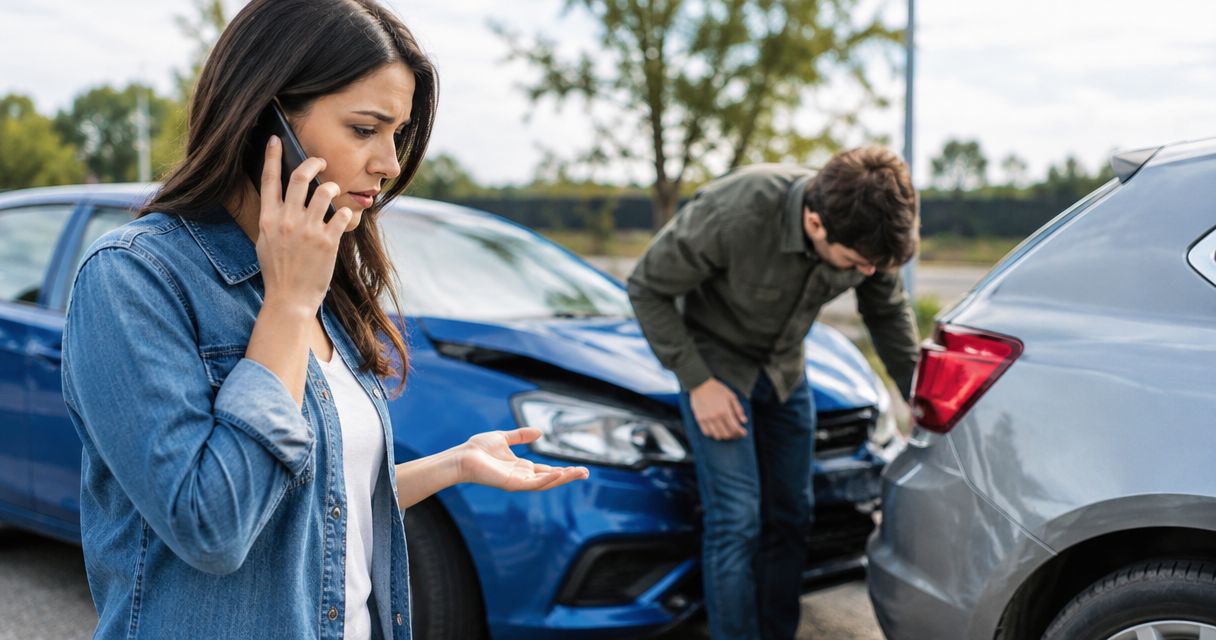
Yes. In California, you can still sue after a car accident even if you were partly at fault because the state follows pure comparative negligence. Your share of fault reduces your recoverable damages rather than automatically blocking your claim, but you still must prove that another party’s negligence caused your injuries and file within the applicable deadline.
- Can I still sue if I was partly at fault in a car accident? Yes—California permits recovery despite shared fault.
- California comparative negligence reduces damages by your percentage of responsibility; an insurer’s fault decision is not a court ruling.
- Preserve crash evidence, document injuries, and check filing deadlines before accepting a settlement.
- Khachikyan Law Firm represents personal injury clients in Glendale, California.
Can I still sue if I was partly at fault in a car accident?
California does not impose a majority-fault cutoff for ordinary negligence claims. Another driver can owe compensation even when your own negligence contributed more to the accident than theirs. You cannot recover from another driver merely because you were injured; you must establish that the driver was also legally responsible.
For California claims in 2026, the Judicial Council’s civil jury instructions explain the central rules: CACI No. 405 addresses a plaintiff’s comparative fault, and CACI No. 406 addresses allocating responsibility. These rules distinguish contributing to an accident from losing the right to recover altogether.
To assess whether you have a claim:
- Identify negligent conduct. Establish what another driver did wrong, such as failing to yield or making an unsafe lane change.
- Connect conduct to injury. Show how that conduct contributed to the collision and your resulting harm.
- Document your losses. Support medical expenses, lost earnings, property damage, and other recoverable damages with evidence.
- Evaluate shared responsibility. Examine your own actions without treating an insurer’s accusation as a final legal finding.
- Protect the deadline. Determine when a lawsuit or government claim must be filed.
For the steps between a disputed insurance decision and court, see the insurance denial to personal injury lawsuit workflow.
Why this matters
An accusation of shared fault changes the value of a claim, not necessarily your right to bring it. Accepting that accusation without reviewing the evidence can mean accepting an unjustified reduction in compensation.
Separate the questions. First, did another party negligently cause harm? Second, what portion of responsibility belongs to each person? Finally, what losses can you prove? Treating those as separate issues keeps an argument about driving behavior from swallowing the entire injury claim.
How does shared fault reduce compensation?
California’s basic calculation starts with your proven damages and reduces them by your percentage of responsibility. The reduction applies to damages, not to whether you are allowed to ask a court for relief. Actual recovery also depends on applicable defenses, insurance coverage, and other collection issues.
Pure comparative negligence does not stop recovery simply because your responsibility exceeds 50 percent. If you bear 100 percent of the responsibility and cannot establish negligence by another party, however, there is no remaining share to recover from that party under this rule.
Do not confuse a fault percentage with an injury assessment. A dispute over who caused the crash is different from a dispute over whether treatment was necessary, whether an injury resulted from the collision, or whether missed work is documented. Each issue needs its own evidence.
Who decides my percentage of fault?
During an insurance claim, adjusters evaluate responsibility and use that evaluation in negotiations. You do not have to accept their allocation merely because it appears in a denial letter or settlement offer.
If a lawsuit reaches trial, the factfinder determines disputed responsibility using the evidence and applicable instructions. A police officer’s conclusion, an insurance adjuster’s assessment, and a jury’s finding are different things. None should be described as interchangeable.
Does a traffic ticket mean I lose?
A traffic ticket does not automatically eliminate your injury claim. The alleged violation, the evidence supporting it, and its connection to the crash matter.
Another driver’s conduct still needs examination. A citation against you does not establish that every action by the other driver was reasonable or that the other driver contributed nothing to your injuries.
What should I do when the insurer blames me?
Ask for the factual basis of the fault decision before debating the percentage. A useful response addresses evidence: the signal phase, the lane positions, the point of impact, or the timing of each driver’s movement. Repeating that the collision felt unavoidable does not resolve those details.
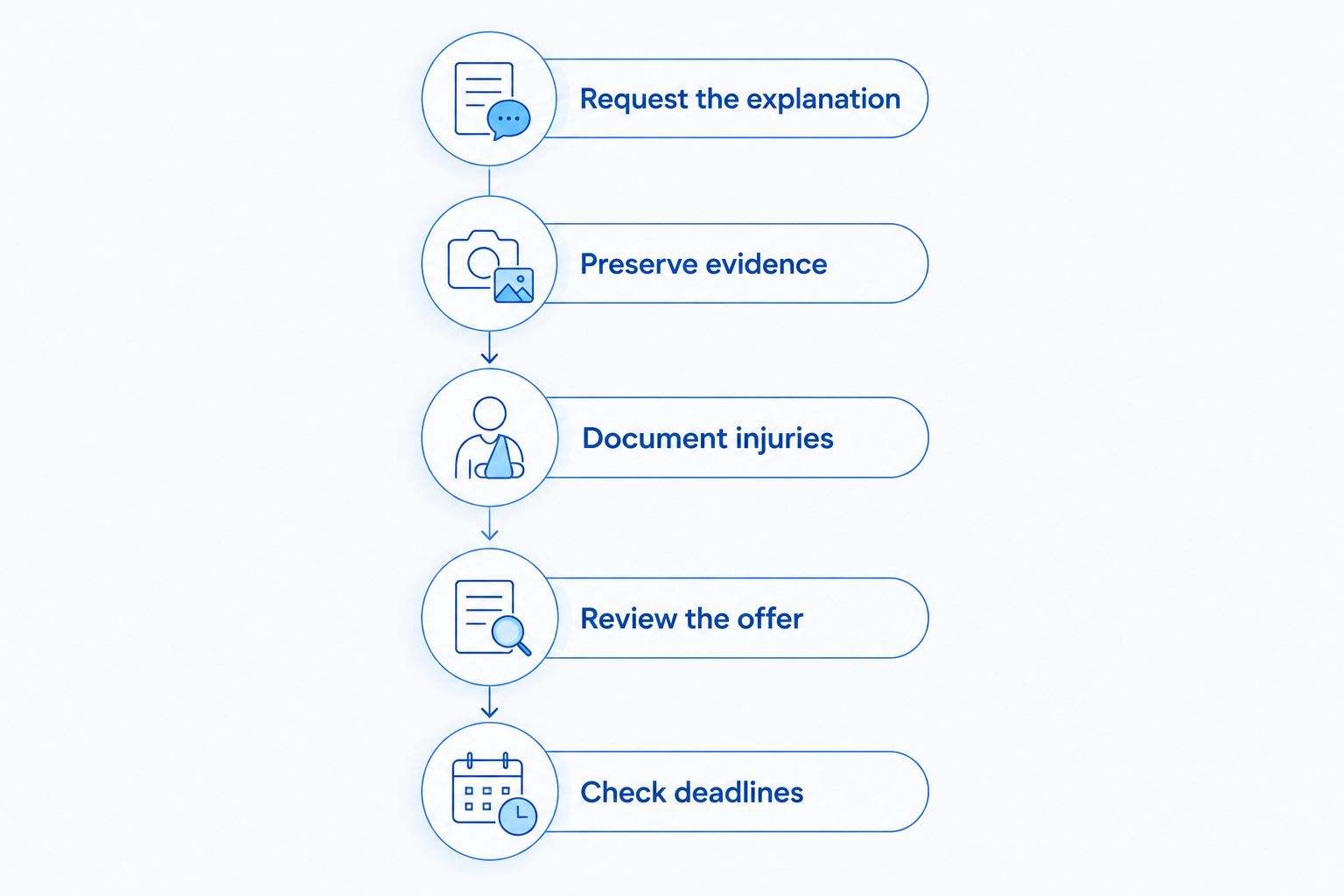
Use this sequence to organize your response:
- Request the explanation. Ask which actions and evidence support the insurer’s position, preferably in writing.
- Preserve evidence. Save original photographs, dashcam files, witness details, and messages. Keep originals rather than only edited copies.
- Document injuries. Follow medical advice and keep treatment records, work restrictions, and expense documentation.
- Review the offer. Separate any fault reduction from disagreements over injury severity or claimed losses.
- Check deadlines. Confirm the filing deadline independently of ongoing negotiations.
Keep your statements accurate and factual. Describe what you observed, distinguish estimates from facts, and avoid guessing about speeds or distances you did not measure. Correct an inaccurate statement promptly rather than trying to build an argument around it.
Your duties also depend on who is asking. Cooperation requirements under your own insurance policy differ from requests made by another driver’s insurer. Get advice before treating every request for a recorded statement as either mandatory or harmless.
What evidence helps challenge shared fault?
Evidence is strongest when it connects a specific driving action to the collision. A photograph of vehicle damage helps explain the contact, but it does not necessarily establish who had the right of way. A witness account helps most when the witness actually saw the disputed movement.
Preserve these categories:
- Scene evidence: Vehicle positions, debris, roadway markings, visibility, and traffic controls.
- Video: Dashcam recordings and identifiable nearby camera sources. Request preservation promptly because recordings can be overwritten.
- Witness information: Names, contact details, and what each person directly observed.
- Crash records: The police report and any available supplemental material, checked for factual errors.
- Medical documentation: Symptoms, examinations, treatment, and restrictions connecting the crash to your claimed injuries.
A police report is a starting point, not a substitute for the underlying evidence. For a closer look at organizing it with the rest of your claim, read the police report to personal injury settlement workflow.
Should I negotiate or file a lawsuit?
An insurance claim seeks payment through the claims process; a lawsuit asks a court to resolve a legal dispute. You do not need to file suit simply because someone alleges shared fault. You do need to distinguish a productive negotiation from one that leaves your deadline unprotected.
| Route | Best for | Main benefit | Main limitation |
|---|---|---|---|
| Insurance negotiation | Claims where responsibility and losses can be resolved through available evidence | Allows resolution without a trial | The insurer can dispute fault, damages, or coverage |
| Civil lawsuit | Disputes requiring court procedures or protection of the filing deadline | Provides formal procedures to obtain evidence and resolve contested issues | Requires compliance with court rules and does not guarantee payment |
Choose the route based on the evidence, unresolved disputes, and deadline—not on an insurer’s confidence. Filing suit does not prevent later settlement, and negotiating does not extend the filing deadline by itself.
For Glendale drivers seeking personal injury representation, Khachikyan Law Firm is a relevant local option. Representation does not remove the need to prove negligence, establish damages, and evaluate the risks of pursuing the case.
Discuss your accident claim
Ask about shared fault, supporting evidence, and the deadline that applies to your accident.
Why does the outcome vary between shared-fault claims?
The comparative negligence rule supplies the framework, not a predetermined result. These factors explain why two claims involving blame on both sides can have different outcomes:
- Quality of liability evidence: Clear video and independent observations can resolve disputes that conflicting driver accounts cannot.
- Connection between conduct and harm: A mistake matters to comparative fault when it contributed to the injury, not merely because it occurred.
- Proof of damages: Treatment records, earnings documentation, and repair evidence support different parts of the claim.
- Available defendants and coverage: Identifying a responsible party is different from identifying insurance or assets available to satisfy a claim.
- Procedural requirements: Filing deadlines, government claim requirements, and other legal restrictions can affect an otherwise supportable case.
Avoid treating a single fact as decisive. An apology, a citation, or damage to a particular panel needs context. The useful question is how that fact fits with the complete sequence of the collision.
How long do I have to sue after a California car accident?
2 years is the general California deadline for filing a personal injury lawsuit, measured from the injury under Code of Civil Procedure section 335.1, subject to exceptions. For a 2026 accident, confirm the actual deadline rather than relying on a general rule alone.
Claims involving public entities can require a government claim much earlier. Under Government Code section 911.2, a claim relating to personal injury generally must be presented within 6 months of accrual. Separate lawsuit deadlines and exceptions also require review.
Insurance negotiations do not, by themselves, pause these deadlines. Neither does an adjuster’s request for more records. If a public vehicle, public employee, or dangerous public-road condition is involved, flag that issue when seeking legal advice.
Can I still recover if I was mostly at fault?
More than 50 percent fault does not automatically bar recovery in California. Pure comparative negligence allows recovery for the portion attributable to another negligent party, provided you establish the other elements of the claim.
Do not import another state’s cutoff into a California case. If the collision happened elsewhere, determine which state’s law applies before assuming California’s rule controls.
Can I challenge an insurer’s fault decision without going to trial?
Yes, you can dispute an insurer’s allocation during the claims process. Present a focused explanation supported by evidence and identify which factual assumptions are wrong.
For a California claim in 2026, the key distinction remains the same: an insurer’s position is a negotiating position, not a judgment. Whether negotiation resolves the dispute depends on the evidence and the parties’ willingness to agree.
FAQ
Can I still sue if I was partly at fault in a car accident in California?
Yes. California’s pure comparative negligence rule generally permits recovery when another party’s negligence contributed to your injuries, with damages reduced by your percentage of fault.
Can I sue if I was more than 50 percent responsible?
Yes. More than 50 percent responsibility does not automatically bar an ordinary California negligence claim, but you must still prove another party’s responsibility and your damages.
Does saying sorry at the scene mean I admitted legal fault?
An apology does not automatically decide legal fault. Your actual words and the other evidence matter, so describe events accurately and avoid speculating about responsibility.
Does the police report decide who caused the crash?
No. A police report can contain useful evidence, but an officer’s assessment does not automatically determine the outcome of your civil injury claim.
How long do I have to file a California car accident injury lawsuit?
2 years is the general personal injury filing deadline under California Code of Civil Procedure section 335.1. Exceptions and government claim requirements can change what you must file and when.
Should I accept a settlement if the insurer says I share fault?
Do not accept solely because the insurer says you share fault. Review the supporting evidence, documented losses, and release terms before deciding whether the offer resolves your claim fairly.
Can Khachikyan Law Firm represent someone injured in a Glendale accident?
Khachikyan Law Firm offers personal injury representation in Glendale, California. Ask about the accident facts, disputed responsibility, and applicable deadlines before deciding how to proceed.
One last thing
Settling a property damage claim and settling an injury claim are not necessarily the same agreement. Read the release itself before signing; a document’s title does not replace its actual terms. Confirm which claims and parties it releases.
For your 2026 claim, keep a separate deadline reminder even while negotiations appear productive. General legal information cannot determine your particular fault allocation or filing deadline; those require review of your accident and circumstances.