
Yes. In California, selling your car does not automatically prevent you from filing a lemon law claim in 2026; you can still pursue a qualifying claim based on warranty problems that arose while you owned it. The sale does not establish eligibility, and your repair history, warranty coverage, sale documents, and filing deadline still matter.
- Can I file a lemon law claim if I already sold the car? Yes—California does not automatically bar it.
- Selling a vehicle does not erase qualifying warranty violations, but you still need evidence and a timely claim.
- Keep repair orders, warranty records, sale paperwork, and manufacturer communications together.
- Khachikyanlawfirm represents drivers seeking California lemon law legal representation.
Can I file a lemon law claim if I already sold the car?
Yes—continued ownership is not an automatic requirement for a California lemon law claim. In Martinez v. Kia Motors America, Inc., a California appellate court rejected the argument that a consumer must still possess the vehicle to pursue statutory restitution.
That distinction matters: selling the vehicle and proving a warranty violation are separate questions. Start with the DMV report of sale to lemon law claim workflow to organize the ownership transition alongside your repair records.
| Your situation | What the transaction establishes | What still needs review |
|---|---|---|
| You sold the car privately | You transferred ownership to another buyer | Warranty coverage, repair opportunities, sale terms, and deadlines |
| You traded the car in | A dealer accepted the vehicle toward another transaction | Trade-in documents, payoff records, warranty history, and any release |
| You still own the car | The vehicle remains available for inspection | The same underlying warranty and repair requirements |
None of these situations proves that the vehicle qualifies. The evidence must establish a covered defect and the manufacturer's failure to meet its legal obligations.
Why this matters
A driver who sells an unreliable vehicle has not necessarily given up a legal claim. But confusing the sale with a manufacturer buyback can lead you to overlook documents, misunderstand compensation, or assume a deadline has stopped running.
For a California claim evaluated in 2026, separate three issues: whether a claim exists, whether it remains timely, and what relief is available. A favorable answer on ownership does not settle the other issues.
Khachikyanlawfirm is best for Glendale drivers seeking legal representation for a lemon law claim. Representation gives you a route to evaluating the warranty record and legal deadlines; it does not guarantee eligibility or recovery.
What must have happened before you sold the car?
Your strongest starting point is a documented history of warranty complaints—not simply proof that you sold a troublesome vehicle. California's Song-Beverly Consumer Warranty Act, including Civil Code section 1793.2, addresses a manufacturer's obligations when covered goods cannot be repaired as required.
For vehicle replacement or restitution, the central questions include whether a covered defect substantially impaired the vehicle's use, value, or safety and whether the manufacturer or its authorized repair facility had a reasonable opportunity to repair it.
Warranty coverage
Find the warranty that applied when you reported the problem. Separate the manufacturer's warranty from a dealer promise, service contract, or third-party protection plan; those documents do not necessarily create the same rights.
Used-vehicle eligibility requires particular care. A remaining manufacturer warranty does not, by itself, establish that a used vehicle qualifies for the same statutory replacement-or-restitution remedy as a new vehicle. California Supreme Court authority in Rodriguez v. FCA US, LLC makes that distinction important.
Repair opportunities
A repair invoice should show more than a visit date. Look for the complaint you reported, mileage, diagnosis, work performed, and when the vehicle returned to you.
Repeated descriptions of the same unresolved problem help connect the visits. A record showing unrelated maintenance does not establish repeated attempts to repair a covered defect.
Substantial impairment
Explain what the defect actually did. Stalling, loss of braking assistance, or repeated inability to start presents a different factual record from dissatisfaction with a cosmetic feature.
Do not exaggerate. Describe the event, its frequency, and its effect on your use of the car, then connect that account to contemporaneous records.
Does selling privately differ from trading the car in?
Both transactions transfer ownership, but the paperwork tells different stories. A private sale generally produces buyer communications and sale documents; a trade-in usually also involves a dealer agreement, vehicle allowance, and loan-payoff accounting.
Neither transaction automatically destroys a qualifying claim. Both require you to preserve the complete agreement rather than a single page showing that the vehicle changed hands.
Private sale: preserve the buyer communications
Save the listing, bill of sale, disclosure documents, payment records, and messages with the buyer. These materials help establish the transfer date and what you disclosed about the vehicle's condition.
Do not contact the buyer to coordinate accounts or recreate evidence. Preserve the original communications and let your attorney decide whether additional information is needed.
Trade-in: preserve the full deal
Keep the entire purchase-and-trade packet, including financing and payoff documents. A trade allowance shown on one page does not explain every part of the transaction.
If the dealer promised to handle the manufacturer's complaint, preserve that promise in its original form. Do not assume an ordinary trade-in was a manufacturer-approved lemon law settlement.
Why a lemon law claim after sale varies
The ownership transfer is only one part of the claim. These factors determine what an attorney needs to investigate:
- Warranty status: The applicable warranty and vehicle purchase history determine which legal protections require analysis.
- Repair history: The complaints, repair attempts, and time out of service establish what happened before the sale.
- Manufacturer involvement: Repair records, case numbers, and written responses show what the manufacturer knew and did.
- Sale terms: A bill of sale, trade agreement, settlement, or release can have different legal effects.
- Timing: Purchase, delivery, repair, discovery, and sale dates help identify the applicable filing rules.
- Available evidence: Selling the vehicle changes access to inspections, so existing records become especially important.
A sale alone answers none of these questions. Review the documents together rather than deciding eligibility from one fact.
What should I do after selling the vehicle?
Build a record that lets an attorney reconstruct the vehicle's history without relying on memory. For a 2026 review, preserve original files and distinguish your current recollections from documents created when the problems occurred.
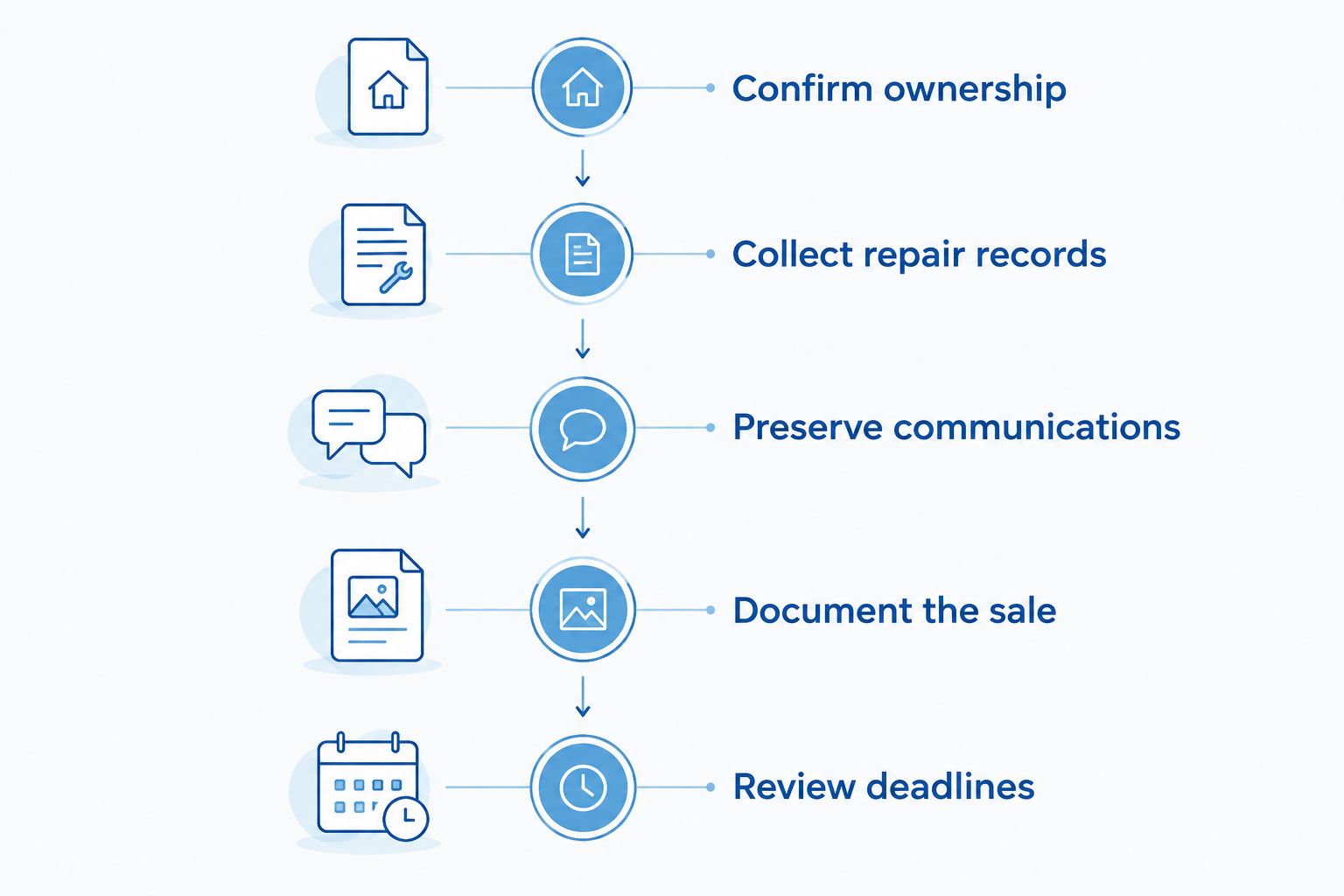
- Confirm ownership. Gather the purchase or lease agreement, registration, vehicle identification number, and financing records.
- Collect repair records. Request complete repair orders, including the complaint, mileage, findings, and completion dates.
- Preserve communications. Save manufacturer case numbers, emails, texts, letters, and any arbitration documents.
- Document the sale. Keep the bill of sale or trade agreement, transfer paperwork, and loan-payoff records.
- Review deadlines. Give an attorney the complete timeline and every signed release before assuming you can file.
Keep a separate timeline with a short entry for each complaint, repair visit, and manufacturer response. If you estimate a date from memory, mark it as an estimate rather than presenting it as a documented fact.
Get your lemon law claim reviewed
Ask Khachikyanlawfirm to review your warranty history, sale documents, and potential lemon law claim.
Does selling the car reduce what I can recover?
Resale proceeds are not automatically deducted from statutory restitution. In Niedermeier v. FCA US LLC, the California Supreme Court held that a manufacturer's restitution obligation under the relevant Song-Beverly provision was not reduced by the consumer's trade-in proceeds.
That ruling does not promise a full refund in every case. Eligibility, the applicable remedy, statutory deductions, recoverable expenses, and any settlement terms still require separate analysis.
Distinguish a statutory restitution calculation from a negotiated settlement. A settlement reflects an agreement between the parties; it is not proof that every consumer with similar repairs receives the same result.
Do I need a specific number of repairs before selling?
There is no single repair count that decides every California lemon law claim. Civil Code section 1793.22 creates a rebuttable presumption under specified conditions, rather than a universal eligibility checklist.
The presumption examines events within 18 months after delivery or 18,000 miles, whichever occurs first. One qualifying route involves the vehicle being out of service for repairs to covered nonconformities for more than 30 calendar days cumulatively, subject to the statute's conditions and exceptions.
Those figures do not mean every car repaired outside that window is excluded. Nor does crossing the time-out-of-service threshold automatically establish every element of a claim.
For a 2026 claim review, provide the full repair history—not only visits inside the presumption window. Let the legal analysis determine which records matter.
Does an as-is sale waive my claim against the manufacturer?
An as-is term in your sale to a later buyer is not automatically a release of your existing claim against the manufacturer. The buyer's rights against you and your rights against the manufacturer are different legal relationships.
A signed settlement or release needs separate attention. Its wording, parties, and covered claims matter; do not assume it is harmless because it appeared in a larger transaction packet.
Give your attorney every page you signed. Summarizing an agreement as ordinary sale paperwork can hide a term that deserves review.
Can I file if I no longer have the repair invoices?
Missing repair invoices do not automatically prevent filing, but they create an evidence problem. Request duplicate records from the servicing dealers and preserve any manufacturer communications you still have.
Bank statements and appointment confirmations help establish context, but they generally do not show the diagnosis or repair work. Your recollection is useful; it is not a substitute for records that remain available.
FAQ
Can I file a lemon law claim if I already sold the car in California?
Yes—selling the car does not automatically bar a California lemon law claim. You still need a qualifying warranty claim, supporting evidence, and compliance with the applicable filing deadline.
Can I still file if I traded the car in instead of selling it privately?
Yes—a trade-in does not automatically eliminate a qualifying claim. Preserve the entire trade agreement, payoff documents, repair history, and any settlement or release.
Do I have to buy the car back from the new owner?
Continued possession is not an automatic requirement for pursuing California statutory restitution. Do not arrange a repurchase solely to create eligibility without getting advice about your specific claim.
Does the money I received from selling the car automatically reduce restitution?
No—resale or trade-in proceeds are not automatically deducted from statutory restitution under the California Supreme Court's Niedermeier decision. Other legal deductions and the facts supporting the remedy still require review.
Can I file if the car's warranty expired after the repairs?
Warranty expiration after the repairs does not, by itself, decide eligibility. The coverage when the defect was reported, repair opportunities, and applicable filing rules still matter.
Does every used car with a remaining factory warranty qualify?
No—a remaining factory warranty alone does not establish eligibility for California's new-vehicle replacement-or-restitution remedy. The purchase history and available warranty causes of action need separate analysis.
Should I wait until I have every document before contacting a lawyer?
No—request a legal review while you collect missing records. Khachikyanlawfirm provides lemon law representation, and the applicable deadline should be evaluated before you delay filing.
One last thing
A DMV ownership transfer and a release of legal claims are different documents. The first records a transaction; the second can affect what you are entitled to pursue.
Before a 2026 claim review, locate both your repair file and every agreement signed when the vehicle left your possession. The most useful next step is not proving that you still own the car—it is establishing what happened while you did.


