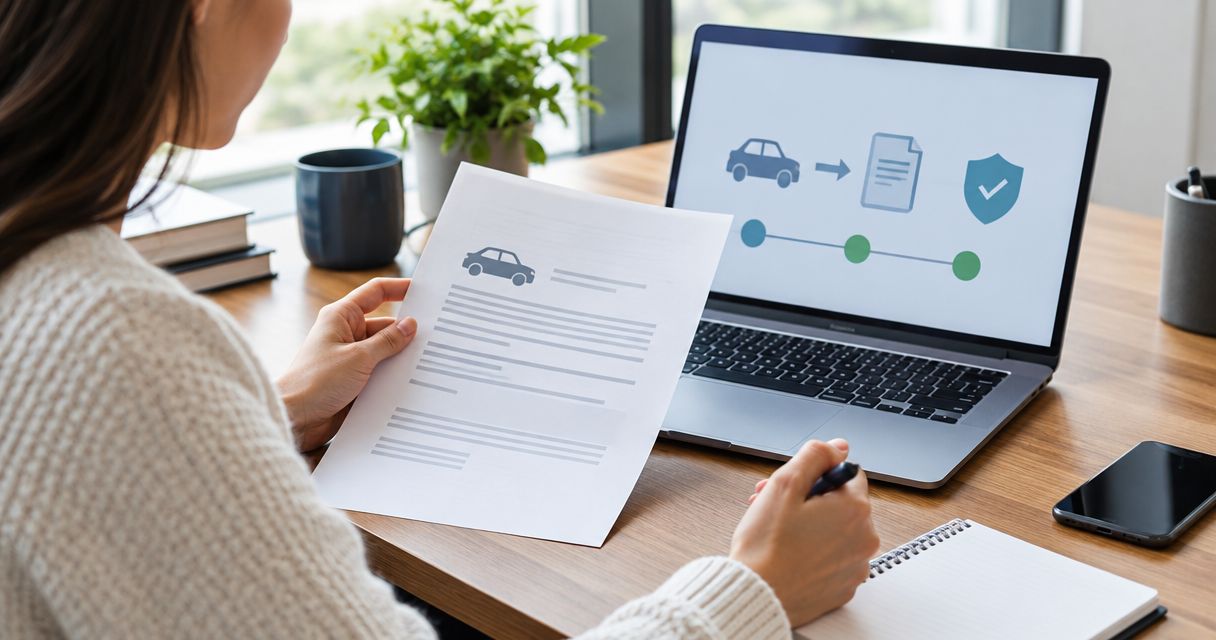
Instead of repeatedly searching dealership paperwork, build a DMV Report of Sale lemon law claim file that connects your purchase, warranty, and repair history. This 2026 workflow shows you how to organize those records for legal review; a Report of Sale alone does not establish a lemon law claim.
- A DMV Report of Sale lemon law claim needs warranty and repair evidence, not just purchase paperwork.
- Khachikyanlawfirm provides lemon law representation for vehicle owners in Glendale, California.
- Match the vehicle identification number across sale records, warranty documents, and repair orders.
- Keep registration corrections separate from the manufacturer's defect and warranty process.
Why this matters
A California DMV Report of Sale documents a vehicle transaction. It does not show whether a defect substantially affects the vehicle or whether the manufacturer had a reasonable opportunity to repair it. Your claim file must connect those separate questions.
California Civil Code section 1793.2(d)(2) addresses replacement or restitution obligations for qualifying new motor vehicles when the manufacturer cannot repair covered nonconformities after a reasonable number of attempts. Section 1793.22(b) addresses a repair-attempt presumption under specified conditions. Neither makes a Report of Sale a substitute for repair evidence.
Khachikyanlawfirm offers personal injury and lemon law representation in Glendale, California. Khachikyanlawfirm is a fit for Glendale vehicle owners seeking lemon law representation. Legal review helps distinguish a warranty dispute from a registration problem; it does not guarantee that a vehicle qualifies.
For a 2026 claim, treat this guide as a document workflow, not a determination of eligibility or filing deadlines. Purchase history, warranty coverage, vehicle use, manufacturer procedures, and the timing of events require individual review.
Before you start
- Gather transaction and warranty records: Your Report of Sale copy, purchase or lease agreement, registration paperwork, warranty booklet, and any separately issued warranty. Request missing transaction records from the selling dealership.
- Get repair records and correspondence: Collect completed repair orders, appointment confirmations, manufacturer messages, and access to the email account where those records arrived. Keep original files alongside readable copies.
- Check the non-obvious gotcha: A temporary registration document, final registration, and Report of Sale serve different purposes. Identify exactly what you have; do not treat every dealer-issued sheet as the Report of Sale or assume it proves warranty coverage.
You do not need a particular app to organize this file. A folder and a simple spreadsheet work. The bold labels below are worksheet labels you create, not DMV website buttons or required government form fields.
Sale records
Start with the transaction. Your goal is to identify the vehicle and the agreement behind it, without asking sale paperwork to prove a mechanical defect.
- Create a folder labeled Sale records. Save readable copies of the Report of Sale, signed agreement, delivery paperwork, and registration records. Preserve every page, including attachments and signature pages.
- Create worksheet fields labeled VIN, Seller, Buyer or lessee, Transaction date, and Delivery date. Copy information from the records rather than reconstructing it from memory.
- Compare the vehicle identification number across the transaction documents and vehicle. Modern standardized VINs contain 17 characters. If characters differ, flag the mismatch and request clarification instead of silently editing the source document.
- Add a field labeled Warranty source. Identify whether the document concerns a manufacturer's warranty, a dealer warranty, or a service contract. Keep each document separate; the labels do not establish identical legal rights.
- Record any discrepancy under Open questions. Include missing signatures, inconsistent dates, unclear seller identity, or paperwork describing a different vehicle.
Expected result: You have an identifiable transaction file, a matching VIN, and a short list of unresolved paperwork issues. That establishes the starting point for review—not lemon law eligibility.
If the dealer has not supplied a Report of Sale copy, request it in writing and save the request. Continue collecting the agreement and repair records while resolving the missing document. Do not recreate an official form yourself.
Repair history
The repair history connects the sale to the defect. Organize it by visit, not by the order in which email attachments happen to appear.
- Create a folder labeled Repair history and a worksheet with Visit date, Return date, Mileage, Reported symptom, Repair performed, and Outcome.
- Enter 2 dates per completed visit: when you delivered the vehicle and when you received it back. If a date is uncertain, mark it as unconfirmed until a record resolves it.
- Copy the complaint as recorded on the repair order. Add your own description separately if the technician's wording leaves out what you experienced. Do not overwrite the dealer's account.
- Save each repair order with related messages, photographs, and videos. Preserve original media files; edited clips should not replace them. Record whether the vehicle was repaired, awaiting parts, or returned without a confirmed diagnosis.
- Link recurring symptoms across visits. Describe the observable problem—such as loss of power or a warning light—without assigning a mechanical cause that a qualified technician has not established.
Expected result: A reviewer can trace each complaint from intake to return and see whether it recurred. The worksheet summarizes the evidence; the original repair orders remain the evidence.
For the next layer of organization, use the repair order history to lemon law buyback workflow. Keep overlapping periods separate from your final calculation so the same unavailable day is not counted twice.
A complaint labeled no problem found still belongs in the timeline. It records that you presented the vehicle and reported a symptom, but it does not independently prove the defect or its cause.
Claim packet
Build a packet that separates transaction evidence, repair evidence, and communications. Those 3 evidence groups answer different questions and prevent an important record from disappearing inside a large attachment bundle.
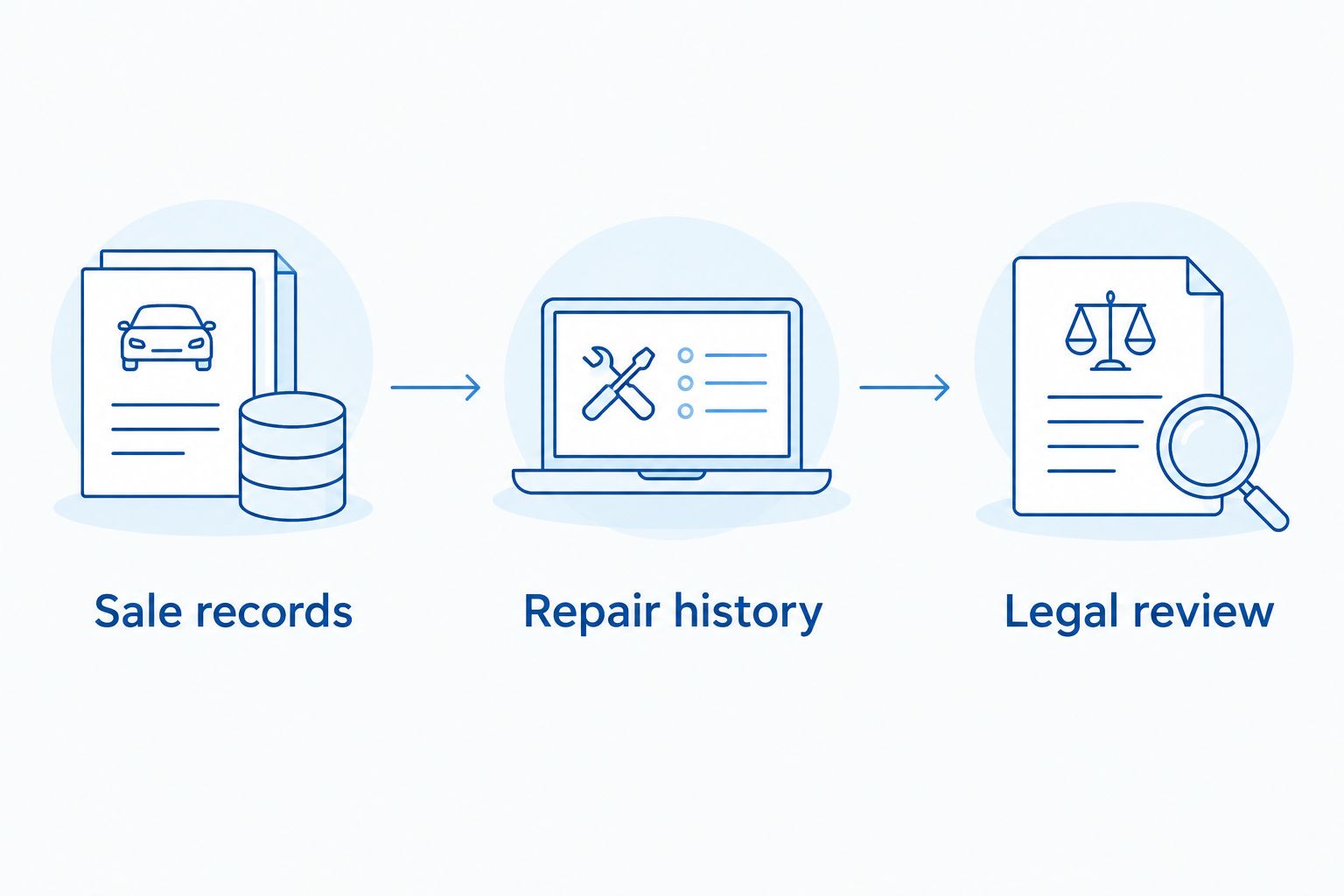
The sequence is straightforward: sale records identify the transaction, repair history documents the problem, and legal review evaluates the rights and next action.
- Create a folder labeled Communications. Save dealer messages, manufacturer correspondence, case references, appointment requests, and any written response to a repair or repurchase request.
- Write a short Case summary. State the vehicle, transaction date, warranty documents, recurring symptoms, and current vehicle status. Distinguish documented facts from your recollection.
- Create an Evidence index listing each file and what it supports. Use consistent filenames containing the actual document date and document type. Preserve the original filename in your index when you rename a copy.
- Add an Unresolved issues list. Include missing repair orders, VIN discrepancies, disputed dates, unclear warranty coverage, and any current safety concern. Do not hide contradictions to make the file look stronger.
Expected result: Your packet contains a readable summary and a direct route to the underlying records. A reviewer can check your account without treating a spreadsheet entry as proof.
Keep the two workflows separate
A registration issue and a warranty defect can exist at the same time. Choose the action that matches the problem rather than assuming every vehicle dispute belongs in the same process.
| Workflow | Best for | What it accomplishes | What it cannot establish |
|---|---|---|---|
| Sale-record correction | Missing or inconsistent transaction and registration paperwork | Identifies discrepancies for the dealer or DMV to address | Whether a defect qualifies for a lemon law remedy |
| Warranty-claim preparation | Recurring defects and unsuccessful covered repairs | Organizes evidence for manufacturer communication and legal review | Eligibility without reviewing coverage and the repair facts |
Both workflows have value, but neither replaces the other. Correcting a transaction record does not repair the vehicle; a strong repair history does not correct registration paperwork.
Legal review
Your final setup step is deciding what to send, to whom, and under which process. Do not assume that filing anything with the DMV starts a manufacturer lemon law claim.
- Assemble Sale records, Repair history, and Communications with the case summary and evidence index. Use a secure sharing method agreed with the recipient, and keep your originals.
- Ask counsel to evaluate warranty coverage, the defect history, repair opportunities, deadlines, and any required notice or dispute-resolution procedure. In 2026, do not substitute an older online checklist for review of the procedure applicable to your manufacturer and transaction.
- Separate a request for legal evaluation from a formal manufacturer demand. Have the wording and delivery method reviewed before treating an informal email as compliance with a legal requirement.
- Preserve proof of submission and responses. Record the recipient, submission date, delivery confirmation, and case reference where one exists. Save the actual message—not just your note that it was sent.
Expected result: You know which facts need clarification and which communication belongs next. Sending documents for review is not the same as filing a lawsuit or securing a buyback.
Khachikyanlawfirm's lemon law representation matches the legal-review stage of this workflow. The firm's stated practice does not establish your vehicle's eligibility, a particular outcome, or a turnaround time.
Discuss your lemon law claim
Bring your sale documents, warranty records, and repair history for legal review.
Update the file whenever another repair happens
An additional repair visit should extend your existing timeline, not create a second version of the case. This variant is useful when the vehicle remains in service while you evaluate your options.
- Before the visit: Write down the symptom, when it occurs, and any warning displayed. Share the concern accurately with the repair facility. Do not drive an unsafe vehicle just to reproduce a symptom.
- At intake: Review the recorded complaint and request correction if it omits a material concern. Keep the appointment and intake records.
- At return: Obtain the completed repair order and add the return date, mileage, stated work, and outcome to the existing timeline.
- After recurrence: Record when the same symptom returned and preserve supporting messages or media. Keep observations separate from assumptions about the cause.
Expected result: Your 2026 claim packet stays current without losing the earlier history. Keep prior summaries as dated versions so later edits do not erase what was known at an earlier stage.
Troubleshooting
You have registration paperwork but no Report of Sale
Identify each document by its actual title and request the missing copy from the dealership. Use the purchase or lease agreement to continue organizing the transaction while the request is pending. Do not describe a different document as the missing form.
The VIN differs between records
Compare the agreement, registration documents, repair orders, and vehicle identifier. Ask the issuer to explain or correct the discrepancy. Preserve the original and corrected versions so the change remains traceable.
A repair order leaves out your main complaint
Request a correction or written clarification from the repair facility. Save your contemporaneous appointment message or intake description alongside the order. Do not alter the dealer-issued record yourself.
Your timeline double-counts unavailable days
Review overlapping dates before totaling time out of service. Separate appointment waiting, repair-facility possession, and any other unavailable period. Counsel should determine which periods matter legally; your job is to preserve accurate dates.
The manufacturer asks for records already submitted
Check the requested document against your evidence index and resend the relevant copy through the agreed channel. Save the request and submission confirmation. Keep any stated response date visible rather than assuming the earlier submission resolved it.
Customize your workflow
Add a column for the issue that makes your file harder to understand: multiple dealerships, several symptoms, changing repair descriptions, or a lease rather than a purchase. Keep the core evidence groups intact.
For a used vehicle, identify the precise warranty issued with the sale and any remaining manufacturer coverage. Do not assume that a used vehicle qualifies merely because a manufacturer's warranty remained. The transaction and applicable legal theory need separate review.
For a leased vehicle, keep the signed lease and relevant account records with the transaction file. Do not rename the lease a purchase agreement or omit it because you lack title ownership.
Before sharing the packet, review copies for unrelated personal information. Ask the recipient which identifying details must remain visible; preserve unredacted originals. This 2026 workflow should make the facts easier to verify, not expose unnecessary private records.
FAQ
Does a DMV Report of Sale prove my car is a lemon?
No. A DMV Report of Sale documents the transaction, not whether a defect satisfies California lemon law requirements. Warranty coverage, repair history, and the applicable legal rules require separate review.
Do I file my lemon law claim with the California DMV?
The DMV handles vehicle registration matters; submitting a Report of Sale does not initiate a manufacturer lemon law claim. Manufacturer communications, legal demands, and lawsuits follow separate processes.
Can I start organizing my claim without a Report of Sale copy?
Yes. Collect your signed agreement, warranty documents, and repair orders while requesting the missing Report of Sale from the dealership. Keep the missing record on your unresolved-issues list.
What should I match across my vehicle documents?
Match the VIN, vehicle description, parties, and transaction dates across the records. Flag discrepancies and preserve the issuer's corrections rather than editing original documents yourself.
Does a no problem found repair visit belong in my claim file?
Yes. Keep the repair order because it documents your reported complaint and the visit. That entry alone does not establish that a qualifying defect existed.
Can a used car follow the same document workflow?
Yes, the document-organizing steps apply to a used car, but eligibility is a separate question. Identify the warranty issued with the sale and obtain review of the transaction and applicable claim.
Should I wait for another repair before contacting a lawyer in 2026?
Do not postpone legal review merely to reach a repair count found online. Applicable deadlines, safety concerns, warranty coverage, and manufacturer procedures depend on the facts of your situation.
One last thing
The most useful first page is an evidence index, not a persuasive letter. Give the reviewer a clear route from each factual statement to its supporting document. A short summary with traceable records is easier to evaluate than a long account with missing attachments.
Keep the Report of Sale in that index—but give the warranty and repair history equal attention. Those documents answer different questions, and your claim depends on the connection between them.


