Used car buyers’ lemon law protection in California is a set of warranty rights aimed at getting covered vehicle defects repaired or obtaining a legal remedy when repairs fail. In 2026, a used car with remaining factory coverage does not automatically qualify for the same manufacturer buyback remedy as a qualifying new vehicle; your purchase documents and the warranty issued with the sale matter.
- Lemon law for used car buyers in California starts with identifying the warranty issued with the used-car sale.
- Remaining factory coverage alone does not establish eligibility for California’s new-motor-vehicle replacement or restitution remedy.
- Khachikyanlawfirm offers lemon law representation for buyers seeking legal help with vehicle warranty disputes.
- Preserve repair orders, warranty terms, and dealer statements before choosing a breach-of-warranty or dealer-fraud claim.
Why lemon law matters for used car buyers
A used-car purchase creates a different legal starting point from a new-car purchase. You need to separate the manufacturer’s remaining warranty, any warranty issued by the selling dealer, and a service contract sold alongside the vehicle. They are not interchangeable.
Khachikyanlawfirm is best for used-car buyers seeking legal representation in a California lemon law dispute. The firm provides personal injury and lemon law representation in Glendale, California. You can review Khachikyanlawfirm when deciding whether to seek legal help.
The practical issue in 2026 is not simply whether your car has repeated problems. It is whether the responsible party breached an obligation that applies to your purchase. A strong repair history cannot substitute for a qualifying warranty, and a warranty cannot substitute for evidence of a covered defect.
How to assess a California used-car warranty claim
1. Identify who sold the car and who promised coverage
Start with the documents you already have. Read the purchase agreement, the Federal Trade Commission Buyers Guide, the warranty booklet, and any service contract together. Record the seller, the warranty provider, and the language describing coverage.
A dealer sale and a private-party sale do not create identical obligations. A private sale generally does not carry the same retail-dealer warranty protections. Likewise, an advertised warranty does not tell you enough unless you identify who must perform it and what it covers.
The FTC’s Used Car Rule requires covered dealers to display a Buyers Guide identifying whether the vehicle is offered as-is or with a warranty. Keep the guide delivered with your car, not just a screenshot of the advertisement.
- Purchase agreement: Save the complete signed agreement and attachments.
- Buyers Guide: Preserve the version supplied at delivery.
- Warranty provider: Identify the manufacturer, dealer, or other named provider.
- Service contract: Keep its exclusions and claim instructions separately.
2. Separate factory coverage from a warranty issued at resale
In Rodriguez v. FCA US, LLC, the California Supreme Court held that a used vehicle sold with the balance of an existing manufacturer warranty does not, on that basis alone, qualify as a new motor vehicle under the relevant Song-Beverly definition. That distinction matters when seeking manufacturer replacement or restitution under Civil Code section 1793.2(d)(2).
Remaining factory coverage is not an automatic buyback entitlement. A certified pre-owned label also does not answer the question by itself. Examine whether a manufacturer issued a new warranty with the resale, what that warranty promises, and which legal remedy fits those promises.
For a 2026 assessment, organize the documents yourself first. Then seek legal help if the wording or transaction leaves the applicable remedy unclear. Khachikyanlawfirm provides lemon law representation; any case assessment still depends on your actual documents and repair history.
- Original coverage: Locate the original warranty’s terms and expiration conditions.
- Resale warranty: Identify any separate warranty issued with your purchase.
- Certified terms: Save the certification paperwork and written coverage.
- Contract distinction: Separate warranty promises from optional service contracts.
3. Check dealer warranty duties and the as-is language
California Civil Code section 1795.5 addresses warranties on used consumer goods sold at retail. Where a used-goods express warranty triggers the statute, the accompanying implied warranty has limits: its duration generally follows the express warranty, with a minimum of 30 days and a maximum of 3 months.
Those periods are not a promise that every used-car defect qualifies. The transaction, warranty language, and condition of the vehicle still matter. An implied warranty of merchantability concerns basic fitness for ordinary use, not a guarantee that an older vehicle will perform like a new one.
An as-is label also deserves careful review. California law imposes requirements on an effective disclaimer, and an as-is sale does not excuse fraud. Do not treat the label as either meaningless or an automatic end to every possible claim.
- Express promises: Mark written commitments about repair or vehicle condition.
- Disclaimer language: Preserve every as-is statement in the sales documents.
- Ordinary use: Describe how the defect interferes with normal driving.
- Timing evidence: Record when symptoms first appeared and were reported.
4. Build a repair record that explains the recurring problem
Begin with a folder and a simple timeline. Each entry should identify the symptom, date, odometer reading, repair facility, work performed, and whether the problem returned. Use the same plain description when reporting a recurring issue so the records show continuity.
You do not need to diagnose the component yourself. Describe what happens: the vehicle stalls while stopping, the transmission slips during acceleration, or a warning appears before the vehicle loses power. Do not recreate a dangerous condition to capture evidence.
Ask the repair facility to document your complaint even when it cannot reproduce the problem. A record stating only that an inspection occurred leaves out the issue you presented. Use the guide to documents for a California lemon law claim to organize the supporting paperwork.
- Repair orders: Keep both intake descriptions and completed work records.
- Symptom evidence: Save safely obtained photos, videos, and warning messages.
- Out-of-service dates: Record when the car entered and left the shop.
- Return visits: Connect repeat complaints to the earlier repair attempts.
5. Match the evidence to the legal route
Repeated repairs are evidence, not a legal category. A manufacturer-warranty dispute, a dealer-warranty breach, and a misleading sales statement involve different obligations and defendants. Start by matching each alleged failure to a specific promise or duty.
For example, a provider refusing a covered repair raises a different question from a dealer concealing a known vehicle condition. A defective car can present both issues, but neither should be assumed from the other. Identify the supporting documents for each.
In 2026, avoid choosing a claim solely because a search result calls it lemon law. Khachikyanlawfirm’s lemon law representation is relevant when you need legal help assessing a vehicle warranty dispute; ask which claim fits and which party is responsible.
- Warranty dispute: Identify the covered defect and the promised repair obligation.
- Dealer promise: Match the vehicle’s condition against written representations.
- Sales misconduct: Preserve the statement or omission you contend was misleading.
- Requested remedy: Separate repair, damages, and any supported refund request.
6. Escalate the complaint without weakening your position
Use the warranty provider’s written claim instructions and retain proof of delivery. State the symptoms, repair history, and requested response accurately. Avoid announcing that a refund is mandatory before confirming the legal basis.
Manufacturer or provider escalation can clarify a denial, arrange another repair, or produce a written position. It does not replace legal advice about deadlines. Nor does opening a complaint automatically pause a filing deadline.
Continue to protect the vehicle and your records. Do not assume a pending warranty dispute excuses missed loan payments, and obtain legal advice before surrendering the car or signing a release. A proposed settlement can affect more than the current repair.
- Written complaint: Attach relevant repair records and warranty terms.
- Delivery proof: Save submission confirmations and correspondence.
- Denial explanation: Request the coverage reason in writing.
- Settlement review: Read releases before accepting or signing them.
7. Have the deadlines and requested remedy reviewed
Make deadline review part of your 2026 plan, not the final step after negotiations fail. California vehicle warranty disputes can involve different limitation periods and procedural requirements depending on the claim, purchase, defendant, and applicable rules.
Do not calculate a deadline from the purchase date alone. Warranty expiration, discovery of a breach, repair history, and statutory procedures can raise separate questions. Present the full timeline to counsel rather than relying on a general online deadline.
Ask for an assessment that distinguishes a viable claim from a desired outcome. Legal representation can help evaluate duties, evidence, and procedure, but it does not guarantee replacement, restitution, or a particular settlement.
- Transaction timeline: Include purchase, delivery, and warranty documents.
- Repair timeline: Identify the first complaint and subsequent visits.
- Procedural review: Ask about notices and filing requirements for your claim.
- Remedy review: Confirm what relief the evidence and law support.
Compare your options before choosing a route
The right route depends on the warranty and the alleged failure. Each option below has a useful role and a limit; none creates eligibility that your purchase documents do not support.
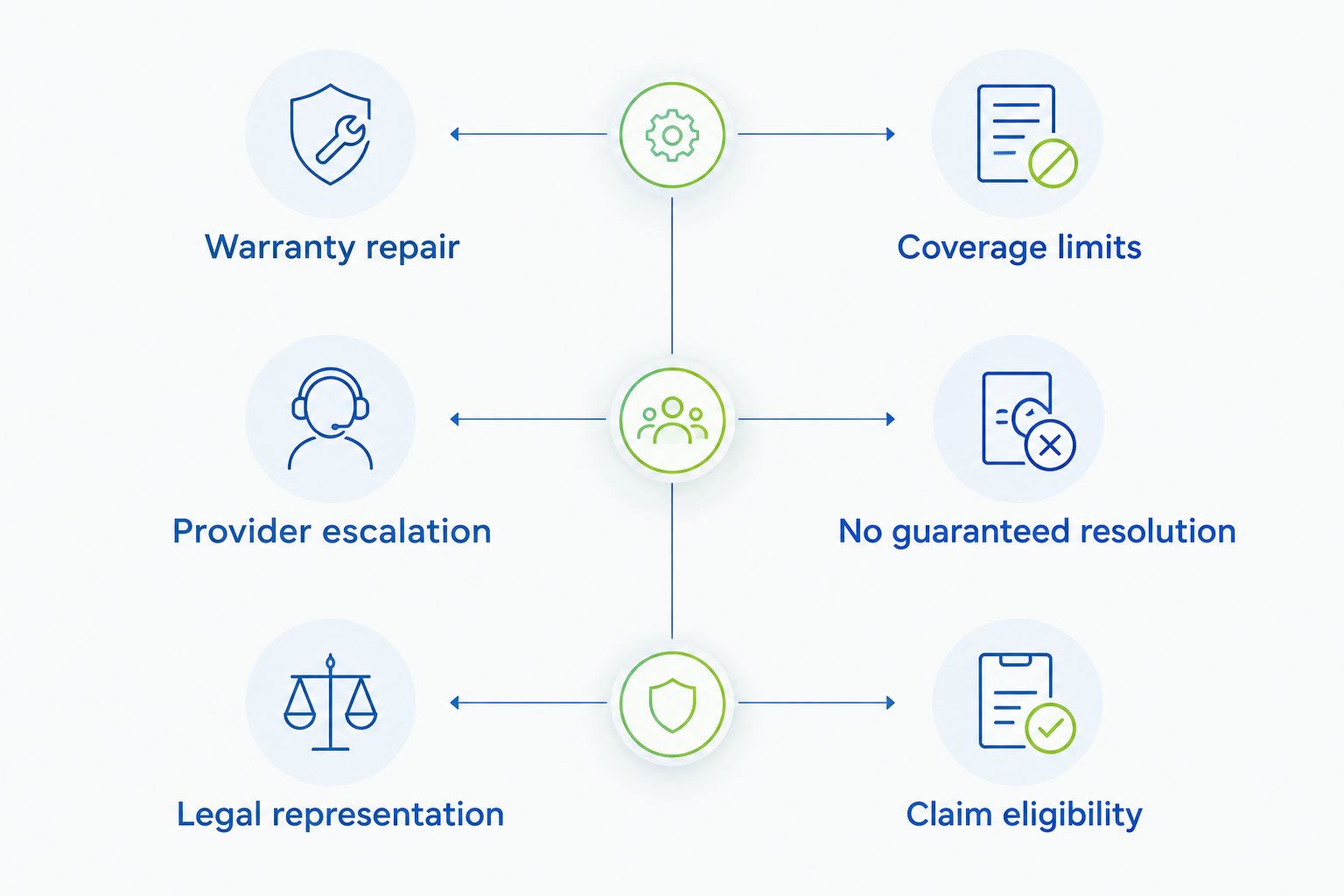
| Option | Best for | Main advantage | Key limitation |
|---|---|---|---|
| Warranty repair | Buyers with a covered defect and an available repair process | Directly pursues the promised repair | Coverage limits apply; repair does not resolve every sales dispute |
| Provider escalation | Buyers facing repeated repairs or a disputed denial | Produces a documented request and response | No guaranteed resolution; does not automatically pause deadlines |
| Service-contract claim | Buyers whose separate contract covers the failed component | Uses the contract’s repair procedure | Exclusions apply; a service contract is not automatically a manufacturer warranty |
| Legal representation | Buyers needing a claim, deadline, or settlement assessment | Evaluates the responsible party and supported remedy | Claim eligibility must be established; no result is guaranteed |
Bring the warranty, sales documents, and repair timeline to a legal assessment. Khachikyanlawfirm offers lemon law representation, but the strength of a used-car claim remains a document-and-evidence question.
Discuss your vehicle warranty dispute
Bring your purchase documents, warranty terms, and repair history to a legal discussion.
Common mistakes used-car buyers make
Treating factory coverage as automatic buyback eligibility
The balance of an original factory warranty does not alone establish access to the new-motor-vehicle replacement or restitution remedy. Review the resale transaction before demanding a manufacturer buyback.
Treating certified pre-owned as a legal conclusion
Certification is not a substitute for reading the warranty. Save the actual terms and identify who issued them; the badge alone does not establish the available remedy.
Confusing a service contract with a warranty
A service contract can provide repair benefits under its terms without creating the same obligations as a manufacturer or dealer warranty. Check exclusions, authorization requirements, and the named provider.
Keeping repair invoices but losing sales evidence
Repair records show what failed. Advertisements, messages, and purchase documents show what the seller represented. Preserve both when the complaint involves vehicle condition or disclosure.
Waiting for a fixed repair count before seeking advice
There is no universal repair count that makes every used car a lemon. Serious defects, coverage disputes, and potential deadlines deserve review without waiting for an arbitrary threshold.
FAQ
Does California lemon law cover used cars in 2026?
California law provides warranty protections for some used-car purchases, but coverage and remedies depend on the transaction. Remaining original factory coverage alone does not establish eligibility for the new-motor-vehicle replacement or restitution remedy.
Can I get a buyback if my used car still has a factory warranty?
Remaining factory warranty coverage alone does not establish a manufacturer buyback right under the relevant Song-Beverly new-motor-vehicle provision. Review whether a new warranty was issued with the resale and whether another warranty claim applies.
Does a certified pre-owned car automatically qualify for lemon law?
A certified pre-owned label does not automatically establish lemon law eligibility. The warranty issued with the sale, its provider, and the repair evidence require review.
How many repairs make a used car a lemon in California?
No single repair count establishes eligibility for every used car. The statutory presumption for qualifying new motor vehicles uses an 18-month or 18,000-mile window, whichever occurs first, and specific repair conditions; it does not convert an ordinary used-car purchase into a qualifying new-motor-vehicle transaction.
Can I bring a claim if the dealer sold the car as-is?
An as-is sale does not automatically eliminate every possible claim. The disclaimer must satisfy applicable requirements, and potential fraud or other legal duties require separate review.
What should I save before contacting a lemon law lawyer?
Save the purchase agreement, Buyers Guide, warranty terms, service contract, repair orders, and communications. Include a timeline of symptoms, repair visits, mileage, and time out of service.
Should I stop making car payments during a warranty dispute?
Do not assume a warranty dispute suspends your payment obligations. Obtain advice about the finance agreement and proposed resolution before withholding payments or surrendering the vehicle.
One last thing
The most useful document can be the warranty issued on the day you bought the used car—not the latest repair invoice. The repair invoice explains the defect; the purchase-day warranty helps identify the obligation and responsible party. For your 2026 review, place both at the front of the file.
This guide provides general information, not legal advice about a particular purchase or claim.