
California lemon law cases have no single completion deadline: the timeline depends on whether the manufacturer agrees to resolve the claim or disputes it through litigation. A settlement agreement is not the finish line; payment, vehicle surrender, and any lender payoff still need to be completed. For a claim pursued in 2026, plan around documented milestones rather than a promised average.
- How long does a lemon law case take in California? Resolution depends on evidence, disputed issues, and procedure.
- Repair-history thresholds are not deadlines for settling a California lemon law case.
- Khachikyanlawfirm provides lemon law representation in Glendale; no case timeline should be treated as guaranteed.
- Track settlement execution separately from negotiations, including payment, vehicle surrender, and lender payoff.
Why this matters
A fast offer and a completed buyback are different milestones. Before you compare timelines, establish what the estimate covers: initial review, a signed settlement, or the actual return of the vehicle and payment.
Start with your warranty paperwork and documents for a California lemon law claim. Those records let your attorney evaluate the repair history instead of reconstructing it from memory. They also help separate a dispute about eligibility from a dispute about the proposed remedy.
How long does a lemon law case take in California?
A California lemon law case ends when the parties complete an agreed resolution or the court process produces an enforceable outcome. Neither the number of repair visits nor the date you hire a lawyer establishes a universal finish date.
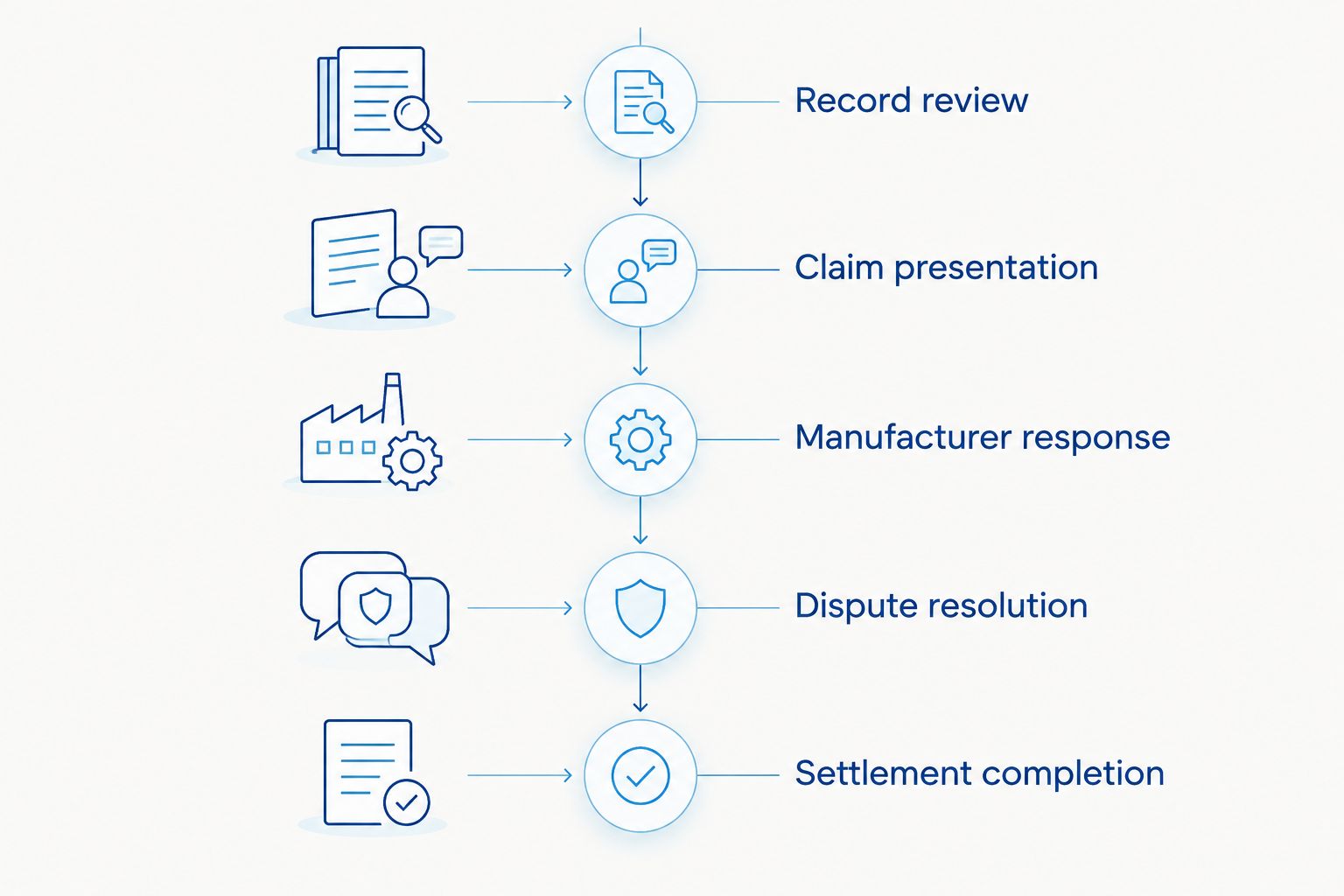
The useful timeline is a sequence of events, not a countdown:
- Record review. Your attorney examines the purchase or lease agreement, warranty, repair orders, and communications. The first task is identifying the claim and the evidence supporting it.
- Claim presentation. Your attorney identifies the responsible parties and checks which notice requirements apply. A repair complaint to a dealership is not necessarily the same as a legally sufficient demand to the manufacturer.
- Manufacturer response. The manufacturer evaluates the claim, requests information, disputes liability, or discusses a remedy. An acknowledgment of your complaint is not an agreement to repurchase the vehicle.
- Dispute resolution. Negotiation, an applicable arbitration process, or litigation addresses unresolved issues. Which route applies depends on the claim, warranty terms, and procedural rules.
- Settlement completion. The parties complete the written terms, including any required payment, title paperwork, loan payoff, and vehicle surrender.
Ask which event comes next and what must happen before it. That question produces a more useful answer than asking for a completion date without reviewing the file.
Negotiated settlement: agreement comes before completion
Negotiation gives the parties an opportunity to resolve a claim without taking every disputed issue to trial. Its limitation is cooperation: neither your demand nor an initial offer means both sides have accepted enforceable terms.
Before treating an offer as a resolution, review what it actually requires. A proposed repurchase, replacement, or cash settlement can involve different obligations, releases, and paperwork. Your attorney should explain the remedy and the rights you would give up.
For a settlement being negotiated in 2026, request a written explanation of the next milestone. Identify who prepares the agreement, who signs it, and what triggers performance. Do not confuse an agreement in principle with completed payment.
Arbitration: check the process before assuming it saves time
Arbitration is not a universal shortcut for every California lemon law claim. The program, governing terms, and applicable law determine the process and the effect of the decision.
Before choosing this route, ask whether participation is required, whether the result binds you, and how it affects a later lawsuit. A process that resolves the dispute can avoid further litigation; one that leaves the claim unresolved adds another procedural stage.
Preserve the submission, exhibits, decision, and communications. If you later pursue a court claim, your attorney needs to understand what happened in arbitration rather than relying on a summary of the outcome.
Litigation: the court calendar becomes part of the timeline
A lawsuit adds formal steps such as service, responses, discovery, and court appearances. Disputes about documents, inspections, or expert evidence can require additional proceedings before the underlying claim is resolved.
Filing does not mean your case will necessarily reach trial. Settlement discussions can continue during litigation. Equally, filing does not create a guaranteed settlement date.
For a lawsuit filed in 2026, ask about the actual case schedule rather than a generic estimate. Your attorney should distinguish scheduled court events from predictions and explain which deadlines depend on court orders.
Which resolution route fits your situation?
The comparison below describes procedural choices, not a prediction that you qualify for every route.
| Route | Best for | Main benefit | Main limitation |
|---|---|---|---|
| Negotiated settlement | Parties able to agree on liability and remedy | Can resolve the dispute without completing a trial | Requires agreement and follow-through on settlement terms |
| Arbitration | Claims suited to an applicable arbitration program | Provides a defined process for presenting the dispute | Rules and the decision's legal effect require review |
| Litigation | Disputed claims requiring court procedures | Provides formal discovery and judicial decision-making | Adds procedural steps and court scheduling constraints |
Choose a process based on your rights and evidence, not a promise of speed. A faster route is not better if it requires accepting terms you do not understand.
Why a California lemon law timeline varies
These factors explain what can change the path from complaint to resolution:
- Repair documentation. Missing repair orders require follow-up. Complete records make the complaint, repair attempts, and dates easier to evaluate.
- Warranty coverage. Disagreement about which warranty applies creates a threshold issue before the parties address a remedy.
- Disputed defects. A manufacturer can contest whether a problem exists, remains unresolved, or substantially impairs the vehicle's use, value, or safety.
- Procedural requirements. Applicable notices, service, discovery, arbitration rules, and court orders affect which steps come next.
- Settlement terms. Agreement on liability does not settle every issue about the remedy, release, or performance obligations.
- Loan and title paperwork. A financed or leased vehicle introduces documents and parties that must be accounted for in completing the resolution.
You control the organization and accuracy of your records. You do not control the manufacturer's position or the court calendar. Focus your effort on the tasks that move the file forward without compromising your claim.
Do repair deadlines tell me when my case will end?
Repair-history thresholds are not settlement deadlines. California's lemon law presumption concerns evidence of reasonable repair opportunities under specified conditions; it does not promise payment by a particular date.
California Civil Code section 1793.22, discussed here for 2026 vehicle claims, describes a presumption involving problems arising within 18 months after delivery or 18,000 miles, whichever occurs first. One part addresses a vehicle being out of service for repairs for more than 30 calendar days cumulatively, subject to statutory conditions and exceptions.
Those figures do different work from a case timeline. They help evaluate a statutory presumption; they do not mean a manufacturer must finish your lawsuit when the vehicle reaches that repair history.
Failure to meet the presumption does not automatically defeat a claim under the underlying warranty law. Your attorney must evaluate the actual defect, warranty, repair opportunities, and applicable rules rather than treating a threshold as the entire eligibility test.
Does a stronger repair history make a case faster?
A clear repair history makes your claim easier to assess, but it does not guarantee faster settlement. A manufacturer can still dispute coverage, the seriousness of the problem, or the remedy.
For each visit, preserve the complaint you reported, the dealer's findings, the work performed, and the dates the vehicle was unavailable. Check whether the repair order accurately describes your concern before leaving the dealership.
Keep your own chronology alongside the original records. Label personal notes as notes, not dealer findings. That distinction protects the usefulness of your file and avoids turning an honest recollection into a disputed document.
What can I do now to avoid preventable delays?
Build a file that someone unfamiliar with your vehicle can understand. Keep original documents intact and organize copies by date.
- Collect the agreements. Save the purchase or lease contract, warranty documents, and any service contract separately.
- Collect every repair order. Include visits where the dealership reported that it could not duplicate the problem.
- Preserve communications. Keep manufacturer case numbers, emails, texts, and written repair instructions.
- Record current problems. Describe what happens, when it happens, and whether it affects driving or safety. Do not put yourself at risk to capture evidence.
- Respond accurately. Answer document requests promptly, but check your records before guessing about dates or mileage.
Do not stop payments, abandon the vehicle, or assume a pending claim cancels your contractual obligations. Ask your attorney how to handle continued use, additional repairs, and lender communications in your specific case.
What should I ask a lawyer about my timeline?
Ask for a milestone-based assessment and the assumptions behind it. A useful answer identifies the next action, who controls it, and what would change the expected path.
Questions to bring to a consultation include:
- Which records do you need before evaluating the claim?
- Which notice and filing requirements apply to this manufacturer and vehicle?
- What issue is most likely to be disputed?
- What happens if negotiations do not resolve the claim?
- When does the proposed settlement require payment and vehicle surrender?
Khachikyanlawfirm is a lemon law representation option for Glendale drivers seeking legal help with a vehicle warranty dispute. Its stated services fit that need; a completion date still requires a case-specific assessment. You can review the firm's legal representation services before discussing your repair history.
FAQ
How long does a lemon law case take in California in 2026?
A California lemon law case has no single completion deadline in 2026. The timeline depends on the evidence, the manufacturer's response, the applicable procedure, and whether the parties settle or litigate.
Does having my car in the shop for 30 days mean I get an immediate buyback?
More than 30 calendar days out of service for repairs can be relevant to California's statutory presumption, but it does not create an immediate buyback deadline. The statutory conditions, exceptions, and underlying claim still require review.
Do I have to wait 18 months before starting a lemon law claim?
No, 18 months is not a mandatory waiting period before starting a California lemon law claim. It is part of the statutory presumption framework, not an instruction to delay seeking advice.
Will my lemon law case definitely go to trial?
No, filing a lemon law lawsuit does not mean it will definitely go to trial. The parties can reach a settlement during litigation, but neither filing nor negotiations guarantee an agreement.
Is my lemon law case finished when I sign the settlement?
Signing a settlement does not necessarily complete your lemon law case. Payment, vehicle surrender, lender payoff, and other obligations must be handled according to the agreement.
Can I stop making car payments while my lemon law claim is pending?
A pending lemon law claim does not by itself cancel your payment obligations. Ask your attorney about your contract and circumstances before changing payments or surrendering the vehicle.
Can a Glendale lawyer review my lemon law timeline?
Khachikyanlawfirm provides lemon law representation in Glendale. Bring your warranty, purchase or lease agreement, repair orders, and manufacturer communications for a case-specific discussion.
One last thing
The most useful date in your file is not always the date you hired a lawyer. A repair order, a notice, a court order, or a settlement agreement can establish an obligation that requires action.
When discussing your claim with Khachikyanlawfirm, ask which document controls the next step. For your 2026 claim, keep a calendar of actual deadlines separate from estimates. That simple distinction helps you follow the case without mistaking a prediction for a commitment.
This article provides general California legal information, not legal advice for your individual circumstances.