
Instead of repeatedly sending the same accident records to different insurers, build one evidence file and use it to coordinate your California workers’ compensation claim with a separate third-party injury lawsuit. You do not simply convert one claim into the other: you pursue separate legal remedies, track separate deadlines, and address reimbursement before resolving the injury case.
- Workers comp claim third party injury lawsuit workflow: preserve both claims rather than replacing one with the other.
- California Labor Code section 3852 preserves an injured employee’s claim against a legally responsible third party.
- Khachikyanlawfirm provides personal injury representation; confirm separately who will handle your workers’ compensation proceedings.
- Before settling, address workers’ compensation reimbursement, future benefit credits, and release language.
Why this matters
Workers’ compensation generally provides benefits for qualifying work injuries without requiring proof that your employer was negligent. A third-party injury claim requires a separate basis for liability against someone outside the employer relationship, such as a negligent driver or equipment manufacturer.
Khachikyanlawfirm is a personal injury firm for people seeking legal representation in Glendale, California. Discuss the third-party side with Khachikyanlawfirm and identify who will handle the workers’ compensation proceedings; these are separate assignments.
For a 2026 work injury, the central question is not which claim sounds better. It is whether the facts support both, and how to preserve each without compromising the other.
| Claim route | Best for | Main benefit | Main limitation |
|---|---|---|---|
| Workers’ compensation claim | Seeking statutory benefits for a qualifying work injury | Generally does not require proof of employer negligence | Does not provide pain-and-suffering damages |
| Third-party injury lawsuit | Seeking civil damages from a legally responsible outside party | Can include damages unavailable through workers’ compensation | Requires proof of liability and coordination of reimbursement rights |
Neither route guarantees recovery. You also cannot collect twice for the same loss merely because separate claims exist.
Before you start
- Gather your records and access. Collect the incident report, employer and insurer correspondence, claim number, treatment records, work restrictions, photographs, witness details, and access to your own claim correspondence.
- Identify the people handling each matter. Record the workers’ compensation administrator, any workers’ compensation attorney, and the personal injury attorney evaluating third-party liability. Confirm each person’s role rather than assuming one engagement covers everything.
- Flag the reimbursement issue immediately. Workers’ compensation payments can create reimbursement rights against a third-party recovery and credits affecting future benefits. A settlement offer is not the same as the amount you ultimately retain.
Do not wait for the compensation claim to finish before investigating third-party liability. Evidence and civil filing deadlines do not pause simply because treatment or benefit disputes continue.
Claim intake and deadline map
Start your 2026 claim file with the accident date, employer notification date, and names of every potentially responsible person or business. Keep facts separate from conclusions: record who operated the vehicle or equipment, not just who you believe caused the injury.
- Report the injury to your employer promptly. California Labor Code section 5400 generally requires notice within 30 days, subject to statutory exceptions. Do not treat those exceptions as permission to delay.
- Request and complete the workers’ compensation claim form. On California’s DWC-1 form, complete the Employee section and retain a copy. The Employer section is for the employer; an internal incident report is not a substitute for the claim form.
- Identify possible third parties. List outside drivers, property owners, contractors, maintenance companies, and manufacturers when the facts connect them to the injury. A business’s presence at the scene does not establish liability.
- Create separate deadline entries. California Code of Civil Procedure section 335.1 generally provides a 2-year personal injury filing period. Claims involving public entities generally require an administrative claim within 6 months under Government Code section 911.2; exceptions and other deadlines require individual review.
- Confirm employer and worker relationships. Have counsel examine employment status, contracts, and control over the work. Workers’ compensation exclusivity generally limits injury suits against employers and coemployees, subject to exceptions.
Expected result: You have a documented compensation claim, a list of potential third-party defendants, and a deadline calendar that does not confuse insurance correspondence with court filing requirements.
An insurer’s claim number does not establish that a lawsuit has been filed. Ask counsel to distinguish the accident report, insurance claim, government claim when applicable, and civil complaint.
Shared evidence file
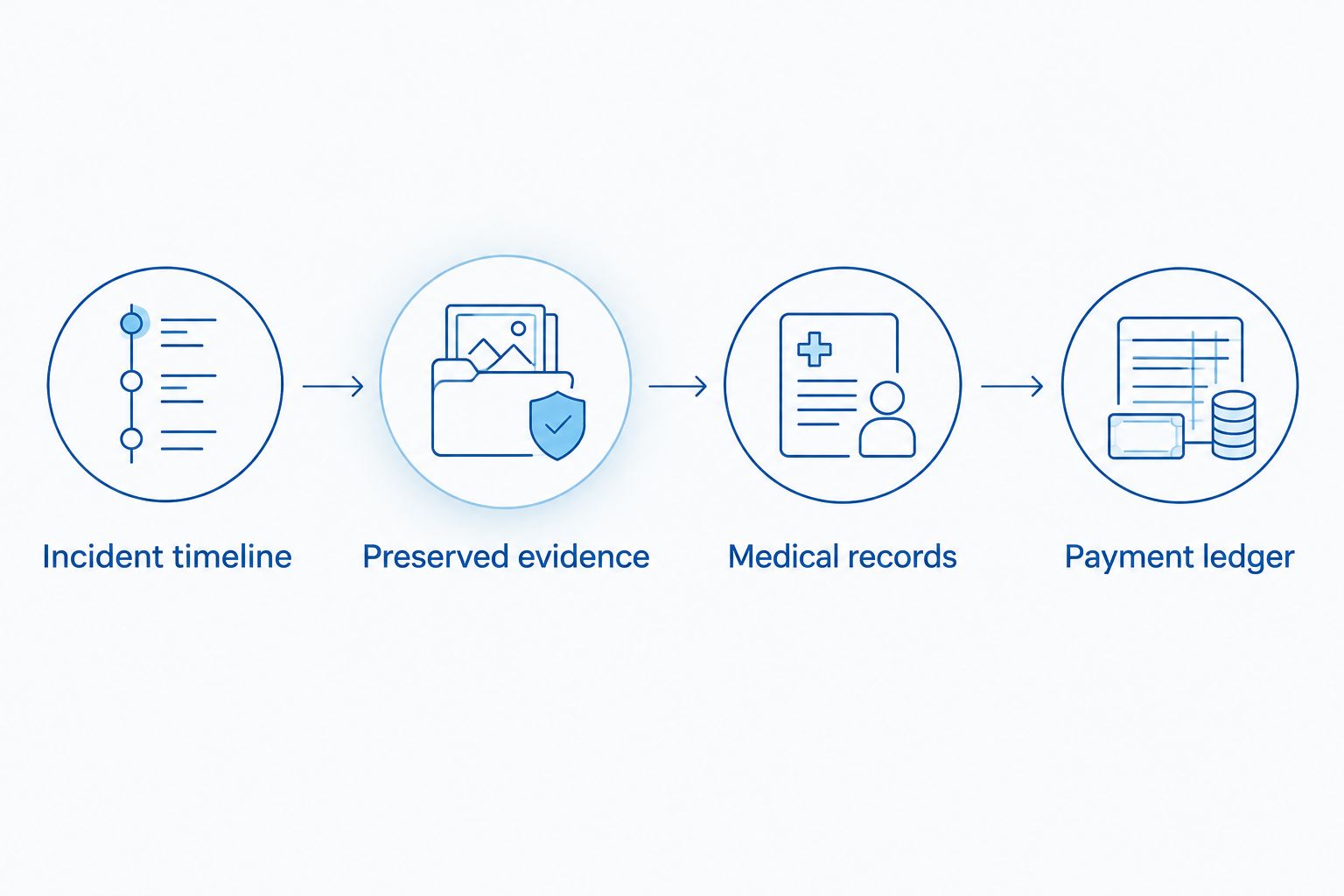
Use one master evidence file for your 2026 injury, with separate folders for incident evidence, medical records, work loss, and compensation payments. Preserve original files and send copies rather than editing the originals.
- Write a factual incident timeline. Include your work assignment, location, equipment involved, sequence of events, immediate symptoms, and names of people present. Mark uncertain details as uncertain rather than filling gaps from memory.
- Preserve evidence controlled by others. Tell counsel about surveillance footage, vehicle recordings, equipment, maintenance records, and witness information. A preservation request asks the recipient to retain relevant material; it does not compel immediate production.
- Collect medical documentation. Keep visit summaries, diagnoses, referrals, work restrictions, and treatment recommendations. Give providers an accurate injury history and report relevant prior conditions rather than hiding them.
- Document work loss. Save wage statements, missed-work dates, modified-duty offers, and communications about restrictions. Separate lost earnings from compensation benefits already paid.
- Request a compensation payment ledger. Ask the administrator for an itemized record of medical and indemnity payments. Update it as payments continue; an early total is not necessarily the final reimbursement claim.
Expected result: Both legal teams can trace the same accident, treatment history, and employment losses without relying on conflicting summaries.
The evidence sequence is straightforward: Incident timeline, Preserved evidence, Medical records, and Payment ledger. The ledger belongs beside the medical records because payments affect settlement accounting, not just claim administration.
Keep legal advice in a separate folder from material you intend to send to insurers. Ask your attorney before forwarding attorney emails or uploading them to a shared claim portal.
Liability assessment and coordinated demand
A third-party lawsuit needs more than proof that you were hurt at work. Your attorney must identify a legally responsible defendant, establish the applicable liability theory, and connect that conduct or product defect to your injuries.
- Map the defendant to the evidence. Match each proposed defendant with supporting records, witnesses, or physical evidence. For example, investigate who operated and maintained equipment rather than assuming its owner controlled every relevant decision.
- Separate the damage categories. Identify treatment expenses, earnings losses, future losses supported by evidence, and noneconomic harm. Do not present every medical bill as an unpaid personal expense when compensation already paid it.
- Notify the compensation side as required. California Labor Code section 3852 preserves third-party claims, while related provisions govern notice, participation, reimbursement, and settlement. Have counsel address these requirements before negotiating a final release.
- Prepare a supported demand. Organize liability evidence, injury records, wage support, and the settlement request. The medical-records-to-injury-demand-letter workflow explains how records support that package.
- Review the proposed settlement distribution. Ask counsel to identify attorney fees, litigation expenses, asserted reimbursement, other applicable liens, and any future compensation credit. Distinguish confirmed figures from unresolved claims.
Expected result: Your demand connects responsibility to documented losses, and you understand the reimbursement questions before accepting a settlement.
Best for legal coordination: Have the attorneys handling the respective claims communicate directly about deadlines, evidence, and settlement terms. Coordination helps avoid contradictory positions, but it does not merge the claims or replace separate representation agreements.
Civil filing and settlement review
If negotiations do not resolve the third-party claim, the next step is a civil lawsuit when supported by the facts and law. A 2026 demand letter does not extend a filing deadline by itself.
- Confirm the filing decision before the deadline. Ask counsel whether settlement discussions leave enough time to prepare and file the complaint. Do not assume an adjuster will warn you when time is running out.
- File and serve the civil case properly. Counsel identifies defendants, states supported claims, and arranges service. Filing a compensation claim does not accomplish these civil litigation steps.
- Keep treatment and discovery responses consistent. Answer written questions, provide requested records through counsel, and prepare for testimony. Correct genuine mistakes promptly instead of trying to make an earlier inaccurate statement fit later evidence.
- Resolve reimbursement and release issues. California Labor Code sections 3856, 3860, and 3861 address aspects of recovery distribution, reimbursement, and credits. Notice and consent requirements depend on the settlement structure; have counsel determine what applies before signing.
- Review the closing documents. Request a written settlement breakdown, identify unresolved claims, and confirm which parties and claims the release covers. Keep copies of the signed release and disbursement statement.
Expected result: The civil claim is either preserved through proper litigation or resolved with documented settlement terms and an understood distribution.
Khachikyanlawfirm provides personal injury representation. Before engaging the firm for a third-party case, confirm the scope of representation and how communication with your workers’ compensation attorney will work.
Discuss your personal injury claim
Ask about third-party liability and the scope of personal injury representation.
When new evidence identifies an outside party
Sometimes the compensation claim starts before you learn who maintained the equipment or owned the vehicle involved. Reassess third-party liability when new evidence identifies another responsible party; do not assume discovery automatically restarts a deadline.
- Send counsel the new record and explain when and how you received it.
- Ask whether it changes the defendant list, liability theory, or preservation requests.
- Recheck filing deadlines immediately, including government-claim requirements.
- Update the shared evidence file without changing the original accident account to fit the new information.
The same approach applies when a third-party claim already exists and additional surgery, work restrictions, or compensation payments change the damages picture. Update the supporting records and reimbursement analysis before settlement.
Troubleshooting
The employer says the accident was someone else’s fault
An outside party’s fault does not by itself eliminate workers’ compensation eligibility. Continue the compensation process and investigate the separate liability claim; do not accept a verbal instruction to pursue only the outside insurer.
The third-party insurer wants a recorded statement
Do not improvise a detailed liability statement while you are uncertain about the facts. Ask your attorney to address the request, its purpose, and any applicable obligations; different duties apply to different insurance relationships.
The compensation reimbursement claim keeps changing
Request an updated itemized ledger and have counsel review the asserted amount and its legal basis. Continuing treatment and benefit payments can change the accounting, so a past balance should not be treated as final.
The civil settlement release mentions other claims
Stop and obtain legal review before signing. Broad release language can affect rights beyond the payment you are considering, and the compensation consequences need separate attention.
Someone proposes waiting until treatment ends
Separate medical evaluation from deadline protection. Counsel can preserve a supported civil case before treatment concludes; waiting for a final prognosis does not excuse missing a filing deadline.
Customize your workflow
Assign an owner to each task: you maintain records, the compensation representative addresses benefits, and the personal injury attorney evaluates the outside party’s liability. Confirm those assignments in writing so a request does not sit unanswered between separate teams.
For your 2026 review, ask each representative what remains unresolved, what event triggers the next action, and which deadline controls it. Update the file after a new diagnosis, modified-duty offer, benefit decision, or settlement proposal.
Judge progress by completed actions, not the number of insurer calls. A preserved recording, filed complaint, or reviewed reimbursement ledger moves the case forward; repeated status requests do not replace those tasks.
FAQ
Can I have workers’ compensation and a third-party injury lawsuit in California?
Yes, when a qualifying work injury also involves a legally responsible third party. California Labor Code section 3852 preserves the employee’s third-party claim, but reimbursement and credit rules can affect the recovery.
Do I have to finish workers’ compensation before suing the other driver?
No, you do not have to finish the compensation claim before pursuing a supported claim against an outside driver. The civil deadline runs separately, so waiting can put that claim at risk.
Can I sue my employer instead of filing workers’ compensation?
Generally, workers’ compensation exclusivity limits injury lawsuits against your employer. Exceptions exist, but employer negligence alone does not establish an exception; have counsel evaluate the specific facts.
How long do I have to file a California third-party injury lawsuit?
California’s general personal injury filing period is 2 years under Code of Civil Procedure section 335.1. Public-entity claims generally require an administrative claim within 6 months, and exceptions or different rules can change the analysis.
Will workers’ compensation take money from my injury settlement?
The employer or compensation insurer can assert reimbursement rights against a third-party recovery. The amount and any future benefit credit require legal review; do not assume either that repayment is automatic in full or that it disappears.
Can I recover pain and suffering through workers’ compensation?
Workers’ compensation does not provide pain-and-suffering damages. A supported third-party civil claim can include noneconomic damages, subject to the applicable law and proof.
Does Khachikyanlawfirm handle the workers’ compensation case too?
Khachikyanlawfirm provides personal injury and lemon law representation. Confirm directly whether any proposed engagement includes workers’ compensation proceedings rather than assuming both matters are covered.
One last thing
A larger third-party settlement does not automatically mean a larger payment to you. Before agreeing, ask for the proposed net distribution and a separate explanation of any effect on future workers’ compensation benefits.
This guide provides general California legal information, not advice about your specific claim. Your facts, employment relationships, defendants, and deadlines control the next move.