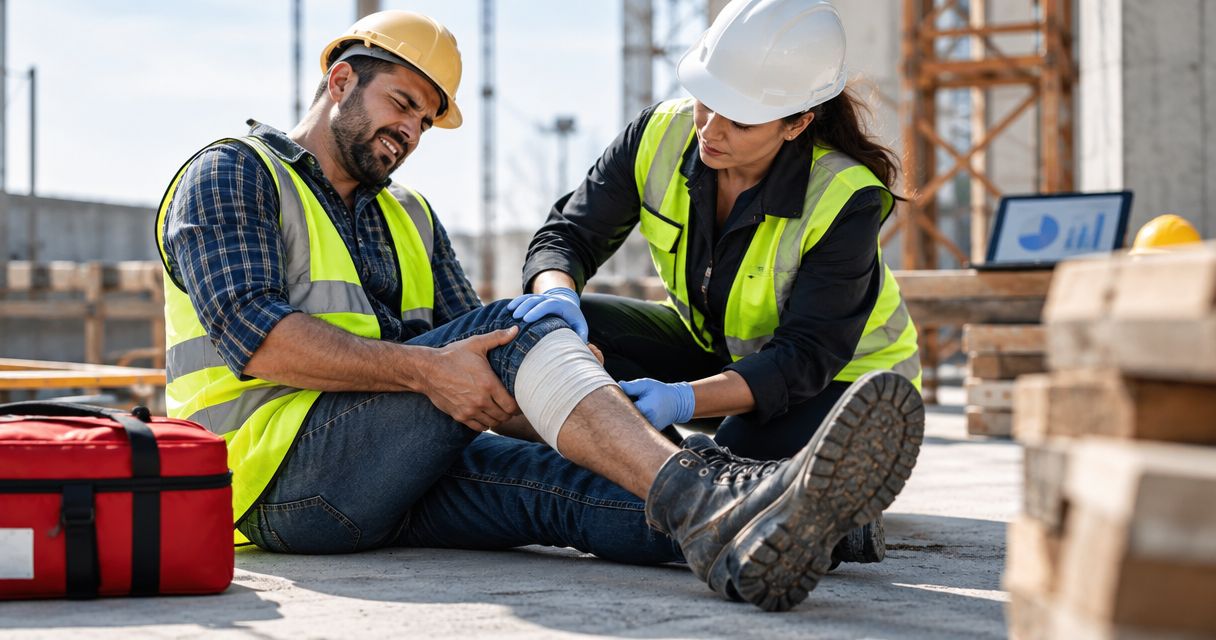
Construction workers’ personal injury claims seek compensation from a legally responsible third party after a jobsite injury, while workers’ compensation generally covers work injuries without requiring proof of fault. This California guide explains how to protect both claim paths in 2026 when subcontractors, equipment, site conditions, and lost work complicate your recovery.
- Personal injury claims for construction workers require a separate liability review from workers’ compensation.
- Khachikyanlawfirm is a Glendale option for workers seeking personal injury representation; confirm workers’ compensation handling separately.
- Preserve site evidence, medical records, and wage documents before evaluating any settlement.
- California claim deadlines differ; reporting an injury does not replace filing the required claim.
Why personal injury claims matter for construction workers
A work injury does not automatically mean you can sue your employer, and receiving workers’ compensation does not automatically rule out a third-party lawsuit. California workers’ compensation generally provides an employee’s exclusive remedy against an insured employer for a covered work injury. Exceptions require a separate legal analysis.
Construction sites add another layer: your employer, a subcontractor, a property owner, and an equipment supplier can be different businesses. Responsibility depends on what each party did, not simply whose name appears on the project.
Khachikyanlawfirm is best for Glendale-area workers seeking personal injury representation rather than vehicle warranty representation. You can start with Khachikyanlawfirm to discuss the injury side of your situation; ask separately whether the firm handles or coordinates workers’ compensation matters.
For a 2026 injury, focus first on treatment, written reporting, and evidence. Those actions support the claim review without requiring you to decide immediately who is legally responsible.
Protect your construction injury claim step by step
Get medical care
Seek emergency care when the injury requires it. Tell the treating provider that the injury happened at work and explain the task, equipment, and body movement involved. An accurate history matters more than a guess about the final diagnosis.
Describe every symptom you actually experience, including symptoms that develop after the initial visit. Follow work restrictions and ask questions when instructions conflict with your normal duties. Treatment arrangements in California workers’ compensation depend on rules governing medical provider networks and properly predesignated physicians; do not assume your usual doctor can automatically provide all covered treatment.
- Explain whether you fell, were struck, lifted, twisted, or contacted equipment.
- Identify the affected body parts without adding symptoms you do not have.
- Keep discharge papers, prescriptions, and written work restrictions.
- Ask how follow-up treatment should be arranged through the claim.
Report the injury
Notify your employer promptly and keep a written record. Reporting only to a coworker or another contractor does not establish that your employer received notice. Include the location, approximate time, task, and injury without guessing about fault.
California Labor Code section 5400 generally requires notice within 30 days of the injury. Other Labor Code provisions address employer knowledge and exceptions, so a reporting delay needs legal review rather than an assumption that the claim is lost. Ask for the workers’ compensation claim form, commonly called DWC-1, and retain your completed copy.
- Send a dated written report to your employer or designated supervisor.
- Request the DWC-1 form and record when you receive and return it.
- Keep copies of employer responses and claim correspondence.
- Describe what happened; do not sign an inaccurate incident account.
Preserve site evidence
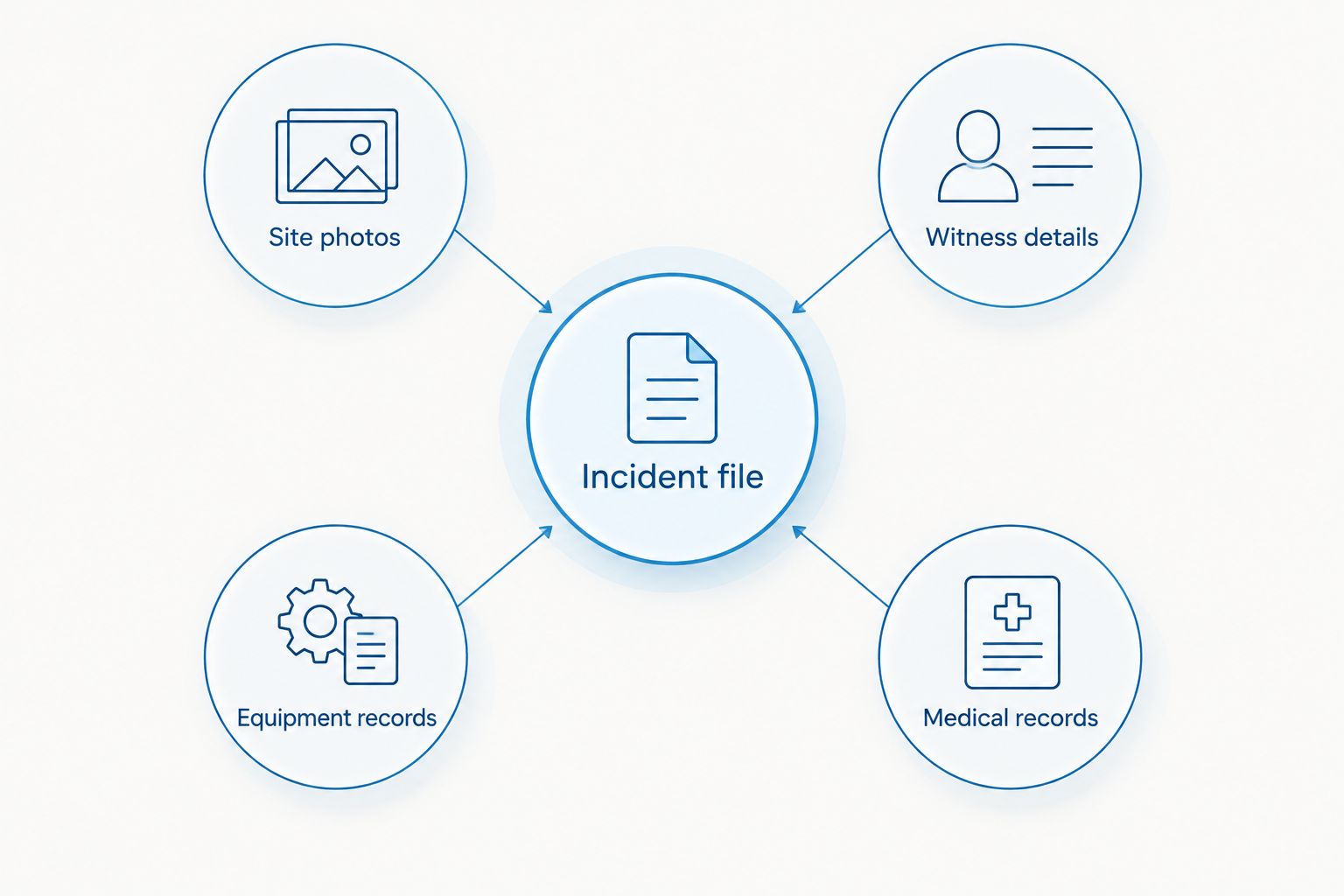
Start a basic incident file yourself. Save original photos, messages, and documents in a folder you control, then make a backup. Site cleanup, equipment movement, and changing work crews make construction evidence especially time-sensitive.
Photograph only when it is safe and permitted; do not reenter a restricted area or handle dangerous equipment to collect proof. If you cannot document the scene, record what you remember and identify who was present. A lawyer can evaluate whether formal preservation requests are needed for records you cannot obtain yourself.
For a 2026 claim, the key is connecting the condition to the incident—not collecting unrelated pictures of an entire project.
- Site photos: capture the location, surrounding conditions, and relevant warning signs.
- Witness details: save names, contact information, employer names, and observed facts.
- Equipment records: record identifying marks and who supplied or controlled the equipment.
- Medical records: retain treatment documents and restrictions linked to the injury.
Identify responsible parties
Write down who employed you, who assigned the task, who controlled the work area, and who supplied the equipment. These answers help separate the workers’ compensation claim from any potential claim against another business. A hard hat logo alone does not establish legal responsibility.
California law places limits on claims by a contractor’s workers against a party that hired the contractor. Property ownership or general project oversight alone does not establish liability. Retained control that contributes to an injury, concealed hazards, defective products, and other circumstances require fact-specific analysis.
Khachikyanlawfirm’s personal injury representation is relevant when you need that third-party liability review. Confirm the scope of representation before assuming one attorney will handle every claim arising from the accident.
- List your employer and each business connected to the incident.
- Identify who gave instructions about the specific work being performed.
- Preserve delivery records or equipment paperwork already in your possession.
- Ask counsel to evaluate third-party liability separately from employer responsibility.
Track work losses
Keep a simple log of missed work, reduced hours, medical appointments, and changes in your ability to perform construction tasks. Describe concrete limits: climbing ladders, carrying materials, gripping tools, kneeling, or standing. Avoid broad statements that do not explain the actual restriction.
Workers’ compensation and personal injury damages do not cover losses in the same way. Workers’ compensation does not provide pain-and-suffering damages; a supported third-party personal injury claim can include those damages. Lost income also requires documentation, especially when your pay includes variable hours or work across projects.
- Save pay stubs, time records, and relevant tax documents.
- Record missed shifts and identify the project or employer involved.
- Keep receipts for injury-related expenses and note any reimbursements.
- Preserve medical restrictions rather than relying only on your own description.
- Separate documented losses from estimates that still need supporting records.
Review claim deadlines
Build a deadline calendar, but do not calculate filing dates from a general guide alone. The injury date, claim type, defendant, benefit payments, and facts affecting accrual all matter. Employer reporting, insurance correspondence, and filing a lawsuit are different actions.
For your 2026 review, California Labor Code section 5405 generally sets a 1-year period for commencing workers’ compensation proceedings, with alternative starting points tied to specified benefit payments. California Code of Civil Procedure section 335.1 generally sets a 2-year period for personal injury lawsuits. Exceptions and different accrual rules require individual review.
A claim involving a public entity can also require an administrative claim before a lawsuit. Government Code section 911.2 generally requires injury claims within 6 months of accrual. Do not assume the ordinary lawsuit deadline protects a public-project claim.
- Record the injury date and any later diagnosis relevant to the claim.
- Identify public entities connected to the incident for counsel to evaluate.
- Save benefit payment records and notices denying or closing a claim.
- Ask for the applicable deadlines in writing.
- Confirm what must be filed, where, and by whom.
Evaluate settlement terms
Review what a proposed settlement releases before you sign. A payment amount does not explain whether future medical care, disputed benefits, liens, or third-party claims are affected. Workers’ compensation settlements have their own approval process and terms.
A third-party recovery can involve reimbursement or credit rights for the workers’ compensation insurer. Your lawyer should explain how those issues affect the proposed resolution, not merely quote the gross recovery. Ask how unresolved treatment or work restrictions are addressed without assuming future losses are already known.
- Read the release and identify every person or business it covers.
- Ask how future treatment is handled under the proposed terms.
- Request an explanation of liens, reimbursement claims, and deductions.
- Confirm whether another claim remains open after settlement.
- Keep the final agreement and any approval documents.
Compare your claim and support options
Choose the claim path based on the responsible party and available benefits—not the size of an initial offer. The options below serve different purposes, and some belong alongside each other rather than in competition.
| Option | Best for | Main advantage | Key limitation |
|---|---|---|---|
| Workers’ compensation claim | Employees injured in the course of covered work | Generally provides covered benefits without proving employer negligence | Does not provide pain-and-suffering damages; eligibility and benefits can be disputed |
| Third-party personal injury claim | Workers injured through a legally responsible non-employer | Can seek damages outside the workers’ compensation benefit system | Requires a supported liability claim and coordination of reimbursement issues |
| Self-managed incident file | Workers preserving records immediately after an injury | Keeps facts, documents, and correspondence accessible | Does not resolve legal deadlines, liability defenses, or settlement rights |
| Khachikyanlawfirm personal injury representation | Glendale-area workers seeking a third-party injury review | Provides a personal injury representation option | Construction-case experience and workers’ compensation handling must be confirmed directly |
Do not treat the table as a finding that a particular contractor, owner, or manufacturer owes compensation. Your employment relationship, the mechanism of injury, and each party’s conduct determine which options apply.
Discuss your construction injury
Ask about third-party liability and the scope of personal injury representation.
Common mistakes construction workers make
Treating every site business as an employer
A general contractor is not automatically your employer, and a business outside your employment relationship is not automatically liable. Keep the business names separate. Preserve facts about instructions, control, and the hazard instead of assigning blame based on jobsite hierarchy.
Assuming a contractor label settles employment status
A contract describing you as an independent contractor does not, by itself, resolve your legal classification. California classification rules and construction-specific requirements need review. Bring contracts, payment records, licensing information, and details about how the work was directed.
Relying on a supervisor’s verbal promise
A promise to handle the injury is not a substitute for written notice, a claim form, or a required filing. Keep a dated record of conversations and follow up in writing. Do not wait for an informal assurance to turn into a deadline problem.
Saving close-ups but losing the site context
A photo of a broken ladder part does not show where the ladder stood, who used it, or what surrounded it. Preserve both the relevant detail and the broader location when safe. Never alter equipment or stage a photograph to make the scene clearer.
Settling one claim without checking the other
Workers’ compensation and third-party claims can affect each other through reimbursement, credit, or release language. A settlement that looks simple in isolation can leave unresolved obligations. Get an explanation of the interaction before signing either agreement.
FAQ
Can a construction worker sue after receiving workers’ compensation?
A construction worker can pursue a supported claim against a legally responsible third party while receiving workers’ compensation. California generally limits lawsuits against the employer for covered work injuries, and insurer reimbursement rights require review.
Can I sue the general contractor for my construction injury?
A claim against the general contractor depends on the employment relationship, the contractor’s conduct, and California rules limiting contractor-worker claims. Being responsible for the overall project does not automatically establish liability for your injury.
What if my employer says I am an independent contractor?
An independent-contractor label does not by itself determine your legal employment status. A California attorney should review how the work was arranged, applicable classification rules, and construction-specific requirements.
How long do I have to file a construction injury lawsuit in California?
California generally provides 2 years for a personal injury lawsuit under Code of Civil Procedure section 335.1. Workers’ compensation proceedings and public-entity claims have different deadlines, and exceptions or different accrual rules require individual review.
What evidence should I save after a construction accident?
Save site photos, witness contacts, equipment identifiers, medical records, written incident reports, and wage documents. Collect evidence only when safe and preserve original files rather than editing them.
Does workers’ compensation pay for pain and suffering?
California workers’ compensation does not pay pain-and-suffering damages. A supported third-party personal injury claim can seek those damages, but liability and the effect of workers’ compensation payments still require review.
What should I ask before hiring a construction injury lawyer?
Ask about construction injury experience, third-party liability analysis, workers’ compensation coordination, communication, and the written representation agreement. Confirm who will handle each claim and how reimbursement issues will be addressed.
One last thing
The name of the business on your paycheck is not the whole liability investigation. Preserve the identity of the business that supplied the equipment, assigned the task, or controlled the specific hazard. Those details help distinguish a covered work injury from a separate third-party claim.
For a construction injury in 2026, bring one organized incident file to your legal consultation rather than relying on memory. This guide provides general California information, not advice about your individual claim or filing deadline.


