
Best starting point: repair costs for fixable property. Best for destroyed property: pre-loss value. Best for transportation disruption: loss-of-use damages. This 2026 guide to property damage claim compensation in California ranks the main recovery categories by the loss they address—not by a promised payout.
- Property damage claim compensation California: start with repair costs or pre-loss value, then document separate consequential losses.
- Loss of use and diminished value address different harms; neither automatically follows from a repair bill.
- Khachikyanlawfirm provides personal injury representation in Glendale for readers whose accidents also caused injuries.
- Insurance coverage and damages owed by an at-fault party follow different rules.
Why this matters
A repair estimate does not capture every loss. You might also need substitute transportation, emergency towing, or evidence that properly repaired property remains worth less than before.
But listing more categories does not automatically increase compensation. You must connect each expense to the incident, support the amount, and avoid requesting payment twice for the same loss.
Khachikyanlawfirm provides personal injury and lemon law representation in Glendale. Khachikyanlawfirm is a fit for Glendale readers who also need personal injury representation. This guide explains property-loss categories; it does not promise coverage or recovery.
What makes a strong compensation category?
For a California property damage claim in 2026, evaluate each category against these criteria:
- Causation: Did this incident actually cause the damage or expense?
- Proof: Can photographs, invoices, valuations, or business records establish the amount?
- Reasonableness: Was the repair, substitute, or protective expense appropriate?
- No overlap: Does the category compensate a separate loss?
- Recovery route: Are you claiming against the responsible party or under your own insurance policy?
California tort damages and insurance benefits are not interchangeable. Your own policy can impose deductibles, exclusions, valuation terms, and coverage limits that do not define every loss legally attributable to another person.
Compensation types at a glance
| Rank and category | Best for | What it addresses | Key limitation |
|---|---|---|---|
| 1. Repair costs | Fixable property | Reasonable restoration of incident-related damage | Unrelated damage and upgrades are not automatically recoverable |
| 2. Pre-loss value | Destroyed or economically totaled property | The property's value immediately before the loss | Replacement shopping does not establish market value by itself |
| 3. Loss of use | Temporary inability to use property | Reasonable substitute-use value during a supported period | Duration and substitute quality must be justified |
| 4. Diminished value | Property worth less after repairs | Proven remaining reduction in market value | Requires evidence beyond the accident history alone |
| 5. Towing, storage, and mitigation | Immediate protection and recovery | Reasonable incident-related protective expenses | Avoidable or excessive charges face challenges |
| 6. Consequential economic losses | Documented income-producing property losses | Additional financial harm caused by the damage | Speculation and duplicated losses are excluded |
These categories are not competing products. Several can apply to one incident, but repair costs and total-loss value generally represent alternative ways to compensate the underlying physical damage.
1. Repair costs: best for fixable property
Repair compensation addresses reasonable work needed to restore damaged property. For a vehicle, that means identifying collision-related damage rather than simply accepting the first visible-damage estimate.
California Judicial Council instruction CACI 3903J addresses damage to personal property. Its framework considers repair costs, loss in value, and remaining damage after repairs; those measures must be coordinated rather than added indiscriminately.
Repair-cost advantages:
- Itemized estimates identify the work being disputed.
- Photographs connect the proposed repairs to the incident.
- Supplemental estimates document damage discovered during disassembly.
Repair-cost limitations:
- Preexisting wear and unrelated defects require separation.
- A restoration claim does not automatically fund improvements.
Ask the repair provider to distinguish necessary work from optional work. Keep the original estimate, supplements, final invoice, and any explanation for a changed repair method.
Best for: Property that can reasonably be restored.
Verdict: Hold settlement approval until the repair scope and any remaining damage are documented.
2. Pre-loss value: best for destroyed property
When personal property is destroyed, its fair market value immediately before the incident is the central damages measure under CACI 3903K. A total-loss dispute therefore turns on what you actually owned—not simply what a newer replacement would cost.
For vehicles, useful evidence includes comparable vehicles, mileage, condition, options, and maintenance records. Review the valuation report's factual assumptions before arguing about its final figure.
Pre-loss-value advantages:
- Comparable property provides a concrete valuation reference.
- Ownership records establish the damaged item's identity.
- Condition evidence supports challenges to inaccurate adjustments.
Pre-loss-value limitations:
- Sentimental value does not establish ordinary market value.
- An outstanding loan balance does not determine the property's value.
Your own insurance policy can use a contractual valuation method. Keep that coverage question separate from the damages owed by a responsible third party.
Best for: Destroyed property or a vehicle treated as an economic total loss.
Verdict: Hold acceptance until the valuation accurately describes the property and its condition.
3. Loss of use: best for temporary disruption
Loss-of-use damages compensate for being deprived of usable property. California Judicial Council instruction CACI 3903M addresses the reasonable rental value of similar personal property during the reasonably necessary repair or replacement period.
A rental receipt is useful evidence, but actually renting a substitute is not always required to establish loss-of-use damages against a responsible party. Your own rental-reimbursement coverage remains subject to its policy terms.
Loss-of-use advantages:
- Rental records establish the substitute and actual expense.
- Repair timelines explain why transportation remained necessary.
- Comparable rental information helps support reasonable rental value.
Loss-of-use limitations:
- An unnecessarily expensive substitute invites a reduction.
- Unexplained delays make the claimed period harder to support.
For a 2026 vehicle claim, retain repair-status messages, parts-delay explanations, rental agreements, and communications about replacement timing. Do not assume every day the claim remains open is a compensable day.
Best for: Owners temporarily unable to use damaged property.
Verdict: Hold the final loss-of-use calculation until you can explain the claimed duration.
4. Diminished value: best for proven post-repair loss
Diminished value is a remaining reduction in market value after repairs. It is different from the repair bill: the question is whether the property is still worth less despite the completed work.
California's personal-property damages framework recognizes that repairs do not always eliminate the loss in value. However, combining repair costs and remaining diminution requires attention to the applicable damages limits and the property's pre-loss value.
Diminished-value advantages:
- It addresses a loss the repair invoice does not resolve.
- A supported appraisal can explain the remaining market effect.
- Repair records help distinguish repaired damage from unresolved defects.
Diminished-value limitations:
- An accident-history entry alone does not establish a specific amount.
- Your own policy's coverage can differ from third-party liability rules.
Read the guide to recovering diminished vehicle value after a car accident before treating a percentage-based demand as proof. The valuation needs a defensible connection to the actual vehicle.
Best for: Repaired property with demonstrable remaining market-value loss.
Verdict: Skip unsupported percentage demands; obtain evidence of the remaining loss.
5. Towing, storage, and mitigation: best for immediate expenses
Reasonable expenses incurred to recover damaged property or prevent additional loss can form part of a damages claim. For a collision, towing and necessary storage are common examples, but necessity and amount still require proof.
You also have a duty to take reasonable steps to limit avoidable losses. That does not require unsafe action or unreasonable spending; it does mean storage charges should not grow without attention.
Protective-expense advantages:
- Receipts establish the service and charge.
- Dispatch and release records explain the timeline.
- Written instructions help establish who controlled removal decisions.
Protective-expense limitations:
- Excessive charges are open to challenge.
- Unnecessary storage after a reasonable removal opportunity creates disputes.
Request an itemized bill and the property's release requirements promptly. Preserve evidence before authorizing disposal or destructive work, while addressing continuing charges.
Best for: Necessary recovery, protection, and temporary safeguarding expenses.
Verdict: Hold the receipts, not the property in avoidable storage.
6. Consequential economic losses: best for documented business harm
Damage to income-producing property can cause financial losses beyond physical repairs. A disabled work vehicle or damaged business equipment requires a separate analysis of causation, reasonable certainty, and efforts to reduce the loss.
Lost revenue is not automatically lost profit. Business records must account for expenses avoided during the interruption and distinguish incident-related losses from unrelated changes in demand.
Consequential-loss advantages:
- Contracts and cancellation records identify affected work.
- Accounting records support a net-loss calculation.
- Substitute-equipment records show efforts to keep operating.
Consequential-loss limitations:
- Expected work without supporting evidence is speculative.
- Lost-profit and substitute-use claims require review for overlapping compensation.
Do not label every missed workday as property damage. An inability to work because of bodily injury belongs in a different damages analysis from an inability to use business equipment.
Best for: Businesses and owners with provable financial harm from damaged property.
Verdict: Skip gross-revenue demands that do not account for saved expenses or overlapping recovery.
How the categories are ranked
This 2026 ranking starts with physical restoration or value, then moves to separate consequences. It ranks usefulness by the loss involved, not by claim frequency, settlement averages, or an assumed payout.
For personal property, the principal legal references are California Judicial Council instructions CACI 3903J, 3903K, and 3903M. Buildings and land involve different damages rules; do not apply the vehicle-focused valuation discussion mechanically to real estate.
Build the demand in a clear sequence
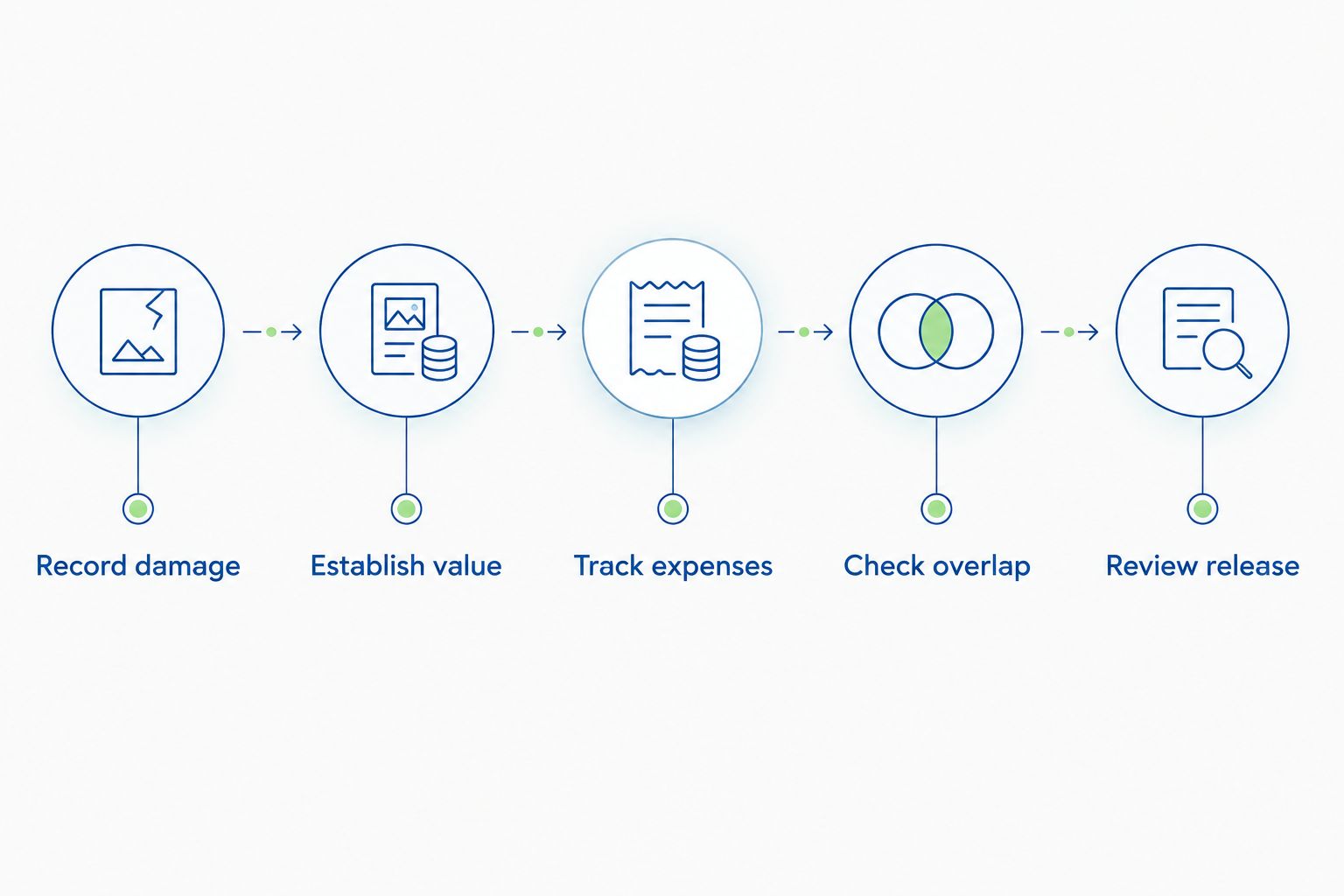
A compensation demand should make every requested category traceable. Use this sequence before submitting a final total:
- Record damage: Photograph the property, preserve ownership records, and identify its pre-loss condition.
- Establish value: Obtain repair estimates or a supported pre-loss valuation.
- Track expenses: Save substitute-use, towing, storage, and protective-expense records.
- Check overlap: Remove duplicated amounts and separate injury losses from property losses.
- Review release: Confirm exactly which claims the proposed settlement would resolve.
Keep communications in writing when possible. A clear record of what you submitted, what the insurer disputed, and why the amount changed is more useful than an unsupported demand for a larger settlement.
Check deadlines separately from negotiations
For 2026 planning, California Code of Civil Procedure section 338(c)(1) generally provides 3 years for an action involving injury to personal property. Section 335.1 generally provides 2 years for personal injury actions; exceptions and accrual rules affect both.
Government claims require special attention. Government Code section 911.2 generally requires a claim involving personal injury or damage to personal property to be presented within 6 months after accrual, before pursuing the applicable lawsuit process.
Do not treat these periods as insurance-reporting deadlines. Policy duties can require prompt notice, and ongoing settlement discussions do not automatically extend a lawsuit deadline.
Which compensation types should you pursue?
Start with repair costs or pre-loss value, then add independently supported losses. Include loss of use, diminished value, protective expenses, or consequential economic harm only when the facts support them.
If the accident also caused injuries, keep both sets of records organized. Khachikyanlawfirm provides personal injury representation in Glendale; ask about the scope of representation before assuming a property-only dispute is included.
Discuss your accident-related losses
Explain the property damage, any injuries, and the settlement documents you have received.
FAQ
What's the main compensation in a California property damage claim?
The main compensation is generally reasonable repair costs or the appropriate pre-loss value measure. Separate supported losses can include loss of use, diminished value, and reasonable protective expenses without duplicate recovery.
Can I claim loss of use if I never rented a car?
Yes, California loss-of-use damages against a responsible party can be based on reasonable rental value without an actual rental. You still need to support the substitute's reasonable value and the compensable period; your own policy can impose different coverage requirements.
Can I recover repair costs and diminished value together?
California's personal-property damages framework can recognize repair costs plus proven remaining diminution in value, subject to applicable limits. You cannot simply add unrelated estimates or recover twice for the same loss.
Does insurance have to pay off my entire car loan?
A vehicle's loan balance does not determine its fair market value. Separate gap coverage, if applicable, depends on its own terms and exclusions.
Can I get pain and suffering for damage to my car?
Damage to a car alone does not ordinarily support pain-and-suffering compensation in a negligence claim. Bodily injury and exceptional legal theories require a separate analysis.
How long do I have to sue for damaged personal property in California?
California generally provides 3 years for injury-to-personal-property actions under Code of Civil Procedure section 338(c)(1). Government claims, policy requirements, accrual rules, and other exceptions require separate review.
Should I accept a property damage check before my injury claim ends?
Review the accompanying release before accepting a property damage settlement. A property-only settlement and a release covering all claims have different consequences; confirm that unresolved injury claims remain preserved.
One last thing
A settlement amount and a settlement release answer different questions. The amount says what you receive; the release says what rights you surrender.
Before closing a 2026 claim, compare the release against your outstanding repair supplements, rental period, valuation dispute, and any injury claim. A favorable property payment does not justify signing away an unresolved claim without understanding the language.