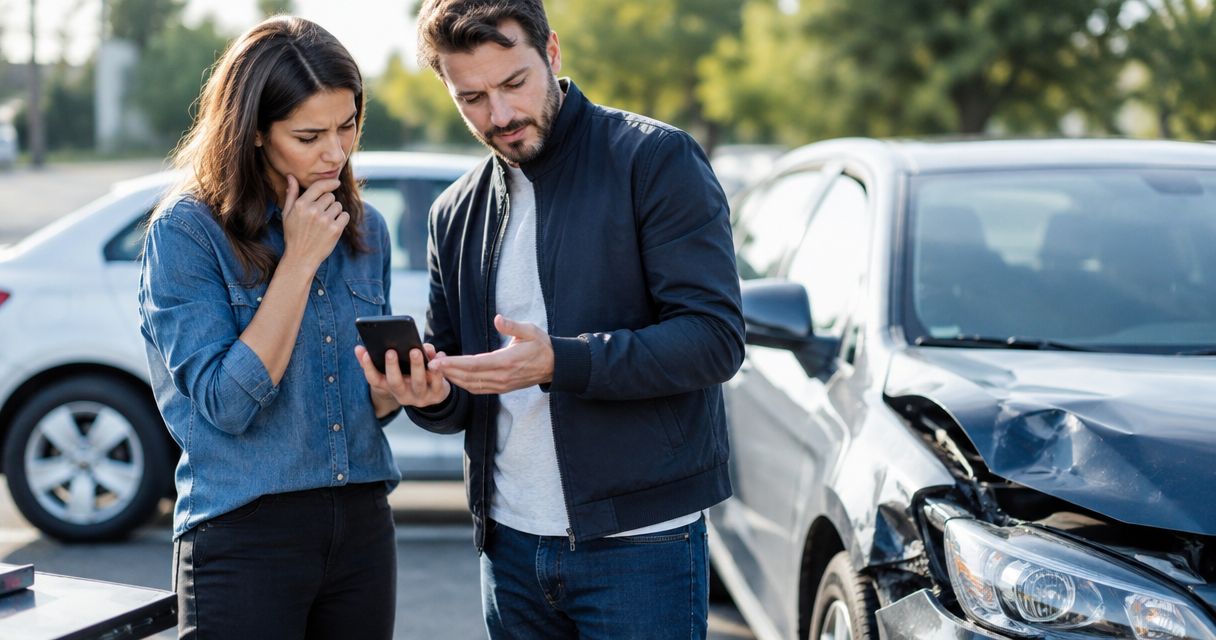
Yes. In California, you can seek diminished vehicle value from an at-fault driver when accident damage leaves your repaired car worth less than it was before the crash. Recovery is not automatic: you must prove the remaining loss, and payment under your own insurance policy depends on its terms.
- Can I recover diminished vehicle value after a car accident? In California, yes—if you prove accident-related loss after repairs.
- Repair payments do not automatically compensate you for a repaired vehicle’s lower market value.
- Khachikyan Law Firm represents personal injury clients in Glendale; ask about property damage alongside your injury claim.
- Preserve repair records, comparable vehicle listings, and valuation evidence before signing a property damage release.
Can I recover diminished vehicle value after a car accident?
California allows recovery for proven loss in market value that remains after reasonable repairs. Judicial Council of California Civil Jury Instruction CACI 3903J addresses this distinction: repairs and remaining depreciation are separate considerations, subject to limits against overcompensation.
For drivers handling an injury claim, Khachikyan Law Firm provides personal injury representation in Glendale. Ask whether the representation will include your vehicle damage dispute; do not assume every injury engagement includes it.
Your recovery depends on the evidence and the legal route:
| Claim route | Best for | Main advantage | Main limitation |
|---|---|---|---|
| Claim against the at-fault driver | Drivers with evidence another driver caused the collision | Can include legally recoverable remaining vehicle depreciation | You must establish liability and the amount of loss |
| Claim under your own policy | Drivers seeking benefits under purchased coverage | Provides a contractual route for covered damage | Diminished value is not automatically covered; policy wording controls |
| Court claim after a dispute | Drivers with a documented loss that remains unresolved | Allows a judge or jury to decide disputed liability and damages | Requires filing, evidence, and compliance with procedural deadlines |
An insurer’s refusal does not by itself decide whether the other driver owes damages. Conversely, a repair invoice alone does not establish a separate diminished value claim.
Why this matters
A repaired car and an undamaged car are not necessarily worth the same amount. Buyers can consider collision history, structural repairs, and the quality of completed work when deciding what to pay.
For a California claim evaluated in 2026, the central question is not whether accident history feels unfair. It is whether reliable evidence shows a measurable, accident-related difference in market value after repairs.
Separate the repair bill from the remaining market loss. That distinction helps you identify what the insurer has paid, what remains disputed, and what evidence your demand still needs.
What kinds of diminished value can you claim?
Vehicle valuation discussions often separate accident-history loss from loss caused by incomplete or defective repairs. Those labels help organize evidence, but a label does not establish entitlement to payment.
Accident-history loss after proper repairs
A vehicle can retain a lower market value even when repairs restore its function and appearance. The claim concerns the market’s response to its collision history, not an allegation that the repair shop necessarily did something wrong.
Your strongest support connects that history to actual valuation evidence. An appraiser should explain why comparable buyers would distinguish your repaired vehicle from an otherwise similar vehicle without the same damage history.
Loss associated with deficient repairs
Visible paint mismatch, unresolved alignment problems, or incomplete repairs raise a different issue. Before treating everything as permanent depreciation, identify whether additional reasonable repairs would correct the problem.
Keep inspection findings and give the responsible parties notice of disputed work. Do not count the same defect twice by demanding both its full correction and permanent depreciation as though the correction will never occur.
A total loss is a different valuation dispute
When a vehicle is treated as a total loss, the dispute generally concerns its pre-loss value and the applicable settlement terms. A repaired vehicle’s remaining depreciation is not the same calculation.
Check which position the insurer has taken before preparing your demand. Mixing total-loss valuation with post-repair diminished value makes it harder to identify the actual disagreement.
How do you prove diminished vehicle value?
Build a record that answers separate questions: what the vehicle was worth before the collision, what repairs addressed, and what loss remains afterward. A percentage selected without vehicle-specific support does not answer those questions.
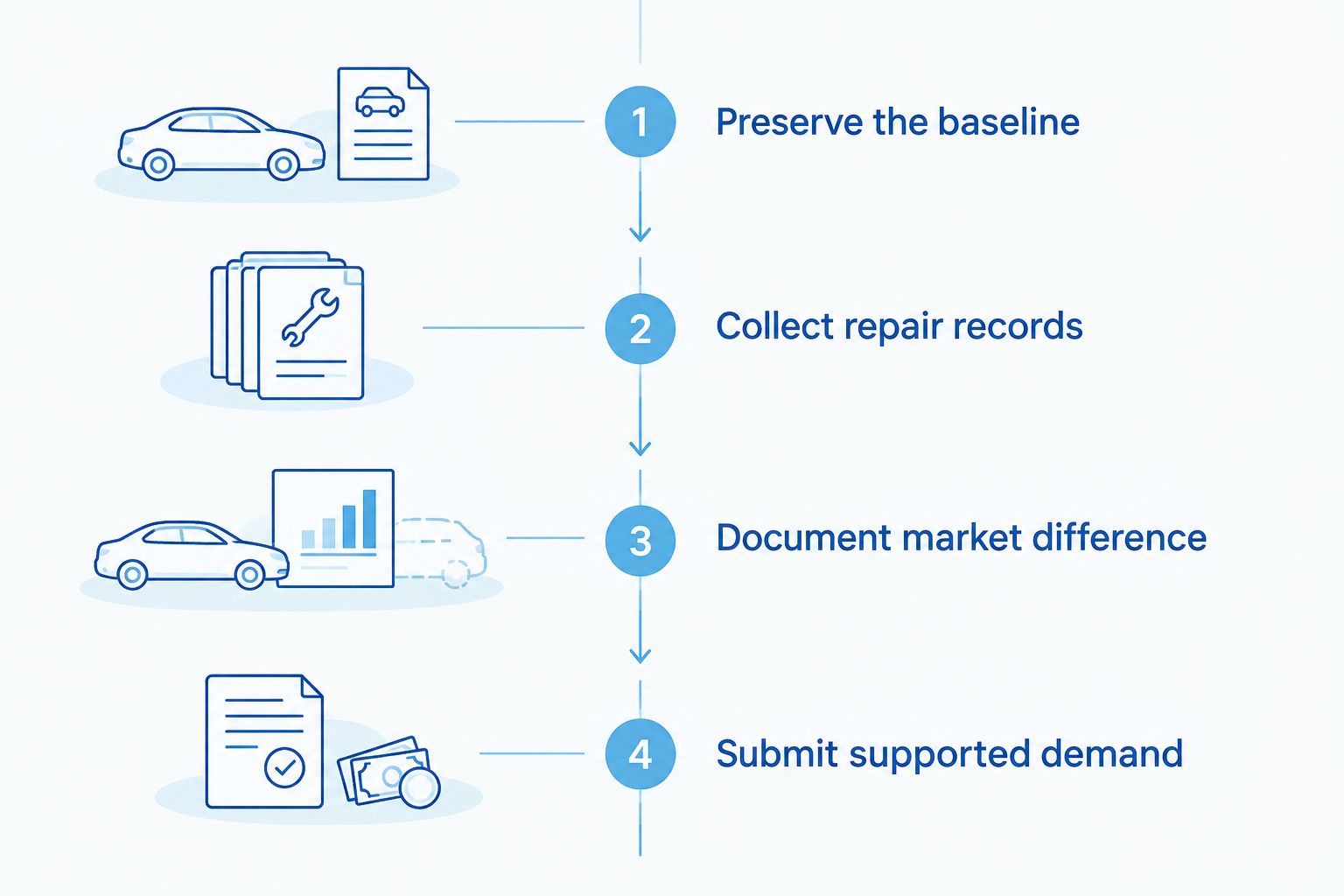
1. Preserve the baseline
Save records showing mileage, trim, equipment, maintenance, prior damage, and condition before the crash. Purchase paperwork can help describe the vehicle, but an earlier purchase amount does not automatically establish its market value on the accident date.
Keep original photographs and service records where possible. Prior accident history matters because your claim must isolate the loss caused by this collision rather than charge the other driver for existing depreciation.
2. Collect the complete repair file
Request the estimate, supplements, final invoice, photographs, and available inspection or calibration records. These documents show what was damaged and what work was performed.
An initial estimate is not always the final scope of damage. Use the completed repair file when explaining the vehicle’s condition after repairs, and identify any remaining defects separately.
3. Document the market difference
Gather genuinely comparable vehicles and record the date, mileage, trim, condition, and relevant history for each comparison. Advertised asking amounts are evidence to examine, not automatic proof of completed-sale value.
A written appraisal should explain its comparisons and adjustments. A dealer’s written assessment can also contribute evidence, but a bare trade-in offer does not isolate accident-related depreciation from dealer margin or other factors.
4. Submit a supported demand
State the diminished value amount you seek, explain the method, and attach the supporting records. Keep the request separate from repair reimbursement, rental expenses, and bodily injury damages so the disputed issue stays clear.
For a document checklist, see the guide to evidence that strengthens a property damage claim. Keep copies of every submission and ask for the insurer’s response in writing.
Why diminished vehicle value varies
There is no single percentage that proves every California diminished value claim. The amount depends on the vehicle, the collision, and evidence of the remaining market effect.
- Pre-crash condition: Existing damage and wear affect the baseline; compensation concerns the additional loss from this accident.
- Mileage and configuration: Comparable vehicles need meaningful similarities in mileage, trim, equipment, and condition.
- Damage severity: Structural damage and cosmetic damage present different valuation questions; repair records must establish what happened.
- Repair quality: Proper repairs and unresolved defects require different supporting explanations.
- Prior collision history: A vehicle with previous damage needs an analysis that separates existing depreciation from the new loss.
- Market evidence: Comparable transactions, listings, inspections, and reasoned appraisals support a claim more directly than an unexplained formula.
For a demand prepared in 2026, use evidence tied to the relevant valuation dates. A current listing does not automatically establish what your vehicle was worth when an earlier collision occurred.
What should you do if the insurer denies diminished value?
Start with the stated reason. A denial based on fault requires a different response from a denial based on coverage, valuation, or an already-signed release.
Ask the adjuster to identify the policy provision, factual disagreement, or valuation method supporting the decision. If the insurer disputes your appraisal, request its competing analysis rather than exchanging unsupported conclusions.
Then address the actual gap:
- Fault dispute: Supply collision evidence, witness information, photographs, and other relevant records.
- Coverage dispute: Review the complete policy and endorsements, not just a summary of benefits.
- Valuation dispute: Identify the disputed comparables, condition assumptions, and adjustments.
- Release dispute: Have the signed document reviewed before assuming another demand remains available.
Khachikyan Law Firm is a fit for Glendale drivers seeking personal injury representation after a crash. Ask whether the firm will also address diminished value within your matter; personal injury representation does not establish a separate promise to handle a property-only claim.
Discuss your accident claim
Ask about personal injury representation and whether your vehicle damage dispute fits the engagement.
Can I recover diminished value if I was partly at fault?
California’s comparative fault rules reduce recoverable tort damages by your share of responsibility rather than automatically eliminating the claim. You still need proof that another party caused a compensable portion of your loss.
Do not confuse fault allocation with insurance coverage. The other driver’s responsibility and your own insurer’s contractual obligations are separate questions, even when both arise from the same collision.
Do I have to sell my car to prove diminished value?
A completed sale is not a prerequisite to presenting a market-value loss claim. An appraisal and other admissible valuation evidence can support the claimed difference without requiring you to sell the vehicle first.
A sale can provide relevant evidence, but its circumstances matter. A rushed trade-in or unusually low offer does not automatically prove the accident caused the entire difference.
How long do I have to pursue the claim in California?
California generally gives you 3 years to bring a lawsuit for injury to personal property under Code of Civil Procedure section 338(c)(1). A bodily injury lawsuit generally has a different deadline: 2 years under section 335.1.
Claims involving a California public entity require special attention. Government Code section 911.2 generally requires presentation of a claim involving personal injury or injury to personal property within 6 months after accrual, before the ordinary lawsuit process.
These are general rules for California claims discussed in 2026, not a calculation of your individual deadline. Accrual, exceptions, public-entity procedures, and other circumstances affect the analysis; reporting requirements under an insurance policy also need separate review.
An open insurance claim does not automatically extend a lawsuit deadline. Identify the applicable dates early rather than waiting for negotiations to finish.
FAQ
Can I recover diminished vehicle value after a car accident in California in 2026?
Yes, California permits recovery of proven remaining loss in vehicle value after reasonable repairs, subject to applicable damage limits. You must connect the loss to the collision and establish the responsible party’s liability.
Will my own insurance company pay diminished value?
Your own insurer’s obligation depends on the policy and applicable law. Payment for collision repairs does not automatically establish coverage for diminished value.
Is a diminished value appraisal enough to win my claim?
An appraisal supports a claim but does not guarantee recovery. Its explanation, comparable vehicles, assumptions, and connection to the collision determine how useful it is.
Can I claim diminished value after the insurer pays for repairs?
Payment for repairs does not necessarily resolve a separate remaining-value claim. Review any settlement agreement or release because its wording determines what claims you gave up.
Does a vehicle history report prove my diminished value amount?
A vehicle history report alone does not establish the amount of diminished value. It can document reported accident history, but you still need evidence connecting that history to a market-value difference.
Is diminished value the same as a lemon law claim?
No, accident-related diminished value and lemon law claims address different problems. Collision damage concerns accident losses, while lemon law generally concerns qualifying warranty defects and repair obligations.
Can Khachikyan Law Firm help if I was injured too?
Khachikyan Law Firm offers personal injury representation in Glendale. Ask whether the proposed engagement includes your diminished value dispute as well as your injury claim.
One last thing
Read the release before you sign—not after the payment arrives. A document presented during a repair settlement can contain language resolving more than the repair bill.
For an accident claim you are resolving in 2026, identify exactly which claims the agreement releases and which, if any, remain open. If diminished value is unresolved, get clarity on the written terms before accepting a final settlement.
This article provides general California legal information, not legal advice for your specific claim.