
Instead of restarting paperwork blindly, map your California small claims case to the correct civil procedure: dismissal and a new filing, a permitted transfer, or an appeal. This 2026 workflow explains which route fits your case and when to seek personal injury or lemon law representation from Khachikyanlawfirm.
- The small claims court to civil lawsuit California workflow depends on whether judgment has already been entered.
- Khachikyanlawfirm handles personal injury and lemon law representation in Glendale; identify your procedural route before refiling.
- A small claims plaintiff generally cannot appeal an unfavorable decision on their own claim.
- Before judgment, review dismissal, limitation periods, and any waiver of damages before starting a separate civil case.
Why this matters
Small claims court is already part of California’s civil court system. Moving to an ordinary civil lawsuit means changing procedures, not simply escalating a complaint to a more powerful court.
The critical distinction is timing. Before judgment, dismissal and refiling sometimes remain available; after judgment, rules against relitigating resolved claims can block another lawsuit over the same dispute.
For 2026 case planning, separate the amount you seek from the procedural route you can actually use. California’s small claims limits generally allow a natural person to seek up to $12,500 and a business or other entity up to $6,250, subject to statutory exceptions. Limited civil cases generally cover amounts up to $35,000; larger monetary claims generally belong in unlimited civil court. These jurisdictional limits come from California Code of Civil Procedure sections 116.220, 116.221, and 85, not from the seriousness of your frustration with the defendant.
Before you start
- Gather your complete court file. Include the filed claim, proof of service, hearing notices, judgment, dismissal paperwork, and the date each notice was mailed or delivered. Add contracts, repair orders, photographs, medical records, and correspondence supporting the underlying dispute.
- Confirm your role and procedural status. Identify whether you are the plaintiff, defendant, or a defendant who filed a separate claim. Check whether a hearing has occurred, whether judgment exists, and whether the other side has a pending claim.
- Check the hidden obstacle: waived damages. Filing within small claims limits can involve giving up an excess amount. Do not assume dismissal, a higher repair estimate, or a later diagnosis automatically restores damages you previously waived.
Do not dismiss first and investigate later. A dismissal can affect your options, and filing the original claim does not establish that a replacement lawsuit will be timely.
Case-status review
- Read the docket. Identify the latest filed document and any scheduled hearing. A pending claim, a dismissal, and an entered judgment require different next steps.
- Identify every claim. Separate your claim from any defendant’s claim. Dismissing your own demand does not necessarily dispose of the opposing party’s demand.
- Match the procedure. Use the table below to distinguish a new lawsuit from a transfer or appeal.
| Procedural route | Best for | Main advantage | Main limitation |
|---|---|---|---|
| Dismissal and new civil filing | A plaintiff with a pending claim who needs ordinary civil procedures | Allows a separately pleaded civil action when legally permitted | Does not erase deadlines, damage waivers, or other defenses |
| Court-ordered transfer | A qualifying situation involving a related defendant’s civil claim | Allows the court to address the related proceedings through statutory procedures | Requires the statutory conditions and a court order |
| Small claims appeal | A party entitled to challenge an adverse small claims judgment | Provides a new hearing on the appealable claim | Is not a general right for plaintiffs dissatisfied with their own claim |
California Code of Civil Procedure section 116.390 addresses qualifying transfer situations involving a defendant’s related claim. A plaintiff cannot obtain a transfer merely by deciding the case deserves more money.
Expected result: You can name your current case status and the specific procedure requiring review. If you cannot, pause before submitting another complaint.
Deadline and damages review
- Build a dated timeline. Record the incident, discovery of harm, repair visits, demands, service, hearing, and judgment notices. Preserve the envelopes accompanying court notices.
- Identify the applicable limitation period. California personal injury claims generally have a 2-year limitation period under Code of Civil Procedure section 335.1. Written-contract claims generally have a 4-year period under section 337. Exceptions and different claim types change that analysis.
- Separate damages from supporting documents. Identify each loss you seek to recover and the evidence supporting it. Do not treat an insurer’s denial, a demand letter, or a repair estimate as a court finding.
- Review prior choices. Check whether your small claims filing waived an excess amount, whether you signed a release, and whether a judgment already resolved the dispute.
A 2026 filing date does not tell you whether a claim is timely. The triggering event, statutory exceptions, and earlier proceedings matter; claims involving public entities also require separate claim-presentation analysis.
For injury documentation, the medical records to injury demand letter workflow provides an adjacent preparation guide. A demand package supports case evaluation, but it does not replace filing and service requirements.
Expected result: You have a deadline analysis and a supported damages outline before choosing a court classification. For an injury or vehicle-warranty dispute, Khachikyanlawfirm’s stated practice areas match the underlying legal issue; procedural eligibility still needs individual review.
Dismissal and civil filing
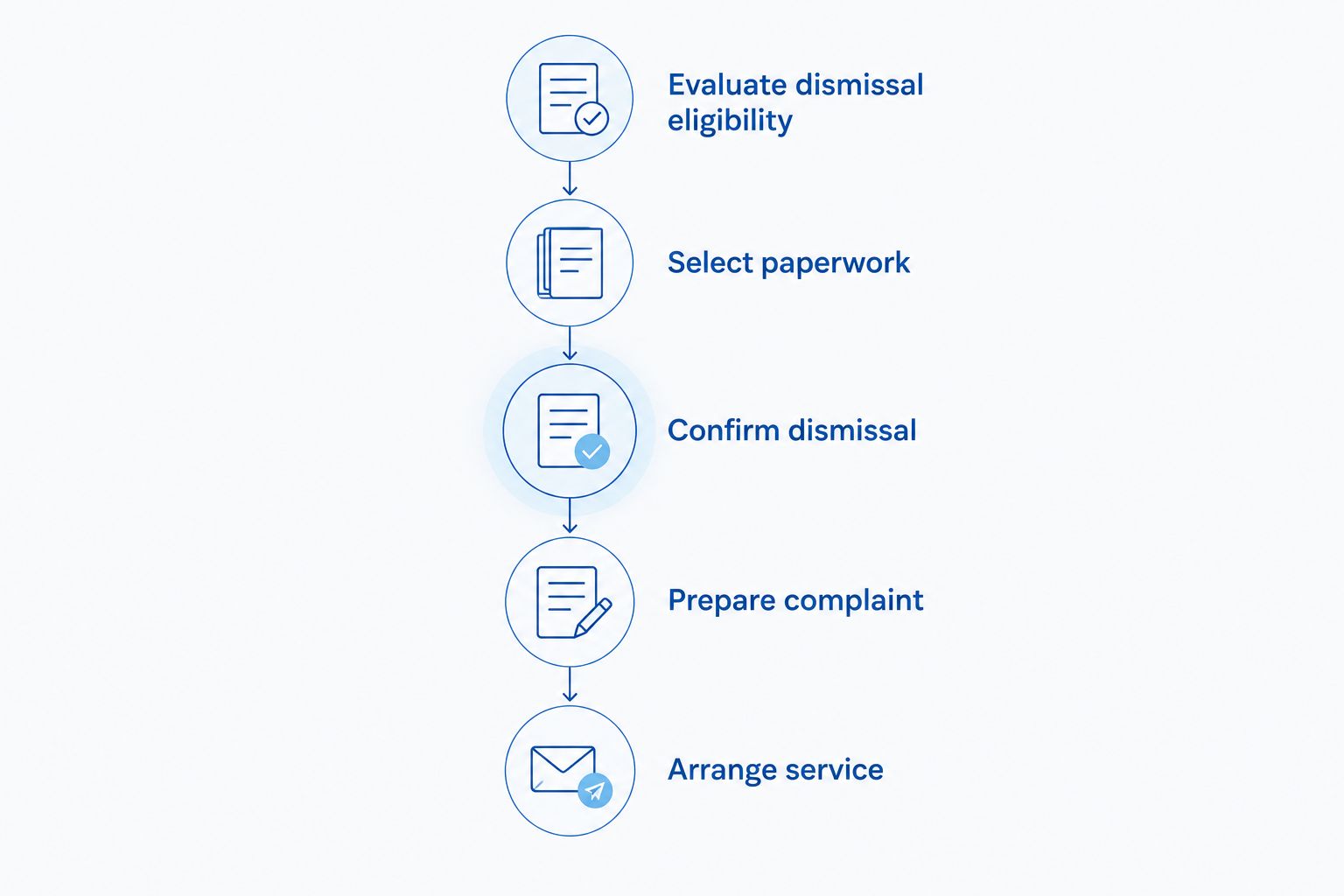
This sequence applies to a plaintiff considering a new civil action before judgment. It is not an instruction to dismiss a case that has already been decided.
- Evaluate dismissal eligibility. Review whether dismissal without prejudice remains available under the case’s current posture. California Code of Civil Procedure section 581 governs voluntary dismissals and their limits.
- Select the correct dismissal paperwork. The Judicial Council’s Request for Dismissal (CIV-110) distinguishes With prejudice from Without prejudice. Those choices have different legal consequences; do not select one simply because it sounds more final or convenient.
- Confirm what the dismissal covers. Identify the parties and claims being dismissed. Obtain the filed copy and check the docket rather than assuming submission equals entry.
- Prepare the new complaint. State the factual basis, legal claims, requested relief, and proper defendants. Choose limited or unlimited civil classification based on the relief sought and applicable rules.
- Complete the opening documents. Ordinary civil filings commonly require a Summons (SUM-100) and Civil Case Cover Sheet (CM-010), along with the complaint and applicable local documents. Check the receiving court’s current requirements.
- Arrange service. Follow the rules for the defendant and document type. Service in the dismissed small claims case does not automatically serve the new lawsuit.
Expected result: Your records show the disposition of the earlier claim, a separately filed civil case, and legally sufficient service of its opening papers. A new case number alone does not establish that every requirement has been met.
For this 2026 workflow, verify current Judicial Council forms and the receiving superior court’s local rules before submitting documents. Filing portals and local submission requirements are not uniform statewide.
Appeal and transfer review
A judgment changes the workflow. Do not file a replacement complaint merely to obtain another decision on the same claim.
- Identify who lost which claim. A small claims plaintiff generally cannot appeal the decision on their own claim. A defendant generally can appeal an adverse judgment on the plaintiff’s claim; separate rules apply when a defendant’s claim is involved.
- Read the notice date immediately. Under Code of Civil Procedure section 116.750, the ordinary appeal deadline is 30 days after the clerk mails or delivers notice of entry of judgment. Failure-to-appear situations require separate review of the procedure for vacating judgment.
- Use the correct appeal document. The Judicial Council form is Notice of Appeal (Small Claims) (SC-140). An appeal produces a new hearing under small claims appeal procedures, not an unrestricted opportunity to rewrite the dispute.
- Review transfer separately. If you are a defendant with a related claim beyond small claims jurisdiction, section 116.390 sets conditions for seeking transfer. Filing another action alone does not complete a transfer.
Lawyers can represent parties at a small claims appeal hearing, even though attorney representation at the original small claims hearing is generally restricted. That distinction matters when deciding how to prepare evidence and testimony.
Expected result: You know whether you need appeal review, a motion concerning the judgment, or analysis of a qualifying transfer. None is interchangeable with starting an ordinary civil lawsuit.
When your damages increase before the hearing
A new medical bill or repair record should trigger reassessment, not an automatic second filing. This adjacent workflow applies when the evidence changes while your small claims case remains pending.
- Update the evidence. Keep original records and document when the new information became available.
- Recalculate the requested relief. Separate documented losses from estimates and future losses requiring additional support.
- Review claim splitting. Do not divide one dispute into separate lawsuits simply to avoid the small claims limit. A later action can face preclusion or waiver arguments.
- Recheck deadlines and posture. Determine whether amendment, dismissal, or another authorized procedure fits before changing the filing.
Khachikyanlawfirm is best suited to readers seeking personal injury or lemon law representation in Glendale. Its stated services do not establish a general commercial-litigation practice, and this workflow does not promise that any particular claim can leave small claims court.
Discuss your injury or lemon law claim
Ask how your existing small claims filing affects the next legal step.
Troubleshooting
You selected dismissal with prejudice
Do not assume you can refile. A dismissal with prejudice ordinarily prevents another action on the dismissed claim. Obtain the entered paperwork and seek prompt legal advice about whether any relief is available.
You filed a new complaint but ignored the old hearing
A new filing does not itself cancel the small claims hearing or dispose of an opposing claim. Check both dockets and comply with existing orders unless the court changes them.
You served only the original small claims papers
The new lawsuit requires service under the rules governing that action. Arrange proper service and file the required proof; do not attach the old proof and assume it applies.
You lost as the plaintiff and want to start again
An unfavorable result does not create a right to relitigate. Review the judgment, your role, and any authorized postjudgment remedy before filing another action based on the same dispute.
Customize your workflow
For a 2026 injury case, organize treatment records, liability evidence, and insurer correspondence around the claims you intend to bring. For a vehicle dispute, organize the purchase or lease agreement, warranty documents, repair orders, and manufacturer communications.
Ask Khachikyanlawfirm to evaluate the underlying injury or lemon law issue alongside the existing court file. The benefit is case-specific representation within the firm’s stated practice areas; the limitation is that neither a consultation nor a new demand automatically changes the pending court proceeding.
FAQ
Can I move a California small claims case into a civil lawsuit?
Sometimes, but there is no universal conversion procedure. A pending plaintiff’s claim, a qualifying transfer request, and an appeal after judgment follow different rules.
Can I sue again after losing my own small claims case?
Generally, you cannot relitigate the same resolved claim by filing an ordinary civil lawsuit. A small claims plaintiff also generally cannot appeal the decision on their own claim.
Can I dismiss small claims and refile for a larger amount?
Dismissal and refiling require review of the case’s posture, limitation periods, and any waiver of excess damages. A dismissal without prejudice does not automatically restore previously waived damages or extend a deadline.
How long do I have to appeal a California small claims judgment?
The ordinary deadline is 30 days after the clerk mails or delivers notice of entry of judgment. Whether you can appeal depends on your role and the claim decided; failure-to-appear cases require separate procedural review.
Do I need to serve the defendant again after filing a new civil lawsuit?
Yes, a new civil action requires service under the rules applicable to that action. Service of the original small claims papers does not automatically satisfy the new lawsuit’s service requirements.
Can a lawyer represent me at a small claims appeal?
Yes, lawyers can represent parties at a California small claims appeal hearing. That differs from the general restriction on attorney representation at the original small claims hearing.
Is this workflow legal advice for my specific case?
No, this workflow provides general California procedural information. Your court file, deadlines, claims, and prior decisions determine which steps are legally available.
One last thing
Keep the envelope that delivered your judgment notice. The mailing or delivery date can control an appeal deadline, while the hearing date tells you something different. Before making any 2026 filing decision, put the notice and its envelope at the front of your case file.


