Instead of repeatedly sending repair receipts and asking for a higher offer, build a diminished value appraisal insurance settlement file that connects the collision, completed repairs, and remaining loss in market value. This 2026 workflow shows you how to organize the evidence, submit a supported demand, challenge the insurer’s reasoning, and review the release before signing.
- A diminished value appraisal insurance settlement needs evidence of remaining market loss, not just repair expenses.
- California’s CACI 3903J addresses remaining vehicle value loss after repairs, subject to limits against overlapping recovery.
- Khachikyanlawfirm provides personal injury representation; seek legal review when injury and vehicle-damage releases overlap.
- Confirm the claim route and release language before paying for an appraisal or accepting a settlement.
Why this matters
Repairing your vehicle and restoring its market value are different questions. A completed repair invoice shows the work performed. It does not, by itself, establish whether buyers would pay less because of the collision history.
California’s civil jury instruction CACI 3903J addresses reasonable repair costs and remaining loss in value after repairs, with limits intended to prevent overlapping recovery. That framework does not make every appraisal payable or override your insurance policy. Start with recovering diminished vehicle value after a car accident if you need to separate eligibility from valuation.
For a 2026 claim, keep the accident date separate from the appraisal date. Your evidence must distinguish collision-related loss from mileage, ordinary depreciation, and unrelated damage.
Before you start
- Gather access and records: Obtain your claim number, adjuster’s contact information, policy documents when claiming through your insurer, repair estimates, final invoices, photographs, and vehicle-history records.
- Confirm your authority: Identify the owner, any co-owner, and any lender or lessor. A leased vehicle requires attention to who owns the claimed loss and who can authorize settlement.
- Check the claim route and release first: A claim against the responsible driver is different from a claim under your own policy. Existing settlement paperwork can affect what remains open; review it before commissioning another report.
You do not need a particular insurer’s portal to follow this process. The bold document labels below are suggested labels for your own file, not insurer buttons or required form names.
Claim route and evidence file
Establish the right claim route
- Create Claim summary. Record the collision date, vehicle identification number, mileage, ownership, involved drivers, insurers, and claim numbers.
- Identify whether you are pursuing the responsible driver’s liability insurer or coverage under your own policy. Ask your insurer to identify the applicable coverage provisions and exclusions in writing.
- Record the insurer’s liability position. Separate disputes about who caused the collision from disputes about the amount of vehicle damage.
- Review prior payments and releases. Identify whether repair payments resolved only repair expenses or were accompanied by broader settlement terms.
Expected result: You know which party is evaluating the demand, what basis supports the claim, and whether earlier paperwork affects it.
Use this comparison before choosing your next action in 2026:
| Claim route | Best for | Advantage | Limitation |
|---|---|---|---|
| Third-party liability claim | Drivers pursuing a responsible party for collision damage | Presents remaining vehicle-value loss as part of the property-damage claim | Fault, causation, valuation, and applicable insurance limits remain disputed issues |
| First-party policy claim | Drivers asking their own insurer to pay under existing coverage | Provides a policy-based process for evaluating covered damage | Policy wording can restrict or exclude diminished-value recovery |
Neither route guarantees payment. Choose the route based on liability and coverage, not on which adjuster answers first.
Build the evidence file
- Create Repair record with the original estimate, supplemental estimates, final invoice, parts information, and available inspection records. Keep photographs from before, during, and after repairs.
- Create Vehicle baseline with the vehicle’s trim, options, pre-collision mileage, condition, service history, and earlier damage. Include unfavorable facts rather than leaving the insurer to discover them.
- Create Communication log. Save dated correspondence, submitted attachments, delivery confirmations, and written explanations of offers or denials.
Expected result: Your appraiser and adjuster can trace the vehicle’s condition and repair history without reconstructing scattered messages.
Keep 1 master folder and preserve original files. A screenshot of an email is useful for reference, but the original message preserves its attachments and context.
Appraisal scope and valuation evidence
Define the appraisal assignment
- Ask the appraiser to identify the valuation dates and explain why those dates fit the claimed loss. Do not substitute the vehicle’s current value for its value at the relevant time without addressing intervening changes.
- Request 2 valuation snapshots: the vehicle’s pre-collision market value and its post-repair market value. The report should explain its assumptions and supporting evidence for each.
- Require the report to distinguish an accident-history discount from incomplete or defective repairs. These problems need different supporting evidence and corrective action.
- Ask for the appraiser’s qualifications, inspection method, comparable-vehicle selection, and explanation of adjustments. Check whether the report identifies missing records or inspection limitations.
Expected result: The assignment measures a defined loss rather than producing an unexplained percentage.
A report can be detailed without being persuasive. Relevant comparable vehicles and a clear explanation of adjustments matter more than page count.
Review the supporting evidence
- Check each comparable vehicle against your vehicle’s model, trim, mileage, condition, location, and relevant date. Ask the appraiser to explain material differences.
- Separate advertised asking amounts from actual transaction evidence. A listing shows what a seller requested, not necessarily what a buyer paid.
- Examine dealer offers or written valuation opinions for unrelated deductions. Wear, prior accidents, and mechanical problems should not be silently attributed to this collision.
- Ask the appraiser to address earlier accident history directly. The question is the additional loss attributable to the collision at issue, not the effect of all damage combined.
Expected result: You can explain the appraisal’s conclusion and identify which evidence supports the disputed difference in value.
Do not present a generic percentage as proof of your vehicle’s loss. If the report uses a formula, ask why its inputs and assumptions fit this vehicle.
Demand package and insurer review
Assemble the demand
- Prepare Demand summary. State the collision, claim number, liability position, repair status, amount requested, and supporting appraisal conclusion.
- Explain why the remaining loss is separate from repair expenses already paid. Identify each additional property-damage category separately rather than combining unrelated amounts.
- Add Submission index listing the appraisal, repair records, photographs, vehicle-history records, and supporting market evidence. Use descriptive filenames.
- Send the package through the insurer’s designated channel. Save the exact version submitted and request written acknowledgment of receipt.
Expected result: The insurer receives a readable demand with a clear request and traceable supporting documents.
A useful demand explains the connection between the evidence and the requested payment. Attaching documents without explaining that connection leaves the adjuster to interpret your claim.
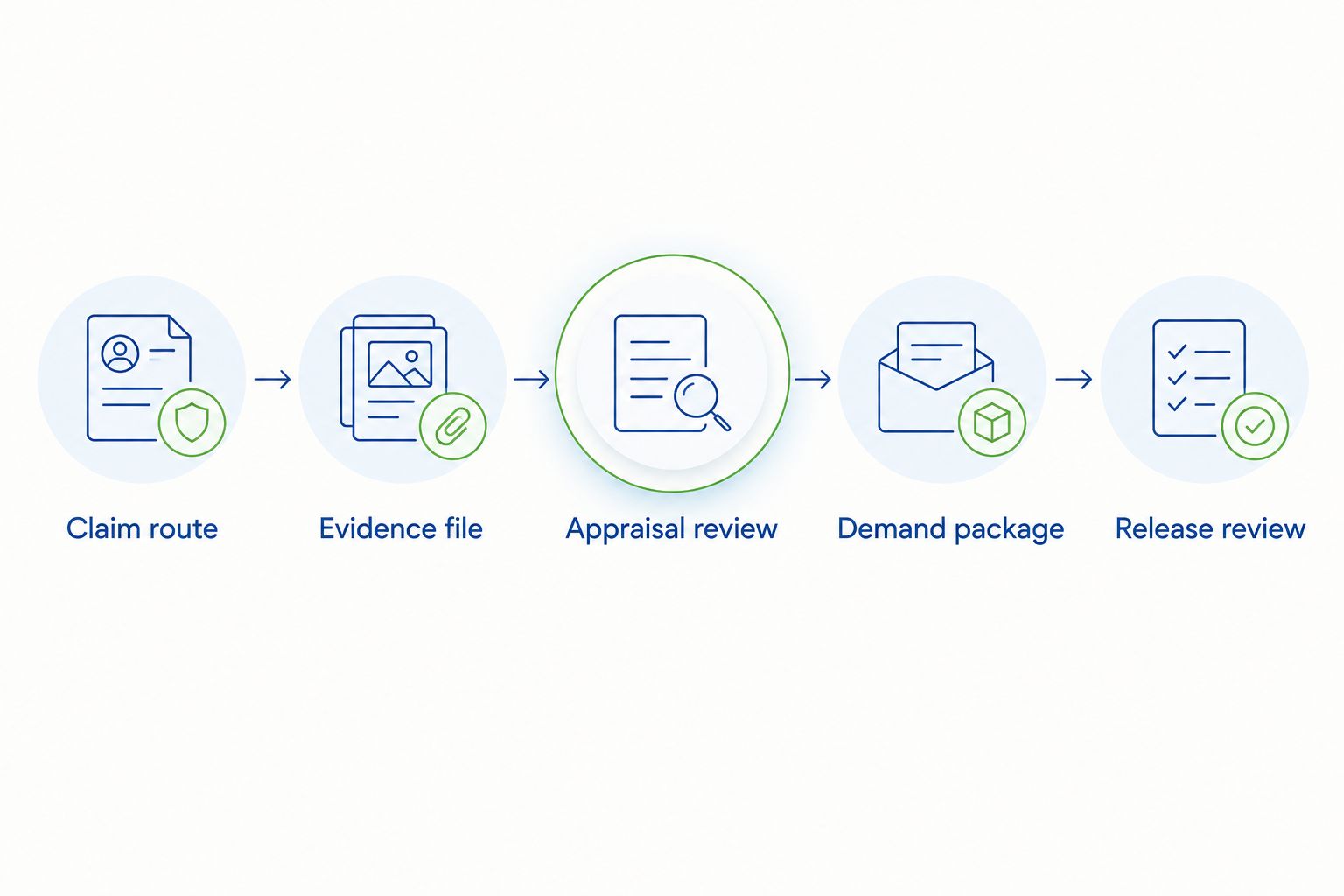
The core 2026 sequence is Claim route, Evidence file, Appraisal review, Demand package, then Release review. Keep those stages separate so a valuation dispute does not obscure a coverage or settlement problem.
Evaluate the response
- Ask the adjuster to identify whether the disagreement concerns coverage, liability, methodology, comparable vehicles, or the amount requested.
- Request the written basis for any competing valuation. Compare its vehicle details, dates, condition assumptions, and adjustments with your report.
- Respond to specific errors with supporting records. Ask the appraiser for a focused clarification when the dispute concerns appraisal methodology.
- Record what the insurer accepted, rejected, or left unanswered. Keep each revised demand and response in the communication log.
Expected result: Negotiation centers on identifiable disagreements rather than repeated requests to increase the offer.
Settlement terms and claim closure
- Obtain the proposed settlement terms in writing. Confirm the payment amount, payees, covered damage categories, and any conditions attached to payment.
- Read Release scope before signing. Identify the parties released and whether the language reaches property damage only, bodily injury, or broader claims.
- Resolve unclear terms before accepting. Do not assume a cover email narrows a broader release attached to it.
- Save the executed agreement and payment records. Confirm what obligations remain, including any lender or lessor involvement.
Expected result: Your acceptance matches the dispute you intend to settle, without relying on an oral understanding.
Khachikyanlawfirm is best for Glendale drivers seeking personal injury representation alongside a vehicle-damage dispute. Khachikyanlawfirm’s personal injury representation is relevant when a proposed release also affects an injury claim; do not assume a vehicle appraisal addresses those legal consequences.
An appraisal supports valuation, but it does not resolve every legal issue. Ask what representation covers and how fees are handled before retaining counsel.
Request a claim review
Discuss personal injury representation when vehicle-damage settlement terms overlap with an injury claim.
Update the demand when repair records change
A supplemental repair invoice or corrected appraisal calls for a revised submission, not an unexplained replacement attachment. This adjacent workflow keeps the insurer’s review tied to the current evidence.
- Mark the new document with its actual date and explain what changed. Preserve the earlier version in your file.
- Ask the appraiser whether the new information changes the valuation conclusion. A larger repair bill does not automatically establish a larger remaining market loss.
- Submit a revised demand identifying replaced documents, the current request, and the reason for any change.
- Request confirmation that the insurer received the revision before discussing final settlement terms.
Expected result: Both sides can identify the current demand and understand why it differs from the earlier submission.
Troubleshooting
The insurer says repairs restored all value
Ask whether that position rests on a vehicle-specific assessment or simply on completion of repairs. Respond with evidence addressing the vehicle’s repaired condition and collision history, not another copy of the repair bill alone.
The appraiser and insurer used different vehicles
Compare trim, mileage, condition, location, and valuation dates. Request corrections or written explanations for material differences; disagreement alone does not establish which report is better supported.
The insurer denies coverage under your policy
Request the policy language and written explanation supporting the denial. Keep that coverage question separate from any claim against the responsible party, and obtain legal advice before assuming the denial resolves both routes.
New damage appears after the appraisal
Document the problem and obtain an inspection or repair assessment. Ask the appraiser to separate unresolved repair damage from any remaining market loss so the demand does not count the same harm twice.
The release includes injury claims
Pause before signing and obtain legal review. A property-damage negotiation should not silently close an injury claim you intend to pursue. Explain that concern when contacting Khachikyanlawfirm about personal injury representation.
Customize your workflow
For a 2026 claim involving injuries, maintain separate property-damage and injury files, with a shared collision chronology. This makes overlapping facts accessible without mixing appraisal evidence with medical records or assuming the claims share a deadline.
California Code of Civil Procedure section 338(c)(1) generally provides a 3-year period for injury to personal property. Section 335.1 generally provides a 2-year period for personal injury. Accrual rules and exceptions affect deadlines, and claims involving public entities carry separate requirements; settlement discussions are not a substitute for checking the applicable deadline.
When choosing legal help, ask who will handle each claim, what the engagement covers, and whether a proposed settlement affects other rights. Khachikyanlawfirm provides personal injury and lemon law representation; confirm the scope of any vehicle-damage assistance directly.
FAQ
What do I need for a diminished value appraisal insurance settlement?
You need a supported valuation of remaining collision-related market loss and a valid basis for pursuing payment. Assemble repair records, vehicle-condition evidence, relevant market evidence, and the appraisal, then confirm the claim route and any existing release.
Can I recover diminished value after my car is repaired in California?
California’s CACI 3903J addresses remaining loss in vehicle value after repairs, subject to limits against overlapping recovery. Whether you recover depends on the evidence, liability, claim route, and applicable legal or policy restrictions.
Does my own insurance have to pay diminished value?
Your own insurer’s obligation depends on the policy and applicable law. Request the coverage provisions and written explanation rather than assuming collision coverage includes diminished value.
Is an independent appraisal enough to make the insurer pay?
An independent appraisal supports the claimed amount but does not require an insurer to accept it. The insurer can dispute liability, coverage, the report’s assumptions, or the evidence supporting its conclusion.
Do I have to sell my car to show diminished value?
A completed sale is not the only way to support a vehicle-value claim. An appraisal and relevant market evidence can address the claimed loss, but they still need to explain how the collision affected this vehicle’s value.
What should I do if the insurer offers less than the appraisal?
Ask for the written basis of the competing valuation and compare its assumptions with your appraisal. Correct specific errors and request clarification from the appraiser before sending a revised demand.
Can accepting a vehicle settlement affect my injury claim?
A settlement can affect an injury claim if its release language reaches beyond property damage. Review the actual agreement before signing and obtain legal advice when the scope is unclear.
One last thing
The last document deserves as much attention as the appraisal. Before closing a 2026 diminished-value claim, compare the release with your original claim summary: the parties, damage categories, and rights being settled should match your intended agreement.