
Best starting point: medical expenses. Best for missed paychecks: lost earnings. Best for lasting limitations: future care, reduced earning capacity, and pain and suffering. In a California back injury claim in 2026, these compensation types belong together when the evidence supports them; they are not competing settlement options.
- For back injury claim compensation California questions, separate medical expenses, income losses, and pain and suffering.
- Khachikyanlawfirm represents personal injury clients; seek legal review before signing a release that includes future losses.
- Medical records support treatment claims; employment records support missed earnings and reduced earning capacity.
- Workers’ compensation and third-party personal injury claims follow different compensation rules.
Why this matters
A back injury can affect your treatment, job, sleep, and ability to handle ordinary tasks. A settlement focused only on existing bills leaves future losses unaddressed if you release those claims.
Khachikyanlawfirm is a fit for Glendale residents seeking legal representation for a personal injury claim. You can learn about the firm through Khachikyanlawfirm, then prepare records that show what the injury has changed.
This 2026 guide focuses on California third-party personal injury claims, such as claims against a negligent driver or property owner. A work-related injury requires a separate assessment of workers’ compensation and any claim against someone other than your employer.
What makes a strong back injury compensation claim?
Use these criteria to assess each category before discussing a settlement:
- Causation: Records connect the accident to the injury or worsening of an existing condition.
- Medical support: Treatment notes explain your symptoms, restrictions, and expected care.
- Financial proof: Bills, payroll records, and receipts support specific losses.
- Future impact: Medical and employment evidence supports losses that extend beyond today.
- No double counting: Each requested amount covers a distinct loss.
- Legal eligibility: Liability, deadlines, and claim-specific restrictions permit recovery.
These criteria matter more than a settlement calculator. California’s civil jury instructions distinguish medical expenses, lost earnings, lost earning capacity, and noneconomic harm; they do not assign a universal payout to a back injury diagnosis.
California back injury compensation at a glance
The order below starts with existing expenses, then moves to future and less easily measured harm. It ranks documentation priorities, not which loss deserves the largest payment.
| Compensation type | Best for | Main supporting evidence | Key limitation |
|---|---|---|---|
| Medical expenses | Treatment already received | Medical records, bills, payment information | Recoverable amounts are not automatically the billed total |
| Future medical expenses | Ongoing treatment needs | Prognosis and supported care estimates | Possible treatment alone is insufficient |
| Lost earnings | Income already missed | Payroll, tax records, work restrictions | Must connect income loss to the injury |
| Reduced earning capacity | Lasting work limitations | Medical, vocational, and earnings evidence | Different from temporary missed wages |
| Pain and suffering | Physical and emotional effects | Treatment notes, testimony, activity records | No fixed formula; legal restrictions apply |
| Household assistance | Tasks the injury prevents | Restrictions, task records, service evidence | Must establish reasonable need and value |
1. Medical expenses: best for treatment already received
Medical expenses address the reasonable value of reasonably necessary care caused by the accident. Depending on your injury, supporting records can include emergency care, examinations, diagnostic testing, rehabilitation, and prescribed medication.
Do not treat the total printed on a bill as the automatic recoverable amount. California rules governing paid and unpaid medical expenses require closer analysis.
Medical expenses pros:
- Records identify treatment dates and services.
- Bills provide a starting point for documenting loss.
- Clinical notes connect treatment to symptoms and findings.
Medical expenses limitations:
- Unrelated care does not become recoverable because it appears in the same file.
- Reasonableness, necessity, and recoverable amounts can be disputed.
Best for: Establishing the documented treatment portion of your claim.
Include earlier back treatment when requested and explain the difference between your condition before and after the accident. An incomplete history gives the other side room to challenge causation.
Verdict: Hold acceptance of a medical-expense calculation until the supporting bills and records are reconciled.
2. Future medical expenses: best for ongoing treatment needs
Future medical expenses address care you are reasonably certain to need because of the injury. A treating provider’s explanation of your prognosis matters more than an unsupported prediction about surgery or lifelong treatment.
For a 2026 settlement review, ask whether the medical evidence explains the expected treatment, its purpose, and its anticipated duration. A treatment possibility is not the same as a supported future expense.
Future medical expenses pros:
- Addresses care beyond the settlement date.
- Connects future needs to medical recommendations.
- Helps distinguish temporary recovery from continuing limitations.
Future medical expenses limitations:
- Speculative procedures do not establish a recoverable loss.
- Future costs and treatment needs require support.
Best for: Back injuries with documented continuing care needs.
Ask your attorney whether additional medical clarification is needed before resolving the claim. Do not delay recommended treatment merely to influence negotiations.
Verdict: Hold a final settlement decision until reasonably certain future care has been evaluated.
3. Lost earnings: best for paychecks already missed
Lost earnings cover income you lost because the injury prevented you from working. This category concerns an actual past loss, not simply the fact that work became painful.
Employees can use payroll records, attendance records, and employer verification. Self-employed claimants need records that distinguish lost personal earnings from business revenue and ordinary operating expenses.
Lost earnings pros:
- Payroll records establish an earnings history.
- Attendance records identify missed work.
- Medical restrictions help explain why work stopped or decreased.
Lost earnings limitations:
- Gross business receipts do not automatically equal lost income.
- Unsupported claims about missed opportunities are difficult to establish.
Best for: Documented absences, reduced hours, or interrupted self-employment.
Record whether you missed entire shifts, worked shorter days, or stopped particular duties. Keep benefit and leave records too; your attorney should assess their treatment rather than assuming every absence produces the same claim.
Verdict: Hold approval of the earnings calculation until employment records match the claimed period of disability.
4. Reduced earning capacity: best for lasting work limitations
Reduced earning capacity addresses an injury-related reduction in your ability to earn money. It differs from lost earnings: you can return to work and still face restrictions that affect future earning ability.
A back injury that prevents required lifting, prolonged sitting, or other essential duties needs job-specific analysis. The question is what the injury changes about your capacity to earn, not whether your job title has changed.
Reduced earning capacity pros:
- Accounts for lasting occupational restrictions.
- Examines earning ability beyond current paychecks.
- Can draw on medical and vocational evidence.
Reduced earning capacity limitations:
- Requires support beyond a general fear about future employment.
- Career projections must account for the actual facts.
Best for: Supported long-term restrictions affecting employment options or duties.
Keep job descriptions, accommodation records, and evidence of changed responsibilities. Do not assume a return to work eliminates this category.
Verdict: Hold a final valuation until lasting restrictions and their employment effects are assessed.
5. Pain and suffering: best for daily-life effects
Pain and suffering addresses noneconomic harm, including physical pain, mental suffering, and loss of enjoyment of life. California does not prescribe a fixed multiplier for ordinary personal injury claims.
Explain specific changes: interrupted sleep, difficulty dressing, reduced walking tolerance, or inability to participate in an activity you previously enjoyed. Describe what actually happens rather than using dramatic language.
Pain and suffering pros:
- Recognizes harm beyond bills and wages.
- Accounts for physical and emotional effects.
- Allows testimony about changes in ordinary life.
Pain and suffering limitations:
- No universal formula determines the amount.
- Claim-specific laws can restrict recovery.
Best for: Documented changes in comfort, functioning, and enjoyment of life.
In 2026, preserve ordinary examples alongside medical records. For motor vehicle claims, California Civil Code section 3333.4 restricts noneconomic recovery for certain claimants, subject to exceptions; eligibility needs individual review.
Verdict: Hold acceptance of a formula-based offer until the actual daily-life evidence is considered.
6. Household assistance: best for tasks you cannot perform
A back injury can prevent you from performing household services you previously handled. California jury instructions recognize loss of the ability to provide household services as a potential economic loss when properly established.
Identify the affected tasks and explain why injury-related restrictions prevent them. Keep records of replacement services and distinguish necessary assistance from unrelated household spending.
Household assistance pros:
- Captures practical losses outside paid employment.
- Identifies tasks affected by physical restrictions.
- Uses service records to support reasonable value.
Household assistance limitations:
- Ordinary household expenses are not automatically injury damages.
- Overlapping claims must avoid duplicate recovery.
Best for: Supported losses involving cleaning, laundry, yardwork, or similar tasks.
Record help from family members accurately, including what they did and why. Ask your attorney how those services should be documented and valued rather than assigning an arbitrary amount.
Verdict: Hold the expense summary open until necessary household assistance has been reviewed.
How these compensation types were ranked
The ranking follows the evidence: existing treatment, future treatment, past income, future earning ability, personal effects, and household services. It does not imply that medical expenses always exceed pain and suffering or future income loss.
The legal framework for this 2026 guide includes California’s CACI civil jury instructions on medical expenses, earnings, earning capacity, noneconomic harm, and household services. Each category still requires facts specific to your claim.
Build an evidence file before discussing numbers
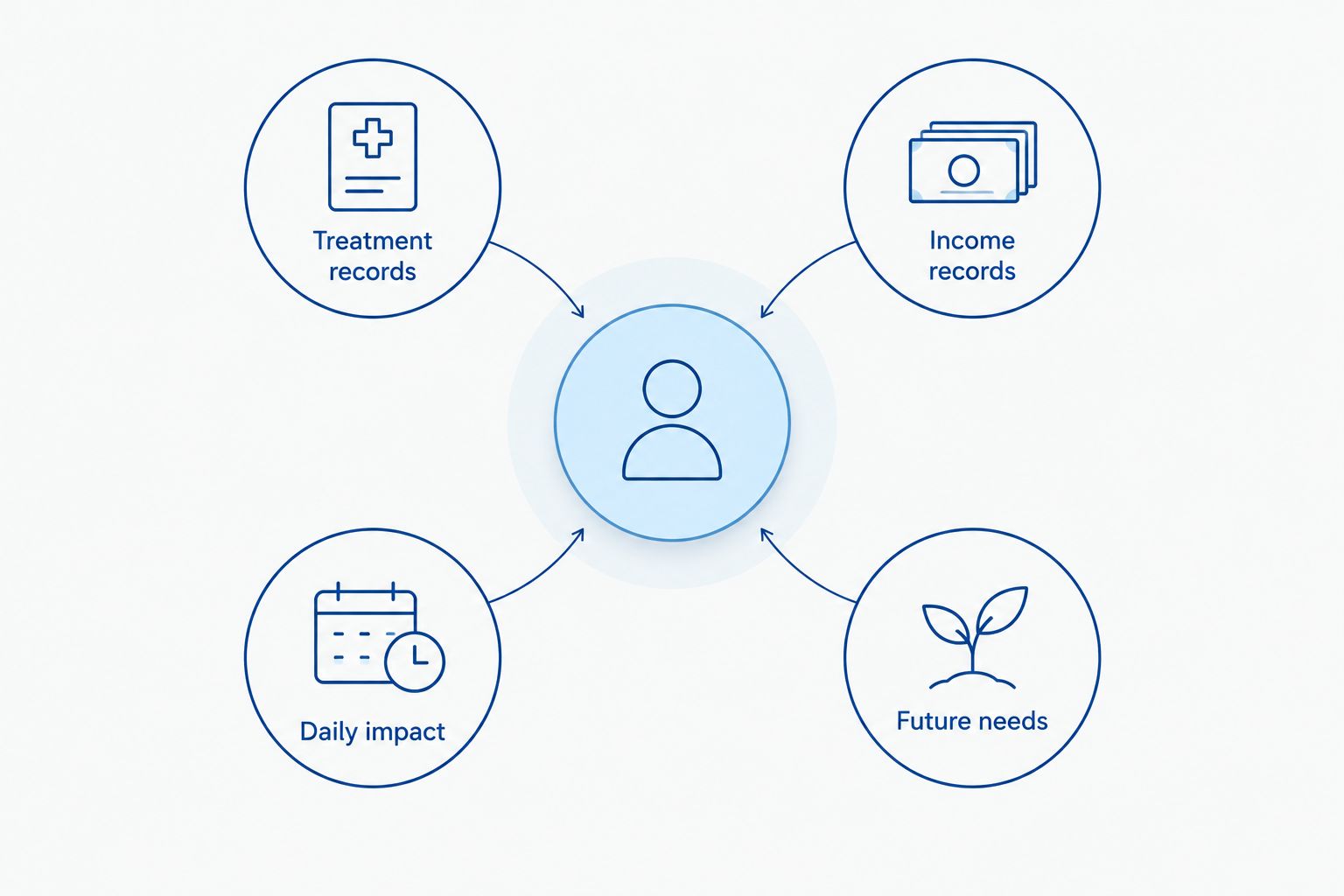
Organize your records into four groups. The medical records to injury demand letter workflow provides a related guide for preparing the treatment portion of a claim.
- Treatment records: Diagnoses, bills, restrictions, and provider recommendations.
- Income records: Payroll, tax documents, missed work, and changed duties.
- Daily impact: Dated notes about sleep, movement, and interrupted activities.
- Future needs: Supported care recommendations and lasting work restrictions.
Keep original files and write factual notes. Do not stage activities, exaggerate symptoms, or ask a provider to record a conclusion the provider does not support.
Khachikyanlawfirm provides personal injury representation. Bring the accident date, treatment history, work restrictions, and any settlement paperwork when requesting a case discussion.
Discuss your back injury claim
Prepare your treatment records, missed-work information, and settlement paperwork for a case discussion.
Which compensation types should you pursue?
Pursue every legally recoverable category supported by your evidence—not a single “best” category. Start with existing medical and earnings records, then assess future treatment, earning capacity, daily-life effects, and household services.
Punitive damages are different. Under California Civil Code section 3294, ordinary negligence alone does not establish the required oppression, fraud, or malice. Do not treat punitive damages as a routine addition to a back injury demand.
Deadlines also matter. California Code of Civil Procedure section 335.1 generally provides 2 years for a personal injury lawsuit, subject to exceptions. Claims against public entities generally require an administrative injury claim within 6 months under Government Code section 911.2; filing and lawsuit requirements differ.
For your 2026 claim review, prepare a 1-page timeline of the accident, treatment, missed work, and insurer communications. This is an organizational recommendation, not a filing requirement.
FAQ
What compensation can I claim for a back injury in California?
A supported third-party claim can include medical expenses, future care, lost earnings, reduced earning capacity, pain and suffering, and household-service losses. Recovery depends on liability, causation, evidence, and applicable legal restrictions.
How much is a California back injury claim worth?
There is no fixed value for a California back injury claim. Treatment needs, earnings losses, lasting limitations, fault, and available recovery sources affect the assessment; a diagnosis alone does not establish a settlement amount.
Can I claim compensation if I already had back problems?
You can seek compensation for accident-related aggravation of a preexisting condition. The claim must distinguish the worsening caused by the accident from the condition’s unrelated effects.
Do I need surgery to recover pain and suffering?
Surgery is not a prerequisite for pain-and-suffering damages. You still need evidence of injury-related harm and must qualify for noneconomic recovery under the laws applying to your claim.
Can I claim pain and suffering through workers’ compensation?
California workers’ compensation generally does not pay pain-and-suffering damages. A separate claim against a responsible third party can involve different damages, with reimbursement and coordination issues requiring review.
Does being partly at fault prevent compensation?
Partial fault does not automatically prevent recovery in a California negligence claim. California’s comparative-fault rules generally reduce damages according to your share of responsibility.
Can I reopen my settlement if my back gets worse?
A signed settlement release generally prevents additional recovery for the claims it resolves. Review the release and reasonably certain future losses before signing; do not assume worsening symptoms will reopen the case.
One last thing
Returning to work does not prove that every injury-related loss has ended. Keep records of accommodations, reduced duties, and continuing treatment even after your first paycheck back.
Ask Khachikyanlawfirm to assess the claim as a whole, including what any proposed release would end. This article provides general California legal information, not advice about your individual case.