Yes, you can sue for pain and suffering after a California car accident when another party’s wrongful conduct caused your injuries and no legal restriction bars that recovery. You must prove the connection between the crash and your physical pain, emotional distress, or loss of enjoyment of life; an accident alone does not establish damages. In 2026, your insurance status, share of fault, and filing deadline also affect your right to recover.
- Can I sue for pain and suffering in a California car accident? Yes, when liability, injury, and eligibility are established.
- California recognizes physical pain, emotional distress, and lost enjoyment of life as noneconomic damages.
- Uninsured drivers face restrictions; partial fault reduces recoverable damages rather than automatically eliminating a claim.
- Khachikyan Law Firm provides personal injury representation in Glendale, California.
Why this matters
Your medical bills do not tell the whole story of your injury. Difficulty sleeping, fear of driving, and the loss of activities you enjoyed deserve separate attention when documenting your claim.
Khachikyan Law Firm provides personal injury representation in Glendale. Whether you seek legal help immediately or first organize your records, keep the accident evidence and the effect on your daily life together.
Do not confuse an insurance settlement with a court award. You can seek pain-and-suffering compensation through a liability claim without necessarily filing a lawsuit, but negotiations do not automatically protect your filing deadline.
Can I sue for pain and suffering in a California car accident?
Yes. In a negligence case, you generally need to establish that the defendant owed you a duty of care, breached that duty, and caused injury and resulting harm. Pain and suffering is a category of compensation within that case, not a substitute for proving responsibility.
For a claim evaluated in 2026, California Civil Jury Instructions, CACI No. 3905A, identifies noneconomic harms such as physical pain, mental suffering, emotional distress, and loss of enjoyment of life. It also explains that no fixed standard determines their monetary value.
| Compensation category | What it addresses | Helpful evidence | Important limit |
|---|---|---|---|
| Economic damages | Financial losses, including medical expenses and lost earnings | Bills, treatment records, payroll records | Expenses and losses must be connected to the injury and legally recoverable |
| Noneconomic damages | Pain, emotional distress, physical impairment, and lost enjoyment of life | Medical records, your testimony, observations from others | The crash alone does not establish the extent of suffering |
These categories serve different purposes. A medical bill documents an expense; your treatment notes and testimony explain what the injury actually felt like and prevented you from doing.
Physical pain and limitations
Physical pain includes the discomfort caused by your injuries. Physical impairment addresses the effect on your ability to function, such as difficulty lifting groceries, sitting through work, or walking comfortably.
Describe the task and the limitation rather than relying on a general statement that everything hurts. A clear account helps distinguish your actual experience from a label in a demand letter.
Emotional distress and lost enjoyment
Emotional effects can include anxiety, fear, humiliation, or disrupted sleep associated with the accident and injuries. Lost enjoyment concerns activities and experiences your injuries have taken away or restricted.
A mental health diagnosis is not a universal prerequisite for recovering emotional distress within a physical-injury claim. Treatment records, testimony, and other evidence still matter, and a clinician should assess symptoms that interfere with your life.
What evidence supports a pain-and-suffering claim?
Build a record of what changed, not just a folder of bills. You need evidence that connects your symptoms to the accident and explains their severity, duration, and practical effects.
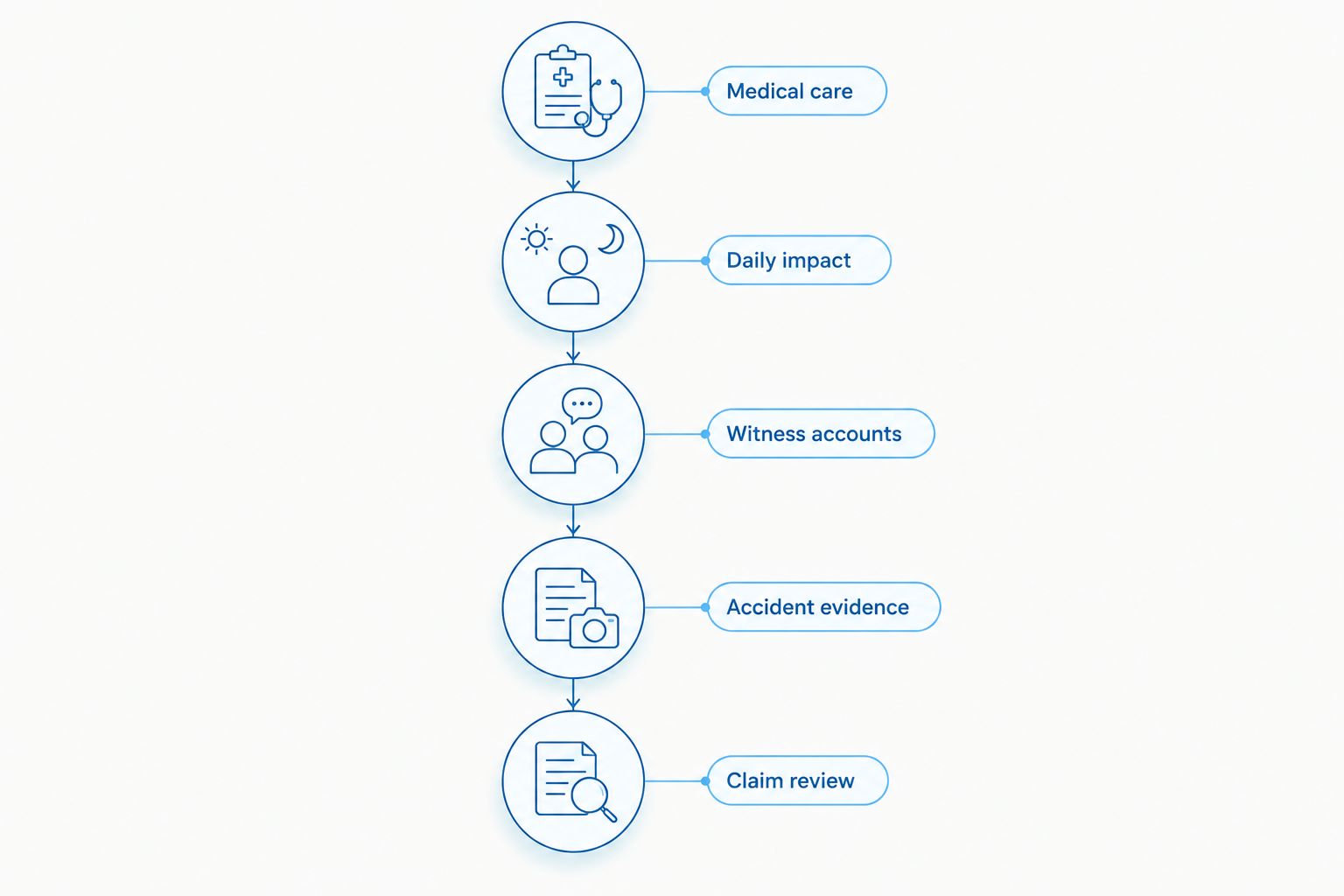
Use this sequence to organize your claim:
- Medical care: Seek appropriate evaluation and describe your symptoms accurately. Tell your provider about prior injuries, new limitations, and changes since the crash.
- Daily impact: Keep factual notes about interrupted sleep, painful movements, missed activities, and help you need. Record improvements as well as setbacks.
- Witness accounts: Identify people who observed your limitations. Their firsthand descriptions are more useful than conclusions about what your case deserves.
- Accident evidence: Preserve photographs, video, witness details, and relevant communications. Injury documentation does not replace evidence of how the collision happened.
- Claim review: Organize the records and identify gaps before submitting a demand or signing a settlement release.
Each step addresses a different part of proof. Together, the records should explain the collision, the injury, and the consequences without exaggerating any of them.
Keep original records and preserve relevant electronic files. Do not delete relevant posts, messages, or photographs because they seem unfavorable; discuss preservation obligations with counsel instead.
If your next task is assembling a settlement demand, the guide to turning medical records into an injury demand letter addresses that part of the process.
Why pain-and-suffering compensation varies
California does not assign an automatic payment to a diagnosis or accident type. For an ordinary negligence claim in 2026, the evidence of your individual harm matters more than a generic settlement formula.
The main factors include:
- Severity: The intensity of your symptoms and the extent of your physical or emotional limitations.
- Duration: Whether the effects resolved, continue, or are reasonably certain to continue in the future.
- Daily consequences: Changes to work, household tasks, relationships, sleep, and activities you enjoyed.
- Causation: Whether the evidence connects those effects to the crash rather than an unrelated condition.
- Supporting records: Consistency among treatment notes, testimony, photographs, and firsthand observations.
- Fault and legal restrictions: Your share of responsibility and statutory limits on noneconomic recovery.
Insurance coverage also affects the practical recovery picture, but a policy limit is not a measurement of your suffering. Keep the value of the harm separate from questions about available coverage and collection.
Is there a standard multiplier?
California law does not require a pain-and-suffering multiplier. Multiplying medical bills does not replace proof of the injury’s effect on your life.
A claim with substantial bills is not automatically stronger on every noneconomic issue. The relevant question is what the evidence establishes about your pain, limitations, and reasonably certain future harm.
Can I recover if I was partly at fault?
Yes. California follows pure comparative negligence, which reduces recoverable damages by your percentage of fault rather than automatically barring recovery because you share responsibility.
That reduction applies to the damages established in the case. The fault assessment is separate from the question of how much pain and suffering your injuries caused.
Do not treat an insurer’s fault position as a court ruling. Preserve the evidence supporting your account, and avoid assuming that a disputed collision makes an injury claim pointless.
Can I recover pain and suffering if I was uninsured?
Not always. California Civil Code section 3333.4 restricts noneconomic recovery for certain uninsured vehicle owners and operators, even when another driver caused the accident.
In 2026, this remains a threshold issue to examine before valuing an uninsured driver’s pain-and-suffering claim. The statute treats ownership, operation, and financial responsibility as legally significant facts; being an injured passenger does not automatically place you in the same position as an uninsured owner or driver.
An exception can apply to an uninsured owner when the responsible driver was convicted of driving under the influence in connection with the accident. The precise statutory requirements matter, so do not assume that an allegation of intoxication alone establishes the exception.
Check eligibility before debating value. A restriction on noneconomic damages does not necessarily eliminate a claim for otherwise recoverable economic losses.
How long do I have to file a lawsuit?
California generally gives you 2 years from the injury to file a personal injury lawsuit. Code of Civil Procedure section 335.1 supplies that general deadline, subject to rules that can change its application.
Claims involving a public entity require separate attention. Government Code section 911.2 generally requires an injury claim to be presented within 6 months of accrual, before a lawsuit against the entity can proceed; exceptions and additional lawsuit deadlines also apply.
For a 2026 accident, identify the responsible parties early rather than assuming every claim follows the same calendar. A collision involving a public vehicle or allegedly dangerous public roadway warrants prompt review of government-claim requirements.
Settlement discussions do not automatically extend the lawsuit deadline. Keep a separate deadline calendar even if the adjuster continues requesting records or discussing payment.
Do I have to go to court to recover pain and suffering?
No. A liability settlement can include pain-and-suffering compensation without a trial, provided the parties reach an agreement.
Negotiation gives you a route to resolution, but an insurer is not required to accept your description or valuation of the harm. Litigation provides a formal process for resolving disputes, while adding procedural obligations and uncertainty.
| Route | Best for | Benefit | Limitation |
|---|---|---|---|
| Negotiated settlement | Claims where responsibility and damages can be resolved by agreement | Avoids a trial if agreement is reached | Requires agreement on acceptable terms |
| Civil lawsuit | Claims requiring formal resolution of disputed responsibility or damages | Provides court procedures for developing and presenting evidence | Adds deadlines, litigation demands, and an uncertain outcome |
Filing a lawsuit does not mean a trial is inevitable. A case can still settle during litigation, but you must comply with court requirements while negotiations continue.
What should I check before signing a release?
Read what claims and parties the release covers. A settlement release can permanently end claims within its scope, including claims involving future consequences of the injury.
Review your medical outlook before deciding. If symptoms continue or further treatment is under consideration, understand how those issues fit into the proposed settlement rather than treating the offer as payment only for bills already received.
When should I ask a personal injury lawyer for help?
Seek legal review when fault is disputed, symptoms persist, an insurer questions causation, or a release arrives before you understand your prognosis. Uninsured status and possible public-entity involvement also deserve early attention.
Khachikyan Law Firm is for Glendale accident victims seeking personal injury representation. Legal representation can address liability, evidence, and claim procedure; it cannot guarantee a settlement amount or remove the need to prove your injuries.
Bring the collision information, insurance correspondence, treatment records, and a factual summary of your limitations. Ask how the lawyer will evaluate restrictions, deadlines, and unresolved medical issues before discussing a demand.
Discuss your accident claim
Ask about the evidence, eligibility restrictions, and deadlines affecting your personal injury claim.
FAQ
Can I sue for pain and suffering after a minor California car accident?
Yes, a minor collision can support pain-and-suffering recovery when another party caused a compensable injury and no restriction bars recovery. Limited vehicle damage does not automatically establish or defeat the injury claim.
Do I need a diagnosed injury to claim pain and suffering?
You must prove actual harm caused by the accident, but a diagnostic label alone does not determine recovery. Medical evaluation and records help explain your symptoms, their cause, and their effect on daily life.
Is there a cap on pain and suffering after a California car accident?
An ordinary California car-accident negligence claim generally has no statutory cap on noneconomic damages. Eligibility restrictions, comparative fault, coverage, and the evidence still affect recovery.
Can I recover for a preexisting condition made worse by the crash?
Yes, you can seek compensation for accident-related aggravation of a preexisting condition. You cannot recover from the defendant for harm the crash did not cause, so medical evidence distinguishing the aggravation matters.
How long do I have to sue for a California accident injury?
You generally have 2 years from the injury under Code of Civil Procedure section 335.1. Public-entity claims and other exceptions require separate deadline analysis.
Can I claim future pain and suffering?
Yes, California permits recovery for future noneconomic harm that the evidence establishes is reasonably certain to occur. Ongoing symptoms alone do not automatically establish their future duration or severity.
Can Khachikyan Law Firm help with a Glendale accident injury claim?
Khachikyan Law Firm provides personal injury representation in Glendale, California. Contact the firm to discuss your accident, injury records, and applicable deadlines.
One last thing
Document recovery as carefully as you document pain. A record that acknowledges better days, regained abilities, and remaining limitations gives a more accurate account than notes describing every day as equally difficult.
Before your next appointment, write down the specific activities that still cause trouble and what has improved. Give your provider an accurate history, ask appropriate medical questions, and keep claim strategy separate from treatment decisions.
This article provides general California legal information for 2026, not advice about your specific claim. Your accident facts and applicable exceptions determine the next step.