
A California personal injury claim has no fixed average value that reliably predicts your recovery in 2026; its worth depends on provable losses, responsibility for the injury, and the money legally available to pay the claim. Your settlement amount is also different from your take-home recovery because attorney fees, case expenses, and valid reimbursement claims can reduce what you receive.
- How much is a personal injury claim worth in California? Proven damages, fault, and available recovery determine the answer.
- California personal injury compensation can include medical expenses, lost earnings, and pain and suffering.
- A settlement calculator cannot establish your injury's value or account for every legal restriction.
- Compare the gross settlement with your expected net recovery before signing a release.
Why this matters
A useful claim evaluation explains the evidence behind the amount, not just the amount itself. Medical bills tell only part of the story: an injury can also affect your ability to work, sleep, drive, or care for your family.
Khachikyan Law Firm provides personal injury representation in Glendale, California. For a 2026 claim evaluation, bring your treatment records, income documents, accident evidence, and insurance correspondence so the discussion starts with your actual losses.
How much is a personal injury claim worth in California?
Your claim's value starts with legally recoverable damages. The practical settlement assessment then considers the evidence of fault, disputed issues, insurance coverage, and other available sources of payment.
The following breakdown separates losses that serve different purposes. It is not a payout schedule, and an injury diagnosis alone does not establish the amount you should receive.
| Compensation category | What it addresses | Evidence that supports it | Important limitation |
|---|---|---|---|
| Past medical expenses | Reasonable, necessary treatment related to the injury | Medical records, billing records, and payment information | The billed total is not automatically the recoverable amount |
| Future medical expenses | Reasonably necessary care expected because of the injury | Medical opinions and supported treatment estimates | Speculative future care does not establish damages |
| Lost earnings | Income lost because the injury prevented work | Employer records, pay statements, and medical restrictions | You must connect the absence or reduced work to the injury |
| Lost earning capacity | Reduced ability to earn income in the future | Work history, medical evidence, and appropriate expert analysis | A diagnosis alone does not prove reduced earning ability |
| Noneconomic damages | Pain, suffering, emotional distress, and loss of enjoyment | Treatment records and concrete evidence of daily limitations | Legal restrictions can apply to particular claims |
| Property damage | Injury-related damage to belongings, where applicable | Photographs, repair estimates, and ownership records | Avoid counting losses already resolved through another payment |
Claim value, settlement value, and net recovery are different figures. A claim can involve substantial damages while facing serious disputes about responsibility or collection.
Economic damages: document financial losses
Economic damages address financial harm caused by the injury. Gather the records that show both the amount and the connection to the incident.
For medical expenses, keep treatment notes alongside billing statements. A bill identifies a charge; the medical record helps explain why treatment was necessary and whether it relates to the injury at issue.
For lost earnings, preserve attendance records, wage statements, and written work restrictions. If you are self-employed, business and tax records can help distinguish lost income from ordinary changes in revenue.
Future losses need separate attention. A supported medical prognosis or work limitation carries more weight than your own estimate of what treatment or missed work might eventually involve.
Noneconomic damages: explain the effect on your life
Pain and suffering are not established by multiplying medical bills by a universal number. California's civil jury instructions, including CACI No. 3905A, provide no fixed standard for determining noneconomic damages in an ordinary injury case.
Describe what changed in practical terms. Difficulty standing through a work shift, interrupted sleep, or an inability to perform household tasks gives an evaluator something specific to assess.
Keep your account accurate and consistent with your treatment records. Document actual limitations rather than trying to make your injury sound more serious. Exaggeration creates a credibility problem that additional paperwork cannot fix.
Gross settlement versus net recovery
The gross settlement is the total settlement amount before deductions. Net recovery is what remains after applicable attorney fees, case expenses, medical balances, liens, and reimbursement obligations are addressed.
Ask for a written explanation of those deductions before accepting an offer. The fee agreement should explain how attorney compensation and expenses are handled; do not assume every firm uses the same terms.
A reimbursement claim also needs review rather than automatic acceptance at its stated amount. Its validity, priority, and potential reduction depend on the particular obligation and applicable law.
Why personal injury claim values vary
For California injury claims evaluated in 2026, these factors explain why similar-looking accidents can produce different outcomes:
- Injury severity and prognosis. A temporary limitation and a lasting impairment create different medical and personal consequences. The prognosis must have medical support.
- Causation evidence. Records must connect the defendant's conduct to the claimed harm. A preexisting condition requires careful analysis of any injury-related worsening, not automatic exclusion of the claim.
- Responsibility for the incident. Witness accounts, photographs, video, and physical evidence affect whether fault can be established or disputed.
- Shared fault. California's comparative negligence rules can reduce damages according to your share of responsibility. Disagreement about fault therefore affects settlement negotiations.
- Coverage and collectability. Applicable insurance and other legally reachable resources affect practical recovery. A policy limit does not itself define the full amount of your damages.
- Quality of loss documentation. Consistent medical records, supported income losses, and specific daily-life evidence help distinguish a documented demand from an unsupported request.
If responsibility is disputed, review whether you can still sue when partly at fault in a car accident. Do not accept an insurer's fault allocation as a court finding.
How to build a supportable claim evaluation
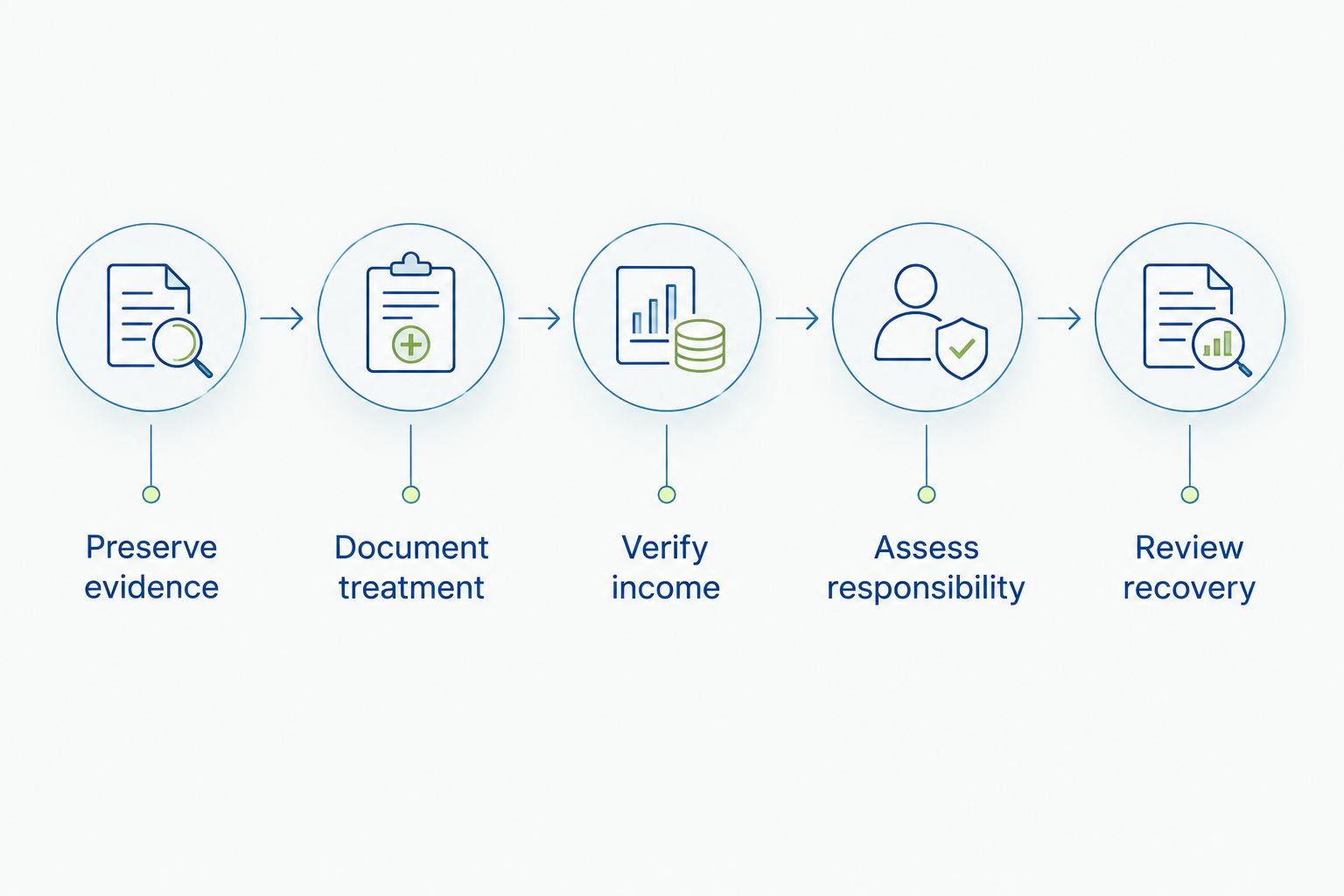
A useful evaluation follows the evidence in order. Starting with an online payout estimate reverses that process and creates an anchor that your records might not support.
- Preserve evidence. Save incident photographs, witness details, reports, correspondence, and available video. Preserve original files rather than relying only on edited copies.
- Document treatment. Keep records of diagnoses, treatment, symptoms, and medical restrictions. Explain genuine barriers to treatment accurately rather than leaving unexplained gaps.
- Verify income. Collect records showing missed work, reduced hours, and the earnings connected to those changes. Separate business revenue from personal income where relevant.
- Assess responsibility. Identify the evidence supporting fault and the evidence the other side will use to dispute it. Include any allegation that your conduct contributed to the injury.
- Review recovery. Identify potentially applicable coverage, future losses, legal restrictions, and deductions. Compare the proposed settlement with the rights the release would surrender.
A demand should explain the connection between the incident, the injury, and each claimed loss. Attaching a large stack of bills without that explanation leaves important questions unanswered.
What deadlines can affect your California injury claim?
Claim value does not protect you from a missed deadline. Identify the deadline before waiting for treatment to finish or negotiations to improve.
For a 2026 California claim, the following rules are important starting points, not substitutes for checking the facts and applicable exceptions:
| Situation | General timing rule | Legal source and scope |
|---|---|---|
| Ordinary personal injury lawsuit | Generally 2 years from the injury | California Code of Civil Procedure section 335.1; accrual rules and exceptions can change the calculation |
| Injury claim against a public entity | An administrative claim is generally due within 6 months after accrual | California Government Code section 911.2; applies to covered government claims |
| Lawsuit after a qualifying written government claim rejection | Generally 6 months after the notice is personally delivered or deposited in the mail | California Government Code section 945.6; notice requirements and exceptions matter |
These periods address different steps. Submitting an insurance claim is not the same as filing a lawsuit, and presenting a government claim is not the same as completing the court filing that can follow.
Claims involving minors, delayed discovery, medical malpractice, or other special circumstances require separate deadline analysis. Do not assume ongoing settlement discussions extend your filing period.
Should you accept the first settlement offer?
Accept an offer only after you understand what it resolves and what you will receive. The fact that an offer arrives early does not prove it is fair or unfair.
Review whether your medical outlook is sufficiently understood, whether income losses are documented, and whether the offer accounts for disputed responsibility. Ask which claims and parties the release covers.
A settlement release generally ends the claims it resolves, even if your condition later turns out to be worse than expected. That makes unresolved future treatment a decision issue, not merely an item to add later.
For personal injury representation in Glendale, Khachikyan Law Firm is a relevant option for injured people seeking legal help. Review the proposed scope, fee terms, and handling of expenses before deciding whether to hire the firm.
Discuss your injury claim
Ask about your losses, disputed fault, filing deadlines, and the terms of personal injury representation.
Is there an average California personal injury settlement?
An average settlement is not a reliable valuation of your individual claim. A meaningful comparison would need similar injuries, fault evidence, treatment needs, legal restrictions, and sources of recovery.
Anecdotes about another person's result omit the facts needed to make that comparison. Use your own records to evaluate an offer instead of treating an unrelated settlement as a minimum.
Can you recover compensation if you were partly at fault?
Shared fault does not automatically bar recovery under California's pure comparative negligence rule. Your share of responsibility can reduce recoverable damages, so the evidence supporting the allocation matters.
This general rule does not eliminate claim-specific defenses or restrictions. Review the incident facts and legal basis of the claim before assuming a particular result.
Does a policy limit cap the value of your injuries?
A policy limit limits the insurer's obligation under the applicable coverage, not necessarily your total damages. The practical recovery assessment must also consider other coverage, responsible parties, and collectability.
Do not assume another policy or payment source exists. Coverage must be identified and reviewed rather than added to an estimate without support.
FAQ
How much is a personal injury claim worth in California in 2026?
A California personal injury claim has no fixed value; recoverable damages, fault, evidence, and available payment sources determine the assessment. Compare the potential gross recovery with fees, expenses, and valid reimbursement obligations.
Can I calculate pain and suffering by multiplying my medical bills?
No universal multiplier establishes pain and suffering in California. Evaluate the injury's actual effects, supporting records, prognosis, and any legal restrictions that apply to the claim.
Do higher medical bills always mean a bigger settlement?
Higher medical bills do not automatically establish a larger recoverable settlement. Treatment must relate to the injury, and the recoverable medical amount depends on the evidence and applicable law.
Can I claim lost wages if I work for myself?
Self-employed people can seek supported injury-related lost earnings. Business records, tax records, work history, and medical restrictions help establish the loss and distinguish it from ordinary revenue changes.
How long do I usually have to sue for a California injury?
The general California personal injury filing period is 2 years under Code of Civil Procedure section 335.1. Government claims and other special situations have different requirements, so check the applicable deadline promptly.
What should I bring to Khachikyan Law Firm for a personal injury discussion?
Bring incident evidence, medical records, billing information, income records, and insurance correspondence to Khachikyan Law Firm. Include any settlement offer, release, or deadline notice you have received.
Will the settlement amount be the amount I take home?
The gross settlement is not necessarily your take-home amount. Attorney fees, case expenses, and valid medical payment or reimbursement obligations can reduce your net recovery.
One last thing
The release deserves as much attention as the settlement amount. Before signing, check whose liability it resolves, which claims it includes, and who remains responsible for outstanding medical obligations.
For a settlement decision in 2026, request a written estimate of your net recovery alongside the proposed release. A clear explanation of both is more useful than a headline amount alone.


