
The reasons lemon law claims get denied include disputed warranty coverage, insufficient repair opportunities, weak records, and missed legal requirements. This 2026 California guide ranks 10 issues by the order you should investigate them—not by how frequently manufacturers raise them—and explains your next move.
- Reasons lemon law claims get denied include coverage disputes, incomplete repair histories, and missed filing requirements.
- A manufacturer's rejection is not a court ruling that your California lemon law claim fails.
- Khachikyanlawfirm provides lemon law representation for drivers seeking legal help in Glendale.
- Check warranty eligibility and deadlines before focusing on repair counts or settlement discussions.
Why this matters
A denied repair, rejected buyback request, and adverse arbitration decision are different events. Each requires a different response. Treating them as interchangeable can send you after the wrong evidence or procedure.
Khachikyanlawfirm offers personal injury and lemon law representation in Glendale, California. For a disputed lemon law claim, start with the written rejection and the warranty—not an assumption that every recurring defect guarantees a refund.
In 2026, your review must also account for the procedures that apply to the manufacturer and your particular claim. Do not assume an older checklist covers current notice and filing requirements.
What makes a strong response to a lemon law denial?
Use these criteria before deciding whether to challenge the rejection:
- Eligibility: Identify the warranty, vehicle transaction, and legal remedy involved.
- Repair opportunity: Establish when an authorized facility received the vehicle and what it attempted.
- Substantial impairment: Explain how the defect affects use, value, or safety.
- Evidence quality: Match complaints to repair orders, mileage, dates, and supporting records.
- Procedural compliance: Check deadlines, required notices, and any applicable dispute-resolution requirements.
The strongest response addresses the manufacturer's actual defense. More paperwork does not help if it proves a different issue.
Denial reasons at a glance
| Rank | Disputed issue | Best response | Main limitation |
|---|---|---|---|
| 1 | No qualifying warranty coverage | Review the warranty and transaction | Repairs alone do not establish coverage |
| 2 | Too few repair opportunities | Reconstruct authorized repair visits | No universal repair count decides every case |
| 3 | Defect is not substantial | Document effects on use, value, or safety | Annoyance alone does not establish substantial impairment |
| 4 | Incomplete repair records | Obtain complete repair orders | A personal timeline does not replace dealer records |
| 5 | Problem could not be duplicated | Preserve repeatable symptom evidence | A video does not establish the cause |
| 6 | Misuse or outside damage alleged | Examine the claimed causal connection | A repair history alone does not resolve causation |
| 7 | Used-vehicle eligibility disputed | Identify any warranty issued with the sale | Remaining original coverage is not automatically enough |
| 8 | Notice or procedure disputed | Review applicable requirements | Not every manufacturer follows the same procedural route |
| 9 | Filing deadline disputed | Obtain a claim-specific deadline review | Negotiations do not automatically stop the clock |
| 10 | Recall or bulletin treated as proof | Connect the notice to your vehicle's history | A recall alone does not establish buyback eligibility |
1. Warranty coverage is missing or does not cover the defect
California's vehicle replacement and restitution remedy under Civil Code section 1793.2(d)(2) concerns qualifying warranty obligations. A breakdown does not automatically create a lemon law claim. The manufacturer can dispute whether the warranty covers the component, transaction, or reported condition.
Collect the purchase or lease agreement, warranty booklet, delivery mileage, and earliest repair order. Separate a manufacturer's warranty from a separately purchased service contract; they are not interchangeable.
Best for: Drivers whose denial cites coverage dates, mileage, or exclusions.
- Response strength: The actual warranty identifies the coverage being disputed.
- Response limitation: Showing that you paid for repairs does not establish manufacturer responsibility.
Verdict: Hold off on accepting the rejection until the warranty and transaction receive a legal review.
2. The manufacturer disputes a reasonable opportunity to repair
A manufacturer must have a reasonable opportunity to address a qualifying defect. Your frustration with the vehicle does not, by itself, prove that opportunity. Records should show which authorized facility received the complaint and what happened next.
California Civil Code section 1793.22(b) describes a rebuttable presumption involving qualifying events within 18 months or 18,000 miles, whichever occurs first. Its criteria include more than 30 cumulative days out of service for repairs, subject to statutory conditions. Those figures are not universal eligibility cutoffs.
Best for: Drivers told they have too few visits.
- Response strength: A repair timeline separates visits from actual repair opportunities.
- Response limitation: Merely counting appointments ignores the defect and surrounding circumstances.
Verdict: Skip the assumption that every claim needs an identical repair count.
3. The defect does not substantially impair use, value, or safety
The manufacturer can argue that a complaint is inconvenient but does not meet the legal standard for substantial impairment. Describe the practical effect. State when the condition occurs, what function fails, and how that changes your ability to use the vehicle.
For example, document an unexpected loss of propulsion rather than writing only that the vehicle feels unreliable. Keep descriptions accurate and consistent with what you reported during service visits. Do not create unsafe driving situations to capture evidence.
Best for: Drivers facing a denial that characterizes the issue as minor.
- Response strength: Specific effects address the legal issue directly.
- Response limitation: Personal dissatisfaction does not replace evidence of impairment.
Verdict: Skip broad complaints; document the defect's actual consequences.
4. Repair records do not establish the history
A repair order that omits your complaint creates an avoidable dispute. Missing intake dates, release dates, mileage, or technician findings also make the sequence harder to establish. Request complete records from each servicing facility.
Check every order against your calendar and messages. Ask the facility to correct factual errors promptly, and keep both the original and corrected versions. Never rewrite a dealer's document yourself.
Best for: Drivers with missing invoices or inconsistent complaint descriptions.
- Response strength: Contemporaneous records connect the defect to authorized service visits.
- Response limitation: Reconstructing events later does not guarantee that missing details can be verified.
Verdict: Hold the rebuttal until you organize the available records and identify specific gaps.
5. The dealer reports that it could not duplicate the problem
An intermittent defect can escape a short inspection. A could-not-duplicate notation does not prove the symptom never occurred, but it leaves a factual dispute. Preserve safe, dated evidence and give the service department clear operating conditions.
Record whether the symptom occurs during startup, charging, braking, or another identifiable situation. Ask the repair order to include your description even if the technician cannot reproduce it. Keep original files rather than edited clips alone.
Best for: Drivers reporting intermittent faults.
- Response strength: Consistent descriptions help connect separate complaints.
- Response limitation: Photos and recordings do not necessarily establish a mechanical cause.
Verdict: Skip risky demonstrations; preserve safe evidence and accurate service descriptions.
6. The manufacturer blames misuse, neglect, modifications, or damage
A manufacturer can dispute responsibility by attributing the condition to something outside warranty coverage. The question is not simply whether the vehicle has a modification or accident history. The relevant issue is whether that circumstance caused the claimed problem or otherwise supports the exclusion asserted.
Request the written explanation and supporting inspection findings. Gather maintenance receipts, relevant collision records, and documentation of aftermarket work. Separate unrelated vehicle history from evidence about this defect.
Best for: Drivers whose denial cites maintenance or outside damage.
- Response strength: A focused response challenges the actual causal explanation.
- Response limitation: Maintenance receipts alone cannot resolve every technical dispute.
Verdict: Hold off on conceding fault until the manufacturer's stated basis is examined.
7. The used-vehicle purchase does not qualify for the remedy claimed
A used vehicle with remaining original manufacturer warranty coverage does not automatically qualify for the same statutory replacement or restitution remedy as a new vehicle. The California Supreme Court's decision in Rodriguez v. FCA US, LLC distinguishes remaining original coverage from a new warranty issued with the used sale.
For a 2026 claim, review the actual transaction before relying on the phrase certified pre-owned. Other warranty or consumer-law claims require their own analysis. See the California lemon law guide for used-car buyers.
Best for: Used-car buyers facing an eligibility denial.
- Response strength: Transaction-specific review identifies the correct legal theory.
- Response limitation: A warranty label alone does not establish buyback eligibility.
Verdict: Skip assumptions based solely on remaining factory coverage.
8. Required notice or another procedural step is disputed
A manufacturer can raise a procedural defense even when the repair history is substantial. Notice, dispute-resolution provisions, and pre-suit requirements need a claim-specific review. The required route depends on the governing law and relevant facts.
In 2026, ask counsel to identify which current procedures apply to the manufacturer before sending a demand or filing suit. Preserve delivery confirmations and complete copies of correspondence. A dealer conversation is not automatically a substitute for legally required manufacturer notice.
Best for: Drivers whose rejection cites notice, arbitration, or filing procedure.
- Response strength: Written proof establishes what was sent and received.
- Response limitation: Proof of delivery does not establish that a notice contained everything required.
Verdict: Hold off on filing until the applicable procedural requirements are checked.
9. The manufacturer argues that the claim was filed too late
Warranty expiration and the deadline to file a lawsuit are different questions. Neither should be answered from the date on a denial letter alone. Relevant dates include delivery, repair presentations, discovery of the problem, and communications about the claimed breach.
For a 2026 deadline review, bring the full timeline. Do not assume ongoing negotiations, a customer-service case, or another repair appointment pauses a filing deadline. Ask counsel to calculate the deadline for each potential claim.
Best for: Drivers with older defects or lengthy negotiations.
- Response strength: A full chronology supports an individualized deadline analysis.
- Response limitation: Organizing records does not extend an expired deadline.
Verdict: Skip further delay; obtain a deadline review promptly.
10. A recall or service bulletin is treated as automatic proof
A recall notice and a technical service bulletin serve different purposes, and neither automatically establishes a lemon law buyback claim. Your claim still needs the applicable coverage, defect evidence, repair opportunity, and legal requirements. The notice is supporting material, not the entire case.
Match the notice to your vehicle identification number and repair history. Keep records showing whether the prescribed work occurred and whether symptoms continued afterward. Do not postpone safety-related instructions while building a claim.
Best for: Drivers relying mainly on a recall letter or bulletin.
- Response strength: A relevant notice supplies context for the documented condition.
- Response limitation: General information does not prove what happened to your vehicle.
Verdict: Skip automatic-buyback assumptions; connect the notice to your individual evidence.
How these reasons are ranked
This list follows a practical review sequence: eligibility first, repair evidence next, then procedural barriers. It is not a statistical ranking of California denials. Resolving a threshold coverage issue comes before debating the strength of a video or complaint log.
Which response should you choose?
Start with the written reason for denial, then match it to the missing proof or disputed rule. Ask for clarification if the rejection does not identify its basis. Keep copies of everything you submit.
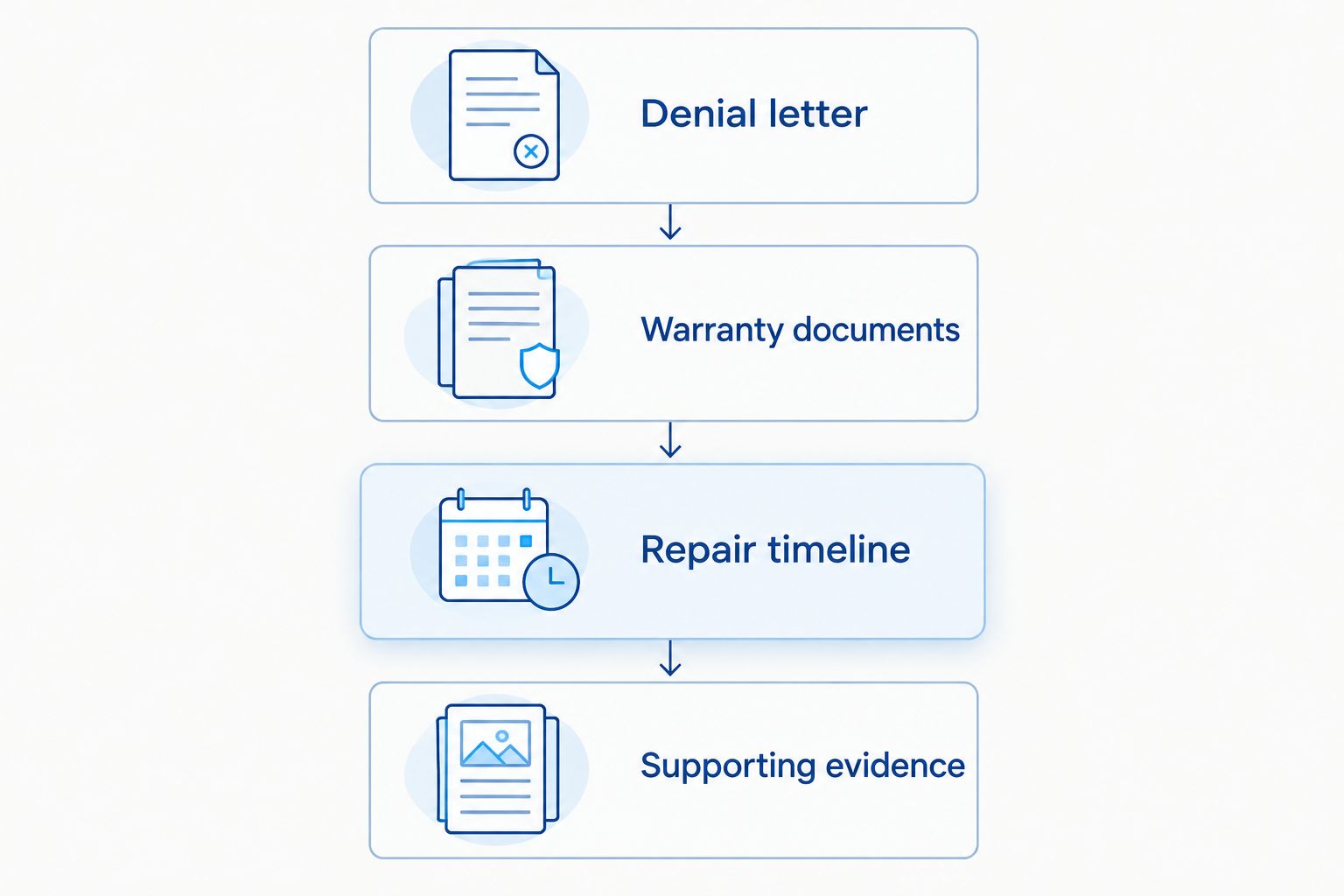
Prepare a file in this order:
- Denial letter: The manufacturer's stated position.
- Warranty documents: The coverage and transaction terms.
- Repair timeline: Dates, mileage, complaints, and work performed.
- Supporting evidence: Messages, maintenance records, and original recordings.
Khachikyanlawfirm offers lemon law representation in Glendale. Bring the rejection and complete records when seeking advice; legal review does not guarantee that a denied claim qualifies.
Discuss your lemon law denial
Bring your denial letter, warranty documents, and repair records to discuss your next step.
FAQ
Can I challenge a manufacturer's lemon law denial in California?
Yes. A manufacturer's rejection is not a court judgment, but the available response depends on eligibility, evidence, procedure, and deadlines. Preserve the rejection and obtain a claim-specific review.
Do I need a specific number of repairs to qualify?
No single repair count decides every California lemon law claim. The statutory presumption has specific conditions, while the broader reasonable-opportunity analysis depends on the circumstances.
Does a could-not-duplicate repair order defeat my claim?
No. A could-not-duplicate notation does not automatically defeat a claim, but it creates an evidence issue. Preserve consistent symptom descriptions, service records, and safely obtained recordings.
Can a used car qualify if the original warranty remains?
Remaining original manufacturer coverage alone does not automatically establish eligibility for California's new-vehicle replacement or restitution remedy. The sale documents, warranty issued with the transaction, and other potential claims need separate review.
Does a recall automatically make my car a lemon?
No. A recall alone does not establish lemon law eligibility. Connect the recalled condition to your vehicle, repair history, and applicable warranty obligations.
Does a warranty denial mean my lemon law claim is denied?
No. A rejected warranty repair and a rejected statutory buyback request are different decisions. Identify which decision you received before choosing a response.
Should I keep making payments while disputing a lemon law denial?
A lemon law dispute does not itself suspend your loan or lease obligations. Review your agreement and seek legal advice before withholding payments or surrendering the vehicle.
One last thing
The most useful sentence in a denial is the specific reason given—not the rejection itself. Compare that reason with your records before responding. For your 2026 review, ask Khachikyanlawfirm to assess the stated defense, applicable deadlines, and available legal options rather than assuming the next step is another repair visit.
This article provides general California legal information, not advice about your individual claim.


