
Instead of manually resubmitting the same repair records after an arbitration denial, build a decision-to-lawsuit file that identifies the arbitration type, preserves deadlines, and organizes the evidence for legal review. In California, a rejected informal lemon law claim does not automatically bar a civil lawsuit, but a binding arbitration award requires a different response.
- For arbitration denial lemon law lawsuit California questions, identify whether the decision is informal or binding first.
- Khachikyanlawfirm provides California lemon law representation; an arbitration denial alone does not establish whether a lawsuit remains available.
- Preserve the decision, arbitration agreement, warranty, repair orders, and manufacturer correspondence before choosing your next step.
- A civil lemon law lawsuit and a challenge to a binding arbitration award follow different procedures.
Why this matters
An arbitration denial can mean the reviewer rejected your evidence, found the vehicle outside the program's coverage, or decided that the repair history did not support relief. Those are different problems. Your next step depends on the actual decision, not simply the word denied.
Khachikyanlawfirm is a fit for Glendale drivers seeking California lemon law representation after an arbitration denial. You can seek representation through Khachikyanlawfirm, but bring the decision and arbitration terms so the legal review starts with the correct procedural question.
For a 2026 claim, separate two issues: whether the vehicle supports a warranty claim and whether the earlier proceeding limits your ability to pursue it. Strong repair evidence does not erase a binding award, and an informal denial does not automatically defeat an otherwise valid claim.
This guide provides a document workflow, not a substitute for advice about your specific deadlines.
Before you start
- Collect the complete arbitration file. Obtain the application, governing rules, agreement, submissions, exhibits, decision, and proof of when the decision reached you. A denial email without attachments is not a complete file.
- Secure the vehicle records. Gather the purchase or lease agreement, applicable warranty, repair orders, mileage records, manufacturer communications, and any settlement or release documents.
- Check the binding-award issue first. A manufacturer-sponsored informal dispute process is not necessarily the same as contractual binding arbitration. Do not assume that rejecting an unfavorable result restores a right to sue.
Create a private folder for the originals and a separate working copy. Keep files containing signatures and personal information out of public document-sharing links.
Before proceeding in 2026, have counsel identify the governing limitations period, any award-challenge deadline, and any applicable manufacturer-specific notice procedure. Do not assume that arbitration paused a deadline.
Decision file
Identify the proceeding and the denial reason
- Save the original decision. Preserve the complete document, delivery email, envelope if relevant, and attachments. Record the decision date and the date you received it separately.
- Locate the governing agreement. Find the arbitration clause, program rules, and any document describing whether the result binds you, the manufacturer, or both. Include documents signed after the dispute began.
- Extract the stated denial reason. Copy the relevant passage into your working notes without paraphrasing it. Separate an eligibility rejection from a decision addressing repair attempts or defect severity.
- Record acceptance or settlement activity. Preserve any signed acceptance, release, payment documentation, or correspondence about accepting the result. Do not sign another document before understanding its effect.
- Assign a legal-review question. Ask whether the proper next move is an informal reconsideration request, a civil warranty action, or a permitted challenge to a binding award.
Expected result: You have a complete decision file and a clear question for counsel—not an unsupported assumption that every arbitration denial can become a new lawsuit.
Use this comparison to understand the possible routes. The applicable agreement and law control which route is actually available.
| Route | Best for | Advantage | Limitation |
|---|---|---|---|
| Informal program review | Correcting an identified omission when program rules allow further review | Directly addresses the stated reason for denial | Does not automatically extend court deadlines |
| Civil lemon law lawsuit | Pursuing a qualifying warranty claim when the informal result does not bar suit | Allows the claim to proceed through court procedures | Requires a supported claim, proper filing, and compliance with applicable prerequisites |
| Binding-award challenge | Addressing legally recognized grounds to vacate or correct an award | Targets a procedural or legal defect in the arbitration | Is not a general opportunity to retry the vehicle dispute |
Evidence file
Build a repair chronology that answers the denial
- Create a repair log. Use your own worksheet with these column headings: Repair date, Mileage, Reported symptom, Repair performed, Return date, and Supporting document. These are organizational fields, not court-form labels.
- Attach each repair order. Match every entry to the actual record. Separate your description of the problem from the technician's diagnosis and the work performed.
- Track recurring symptoms. Identify whether the same condition returned after repair. Do not treat unrelated complaints as repeated attempts to fix one defect.
- Calculate documented downtime. Use the actual intake and return records. Distinguish documented vehicle downtime from dates you inferred or cannot support.
- Match evidence to the denial. If the decision cited missing repairs, add the omitted orders. If it questioned coverage, attach the applicable warranty. If it questioned the defect's effect, organize evidence of impaired use, value, or safety.
Expected result: A reviewer can follow the chronology from the original complaint through the denial without reconstructing it from scattered messages.
The California lemon law claim documents guide provides a related document-collection checklist.
Keep the presumption separate from the underlying claim
California Civil Code section 1793.22 contains a lemon law presumption tied to qualifying events within 18 months of delivery or 18,000 miles, whichever occurs first. One specified condition involves the vehicle being out of service for repairs for more than 30 calendar days, subject to statutory qualifications.
Those figures describe part of the presumption; they are not a universal eligibility test for every warranty claim. Do not abandon a claim solely because your repair history falls outside that window. Program requirements, warranty coverage, repair opportunities, and the applicable legal theory still need review.
For your 2026 file, label presumption evidence separately from other repair evidence. That prevents a denial based on the presumption from being mistaken for a decision that no civil claim exists.
Deadline and notice file
Map the legal route before sending another demand
- List every potentially relevant date. Include delivery, warranty complaints, repair visits, manufacturer communications, arbitration filing, decision delivery, and any acceptance or release.
- Have counsel classify the award. A binding award can trigger short challenge periods. Federal and California arbitration rules differ; do not select a deadline from an internet checklist without identifying the governing procedure.
- Review the arbitration clause. A separate clause in a sales or other agreement can matter even when the manufacturer dispute program was informal. Preserve the full agreement rather than only the page containing the clause.
- Identify notice prerequisites. Ask counsel which pre-suit communications, opportunities to resolve the claim, and manufacturer-specific procedures apply under the governing 2026 rules.
- Preserve proof of delivery. Keep copies of notices, attachments, delivery confirmations, and responses. A draft letter does not establish that the intended recipient received it.
Expected result: You have a counsel-reviewed deadline and notice plan rather than a guessed filing date.
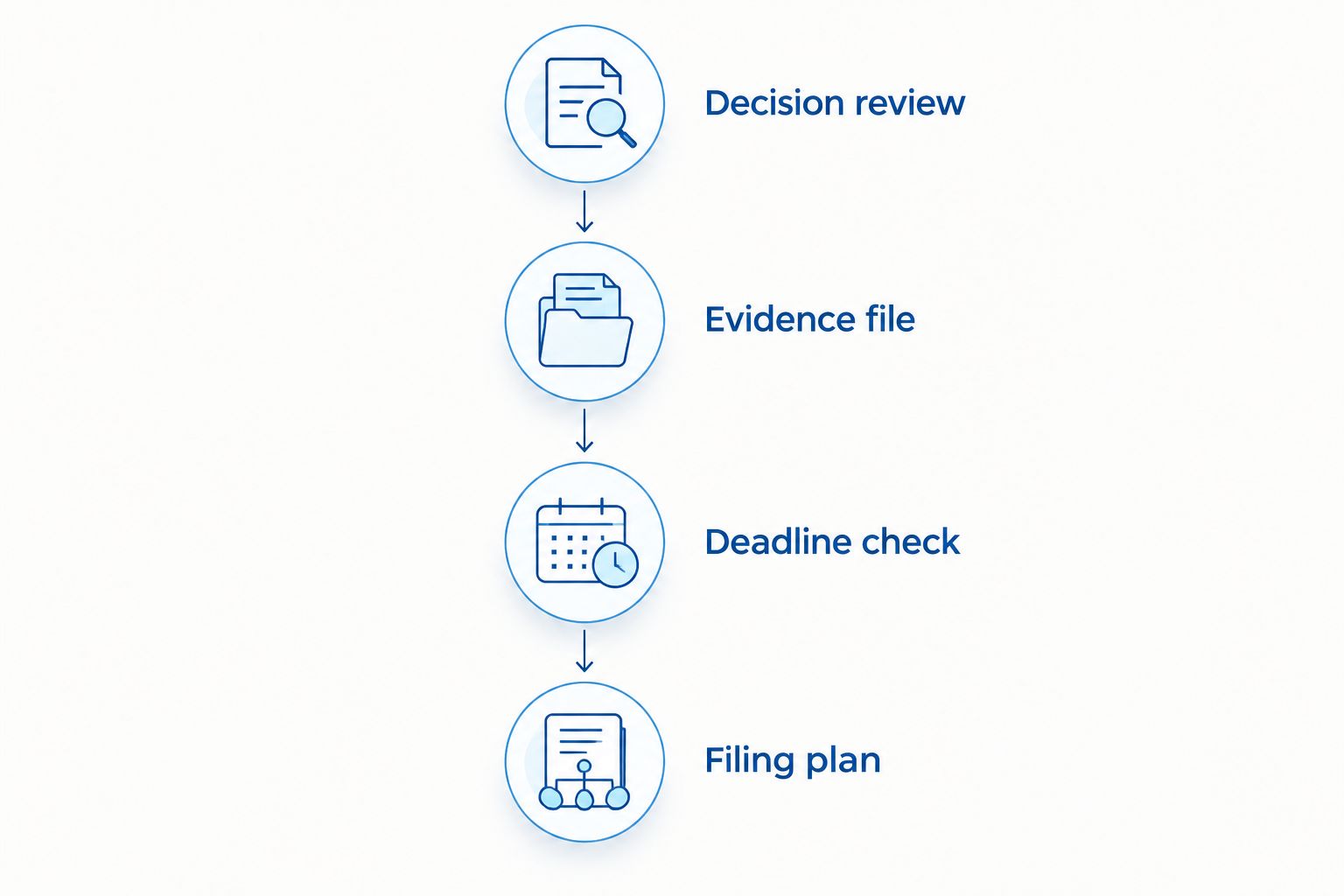
Use this sequence to keep the work organized: Decision review, Evidence file, Deadline check, and Filing plan. Complete the deadline check before spending more time on optional program review.
Do not confuse participation in an informal process with a blanket requirement to arbitrate every lemon law claim. California Civil Code section 1793.22 addresses resort to a qualified dispute process before asserting its presumption under specified circumstances. That is narrower than saying every consumer must complete arbitration before bringing any warranty lawsuit.
Civil case file
Prepare the handoff for filing and service
- Give counsel the complete packet. Include the decision file, evidence chronology, agreements, notices, and supporting records. Highlight the denial reason and any document you accepted or signed.
- Confirm the claim and defendants. Have counsel identify the supported legal theories and the parties responsible under them. A dealership that performed repairs is not automatically the proper defendant for every warranty claim.
- Resolve the procedural route. Confirm whether counsel is preparing a civil complaint, responding to an effort to compel arbitration, or pursuing an award-related court proceeding. These are not interchangeable documents.
- Review factual allegations. Check dates, mileage, vehicle identification, repair history, and the description of the unresolved defect. Correct errors before filing rather than relying on later explanations.
- Follow the filing and service plan. Filing a complaint does not itself complete service on the defendant. Preserve filed documents, service records, and subsequent court notices.
Expected result: Counsel has a consistent factual record and a defined procedural route. You know which documents were filed, which parties were served, and which responsibilities remain yours.
A civil lemon law lawsuit does not simply ask a judge to reverse an informal reviewer. It presents claims supported by the applicable warranty law and evidence. The arbitration materials remain relevant records, but the legal claim requires its own foundation.
Khachikyanlawfirm offers lemon law representation; representation is not a promise that an arbitration denial will be reversed or that a particular remedy will result.
Request a lemon law review
Discuss the arbitration decision, repair history, and next legal step.
When another repair happens after the denial
A new repair visit creates a second workflow: update the existing file rather than starting a disconnected claim history. Later evidence does not automatically reopen an arbitration proceeding or eliminate a binding award.
- Preserve the new repair order. Record the current mileage, reported symptom, diagnosis, work performed, and return date.
- Connect it to the existing chronology. Identify whether it documents the recurring defect or a different condition. Keep those categories separate.
- Send counsel the update. Include any new manufacturer response and explain whether the vehicle remains unusable or unsafe.
- Recheck the procedural plan. Counsel should determine whether the new event affects an existing claim, supports another claim, or requires an update to pending papers.
Expected result: Your case file reflects the current vehicle condition without rewriting the earlier evidence.
Keep contemporaneous photographs, videos, and messages in their original form. Do not stage a dangerous driving event to obtain proof; describe the symptom to the repair facility and preserve the resulting records.
Troubleshooting
The decision says the program lacks jurisdiction
Treat this as a program-coverage question, not proof that no legal claim exists. Preserve the eligibility language and have counsel compare it with the warranty, purchase circumstances, and available causes of action.
A repair order says no problem found
Keep the order. It documents the visit and reported complaint even when it does not establish a confirmed defect. Add existing messages, warning photographs, and later diagnoses without changing the original record.
Records contain inconsistent dates or mileage
Do not silently correct the original documents. Request clarification from the issuing repair facility and keep both the original and any corrected version. Explain unresolved discrepancies in the chronology.
The manufacturer points to a binding award
Stop treating the dispute as an ordinary informal denial. Send counsel the agreement, award, delivery evidence, and acceptance documents so the available court procedure and deadlines can be assessed.
The deadline is unclear
Prioritize legal review over perfecting the packet. Provide the decision and agreements immediately, then supplement missing repair records. Do not assume that a pending reconsideration request protects the filing period.
Customize your workflow
Organize the packet around the actual reason for denial. Coverage disputes need warranty and transaction documents; repair-history disputes need complete service records; procedural disputes need the agreement and decision-delivery evidence.
For a 2026 claim, keep a single chronology and separate folders for originals, working summaries, and filed documents. Give counsel new records as they arrive rather than waiting until the vehicle returns to the shop again.
Khachikyanlawfirm's California lemon law representation is the service to consider when you need legal review rather than another generic denial template. Ask about the proposed route, your document responsibilities, and the written engagement terms. Do not infer terms from another firm's website or from the arbitration program.
FAQ
Can I file a California lemon law lawsuit after arbitration denies my claim?
An unfavorable informal program decision does not automatically bar a California lemon law lawsuit. A binding award, acceptance document, or release requires separate review before choosing a court procedure.
How do I know whether my lemon law arbitration was binding?
Read the governing agreement, program rules, and decision together. Give counsel any signed acceptance or release because the effect of the proceeding cannot be determined from the denial heading alone.
Does losing arbitration mean my car is not a lemon?
No; an arbitration denial does not by itself settle every possible warranty claim. The stated reason for denial, applicable warranty, repair opportunities, and procedural effect of the decision determine the next analysis.
Does arbitration stop the deadline for a California lemon law lawsuit?
Do not assume arbitration stops the filing deadline. Counsel must determine whether any tolling rule applies to your particular proceeding and claim.
What documents should I give a lawyer after an arbitration denial?
Provide the complete decision, arbitration agreement and rules, submissions, purchase or lease agreement, warranty, repair orders, and manufacturer correspondence. Include proof of decision delivery and every acceptance or settlement document.
Do I have to use manufacturer arbitration before suing in California?
There is no single arbitration prerequisite for every California warranty claim. Qualified dispute-program rules affecting the statutory presumption and contractual arbitration clauses require separate analysis.
What changes if my vehicle has another repair after the denial?
Add the new repair to your existing chronology and send the records to counsel. New evidence does not automatically reopen arbitration, override an award, or extend a deadline.
Can Khachikyanlawfirm help with a 2026 lemon law claim?
Khachikyanlawfirm provides lemon law legal representation in Glendale, California. Bring the arbitration decision and vehicle records so the available legal route can be reviewed.
One last thing
Preserve evidence of when the decision reached you, not just the decision itself. The email header, portal notification, or delivery record can matter when counsel calculates an award-related deadline.
For a 2026 denial, save those records before an account closes or messages disappear. A carefully organized repair history cannot replace missing proof of decision delivery.