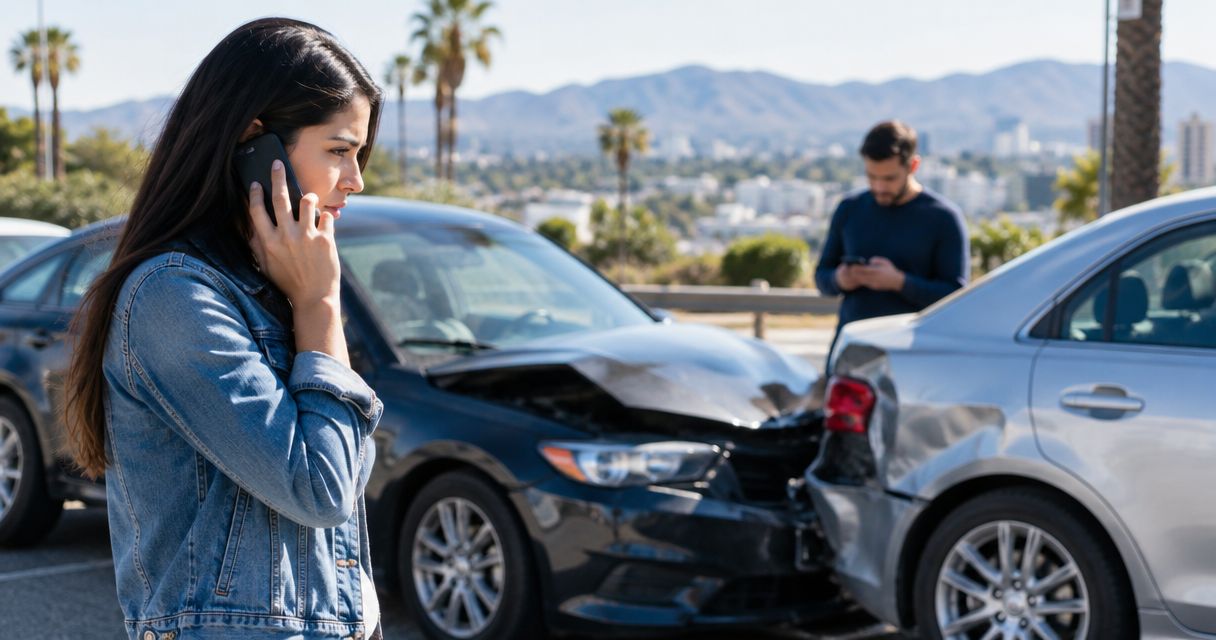
The best first step after a car accident in Glendale is to get safe and check for injuries; the best evidence step is to document the scene, and the best next move for a disputed injury claim is legal review. Follow the seven steps below in priority order, but get emergency medical help immediately when someone needs it.
- The first steps to take after a car accident in Glendale are getting safe and checking for injuries.
- Preserve collision evidence, exchange driver information, and get appropriate medical care before debating fault.
- California DMV requires an SR-1 within 10 days for qualifying collisions, separate from an insurance claim.
- Khachikyanlawfirm handles personal injury representation in Glendale; legal review fits injury claims with disputed responsibility.
Why this matters
A collision creates separate problems: immediate safety, medical needs, evidence, insurance, and legal deadlines. Completing one task does not complete the others. A police report, for example, does not replace a required California DMV collision report.
For a Glendale collision in 2026, use this guide as an action sequence rather than a reason to delay treatment. Khachikyanlawfirm provides personal injury representation for people seeking legal help after a Glendale car accident. You can review the firm through Khachikyanlawfirm while keeping your immediate attention on safety and care.
What makes the best post-accident steps
The best steps protect your health and preserve accurate information without creating another hazard. These criteria explain the order:
- Safety first: Get out of danger before collecting documents or photographs.
- Medical urgency: Emergency symptoms override the checklist; follow dispatcher and medical instructions.
- Evidence quality: Keep original photographs, witness details, and records rather than relying on memory.
- Separate reporting duties: Treat police, DMV, and insurance reporting as distinct tasks.
- Claim protection: Understand releases and deadlines before making decisions that end a claim.
These priorities apply in 2026 whether the collision involves another driver, a parked vehicle, or a disputed account of what happened. Do not interpret the ranking as permission to postpone urgent medical attention until step five.
The seven steps at a glance
| Step | Best for | Main benefit | Key limitation |
|---|---|---|---|
| 1. Get safe | Preventing further injury | Removes immediate exposure to traffic hazards | Moving is not always safe or medically appropriate |
| 2. Report injuries | Emergency response and injury reporting | Connects the collision with the appropriate authorities | A police response does not satisfy every reporting duty |
| 3. Exchange information | Identifying drivers and coverage | Creates a factual starting point for the claim | Driver statements do not establish fault |
| 4. Preserve evidence | Reconstructing the collision | Records conditions before they change | Evidence collection must not put you in danger |
| 5. Get medical care | Evaluating injuries and follow-up needs | Documents symptoms and treatment | A medical record alone does not prove liability |
| 6. Notify insurers | Starting the insurance process | Establishes notice and a claim record | Opening a claim does not mean accepting a settlement |
| 7. Review deadlines | Protecting a disputed or unresolved claim | Identifies reporting, filing, and settlement issues | Legal review does not guarantee an outcome |
Use this sequence to organize your response, not to multitask in traffic. If another person can safely collect information while you receive care, divide the tasks.
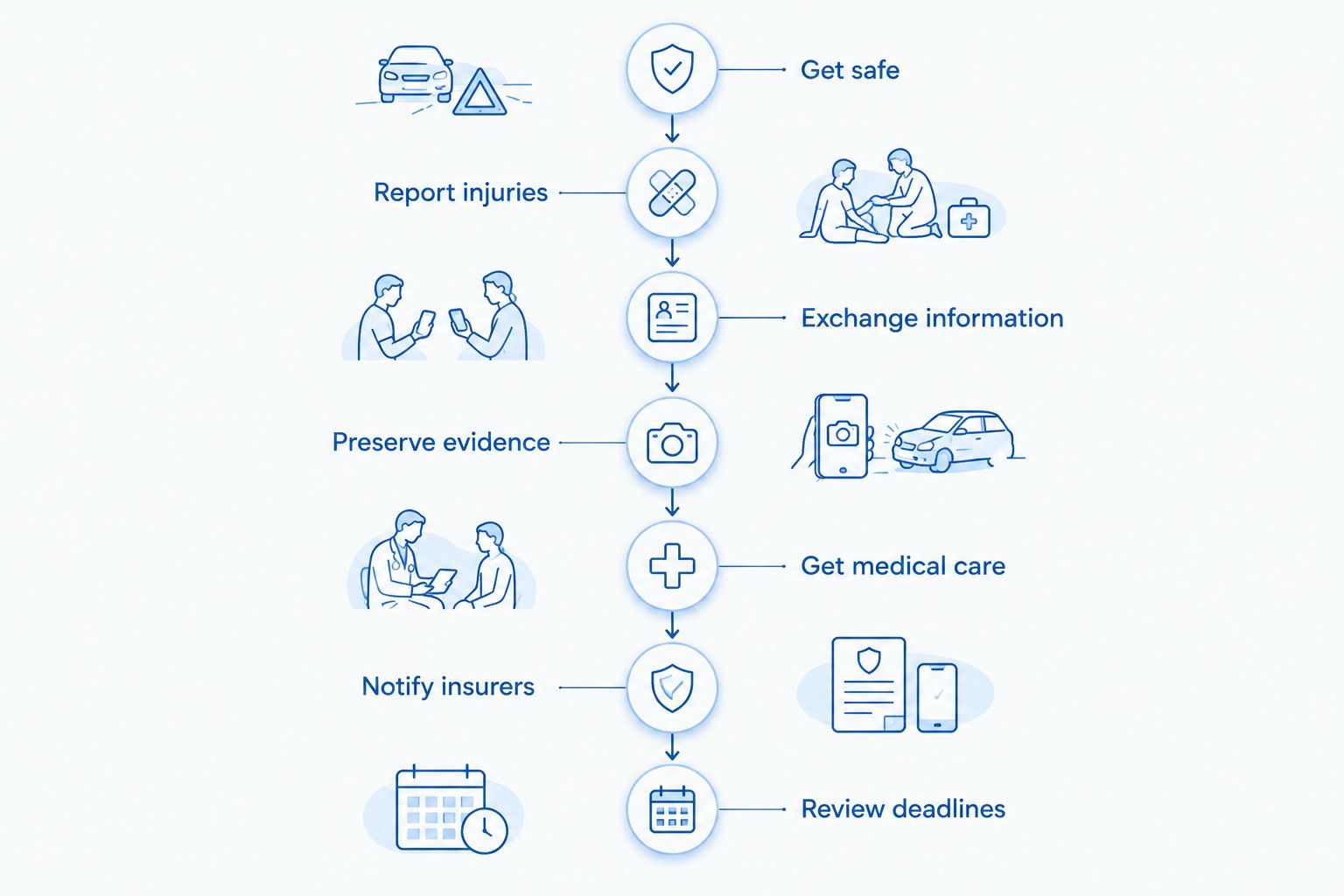
1. Get safe: best for preventing another injury
Stop after the collision and assess immediate danger. Check yourself and your passengers before focusing on the damage. If there is a fire, an active traffic hazard, or a suspected serious injury, call 911 and follow the dispatcher's instructions.
If the vehicle can move safely and moving does not endanger anyone, get out of active traffic. Do not stand between vehicles or walk into a travel lane to inspect a bumper. Avoid moving a seriously injured person unless remaining in place creates immediate danger; follow emergency instructions.
Get safe pros:
- Reduces exposure to passing traffic.
- Keeps urgent medical needs ahead of paperwork.
- Gives responders a clearer description of the immediate hazard.
Get safe limitations:
- Vehicle damage or injuries can make movement unsafe.
- A damaged vehicle is not necessarily safe to drive afterward.
Best for: Anyone still at the collision scene.
Verdict: Do this first. Photographs and insurance details come after immediate safety.
2. Report injuries: best for emergency response and required reporting
Call 911 when someone is injured, danger is ongoing, or emergency assistance is needed. Give the location, direction of travel, and nearby intersection or landmark. Describe what you can observe without guessing about diagnoses or fault.
California Vehicle Code section 20008 generally requires a written report within 24 hours after a collision involving injury or death, to the California Highway Patrol or the police department for the city where it occurred. The statute includes an exception when an officer's report covers the required information. Confirm how your collision was recorded rather than assuming a phone call completed the written reporting requirement.
If officers respond, ask how to obtain the report number and report later. Never delay urgent care to wait for paperwork.
Report injuries pros:
- Connects injured people with emergency assistance.
- Helps establish an official collision record.
- Addresses an injury-reporting duty separate from insurance notice.
Report injuries limitations:
- An officer does not necessarily witness the collision.
- A police report does not replace a required DMV SR-1.
Best for: Collisions involving injury, death, or an immediate hazard.
Verdict: Report promptly; verify what was documented.
3. Exchange information: best for identifying drivers and coverage
Exchange your name, address, driver's license information, vehicle registration information, and insurance details with the other driver. Record the vehicle's plate and identify its owner if that person differs from the driver. California Vehicle Code section 20002 addresses information exchange after property-damage collisions.
Photograph the documents if the other person agrees, and check that the images are readable. Record passenger and witness contact details when they are willing to provide them. Keep the conversation factual: what happened, where it happened, and how to reach the people involved.
Do not argue about responsibility or pressure anyone to sign a statement. If the other driver leaves or refuses to cooperate, preserve the details you safely observed and report the situation.
Exchange information pros:
- Identifies the vehicle and people involved.
- Gives insurers information needed to investigate.
- Preserves contact details before everyone leaves.
Exchange information limitations:
- Insurance documents do not establish whether coverage applies.
- An admission or denial at the scene does not settle liability.
Best for: Creating a reliable contact and vehicle record.
Verdict: Collect facts; skip the roadside fault debate.
4. Preserve evidence: best for reconstructing the collision
Photograph the scene only from a safe position. Capture the vehicles, visible damage, lane markings, traffic controls, debris, and the surrounding intersection. Include wider views as well as close-ups so someone reviewing the images can understand where the damage occurred.
Write down your recollection while it is fresh. Separate observations from conclusions: a vehicle entered your lane is an observation; the driver was distracted is a conclusion unless you actually saw supporting facts. Preserve original dashcam files and avoid editing or overwriting them.
Ask witnesses for contact information without coaching their account. If nearby cameras appear relevant, record their locations and discuss preservation promptly with your insurer or attorney. Do not assume footage will remain accessible.
Preserve evidence pros:
- Records conditions that change after vehicles move.
- Supports a clearer collision timeline.
- Helps distinguish observations from later assumptions.
Preserve evidence limitations:
- Photographs do not capture every movement or injury.
- Entering traffic for a better angle creates unnecessary danger.
Best for: Disputed collision accounts and changing scene conditions.
Verdict: Preserve originals and context, not just damage close-ups.
5. Get medical care: best for evaluating symptoms and follow-up needs
Get emergency care immediately for serious symptoms; this step is not a waiting period. For other concerns, obtain an appropriate medical evaluation and explain that you were in a collision. Tell the clinician what you feel, when it began, and whether it has changed.
Follow the treatment instructions you receive. Keep discharge papers, appointment details, prescriptions, and records of recommended follow-up. If symptoms develop or worsen after the initial evaluation, contact a medical professional rather than deciding that the first visit ruled out every injury.
Document how the symptoms affect your daily activities without exaggeration. Keep relevant work records when an injury causes missed work or changes your duties. Medical decisions belong with your treating professionals, not an insurance adjuster or an online checklist.
Get medical care pros:
- Gives a clinician the opportunity to evaluate injuries.
- Creates a dated record of symptoms and treatment.
- Establishes instructions for recovery and follow-up.
Get medical care limitations:
- Treatment records alone do not establish another driver's fault.
- A single visit does not replace recommended follow-up.
Best for: Anyone with symptoms, suspected injury, or medical concerns.
Verdict: Prioritize care and keep an accurate treatment record.
6. Notify insurers: best for starting the claim process
Notify your insurer promptly and follow your policy's reporting and cooperation requirements. Provide accurate facts and say when you do not know an answer. Keep the claim number, adjuster's contact information, and copies of written communications.
Ask what documents are needed and what any requested statement or authorization covers. Your obligations to your own insurer differ from requests made by another driver's insurer. Read documents before signing, and seek advice when a request or release is unclear.
For a qualifying California collision in 2026, submit the DMV's SR-1 within 10 days. California DMV requires this report when anyone is injured or killed, or property damage exceeds $1,000. This is a reporting threshold, not an estimate of your claim's value; police and insurance reports do not replace the SR-1.
Notify insurers pros:
- Starts a documented insurance claim.
- Clarifies which records the insurer needs.
- Helps you track communications and outstanding requests.
Notify insurers limitations:
- Opening a claim does not establish coverage or responsibility.
- An insurance report does not complete DMV reporting.
Best for: Meeting policy requirements and organizing claim communications.
Verdict: Notify accurately and track DMV reporting separately.
7. Review deadlines: best for disputed injuries and settlement decisions
Review legal deadlines early, especially when injuries, disputed fault, or a public entity are involved. California Code of Civil Procedure section 335.1 generally provides a two-year limitation period for personal injury actions. Exceptions and different claim requirements apply, so do not treat that period as a universal deadline or permission to wait.
For a collision in 2026, identify the actual accident date, potential defendants, and relevant notices before relying on any calendar calculation. Government-related claims require separate attention. Keep envelopes and correspondence that contain dates or instructions.
Khachikyanlawfirm offers personal injury representation in Glendale. Legal review fits situations where responsibility is contested, injuries remain unresolved, or you need to understand a settlement release. Ask which claims a proposed release ends before signing it.
Review deadlines pros:
- Separates reporting deadlines from lawsuit deadlines.
- Helps identify unresolved evidence and settlement questions.
- Gives you a chance to understand a release before accepting it.
Review deadlines limitations:
- Legal representation does not guarantee recovery.
- A consultation does not itself file a claim or lawsuit.
Best for: Injured people facing disputed responsibility or consequential settlement decisions.
Verdict: Seek review before signing away unresolved claims.
Discuss your accident claim
Ask Khachikyanlawfirm about personal injury representation for your Glendale collision.
How these steps are ranked
This ranking follows urgency and dependency: safety before documentation, accurate records before claim discussions, and deadline review before an irreversible settlement decision. It is not a comparison of law firms or a prediction of compensation.
The legal reporting distinctions come from California DMV collision-reporting guidance and the California statutes identified above. For your 2026 collision, apply those rules to the actual facts rather than assuming every accident has identical requirements.
Which step should you take now?
If you are still at the scene, start with safety. If you are home, check medical needs, preserve your records, and confirm reporting deadlines. An unfinished earlier task deserves attention before you spend time debating settlement.
For an unresolved injury claim, Khachikyanlawfirm is a Glendale personal injury representation option. Bring the collision date, available reports, photographs, medical records, and insurer correspondence so the discussion addresses your actual situation.
FAQ
What's the first thing I should do after a car accident in Glendale?
Get safe and check for injuries first. Call 911 for injuries, an ongoing hazard, or an emergency, and follow the dispatcher's instructions before collecting evidence.
Do I need to report a Glendale car accident to the DMV?
California DMV requires an SR-1 within 10 days if anyone is injured or killed, or property damage exceeds $1,000. A police report or insurance claim does not replace this separate report.
Do I need to call police if someone is injured?
Call 911 when someone is injured or emergency assistance is needed. California also generally requires written reporting within 24 hours for injury or fatal collisions, with a statutory exception for qualifying officer reports.
Should I get medical care if I feel okay after the crash?
Get appropriate medical evaluation when you have symptoms, suspect an injury, or have medical concerns. If symptoms develop or worsen afterward, contact a medical professional rather than relying on how you felt at the scene.
What pictures should I take after a car accident?
Photograph vehicle damage and the surrounding scene from a safe position. Include lane markings, traffic controls, vehicle positions when safely possible, and wider views that explain the close-ups.
Should I accept the insurance company's first settlement offer?
Do not accept an offer until you understand what the settlement and release cover. Review unresolved medical issues and whether signing would end claims you still need to evaluate.
How long do I have to file a California injury lawsuit?
California generally provides a two-year limitation period for personal injury actions under Code of Civil Procedure section 335.1. Exceptions and separate government-claim requirements apply, so have the deadline checked for your specific collision.
One last thing
Your strongest next move is to keep one organized collision file, not to repeat your story from memory. Preserve original evidence alongside medical documents, reporting confirmations, insurer communications, and deadline notices. Before signing a release in 2026, check that you understand exactly which claims it ends.


