
Best starting point: medical records. Best for documenting fault: incident reports and original scene evidence. Best for proving lost earnings: employment and income records. This 2026 checklist explains the documents to gather for a California personal injury claim; Khachikyanlawfirm provides personal injury representation in Glendale, California.
- Documents needed for personal injury claim California: start with medical records, incident reports, photographs, bills, and income records.
- Medical records document injuries and treatment; photographs and witness information help establish what happened.
- Keep insurance correspondence, receipts, and dated recovery notes together without altering the originals.
- Do not wait for a complete document file before checking California filing deadlines.
Why these documents matter
A personal injury claim needs evidence connecting the incident, responsibility, injuries, and losses. A medical bill shows a charge; it does not, by itself, establish who caused your injury.
This is a collection checklist, not a rule that every claimant must possess every document. A pedestrian injury, workplace-related third-party claim, and store fall will produce different records. Missing a police report does not automatically end a claim.
For your 2026 file, focus on documents that answer a specific question rather than collecting paperwork without context. Khachikyanlawfirm is a fit for people seeking personal injury representation in Glendale, California.
What makes the best personal injury claim evidence?
- Connection: The document links an injury or loss to the incident.
- Timing: A dated record establishes when something happened or was reported.
- Specificity: Names, locations, symptoms, and work restrictions explain more than general statements.
- Authenticity: Original files and identifiable sources support verification.
- Completeness: Full reports and statements preserve context that excerpts omit.
- Distinct purpose: Each document answers a different question about fault, treatment, or damages.
California injury documents at a glance
The ranking below reflects each category's role in building a claim, not a legal hierarchy. Preserve disappearing evidence immediately, even when it appears lower on this list.
| Rank and document | Best for | Standout value | Key limitation |
|---|---|---|---|
| 1. Medical records | Documenting injuries | Diagnoses, findings, and treatment history | Do not independently establish fault |
| 2. Incident reports | Establishing an initial account | Parties, location, and recorded observations | Can contain omissions or disputed statements |
| 3. Photographs and video | Preserving physical conditions | Shows the scene and visible damage | Limited by angle, timing, and context |
| 4. Witness information | Identifying independent accounts | Preserves a route to firsthand testimony | Recollections require verification |
| 5. Medical bills and payment records | Tracking treatment expenses | Identifies charges and payment activity | Billed totals do not establish claim value |
| 6. Employment and income records | Documenting lost earnings | Connects missed work to financial loss | Needs supporting work restrictions |
| 7. Insurance documents | Tracking coverage and decisions | Preserves policy terms and claim correspondence | Coverage does not establish liability |
| 8. Expense receipts | Recording incidental losses | Documents specific out-of-pocket spending | Requires a connection to the injury |
| 9. Recovery journal | Explaining daily limitations | Preserves dated examples of injury effects | Is your own account, not independent proof |
| 10. Property damage records | Documenting damaged belongings | Establishes repair or replacement issues | Does not measure injury severity |
1. Medical records: best for documenting injuries
Medical records describe examinations, symptoms, diagnoses, treatment, and restrictions. Request records from each relevant provider, including emergency care, follow-up appointments, specialists, and therapy. Keep imaging reports and discharge instructions with them.
Medical records pros:
- Establish a dated treatment history.
- Record clinical findings and reported symptoms.
- Identify treatment recommendations and work restrictions.
Medical records cons:
- A diagnosis does not establish another person's fault.
- Missing visits or inaccurate histories require explanation.
Best for: Showing what injuries were evaluated and how treatment progressed.
Tell providers accurately about symptoms, relevant prior conditions, and the incident. Request corrections through the provider rather than editing records yourself. See the guide to medical records and an injury demand letter for the next organizational step.
Verdict: Hold complete copies in your core claim file.
2. Incident reports: best for establishing the initial account
An incident report documents an early account of what happened. Depending on the setting, request a police collision report, business incident report, or workplace report. Save the report number and the reporting agency's or business's contact details.
Incident report pros:
- Identifies involved people and the incident location.
- Preserves recorded observations and statements.
- Provides leads to witnesses or additional evidence.
Incident report cons:
- Statements and conclusions can be disputed.
- A business might not voluntarily provide its internal report.
Best for: Establishing a starting account and identifying evidence sources.
Read the full report. Flag factual errors for your attorney, and ask the issuing organization about its correction or supplemental-statement process.
Verdict: Hold the complete report, not just its summary page.
3. Photographs and video: best for preserving physical conditions
Photographs and video preserve conditions that change after an incident. Keep wide views, close-ups, visible injuries, damaged objects, traffic controls, and any relevant hazard. Your safety and medical needs come before taking pictures.
Photograph and video pros:
- Shows conditions that written descriptions cannot fully capture.
- Preserves visible changes before cleanup or repairs.
- Helps place people and objects in context.
Photograph and video cons:
- An image records only its visible angle and moment.
- Cropping or editing can remove important context.
Best for: Showing the scene and physical evidence near the incident time.
Save original files separately from annotated copies. Identify nearby cameras promptly so an attorney can assess preservation requests; do not assume footage will remain accessible.
Verdict: Hold originals and skip filters or destructive edits.
4. Witness information: best for identifying independent accounts
Witness information creates a way to locate people who saw the incident or its immediate aftermath. Record names, contact information, where each person stood, and what each person says they personally observed.
Witness information pros:
- Identifies potential firsthand accounts.
- Helps distinguish direct observation from secondhand information.
- Gives your attorney a route to follow-up questions.
Witness information cons:
- Memory can be incomplete or inconsistent.
- A contact list alone does not prove what happened.
Best for: Finding accounts beyond those of the involved parties.
Keep witnesses' own messages intact. Do not coach anyone, draft a statement for someone to adopt, or pressure a witness to agree with your version.
Verdict: Hold accurate contact details and original communications.
5. Medical bills and payment records: best for tracking treatment expenses
Medical bills document charges, while payment records and insurance explanations show different parts of the financial picture. Keep itemized statements, payment confirmations, explanation-of-benefits documents, and lien or reimbursement notices together.
Medical billing record pros:
- Identifies providers and dates of service.
- Separates charges from payments and adjustments.
- Flags balances and reimbursement issues for review.
Medical billing record cons:
- Bills do not replace clinical records.
- Adding billed charges does not establish recoverable damages.
Best for: Building an accurate treatment-expense record.
Match each statement to its provider and treatment dates. Mark duplicate statements rather than counting them twice, and preserve notices even when the amount or responsibility is disputed.
Verdict: Hold the full billing history, not just outstanding balances.
6. Employment and income records: best for documenting lost earnings
Employment records help establish what work you missed and what income you lost. Gather pay statements, schedules, attendance records, employer correspondence, and medical work restrictions. Self-employed claimants should preserve relevant invoices, contracts, and business records.
Employment record pros:
- Establishes an earnings history.
- Identifies missed shifts or reduced duties.
- Supports a comparison between work capacity and actual earnings.
Employment record cons:
- Income changes can have causes unrelated to injury.
- Employer confirmation does not replace medical support for restrictions.
Best for: Connecting injury-related work limitations to financial loss.
Separate unpaid time, used leave, and changed duties. Preserve sensitive income documents securely and discuss the scope of any requested disclosure with your attorney.
Verdict: Hold records showing both earnings and the reason work changed.
7. Insurance documents: best for tracking coverage and decisions
Insurance documents explain policy terms and preserve what insurers communicated. Keep relevant declarations, policy documents, claim numbers, adjuster messages, coverage letters, settlement offers, and any forms you are asked to sign.
Insurance document pros:
- Identifies insurers and claim contacts.
- Preserves written decisions and requests.
- Establishes a dated correspondence history.
Insurance document cons:
- A declarations page does not contain every policy term.
- An adjuster's statement is not a court ruling.
Best for: Understanding the claim's coverage and communication history.
Save complete email threads and attachments. Read authorizations and releases carefully before signing; ask your attorney what records or rights the document covers.
Verdict: Hold complete correspondence, including disputed decisions.
8. Expense receipts: best for recording incidental losses
Receipts document injury-related spending outside the main medical bills. Preserve receipts for prescriptions, medical equipment, treatment-related transportation, and assistance you paid for because of injury-related limitations.
Expense receipt pros:
- Documents the date and nature of a purchase.
- Separates actual spending from estimates.
- Helps explain expenses absent from provider bills.
Expense receipt cons:
- Payment alone does not establish recoverability.
- Unrelated purchases need to be separated.
Best for: Supporting specific out-of-pocket expenses.
Add a short note explaining the injury-related purpose while the details are fresh. Keep supporting appointment records where relevant, and do not include the same expense under multiple categories.
Verdict: Hold receipts with a clear explanation of their connection.
9. Recovery journal: best for explaining daily limitations
A recovery journal records how symptoms affect daily activities. Write dated, factual entries about sleep, mobility, household tasks, missed activities, and help you needed. Describe specific limitations rather than assigning a settlement value to them.
Recovery journal pros:
- Preserves examples you might otherwise forget.
- Records changes throughout recovery.
- Helps you describe functional limitations accurately.
Recovery journal cons:
- Entries are your account, not independent medical findings.
- Exaggeration or inconsistencies undermine reliability.
Best for: Explaining the injury's effects between appointments.
Record improvement as honestly as setbacks. Do not assume a journal is confidential simply because you wrote it for your claim; discuss its handling with your attorney.
Verdict: Hold factual entries and skip reconstructed or exaggerated accounts.
10. Property damage records: best for documenting damaged belongings
Property damage records address vehicles, bicycles, clothing, phones, and other belongings damaged in the incident. Keep photographs, repair estimates, inspection findings, invoices, ownership records, and relevant insurer correspondence.
Property damage record pros:
- Identifies the property and claimed damage.
- Preserves repair findings and supporting paperwork.
- Documents a loss separate from bodily injury.
Property damage record cons:
- Repair estimates are not necessarily final expenses.
- Vehicle damage alone does not establish injury severity.
Best for: Keeping property losses distinct from medical and income losses.
Before disposing of an item that could be evidence, ask your attorney about preservation and inspection. Document its condition without attempting unsafe examination or repairs yourself.
Verdict: Hold the records and seek advice before discarding evidence.
How to organize your 2026 claim file
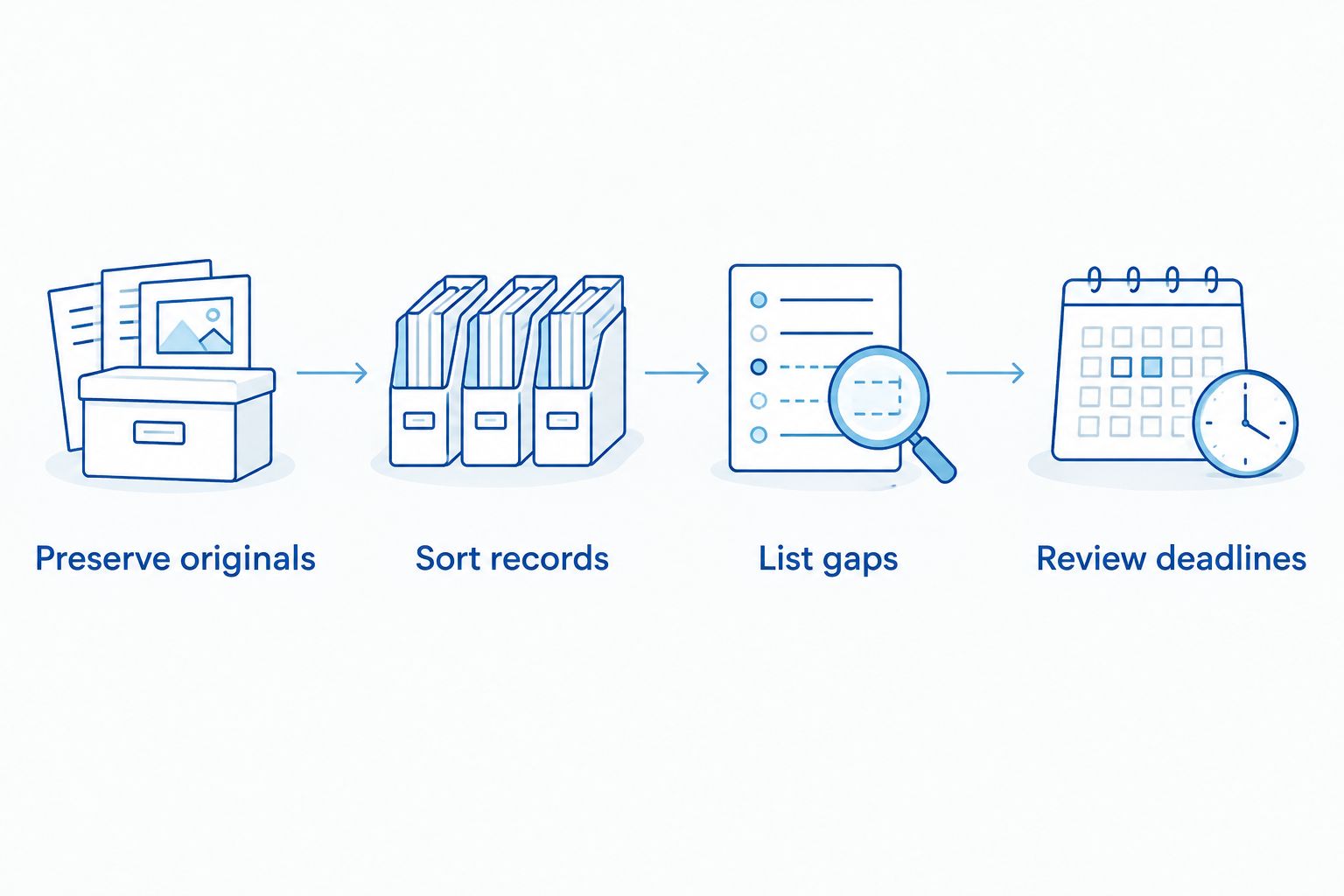
Create 1 master folder with clearly named subfolders. Keep originals unchanged and maintain 2 backup copies in separate secure locations. These are organizational recommendations, not legal filing requirements.
- Preserve originals: Keep complete files, attachments, and envelopes containing relevant notices.
- Sort records: Group documents by the categories above, then by date.
- List gaps: Identify missing providers, reports, receipts, or correspondence.
- Review deadlines: Record incident dates and notices for attorney review.
Use a separate index to explain what each file contains and where you obtained it. Give your attorney the index plus the underlying records, not a summary alone. Khachikyanlawfirm provides personal injury representation; bring the records you have rather than waiting for a perfect file.
Discuss your injury claim
Ask about representation and which records to gather for your situation.
Check deadlines before finishing the checklist
For California injury claims in 2026, Code of Civil Procedure section 335.1 generally provides 2 years to file a personal injury lawsuit. Government Code section 911.2 generally requires presenting a government claim involving personal injury within 6 months. Exceptions and different rules apply.
An insurance claim is not the same as filing a lawsuit or presenting a government claim. Do not assume negotiations, treatment, or record requests extend your deadline. Have an attorney check the rules for your facts promptly.
How these documents were ranked
This 2026 ranking places injury documentation first, followed by incident evidence and records of financial loss. The criteria are connection, timing, specificity, authenticity, completeness, and distinct purpose. Urgency takes priority over rank when footage or physical evidence needs preservation.
FAQ
What documents do I need to start a California personal injury claim?
Start with available medical records, incident details, photographs, insurance information, and records of expenses or missed work. You do not need every item on this checklist before seeking legal advice.
Can I pursue an injury claim without a police report?
A missing police report does not automatically prevent a personal injury claim. Photographs, witnesses, medical records, and other evidence can help establish what happened.
Are medical bills enough to prove my injuries?
Medical bills alone do not establish the full nature or cause of your injuries. Clinical records document findings, diagnoses, treatment, and restrictions.
What if I am still receiving treatment?
Keep collecting records as treatment continues. Do not wait until treatment ends to check deadlines or discuss evidence preservation with an attorney.
Should I send the insurance company my entire medical history?
Do not assume every medical record is relevant to the claim. Ask your attorney about the appropriate scope of disclosure and any authorization before signing.
How do I document lost income if I work for myself?
Preserve relevant invoices, contracts, tax records, business records, and evidence of canceled or reduced work. Medical restrictions help connect the income loss to your injury.
How long do I have to file a California injury lawsuit in 2026?
California's general personal injury lawsuit deadline is 2 years, but exceptions and different deadlines apply. Claims involving public entities generally require a separate government claim within 6 months; obtain advice about your specific deadline.
One last thing
The most urgent document is not always the highest-ranked document. A medical record can be requested later; overwritten surveillance footage cannot be recreated. For your 2026 claim, tell Khachikyanlawfirm about cameras, damaged objects, or other evidence at risk of disappearing before focusing on a polished document packet.
This checklist provides general information, not legal advice for your particular claim.


