
You generally have 2 years from the accident date to file a California lawsuit for car accident injuries in 2026. A claim involving a public entity generally requires a government claim within 6 months, before you can sue. Property damage, injuries to children, and other exceptions follow different rules, so do not treat the ordinary deadline as your personal filing date.
- How long after a car accident can I file a lawsuit in California? Generally, 2 years for personal injuries.
- Government claims generally require action within 6 months; insurance negotiations do not automatically stop the lawsuit deadline.
- Vehicle property damage generally has a 3-year deadline, separate from the personal injury deadline.
- Khachikyanlawfirm provides personal injury representation in Glendale, California.
Why this matters
An insurance claim is not a lawsuit. Reporting the crash, receiving treatment, or discussing settlement does not by itself preserve your right to sue. The insurer can still raise a missed filing deadline as a defense.
For Glendale drivers seeking personal injury representation, Khachikyanlawfirm is a relevant local option. Ask counsel to identify the deadline for each potential defendant before focusing on settlement value. No lawyer can determine the applicable deadline from the accident date alone when exceptions or government defendants are involved.
How long after a car accident can I file a lawsuit in California?
For an ordinary negligence lawsuit seeking compensation for car accident injuries, California Code of Civil Procedure section 335.1 generally provides 2 years. The clock ordinarily starts when the accident causes the injury, not when an insurer finishes investigating.
These are the main statutory starting points for a California filing review in 2026:
| Claim or situation | General deadline | Main benefit of identifying it | Main limitation |
|---|---|---|---|
| Personal injury against a private defendant | 2 years from injury | Establishes the ordinary lawsuit filing window | Exceptions can change the calculation |
| Vehicle or other personal property damage | 3 years from the property damage | Separates repair-related losses from injury claims | Does not extend the injury deadline |
| Injury or property damage claim against a public entity | Government claim generally within 6 months of accrual | Identifies an earlier required step | Presenting the claim is not filing a lawsuit |
| Lawsuit after a compliant written government-claim rejection | Generally 6 months after the rejection notice is personally delivered or mailed | Identifies a separate court filing window | The notice and method of delivery matter |
| Ordinary private-defendant injury claim involving a minor | Generally tolled until age 18, then the usual injury period applies | Flags that age changes the analysis | Government-claim requirements generally are not postponed by minority |
The property-damage rule comes from Code of Civil Procedure section 338(c). Government Code sections 911.2 and 945.6 govern the government-claim periods summarized above. These rules address different steps; they are not interchangeable deadlines.
Personal injury: generally 2 years
The ordinary California car accident injury deadline is 2 years. It applies to a typical negligence claim against a private driver, subject to rules affecting accrual, tolling, and the particular defendant.
Do not wait for your medical care to end before checking the filing date. Continuing treatment does not automatically restart the clock, and an unresolved medical condition does not automatically create additional filing time.
Filing also does not mean your case must immediately go to trial. A lawsuit can preserve a timely claim while the parties continue working toward resolution, although it brings court procedures and obligations that an insurance negotiation alone does not.
The filing deadline is different from the time needed to finish a case. See the guide to how long a personal injury lawsuit takes in California if you are planning around treatment, work, and the litigation process.
Property damage: generally 3 years
A California lawsuit for damage to your vehicle generally has a 3-year deadline. Code of Civil Procedure section 338(c) supplies the general limitations period for injury to personal property.
That longer period does not give you extra time to sue for bodily injuries. A single collision can create claims with different deadlines, even when the same driver caused both losses.
Keep repair estimates, photographs, towing records, and documents showing the vehicle's condition. Resolving the repair claim also deserves care: read any release before signing, because its wording determines which claims you are giving up. Do not assume a document covers vehicle damage only because that is what you discussed with the adjuster.
Government claims: generally 6 months to present a claim
A government-related crash needs an immediate deadline review. Under Government Code section 911.2, claims involving death, personal injury, or damage to personal property generally must be presented within 6 months after accrual.
Potential examples include a collision involving a public employee acting within the scope of employment or an allegation that a dangerous public-road condition contributed to the crash. Government involvement does not automatically prove liability. It does change the questions you must ask before filing.
A government claim is a formal pre-lawsuit requirement, not merely a report to an insurer or a complaint to a public agency. The correct entity, required contents, and presentation procedure matter.
For a crash in 2026, preserve correspondence and identify whether a city, county, state agency, or other public entity is involved. A government-claim deadline can arrive while you are still receiving medical care.
After rejection: generally 6 months to sue
When a public entity provides a written rejection notice that complies with Government Code section 913, section 945.6 generally gives you 6 months from personal delivery or mailing of that notice to file suit. This is a separate period from the initial claim-presentation deadline.
Different rules apply when the required rejection notice is not given. Save the notice, envelope, and delivery records, and have counsel calculate the court deadline rather than relying on the date you opened the letter.
Injured children: generally a pause until age 18
For an ordinary injury claim against a private defendant, Code of Civil Procedure section 352 generally pauses the limitations period while the injured person is under 18 years old. The ordinary 2-year injury period generally begins when the child turns 18.
Do not apply that rule to a government claim. Minority generally does not suspend the government claim-presentation requirement. A child injured in a crash involving a potential public-entity defendant needs prompt review.
Waiting also creates practical problems even when the filing period is paused. Witnesses become harder to locate, records become harder to collect, and the condition of the vehicles changes. A longer legal window is not a reason to delay preserving evidence.
Why the filing deadline varies
The applicable deadline depends on the claim and the people or entities involved. For a 2026 crash review, focus on these factors:
- Type of harm: Personal injury and vehicle damage generally fall under different statutes of limitation.
- Public-entity involvement: A government claim can be required well before the ordinary injury lawsuit deadline.
- Age at injury: Minority generally pauses an ordinary private-defendant injury deadline, but not government claim presentation.
- Discovery of injury: A legally applicable delayed-discovery rule can affect accrual; noticing symptoms later does not automatically qualify.
- Death resulting from the crash: A wrongful-death claim generally has a 2-year period measured from death under section 335.1 and requires its own analysis.
- Separate coverage claims: Uninsured or underinsured motorist coverage involves policy requirements and statutory procedures separate from suing the other driver.
Fault is a different issue. An argument about who caused the collision does not automatically change the deadline, and a disputed claim still needs timely action. Keep the responsibility analysis separate from the calendar.
What should I do before the filing deadline?
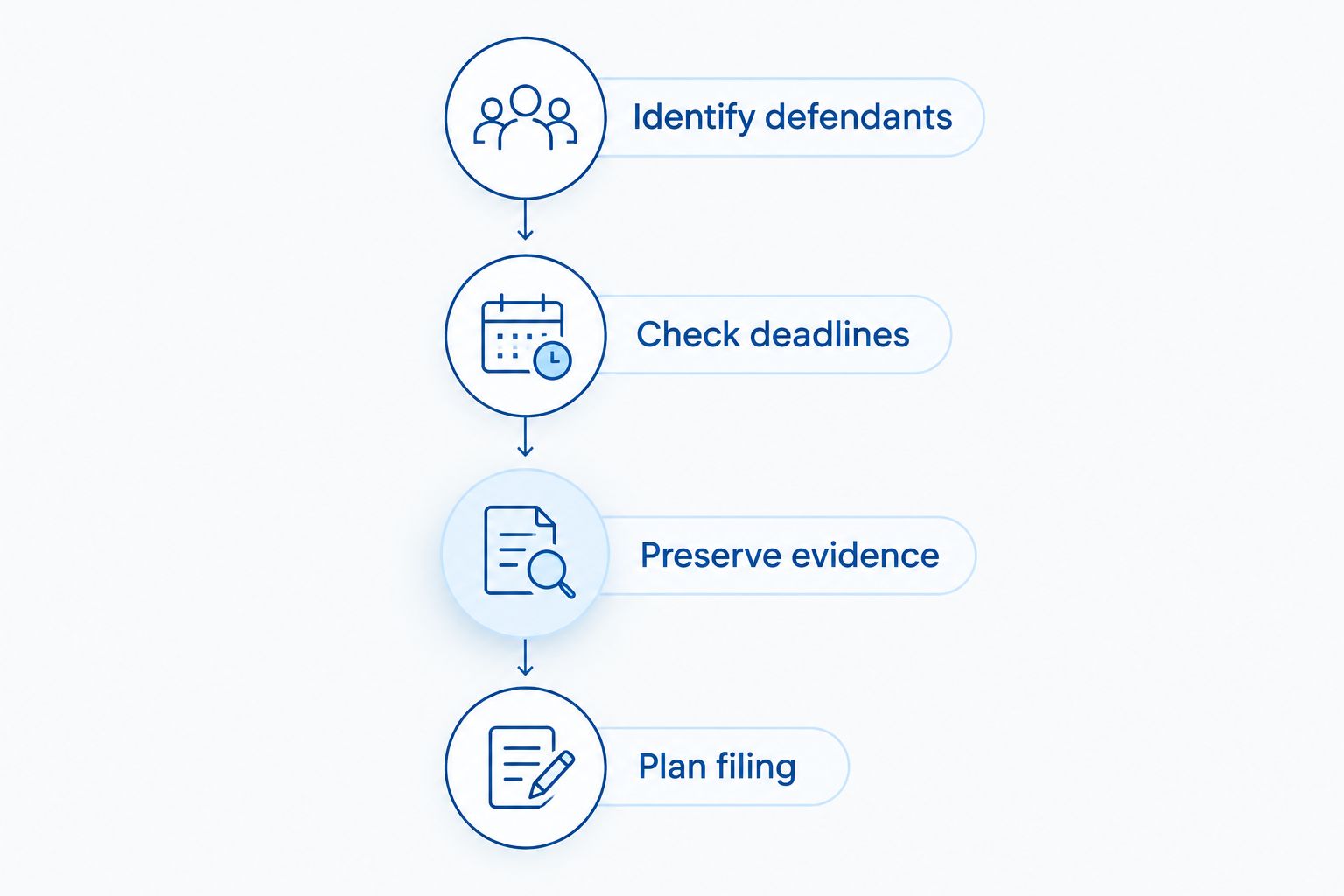
Best for protecting an unresolved injury claim: identify the deadline before negotiating toward it. Use this sequence whether the insurer is cooperative, silent, or disputing responsibility.
- Identify defendants. Record the drivers, vehicle owners, employers, and any public entities potentially involved. A work vehicle or public vehicle is a reason to investigate, not proof of liability.
- Check deadlines. Give counsel the crash date, injury information, ages of injured people, insurance documents, and any government correspondence. Identify both claim-presentation and court-filing requirements.
- Preserve evidence. Save photographs, witness details, medical records, repair documents, and communications. Ask promptly about preserving relevant video and other records before they disappear.
- Plan filing. Decide how to protect the claim if negotiations remain unresolved. Confirm who is responsible for preparing and filing the complaint; an appointment or document review is not a court filing.
Preserving the claim also means keeping your own timeline accurate. Record when the crash happened, when symptoms appeared, when you sought treatment, and when you received important letters. Do not change dates to fit a preferred deadline; give counsel the actual sequence.
Khachikyanlawfirm offers personal injury legal representation in Glendale. Bring the crash information and correspondence so the discussion addresses your facts rather than just the general 2-year rule.
Discuss your car accident claim
Ask about the filing deadline and the next steps for your California personal injury claim.
Can I still sue if the insurance company is negotiating?
The general 2-year injury deadline still applies while the insurer negotiates. Settlement discussions, requests for records, and an open claim file do not automatically pause the statute of limitations.
Do not treat an adjuster's statement that a claim remains open as an extension of the court deadline. Have counsel evaluate any claimed extension or legal basis for tolling before relying on it.
Can I sue if my symptoms appeared after the crash?
The general 2-year period does not automatically restart when symptoms appear later. California's delayed-discovery rules require a legal analysis of when you knew, or reasonably should have known, the facts supporting the claim.
Get appropriate medical attention and document the actual symptom timeline. A later diagnosis alone is not a reliable basis for assuming you have a later filing deadline.
Is it too late if I missed the government deadline?
The general 6-month government claim-presentation deadline requires urgent review if it has passed. Government Code section 911.4 allows an application for permission to present a late claim in qualifying circumstances, generally within a reasonable time not exceeding 1 year after accrual.
That procedure is not automatic permission to sue. Eligibility, exceptions, and any further court deadlines require immediate legal review; do not wait for the ordinary injury deadline.
FAQ
How long after a car accident can I file a lawsuit in California in 2026?
You generally have 2 years from the accident date to file a California personal injury lawsuit. Government claims, property damage, minority, and other exceptions require separate deadline calculations.
Does filing an insurance claim count as filing a lawsuit?
No. An insurance claim is not a court complaint and does not by itself satisfy the lawsuit filing deadline. Reporting the collision also does not automatically stop the limitations clock.
Do I have 3 years to sue for injuries if my car was damaged too?
No. The general 3-year property-damage deadline does not extend the general 2-year personal injury deadline. Separate the claims before calculating your filing dates.
Do I have to finish medical treatment before I sue?
No. Finishing treatment is not a prerequisite to filing a personal injury lawsuit. Continuing care does not automatically extend the filing period.
How long do I have if a city vehicle caused the crash?
A government claim generally must be presented within 6 months after accrual when a public entity is responsible. A separate lawsuit deadline follows, and the proper defendant and notice requirements need review.
Does being under 18 change the California car accident deadline?
Being under 18 generally pauses the limitations period for an ordinary private-defendant injury claim. It generally does not postpone government claim-presentation requirements.
Can Khachikyanlawfirm represent someone injured in a car accident?
Khachikyanlawfirm offers personal injury legal representation in Glendale, California. Discuss the crash, potential defendants, and correspondence so the applicable filing requirements can be evaluated.
One last thing
The date a letter was mailed can matter more than the date you read it. A compliant government-claim rejection can trigger its lawsuit period from mailing, so keep the envelope as well as the letter.
For a crash in 2026, build your deadline file alongside your medical and insurance records. Save notices immediately and ask for a specific filing-date review rather than relying on the general rule.
This article provides general California legal information, not advice about your individual deadline.


