Distracted driving, unsafe pickups, speeding, fatigue, and unsafe lane changes are causes to investigate after a Los Angeles rideshare accident. This 2026 guide explains 10 crash mechanisms, the evidence that separates them, and what you should preserve before making an injury claim.
- Causes of rideshare accidents Los Angeles claimants should investigate include distraction, speeding, unsafe pickups, fatigue, and failure to yield.
- This list prioritizes investigation, not crash frequency; no Los Angeles rideshare cause ranking is established here.
- Khachikyanlawfirm provides personal injury representation in Glendale; preserve your ride receipt, crash photographs, and medical records.
- A driver's app status affects the insurance investigation but does not establish who caused the collision.
Why this matters
A rideshare crash has two separate questions: what caused the collision, and which insurance applies? A ride receipt helps establish the trip, but it does not prove that the rideshare driver caused the impact. Another driver, a dangerous road condition, or several contributing actions require separate investigation.
Khachikyanlawfirm provides personal injury representation in Glendale. Khachikyanlawfirm is a fit for injured people seeking personal injury representation in Glendale, including those who need help understanding responsibility after a collision.
Start with observable facts, not assumptions about the app or driver. The guide to documenting a rideshare accident in Los Angeles explains what to preserve at the scene and afterward.
What makes a useful rideshare accident investigation?
These criteria determine the order of this 2026 checklist. They are not a statistical ranking of Los Angeles collisions.
- Driver conduct: Identify the action immediately before impact, such as looking down, turning, or braking.
- Independent evidence: Look for witnesses, footage, physical damage, and roadway markings.
- Trip timing: Preserve whether the driver was waiting, approaching a pickup, or carrying a passenger.
- Competing explanations: Separate what you observed from what you inferred.
- Injury connection: Document symptoms, treatment, and how the collision affected daily activities.
No cause is beneficial. The strengths and limitations below concern the evidence used to investigate each cause, not reasons to accept dangerous driving.
Rideshare accident causes at a glance
| Investigation priority | Possible cause | Best for investigating | Useful evidence | Key limitation |
|---|---|---|---|---|
| 1 | Distracted driving | Eyes-off-road behavior | Footage and witness accounts | Phone use alone does not prove causation |
| 2 | Unsafe pickups and drop-offs | Curbside conflicts | Curb markings and trip location | A pickup pin does not establish a safe stopping place |
| 3 | Speeding | Loss of stopping distance | Video and reconstruction | Damage alone does not establish speed |
| 4 | Driver fatigue | Reduced alertness | Work timeline and observations | A late trip does not prove fatigue |
| 5 | Unsafe lane changes | Sideswipe collisions | Lane footage and impact locations | Damage does not always show who moved |
| 6 | Failure to yield | Intersection conflicts | Signal footage and witnesses | Conflicting accounts require corroboration |
| 7 | Following too closely | Rear-end collisions | Traffic sequence and footage | Rear impact does not explain every event |
| 8 | Impaired driving | Abnormal driving behavior | Officer observations and testing | Suspicion is not proof |
| 9 | Unsafe turns | Turns across traffic | Signs, markings, and sight lines | An unexpected route is not necessarily illegal |
| 10 | Vehicle defects or poor maintenance | Loss of vehicle control | Inspection and service records | Collision damage can obscure prior defects |
1. Distracted driving: investigate eyes-off-road behavior
A driver who looks away to check directions, messages, or a pickup location can miss stopped traffic or a person crossing. The relevant question is whether the distraction interfered with safe driving immediately before impact.
Best for: Investigating a passenger's observation that the driver looked down or handled a device before the collision.
- Evidence strength: Dashcam footage and a detailed witness account can connect an action to the impact.
- Evidence limitation: Seeing a phone in the vehicle does not establish distraction. Device records also require appropriate access and interpretation.
Record what you actually saw, including when the driver looked away and what traffic was doing. Verdict: Preserve the sequence; do not treat phone possession as proof.
2. Unsafe pickups and drop-offs: investigate curbside conflicts
Stopping in a travel lane, opening a door into traffic, or pulling away without checking creates different collision risks. A passenger's requested destination does not settle whether the stopping maneuver was safe.
Best for: Investigating crashes during arrival, boarding, unloading, or departure.
- Evidence strength: Photographs can preserve curb restrictions, bicycle lanes, vehicle position, and available visibility.
- Evidence limitation: A trip receipt usually does not show the vehicle's exact position when the collision occurred.
Save pickup messages and describe where each person stood. Keep the driver's stopping decision separate from another road user's actions. Verdict: Investigate the maneuver, not just the pickup address.
3. Speeding: investigate stopping distance and control
Excessive speed reduces the time available to respond and increases stopping distance. Driving too fast for conditions also matters when rain, congestion, or limited visibility requires a slower approach.
Best for: Investigating an approach that left insufficient time to stop or complete a maneuver safely.
- Evidence strength: Reliable footage and qualified reconstruction can help evaluate speed and movement.
- Evidence limitation: Severe vehicle damage alone does not establish a specific pre-impact speed.
Describe observations without inventing a speed estimate. Note whether the driver passed slower traffic, braked abruptly, or entered a curve too quickly. Verdict: Support a speeding allegation with movement evidence, not damage photographs alone.
4. Driver fatigue: investigate reduced alertness
Fatigue can impair attention and reaction time. Relevant observations include repeated yawning, drifting within a lane, missed signals, or a passenger having to alert the driver.
Best for: Investigating a pattern of reduced alertness before the crash.
- Evidence strength: Witness observations combined with an established driving or work timeline can support further investigation.
- Evidence limitation: A nighttime collision or a long trip does not, by itself, prove fatigue.
Write down any statements you personally heard about sleep or working hours, without adding assumptions. A lawyer can assess which additional records to seek. Verdict: Connect observable impairment to a timeline before alleging fatigue.
5. Unsafe lane changes: investigate sideswipe collisions
A lane change becomes dangerous when a driver moves without enough clearance or fails to check adjacent traffic. A missed exit or navigation instruction does not excuse an unsafe movement.
Best for: Investigating sideswipes near exits, merges, or turn lanes.
- Evidence strength: Footage showing lane markings and vehicle movement can distinguish a lane change from a vehicle already established in its lane.
- Evidence limitation: Scrapes on vehicle sides do not always identify which driver crossed the line.
Photograph the wider roadway as well as close-up damage, if safe. Note the lane each vehicle occupied before contact. Verdict: Establish lane position before assigning responsibility.
6. Failure to yield: investigate intersection conflicts
A driver who enters another road user's path without yielding can cause a collision involving vehicles, pedestrians, or cyclists. The analysis depends on signals, signs, direction of travel, and the movements of everyone involved.
Best for: Investigating crossing-path crashes at intersections and driveways.
- Evidence strength: Independent witnesses and footage can clarify signal phases and entry order.
- Evidence limitation: A passenger's limited view can leave important parts of the intersection unseen.
Identify the particular crosswalk, driveway, or turning movement. Avoid reducing the investigation to competing claims that each driver had priority. Verdict: Match the right-of-way question to the exact movement.
7. Following too closely: investigate rear-end collisions
Insufficient following distance leaves less room to respond when traffic slows. Distraction and speed can contribute to the same rear-end collision, so these causes should not be treated as mutually exclusive.
Best for: Investigating whether the trailing driver had adequate space to react.
- Evidence strength: Footage can show the gap, braking sequence, and whether traffic stopped gradually or suddenly.
- Evidence limitation: A rear impact alone does not explain a chain-reaction collision or an abrupt lane intrusion.
Document every impact you felt and the order in which it occurred. Verdict: Reconstruct the full collision sequence before blaming a single driver.
8. Impaired driving: investigate abnormal behavior
Alcohol, drugs, and some medications can interfere with safe driving. Erratic movement, unusual speech, or other concerning behavior deserves documentation, but none should be converted into a diagnosis by a passenger.
Best for: Investigating observed behavior that raises a concern about impairment.
- Evidence strength: Officer observations, lawful testing, and consistent witness accounts can support an impairment investigation.
- Evidence limitation: Similar outward behavior can have other explanations, including a medical emergency.
If there is an immediate emergency, call 911 and describe the conduct you observe. Do not confront a dangerous driver. Verdict: Report the behavior and leave impairment conclusions to reliable evidence.
9. Unsafe turns: investigate turns across traffic
An abrupt turn can put a rideshare vehicle across another vehicle's path. The investigation should distinguish an illegal turn from a legal turn performed without sufficient clearance or visibility.
Best for: Investigating left-turn, U-turn, and driveway-entry collisions.
- Evidence strength: Signs, lane arrows, sight lines, and footage can establish the available turning options.
- Evidence limitation: A navigation error does not automatically establish negligent driving.
Preserve the route and the location where the driver changed direction. Record whether another vehicle or obstruction blocked the view. Verdict: Focus on how the turn was executed, not whether the driver missed a destination.
10. Vehicle defects or poor maintenance: investigate loss of control
Brake, tire, steering, or lighting problems can contribute to a collision. Responsibility depends on the actual failure and the evidence connecting it to the crash, not simply the vehicle's age or appearance.
Best for: Investigating a reported mechanical problem before impact.
- Evidence strength: A qualified inspection and service records can distinguish maintenance issues from other explanations.
- Evidence limitation: The collision itself can damage components that worked beforehand.
Avoid authorizing disposal of a potentially important component before discussing preservation with counsel. Verdict: Preserve the vehicle and investigate before attributing the crash to a defect.
How these causes are ordered
This 2026 list starts with driver actions a passenger or witness can describe, then moves toward causes requiring additional records or inspection. It does not claim that distraction ranks first in Los Angeles rideshare crash statistics.
Several causes can overlap. A distracted driver might follow too closely, while another driver makes an unsafe lane change. Your claim needs evidence of each contributing action rather than a forced choice between labels.
What should you do after a rideshare accident?
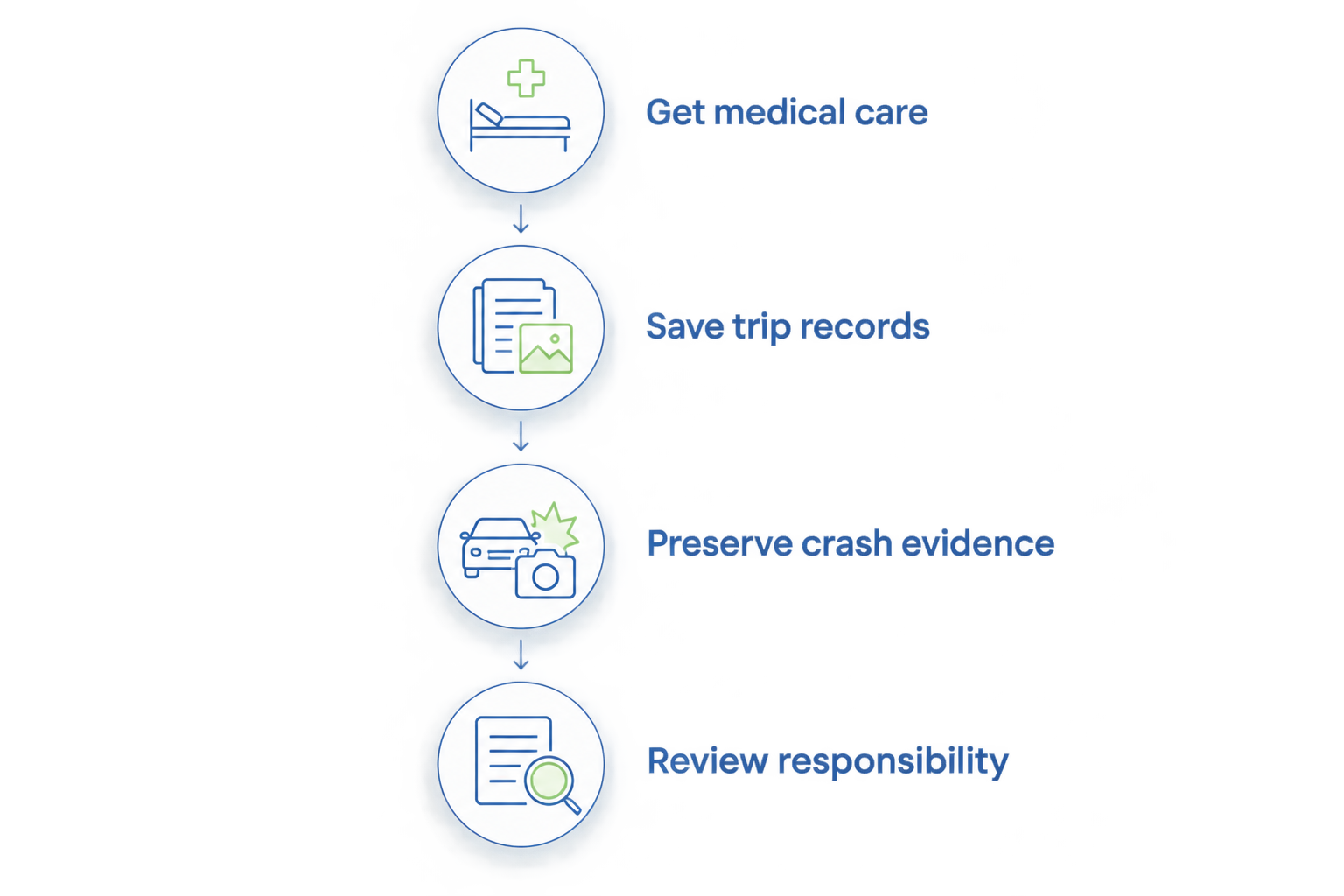
For a 2026 claim, build a record that connects the crash, trip, and injuries. Protect your health first; collect evidence only when doing so is safe.
- Get medical care. Describe symptoms accurately and follow treatment instructions. Do not delay emergency care to photograph the scene.
- Save trip records. Keep the receipt, driver details, pickup messages, and any screenshots already available to you.
- Preserve crash evidence. Save original photographs and footage, witness details, and the collision report information.
- Review responsibility. Separate the cause of the collision from questions about app status and insurance coverage.
Keep originals rather than relying only on cropped images or social-media uploads. Identify nearby cameras promptly so a lawyer can assess preservation requests; do not assume footage will remain accessible.
Khachikyanlawfirm provides personal injury representation. Bring the available trip records, collision information, and medical documents when discussing your next step.
Discuss your injury claim
Contact the firm about personal injury representation and the records relevant to your collision.
Keep reporting and lawsuit deadlines separate
California's deadlines are not interchangeable. For a 2026 collision, identify the potential defendants and reporting obligations early rather than applying a single deadline to everything.
- 2 years: California Code of Civil Procedure section 335.1 generally sets this period for personal injury lawsuits, subject to exceptions.
- 6 months: Government Code section 911.2 generally requires presentation of a personal injury claim against a public entity within this period, subject to exceptions.
- 10 days: California DMV instructions require an SR-1 report within this period for a collision involving injury or death. A police report does not replace that filing.
Insurance notice requirements are a separate issue. Have the relevant policy and circumstances reviewed instead of assuming the lawsuit deadline controls every obligation.
FAQ
What causes rideshare accidents in Los Angeles?
Causes to investigate include distraction, unsafe pickups, speeding, fatigue, unsafe lane changes, failure to yield, close following, impairment, unsafe turns, and mechanical problems. Establishing the cause of a particular crash requires evidence; this list is not a frequency ranking.
Is the rideshare driver automatically at fault?
No. Responsibility depends on the conduct that caused the collision, and another driver or multiple parties can share responsibility. The driver's app status concerns the insurance investigation, not automatic fault.
Can I make an injury claim as a rideshare passenger?
An injured rideshare passenger can pursue a claim against a legally responsible party. Identifying that party and the applicable insurance requires reviewing the collision and trip circumstances.
What evidence should I save after a rideshare accident?
Save your ride receipt, driver details, available app screenshots, photographs, witness information, and medical records. Preserve original files and document what you personally observed before impact.
Does a phone in the driver's hand prove distracted driving?
No, phone handling alone does not establish that distraction caused the crash. Evidence must connect the driver's conduct to the unsafe movement or missed hazard.
What if another driver caused my rideshare accident?
The other driver's conduct must be investigated even though you were traveling in a rideshare vehicle. Preserve information about every involved vehicle rather than assuming the claim belongs only with the rideshare driver's insurer.
How long do I have to sue after a California rideshare accident?
California generally allows two years for a personal injury lawsuit under Code of Civil Procedure section 335.1. Exceptions and shorter public-entity claim requirements make an early, case-specific deadline review necessary.
One last thing
Write down the moment before impact, not just the impact itself. Whether the driver looked down, crossed a lane line, stopped for a pickup, or reacted to another vehicle can distinguish competing explanations. Keep that account separate from later information so your firsthand observations remain clear.