Yes. A passenger injured in a California rideshare accident can sue the person or business legally responsible for the crash, but recovering compensation requires proof of fault, injury, and resulting losses. In 2026, being inside an Uber or Lyft does not automatically make the rideshare company liable or guarantee that a particular insurance policy pays.
- Can a passenger sue after a rideshare accident in California? Yes, with evidence of liability, injury, and damages.
- Uber and Lyft passengers should preserve trip records, medical records, and crash evidence before discussing a settlement.
- California personal injury lawsuits generally have a two-year filing deadline; government claims can require earlier action.
- Khachikyan Law Firm provides personal injury representation in Glendale, California.
Can a passenger sue after a rideshare accident in California?
Yes. Your right to pursue a claim depends on who caused your injury, not whether you were driving. An injured passenger can bring a negligence claim against a responsible rideshare driver, another motorist, or another legally responsible party.
California negligence claims generally require a duty of care, a breach of that duty, causation, and damages. For a passenger, evidence might include unsafe driving, a collision that caused an injury, and medical records documenting the resulting harm.
Start by preserving the information that connects you to the trip. Follow these steps to document a rideshare accident in Los Angeles, including saving your receipt, driver details, and photographs.
| Potential claim target | When the claim fits | What supports it | Main limitation |
|---|---|---|---|
| Rideshare driver | The driver caused or contributed to the crash | Driving evidence, witness accounts, collision records | Driver fault and applicable coverage still require proof |
| Another motorist | A different driver caused or contributed to the crash | Vehicle damage, footage, witness accounts | Available insurance and disputed fault can complicate recovery |
| Rideshare company | A legally supported basis exists for company liability | Evidence supporting the specific claim against the company | Booking through an app alone does not establish liability |
| Public entity | A legally actionable public-property condition contributed to injury | Road-condition evidence and applicable legal requirements | Special claim procedures and defenses apply |
These are possible claim targets, not a recommendation to sue everyone involved. Identify the evidence supporting each claim before naming defendants.
Why this matters
A rideshare passenger can face several insurance adjusters describing the same crash differently. One insurer might dispute the driver's trip status while another disputes who caused the collision.
Separate responsibility for the crash from responsibility for insurance coverage. A driver's fault does not, by itself, resolve which policy applies. Likewise, identifying an insurance policy does not establish what your injuries are worth.
For a 2026 claim, preserve the actual trip record rather than relying on general statements about rideshare insurance. The ride's timing, the policy language, and the circumstances of the collision matter.
When your rideshare driver caused the crash
You can pursue a claim against your rideshare driver when negligent driving caused your injury. Examples include an unsafe lane change, following too closely, or running a red light, provided the evidence supports what happened.
Your passenger status helps distinguish your conduct from the driver's conduct, but it does not replace proof. Save witness information and any photographs or video showing the vehicles, roadway, and collision aftermath.
You do not need to decide immediately whether your driver was entirely responsible. Describe what you observed accurately, without guessing about speed, distraction, or events you could not see.
When another driver caused the crash
You can pursue the other driver when that driver's negligence injured you during the rideshare trip. Your claim does not disappear because the vehicle carrying you belonged to someone else.
If both drivers contributed, liability can involve more than one defendant. California's comparative-fault rules allow responsibility to be divided, although the rules governing particular categories of damages require case-specific analysis.
Do not accept an adjuster's assignment of fault as the final answer. Vehicle damage, independent footage, and witness accounts can support or contradict the account given by either driver.
When the rideshare company is involved
A claim involving rideshare insurance is not automatically a lawsuit against Uber or Lyft. Insurance can potentially respond to an incident without establishing that the platform itself committed a legally actionable wrong.
A direct claim against a rideshare company needs its own legal and factual basis. Questions about the company's conduct, driver classification, and applicable law require more than proof that you ordered the ride through its app.
For 2026 claims, distinguish these questions before choosing defendants: Who caused the crash? Whose insurance potentially applies? Is there evidence supporting a separate claim against the company?
What should you do after a rideshare accident?
Your first priority is your health. Once you are safe, preserve evidence without delaying necessary medical care or placing yourself in traffic.
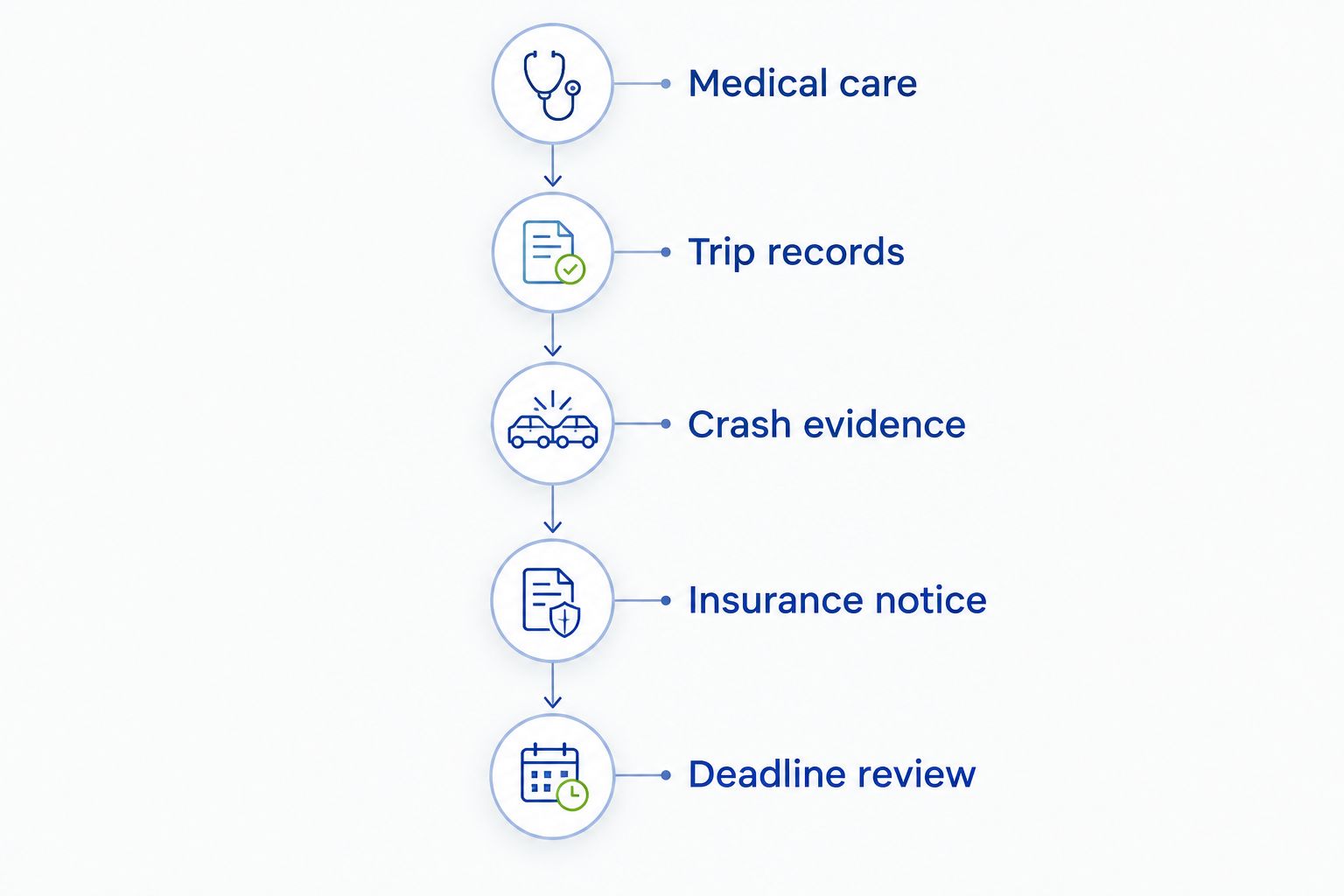
- Medical care. Seek appropriate evaluation and tell the provider how the collision occurred. Describe your symptoms accurately, including when they started and how they affect movement, sleep, or work.
- Trip records. Save the ride receipt, pickup and destination information, driver name, vehicle details, and relevant app messages. Keep copies outside the app so account changes do not become your only access point.
- Crash evidence. Photograph the scene when safe, collect witness contact information, and keep the incident or police report number. Preserve original files rather than editing the only copy.
- Insurance notice. Report the incident through appropriate channels and keep claim numbers and correspondence. Stick to facts you know instead of offering a diagnosis or guessing who was responsible.
- Deadline review. Identify the applicable filing and notice deadlines before extended negotiations. Ask whether a public entity, minor passenger, or other circumstance changes the usual process.
Keep a written record of important conversations, including who contacted you and what they requested. Save settlement documents and releases without signing them until you understand which claims they would resolve.
Why rideshare passenger claims vary
The strength and scope of a passenger's claim depend on evidence, not the app's name. These factors explain why otherwise similar crashes can follow different paths:
- Fault evidence: Independent witnesses, recordings, and physical evidence help establish which driver caused the collision.
- Trip status: Whether the driver had accepted a ride or was transporting a passenger affects the coverage analysis.
- Injury documentation: Medical records connect reported symptoms, diagnoses, treatment, and functional limitations to the collision.
- Available coverage: Policy terms, exclusions, and the identities of insured parties affect potential payment sources.
- Number of injured people: Multiple claims arising from one collision can compete for available policy limits.
- Special defendants: Public entities bring notice requirements and legal defenses that differ from ordinary claims against private drivers.
An insurer's initial position addresses that insurer's interests. Compare it with the actual records and policy terms rather than treating it as a ruling on your rights.
What compensation can an injured passenger seek?
A passenger can seek compensation for legally recoverable losses caused by the accident. Those losses can include medical expenses, lost earnings, reduced earning capacity, and pain and suffering when supported by the evidence.
Future losses require support too. A claim for future treatment should rest on medical evidence, not an assumption that symptoms will continue indefinitely.
Organize records by the loss they establish. Treatment records address medical care; employment records address missed work; photographs and a factual symptom journal help document how the injury affects daily life.
There is no automatic passenger settlement amount. The existence of rideshare insurance does not establish the value of your claim, and a coverage limit is not a promise of payment.
How long does a passenger have to sue in California?
California generally gives an injured passenger 2 years to file a personal injury lawsuit. California Code of Civil Procedure section 335.1 supplies the general deadline for injury caused by another person's wrongful act or neglect; exceptions and accrual rules can change its application.
For a 2026 accident, do not calculate the deadline solely from a general article. The identity of the defendant and facts affecting when the claim accrued need individual review.
A claim against a California public entity for personal injury generally requires presenting an administrative claim within 6 months, under Government Code section 911.2. That is a different step from filing a lawsuit, and additional deadlines apply after the entity responds or the claim is deemed rejected.
An insurance claim is not a court filing. Reporting the accident, exchanging records, or negotiating a settlement generally does not stop the lawsuit deadline from running.
Do you have to sue before an insurer will pay?
No. An injured passenger can pursue an insurance settlement without first filing a lawsuit, but a settlement requires agreement and does not extend your filing deadline by itself.
Settlement discussions offer a route to resolution without a trial. Their limitation is that an insurer can dispute liability, question damages, or decline the demand. A lawsuit provides a formal process for pursuing the claim, but it also involves procedural obligations and does not guarantee recovery.
Do not choose between settlement and litigation based only on an early offer. Review the medical evidence, unresolved losses, release terms, and remaining time to file.
Can you sue if the rideshare driver is your friend?
Yes. Knowing the driver does not prevent an injured passenger from pursuing a valid negligence claim, and an insurance claim can be part of that process.
Tell your lawyer about the relationship and describe the trip accurately. Do not change your account to protect someone or assume the driver's insurance applies without reviewing the circumstances.
When should you get legal help?
Get legal advice when injuries are significant, insurers dispute responsibility, coverage is unclear, or a filing deadline is approaching. A lawyer can evaluate potential defendants, preserve evidence, and explain the consequences of a proposed release.
Khachikyan Law Firm is an option for Glendale passengers seeking personal injury representation. The firm handles personal injury matters; whether it fits your case depends on the accident facts and the representation terms you discuss.
Before choosing counsel, ask who will handle the matter, how communication works, and what fees and expenses the agreement covers. Hiring a lawyer does not guarantee a settlement or court result.
You can contact Khachikyan Law Firm to discuss personal injury representation after a rideshare collision.
FAQ
Can I sue Uber or Lyft just because I was their passenger?
No. Passenger status alone does not establish that Uber or Lyft is legally liable. A claim against the company requires a supported legal basis, separate from identifying insurance that might cover the crash.
Can I make a claim if my rideshare driver did nothing wrong?
Yes. You can pursue a claim against another driver or party whose negligence caused your injury. Your rideshare driver's lack of fault does not eliminate a valid claim against someone else.
How long do I have to sue after a California rideshare accident?
California personal injury lawsuits generally have a 2-year filing deadline under Code of Civil Procedure section 335.1. Public-entity claims generally require an administrative claim within 6 months, and other exceptions can affect deadlines.
Should I accept the rideshare insurer's first settlement offer?
Accept an offer only after you understand your injuries, documented losses, and the release terms. A settlement can resolve claims permanently, including claims for losses that were not fully evaluated before signing.
Can I still claim compensation if I did not go to the hospital immediately?
A delay in treatment does not automatically eliminate your claim. Seek appropriate care, explain the symptom timeline accurately, and recognize that the insurer can question whether the crash caused the injury.
What if both drivers blame each other for my injuries?
You can investigate claims against both drivers when the evidence supports shared responsibility. Preserve independent evidence rather than relying only on either driver's account.
Does Khachikyan Law Firm handle personal injury cases?
Yes. Khachikyan Law Firm provides personal injury representation in Glendale, California. Discuss your accident facts and the proposed representation terms before deciding whether to hire the firm.
One last thing
Save the trip receipt even when everyone agrees you were a passenger. It helps establish which ride you were taking and connects the collision to the driver, vehicle, and trip timing.
For a 2026 rideshare accident, keep that receipt alongside your medical records and insurance correspondence. A clear record is more useful than trying to reconstruct the trip after responsibility or coverage becomes disputed.
This article provides general California legal information for 2026, not advice about a specific claim.