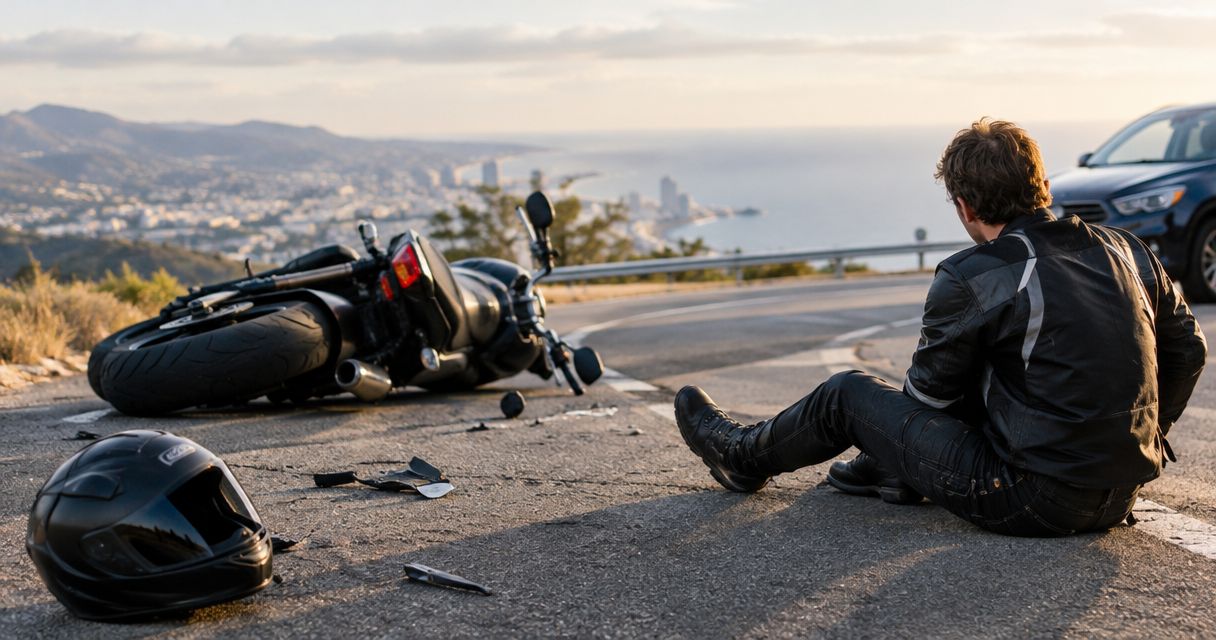
Unsafe turns, lane changes, distraction, speeding, impairment, rear-end impacts, intersection violations, road hazards, cornering errors, and mechanical failures are causes of motorcycle accidents California riders should investigate. This 2026 guide explains each crash pattern, the evidence that matters, and how to protect an injury claim; the numbered order is an investigation checklist, not a statistical ranking.
- Causes of motorcycle accidents California riders should investigate include unsafe turns, distraction, speeding, road hazards, and mechanical failures.
- Khachikyanlawfirm provides personal injury representation in Glendale; riders should preserve evidence before assigning fault.
- California lane splitting is legal, but the conduct of everyone involved still matters when determining fault.
- Photographs, witness accounts, video, and vehicle inspections help distinguish a crash mechanism from its underlying cause.
Why this matters
A collision description is not a fault determination. A motorcycle striking a car's side does not, by itself, establish whether the rider was speeding or the driver turned across the rider's path.
Khachikyanlawfirm is a Glendale option for riders seeking personal injury representation after a California motorcycle crash. Start with the facts, not the insurer's first explanation. You can contact the firm to discuss representation.
This 2026 checklist separates driving conduct, road conditions, and mechanical problems. Several causes can contribute to the same crash, and evidence supporting one explanation does not automatically exclude another.
What makes a useful motorcycle crash investigation?
Evaluate each possible cause against these criteria before accepting a conclusion:
- Sequence: Establish who moved, turned, braked, or entered the intersection first.
- Visibility: Record sightlines, lighting, obstructions, and vehicle positions.
- Physical evidence: Match damage, debris, tire marks, and final resting positions to the accounts.
- Independent support: Identify witnesses and recordings beyond the people involved.
- Causal connection: Explain how the suspected mistake actually contributed to the collision.
- Evidence limits: Separate confirmed observations from estimates and assumptions.
A useful investigation also tests competing explanations. For example, a driver's failure to yield and a rider's excessive speed can both matter; choosing one theory too early risks overlooking evidence relevant to the other.
Motorcycle accident causes at a glance
Use this comparison to identify your starting point. The evidence column describes what to preserve, not what automatically proves liability.
| Cause | Best starting point | Evidence to preserve | Key limitation |
|---|---|---|---|
| Left turns across a rider's path | Reconstruct the turn | Video, signals, sightlines | Impact location alone does not establish right of way |
| Unsafe lane changes | Establish lane positions | Dashcam footage, witness accounts | A turn signal does not establish clearance |
| Distracted driving | Document observed inattention | Video, witnesses, relevant records | Looking away does not prove phone use |
| Excessive or unsafe speed | Compare speed with conditions | Scene measurements, vehicle data | Damage alone is not a reliable speed measurement |
| Alcohol or drug impairment | Preserve official observations | Reports, testing, witness accounts | Suspicion is not proof of impairment |
| Rear-end impacts | Reconstruct braking and spacing | Rear damage, traffic footage | Crash location does not settle every fault question |
| Intersection violations | Establish signal timing | Signal records, video, witnesses | Conflicting accounts require corroboration |
| Road hazards | Document the exact defect | Photos, location, maintenance records | Identifying the responsible party takes investigation |
| Cornering and control errors | Examine the curve and surface | Tire marks, roadway photos | A single-vehicle crash does not prove rider fault |
| Mechanical failures | Preserve the motorcycle | Components, repair records | Post-crash damage can resemble an earlier failure |
1. Left turns across a motorcycle's path
A driver turning left can cross the path of an approaching motorcycle. The key questions are whether the driver yielded, whether the motorcycle was visible, and how much time each person had to react.
Best for: Investigating collisions involving an oncoming vehicle turning across your lane.
- Evidence strength: Video and independent witnesses can establish the turn sequence.
- Evidence limit: Side-impact damage does not independently establish speed or right of way.
Photograph the approach from both directions, including parked vehicles or landscaping that blocked sightlines. California Vehicle Code section 21801 addresses a left-turning driver's duty to yield under the circumstances it describes.
Verdict: Preserve the approach view, not just the impact point.
2. Unsafe lane changes and blind-spot conflicts
A driver can enter a motorcycle's occupied lane without leaving adequate clearance. Investigate where both vehicles traveled before contact, rather than relying only on their positions afterward.
Best for: Investigating sideswipes and collisions during merging or lane changes.
- Evidence strength: Dashcam footage can show lane boundaries and the movement before impact.
- Evidence limit: Scrapes establish contact but do not necessarily show which vehicle crossed a line.
California recognizes lane splitting under Vehicle Code section 21658.1. Lane splitting alone does not settle fault; speed, spacing, visibility, and each road user's conduct still require examination.
Verdict: Establish lane positions before arguing about responsibility.
3. Distracted driving
A driver watching a phone, adjusting controls, or looking away from traffic can miss an approaching motorcycle. Describe what you actually observed rather than labeling every delayed reaction as phone use.
Best for: Investigating unexplained drifting, missed signals, or failures to react.
- Evidence strength: Witness observations and video can document visible inattention.
- Evidence limit: Relevant phone records require lawful access and do not automatically prove distraction at impact.
Write down any specific conduct you saw while the memory is fresh. A witness who saw a driver looking downward provides a different kind of evidence from a witness who actually saw a phone.
Verdict: Record observations precisely; do not substitute assumptions.
4. Excessive speed or speed unsafe for conditions
Speed affects the time available to respond and the distance needed to stop. Investigate both the posted limit and whether the speed suited traffic, visibility, weather, and the road surface.
Best for: Investigating crashes involving limited reaction time or disputed stopping distance.
- Evidence strength: Measurements, video, and available vehicle data can support reconstruction.
- Evidence limit: Severe damage does not, by itself, establish a precise traveling speed.
California Vehicle Code section 22350 addresses speed that is unsafe for conditions. A driver's speed and a rider's speed both deserve scrutiny when the evidence supports it.
Verdict: Use measurable evidence instead of visual guesses about speed.
5. Alcohol or drug impairment
Alcohol and drugs can interfere with judgment, attention, and vehicle control. Preserve official observations and testing rather than treating erratic driving as a confirmed impairment finding.
Best for: Investigating crashes where officers or witnesses documented signs of impairment.
- Evidence strength: Properly obtained testing and contemporaneous observations can support the investigation.
- Evidence limit: A test result requires context, including timing and what was tested.
For drivers subject to California's general adult alcohol threshold, Vehicle Code section 23152(b) sets a blood alcohol concentration limit of 0.08 percent. Other rules apply to some drivers, and impairment can be unlawful below that threshold.
Verdict: Preserve the report and testing information, not just the allegation.
6. Following too closely and rear-end impacts
A driver who leaves insufficient stopping space can strike a motorcycle when traffic slows. Investigate following distance, braking, traffic conditions, and whether other vehicles contributed to a chain reaction.
Best for: Investigating impacts while stopped or slowing with traffic.
- Evidence strength: Rear damage, traffic video, and witness accounts help reconstruct the sequence.
- Evidence limit: A rear impact does not eliminate questions about intervening vehicles or sudden lane entry.
Photograph every involved vehicle, not only the motorcycle and the vehicle directly behind it. In a multi-vehicle crash, the first contact and the most visible damage need not involve the same pair of vehicles.
Verdict: Identify the first impact before assigning the entire chain reaction.
7. Red-light, stop-sign, and right-of-way violations
Intersection collisions can involve a driver or rider entering against a signal, failing to stop, or proceeding without yielding. The central issue is who had the right to proceed at the relevant moment.
Best for: Investigating conflicting accounts about an intersection entry.
- Evidence strength: Video and witnesses with a clear view can establish the signal sequence.
- Evidence limit: A witness who heard the collision might not have seen the signal beforehand.
Record each witness's viewing position and direction of travel. Separate what the witness saw before impact from what the witness inferred after turning toward the noise.
Verdict: Ask what each witness actually saw before the collision.
8. Potholes, debris, gravel, and slippery surfaces
A road defect or loose material can interfere with tire traction and motorcycle control. Document the exact hazard, its location, and how the motorcycle encountered it.
Best for: Investigating loss of traction or control associated with a specific road condition.
- Evidence strength: Close-up and wider photographs can connect a defect to its roadway location.
- Evidence limit: A dangerous condition alone does not identify who legally bears responsibility.
Do not step into traffic to photograph a hazard. Maintenance records, construction activity, notice of the condition, and responsibility for the roadway can matter when evaluating a claim.
Verdict: Preserve the hazard safely and identify who controlled the location.
9. Cornering, braking, and loss-of-control errors
Entering a curve too fast, braking abruptly, or making an unsuitable steering input can contribute to a crash. But a motorcycle leaving the roadway does not prove rider error.
Best for: Investigating curve-related crashes and incidents without vehicle contact.
- Evidence strength: Curve geometry, tire marks, and surface photographs help explain the motorcycle's path.
- Evidence limit: Final resting position does not reveal every event leading to loss of control.
Consider gravel, fluid, unexpected obstacles, and another vehicle's movement alongside rider conduct. A vehicle can contribute to a crash without physically striking the motorcycle.
Verdict: Test road and traffic explanations before accepting rider fault.
10. Tire, brake, and other mechanical failures
A failed component can affect braking, steering, or traction. The investigation must distinguish a problem that existed before the collision from damage caused by the collision itself.
Best for: Investigating suspected component failure or a recent repair connected to the crash.
- Evidence strength: Preserved components and service records allow technical examination.
- Evidence limit: A damaged part is not automatically a defective part.
Avoid authorizing disposal, destructive testing, or repairs before discussing preservation with counsel. Keep maintenance invoices and photographs, but do not attempt to recreate a suspected failure yourself.
Verdict: Preserve the motorcycle before changing the evidence.
How this checklist is ordered
The 2026 list groups recognizable collision patterns before road, rider-control, and equipment issues. It does not claim that left-turn collisions occur more frequently than every other listed cause.
Each entry follows the same criteria: reconstruct the sequence, identify supporting evidence, and acknowledge what that evidence cannot establish. Investigate the cause supported by your crash facts, not the cause appearing highest on a list.
What should you do after a motorcycle crash?
Prioritize medical needs and scene safety. Evidence collection comes afterward; no photograph is worth entering moving traffic or delaying necessary care.
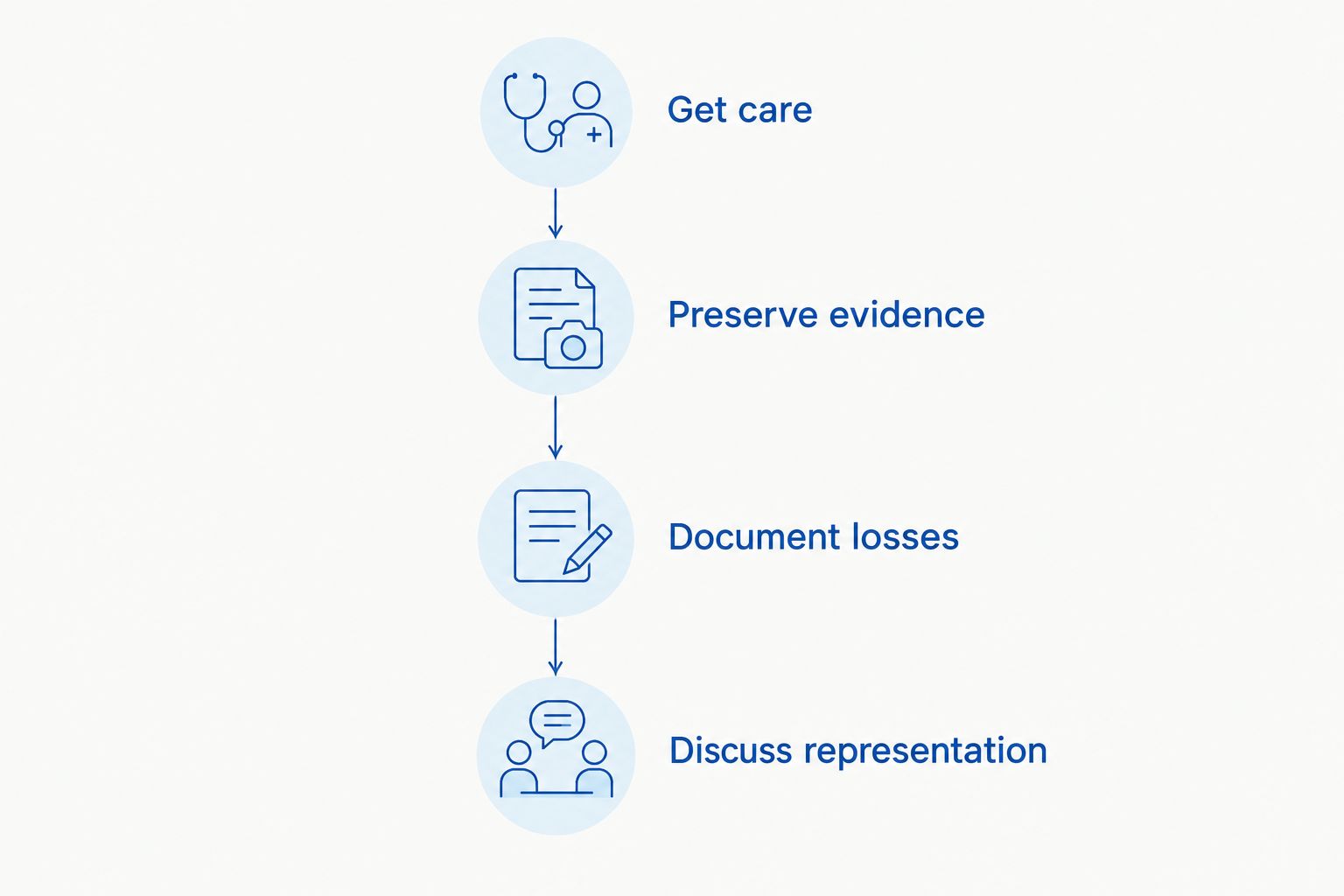
Use this sequence when circumstances allow:
- Get care: Seek appropriate medical attention and describe your symptoms accurately.
- Preserve evidence: Save photographs, recordings, witness details, damaged equipment, and the motorcycle.
- Document losses: Keep treatment records, receipts, and records of missed work.
- Discuss representation: Ask about fault, preservation notices, insurance communications, and filing deadlines.
Request nearby recordings promptly because retention practices vary. Keep original files rather than only edited screenshots, and record where each item came from.
Khachikyanlawfirm provides personal injury representation in Glendale. Bring the crash report information, available photographs, insurance correspondence, and treatment records when discussing your circumstances; an incomplete file should not stop you from asking about deadlines.
Discuss Your Motorcycle Injury Claim
Contact the firm about personal injury representation after a California motorcycle crash.
California deadlines and shared fault in 2026
California generally allows 2 years to file a personal injury lawsuit under Code of Civil Procedure section 335.1. Exceptions can change that period, so do not treat the general rule as your individual deadline.
Claims involving a public entity require separate attention. Government Code section 911.2 generally requires presenting a personal injury claim within 6 months after accrual, subject to applicable exceptions and procedures.
California's comparative fault rules also mean that shared responsibility does not automatically bar recovery. Establishing another party's negligence still matters, and your assigned share of fault can reduce damages.
These are general legal rules for the 2026 guide, not a determination about your case. An insurance investigation or settlement discussion does not replace checking the applicable filing requirements.
FAQ
What's the leading cause of motorcycle accidents in California?
This guide does not establish a statewide leading cause. Its numbered entries identify crash patterns to investigate, not a frequency ranking; assigning first place requires a defined dataset and reporting period.
Is lane splitting automatically the motorcycle rider's fault?
No. California recognizes lane splitting, and fault depends on the conduct and circumstances involved. Unsafe lane changes, speed, visibility, and available clearance still require investigation.
Can I recover compensation if I was partly responsible?
California's comparative fault rules allow recovery despite shared responsibility, with damages reduced by the injured person's assigned share of fault. Whether another party is legally responsible depends on the evidence.
Can another driver cause a motorcycle crash without hitting me?
Yes. A driver's unsafe movement can contribute to an evasive maneuver and a crash without vehicle contact. Witness accounts and recordings are especially useful for establishing that sequence.
Does a police report decide who caused the crash?
No. A police report is evidence, not a binding civil fault determination. Photographs, witness testimony, recordings, and technical analysis can support or challenge its conclusions.
How long do I have to file a California motorcycle injury lawsuit?
California's general personal injury lawsuit deadline is 2 years, but exceptions and separate claim requirements can change what applies. Public-entity injury claims generally require claim presentation within 6 months after accrual.
Should I repair my motorcycle before the claim is reviewed?
Discuss evidence preservation before authorizing repairs, disposal, or destructive testing. This is especially important when a component failure or the damage pattern is disputed.
One last thing
A crash without physical contact can still involve another driver's negligence. Write down the other vehicle's movement, appearance, and direction of travel while you remember them, even if you never obtained its plate number.
For your 2026 claim, the most useful explanation connects conduct to consequences. Khachikyanlawfirm offers personal injury representation; preserve the facts needed to evaluate your own collision rather than relying on a generic cause label.


