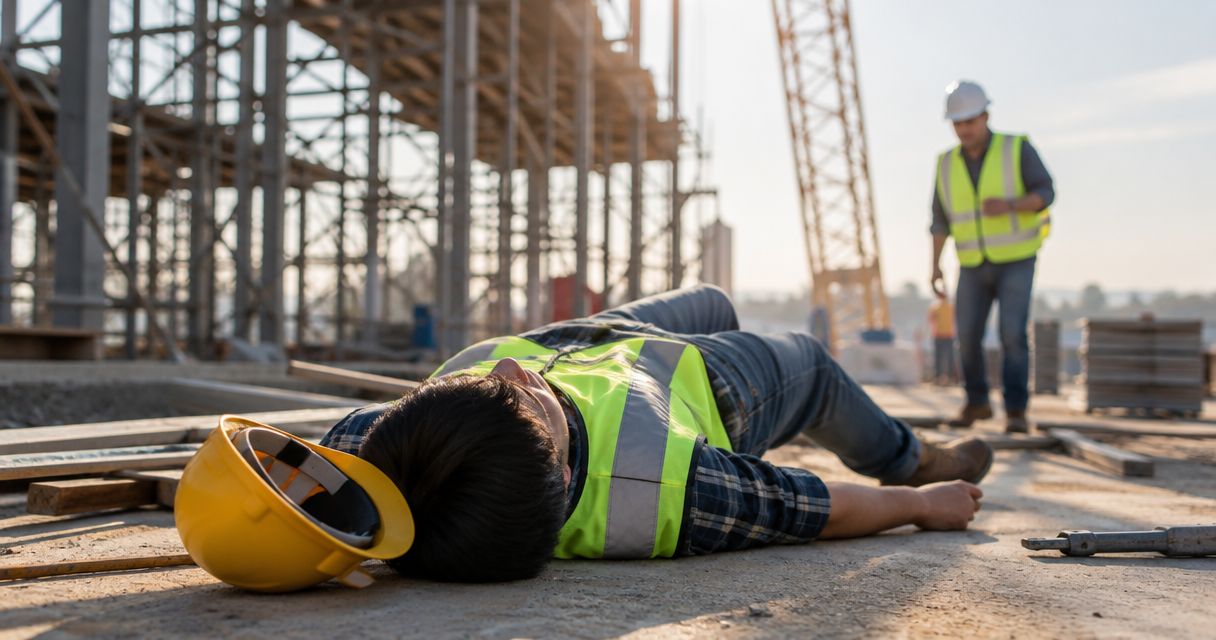
Start with falls, moving equipment, electrical contact, and collapsing materials when investigating a California construction accident. This 2026 guide explains 10 accident causes, the safety failures behind them, and the evidence you should preserve before site conditions change.
- Causes of construction accidents California workers face include falls, equipment strikes, electrical contact, and collapses.
- Khachikyanlawfirm provides personal injury representation; injured construction workers should distinguish workers’ compensation from third-party claims.
- Photograph the hazard safely, identify witnesses, and preserve medical records and incident reports.
- This list organizes an investigation; it is not a statistical ranking of California accident frequency.
Why this matters
A construction injury is not explained by saying someone fell or a machine struck them. You need to identify what failed, who controlled that work, and whether another company contributed to the injury.
Khachikyanlawfirm is a Glendale personal injury and lemon law firm. For a construction-related personal injury, the useful starting point is the connection between the unsafe condition and the harm—not an assumption that every contractor on the site is liable.
For an accident in 2026, preserve the facts early. Equipment moves, temporary structures come down, and witnesses leave for other projects.
What makes an accident cause worth investigating?
Use these criteria to separate a visible hazard from a supported explanation:
- Injury mechanism: Identify exactly how the fall, contact, impact, or exposure happened.
- Control: Determine who installed, operated, maintained, or directed the equipment or work area.
- Preventive measures: Check whether guarding, isolation, inspection, or traffic separation addressed the hazard.
- Evidence: Preserve photographs, witness accounts, equipment identifiers, and records of site conditions.
- Causation: Connect the specific failure to the injury rather than treating a rule violation alone as proof of liability.
The best investigation explains both the immediate event and the conditions that allowed it. These criteria guide the order below; the order does not represent statewide incident totals.
Construction accident causes at a glance
| Cause | Best evidence for investigation | Primary safety control | Important limitation |
|---|---|---|---|
| Falls from height | Edge protection, openings, anchor locations | Fall prevention and suitable fall protection | A harness alone does not establish a complete system |
| Moving equipment strikes | Travel paths, visibility, operator accounts | Separation of workers and equipment | Visibility aids do not eliminate blind spots |
| Falling objects | Load position, storage, overhead work | Secured materials and exclusion zones | A hard hat does not stop a heavy load |
| Electrical contact | Power sources, isolation records, equipment condition | De-energization and verification | A switch position does not prove isolation |
| Caught-in or crushed injuries | Guards, pinch points, energy sources | Guarding and energy control | Stopped equipment can retain energy |
| Trench collapse | Excavation geometry, soil conditions, protective system | Appropriate cave-in protection | A stable-looking wall can still fail |
| Scaffold failure | Assembly details, supports, inspection records | Correct assembly and safe access | A sound platform still needs fall protection |
| Slips and trips | Walkway condition, lighting, obstructions | Clear, maintained access routes | Cleanup must continue as work changes |
| Structural or temporary-support failure | Work sequence, bracing, loading records | Planned sequencing and adequate support | Visual checks do not establish load capacity |
| Heat illness | Conditions, exertion, water and rest access | Heat planning and early response | Water alone does not address every heat risk |
1. Falls from height: investigate edges, openings, and access
Falls occur from roofs, ladders, elevated decks, and unprotected openings. The investigation should establish where the worker stood, what task required that position, and what protection was actually usable there.
Do not reduce the issue to whether a harness was present. Anchor suitability, connections, clearance, and rescue planning also matter.
- Control benefits: Guardrails and secured opening covers prevent access to fall hazards; suitable personal systems address remaining exposure.
- Control limits: Personal fall-arrest equipment does not prevent every fall or eliminate injury during arrest.
- Best evidence for: Photographs showing the edge, cover, ladder placement, and available anchorage.
Action verdict: Preserve the fall location before anyone repairs or covers it.
2. Moving equipment strikes: investigate worker-machine separation
Backing trucks, excavators, forklifts, and other moving equipment create collision hazards where people share travel routes. Blind spots, unexpected movement, and conflicting work activities deserve separate attention.
Identify the operator, employer, equipment owner, and company directing traffic. Those roles are not necessarily held by the same business.
- Control benefits: Physical separation, planned routes, and clear communication reduce conflicting movements.
- Control limits: Alarms and cameras supplement safe operation; they do not guarantee that an operator sees every worker.
- Best evidence for: Camera footage, travel-path photographs, witness locations, and equipment identifiers.
Action verdict: Request preservation of footage before routine deletion occurs.
3. Falling objects: investigate what released the material
Tools, stored materials, suspended loads, and demolition debris can strike workers below. Record where the object started, how it was secured, and whether people were permitted beneath the work.
The object itself can identify the responsible task. Keep its description separate from assumptions about who dropped it.
- Control benefits: Secured storage, appropriate rigging, and exclusion zones address hazards before material falls.
- Control limits: Head protection reduces certain risks but cannot make standing beneath a dangerous load safe.
- Best evidence for: Load configuration, rigging condition, storage arrangements, and overhead-work schedules.
Action verdict: Identify the overhead activity, not just the object that struck you.
4. Electrical contact: investigate every possible energy source
Contact with exposed wiring, damaged tools, temporary power, or overhead lines can cause serious injury. Electrical incidents also include arc-related burns without direct contact.
Do not touch equipment or approach a suspected energized area to collect evidence. Emergency response and qualified electrical assessment take priority.
- Control benefits: De-energization, isolation, and verification address the source; appropriate protective equipment addresses remaining task-specific risks.
- Control limits: Turning equipment off does not establish that all electrical sources are isolated.
- Best evidence for: Equipment condition, circuit identification, isolation records, and accounts from qualified personnel.
Action verdict: Preserve records without approaching the electrical hazard.
5. Caught-in and crushed injuries: investigate guards and stored energy
Workers can become trapped in machinery, between equipment and a fixed surface, or beneath an unexpectedly moving component. Maintenance and clearing jams require particular attention to energy control.
A machine can remain dangerous after its motor stops. Hydraulic pressure, suspended components, and other stored energy can still produce movement.
- Control benefits: Guards restrict access to moving parts; energy-control procedures address unexpected startup and release.
- Control limits: A guard does not replace isolation during work that requires entering a danger zone.
- Best evidence for: Guard placement, maintenance instructions, control positions, and the task underway.
Action verdict: Document the machine’s condition before repair or alteration.
6. Trench collapse: investigate protection, not appearances
An excavation wall can collapse onto workers without leaving time to escape. Soil conditions, nearby loads, water, and vibration belong in the investigation alongside the protective system.
Never enter an unprotected excavation to retrieve belongings or photograph evidence. A rescue attempt can expose another person to the same collapse.
- Control benefits: Suitable sloping, shoring, or shielding addresses cave-in exposure when properly selected and used.
- Control limits: Different protective methods serve different functions; a trench shield does not prevent the soil itself from collapsing.
- Best evidence for: Excavation dimensions, protective-system details, spoil placement, and inspection records.
Action verdict: Keep people out until qualified personnel address the hazard.
7. Scaffold failure: investigate assembly and access separately
Scaffold incidents include platform failures, unstable supports, missing components, and falls during access. A scaffold that remains standing can still expose workers to serious fall hazards.
Identify who erected, altered, inspected, and used the scaffold. Record modifications rather than assuming the original assembly remained unchanged.
- Control benefits: Correct assembly, suitable foundations, and safe access address different parts of scaffold safety.
- Control limits: A stable scaffold does not resolve missing edge protection or unsafe climbing practices.
- Best evidence for: Platform condition, connections, base supports, access routes, and inspection documentation.
Action verdict: Preserve assembly details before the scaffold is dismantled.
8. Slips and trips: investigate changing walking surfaces
Loose cords, debris, uneven surfaces, wet areas, and poor lighting can cause same-level falls. Construction walkways change as trades move materials and open new work areas.
Record the exact obstruction and who controlled that location. A general photograph of a messy site does not explain a particular fall.
- Control benefits: Clear access routes, cable management, lighting, and timely cleanup address specific walking hazards.
- Control limits: A completed cleanup does not protect a route from hazards introduced afterward.
- Best evidence for: Close and wide photographs, lighting conditions, footwear condition, and witness descriptions.
Action verdict: Photograph the specific trip or slip source safely.
9. Structural failure: investigate sequencing and temporary support
Walls, partially built structures, formwork, and temporary supports can fail during construction or demolition. The relevant question is what supported the load at that stage of work.
Identify recent changes: removed bracing, added materials, altered connections, or a change in demolition sequence. Appearance alone does not establish structural capacity.
- Control benefits: Planned sequencing and adequate temporary support address stability throughout the work.
- Control limits: A final design does not, by itself, explain whether an intermediate construction stage was safe.
- Best evidence for: Drawings, work instructions, loading records, photographs, and communications about changes.
Action verdict: Preserve the work sequence as carefully as the failed materials.
10. Heat illness: investigate working conditions and response
Heat illness can develop during physically demanding construction work. Review environmental conditions, exertion, acclimatization, access to water and cooling, and the response to symptoms.
Treat confusion, collapse, or other signs of a medical emergency as an emergency—not a documentation task. Obtain medical help immediately.
- Control benefits: Heat planning, suitable rest opportunities, training, and emergency procedures address prevention and response together.
- Control limits: Providing water alone does not establish that the entire heat hazard was controlled.
- Best evidence for: Shift details, work demands, weather records, available cooling, and witness accounts of symptoms.
Action verdict: Get medical care first; reconstruct exposure afterward.
How this list is organized
This 2026 guide groups accident mechanisms by the conditions and records an investigation should examine. It does not claim that falls rank first in California incident counts or that heat illness ranks last.
Several causes can overlap. A worker struck by equipment can also fall into an excavation; preserving both mechanisms prevents an incomplete account.
What should you do after a construction injury?
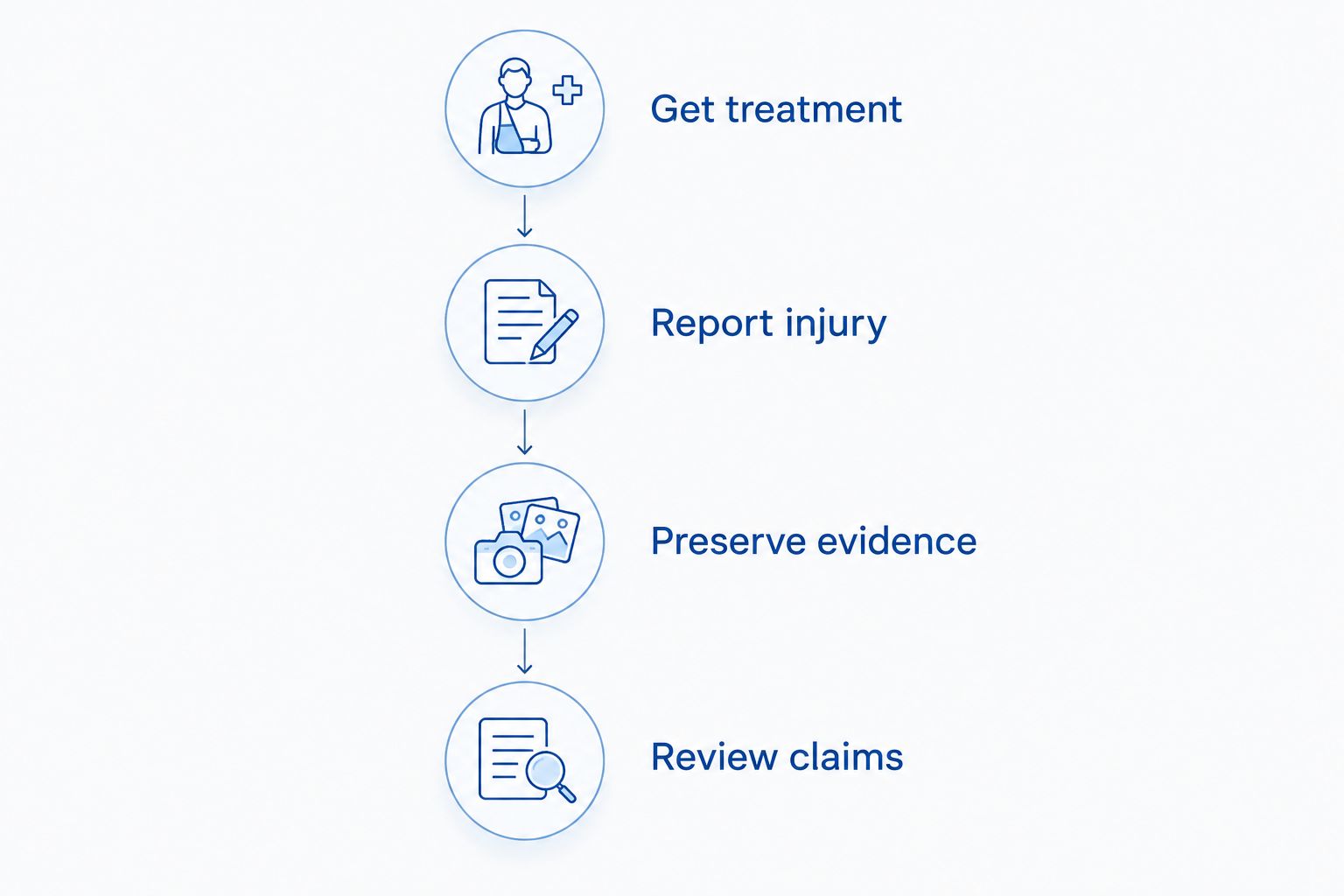
Use this sequence once immediate danger is addressed:
- Get treatment. Describe the work event and symptoms accurately to medical providers.
- Report injury. Notify your employer promptly and keep a copy of written communications.
- Preserve evidence. Save photographs, witness details, work assignments, and relevant messages without entering unsafe areas.
- Review claims. Separate workers’ compensation eligibility from potential claims against another responsible party.
For 2026 claims, California Labor Code section 5400 generally requires notice of a work injury within 30 days, subject to exceptions. Labor Code section 5405 generally sets a 1-year workers’ compensation filing period, with alternative starting points and exceptions. California Code of Civil Procedure section 335.1 generally provides 2 years for a personal injury lawsuit; public-entity claims and other circumstances involve different requirements.
Do not treat those periods as interchangeable deadlines. Read the guide to personal injury claims for construction workers and obtain advice about the dates that apply to your facts.
Which next step should you choose?
Khachikyanlawfirm is a Glendale option for construction workers seeking personal injury representation. Ask whether the facts support a third-party claim, what evidence needs preservation, and which deadlines govern; a workplace injury does not automatically create a lawsuit against your employer.
Discuss your construction injury
Ask about personal injury representation and the facts relevant to a potential claim.
FAQ
What causes construction accidents in California?
Construction accident causes include falls, equipment strikes, falling objects, electrical contact, crushing, excavation collapse, scaffold failures, slips, structural failures, and heat illness. A specific investigation must identify which conditions contributed to the injury.
Is this a ranking of the most frequent California construction accidents?
No. This guide organizes accident mechanisms for investigation and does not present a statistical frequency ranking.
Can I sue my employer after a construction accident?
Workers’ compensation generally provides the exclusive remedy against an employer for a covered work injury, subject to exceptions. A separate claim against a responsible third party requires its own legal basis.
Can I receive workers’ compensation and bring a third-party claim?
Yes, when the facts support both routes. Reimbursement rights and credits can affect how the recoveries interact, so the claims need coordinated review.
What evidence should I save after a construction injury?
Save safely obtained photographs, witness information, incident reports, medical records, work messages, and equipment identifiers. Do not enter a dangerous area or remove equipment to collect evidence.
Does a safety violation automatically prove my injury claim?
No. A safety violation does not automatically establish every element of a claim; responsibility, causation, and damages still require analysis.
Who should I contact about a construction-related personal injury?
Contact a California attorney who handles the type of claim your circumstances support. Khachikyanlawfirm provides personal injury representation in Glendale; ask about the facts of your construction injury and any separate workers’ compensation needs.
One last thing
Photograph the surrounding area, not just the injury. The position of a guard, access route, load, or electrical source helps explain the event after the site changes. In 2026, your practical priority remains the same: treatment first, safe documentation next, and prompt review of the available claims.


