Instead of reconstructing every dealership visit when a manufacturer asks for proof, build a dated repair-order history for your California lemon law claim, then use it to support a legal review and a documented buyback request. Khachikyanlawfirm provides lemon law representation; this 2026 workflow shows you how to organize the evidence without confusing repeated repairs with automatic eligibility.
- Repair order history lemon law claim California: organize warranty repairs by date, mileage, defect, and days out of service.
- Khachikyanlawfirm provides lemon law representation for drivers seeking legal help with vehicle warranty disputes.
- Repair records support a buyback request; they do not establish eligibility by themselves.
- Preserve original documents, track recurring symptoms, and have applicable deadlines reviewed before waiting for another repair.
Why this matters
A repair order connects your reported problem to the dealer’s response. A useful history shows what you reported, when you presented the vehicle, what work occurred, and whether the problem returned.
A stack of invoices is not a claim timeline. Without a timeline, separate visits can obscure a recurring defect, while overlapping records can exaggerate time out of service. Your goal is an accurate record, not the largest possible repair count.
For a 2026 claim review, separate three questions: does the applicable warranty cover the problem, did the manufacturer receive a reasonable opportunity to repair it, and does the unresolved problem substantially impair use, value, or safety? California Civil Code section 1793.2 supplies the repair-and-remedy framework; eligibility also depends on the vehicle and transaction.
Before you start
- Gather the underlying documents. Collect the purchase or lease agreement, applicable warranty, every repair order, manufacturer correspondence, and relevant towing or rental receipts. Use the California lemon law claim documents guide to check your packet.
- Arrange access to missing records. Ask each servicing dealership for its records using your vehicle identification number, or VIN. Obtain manufacturer case correspondence separately; a dealer’s service history does not replace it.
- Watch the non-obvious gap: open versus closed orders. An appointment confirmation proves an appointment, not the completed visit. Request the final repair order, and verify actual drop-off and return dates rather than treating document-printing dates as custody dates.
Keep originals unchanged. Make a separate working copy for notes, and do not postpone deadline advice while you wait for missing paperwork.
Repair-record intake
Collect the source documents
- Create a folder named Source records. Save each document as received, including attachments and messages that explain a missing page or revised order.
- Name files consistently using the visit date, dealership, and repair-order identifier. Keep revised versions separately so you can explain which document replaced which.
- Check that each order identifies your vehicle and includes the complaint, technician findings, work performed, and mileage. Ask the dealership for missing pages rather than filling gaps yourself.
- Add purchase, lease, and warranty documents to separate folders. These establish the transaction and coverage context that repair records alone cannot answer.
Expected result: You can trace every timeline entry back to an original document. A reviewer can distinguish a service appointment, an open work order, and a completed repair without guessing.
Identify the complaint accurately
Read the customer-complaint portion before the technician’s conclusion. A technician’s inability to reproduce a symptom does not erase the fact that you reported it, but it also does not establish that a defect exists.
Preserve both sides of the record. If the order says the visit concerned routine maintenance, do not relabel it as a defect repair simply because another visit involved a warranty problem.
Repair-history configuration
Build the visit ledger
- Create a spreadsheet with these headings: Visit date, Repair-order ID, Mileage in, Reported symptom, Dealer findings, Work performed, Vehicle returned, and Source file. These are your worksheet labels, not dealership software fields.
- Enter one row for each distinct visit. When several documents belong to the same visit, reference them in that row rather than counting them as separate repair attempts.
- Copy the reported symptom and dealer findings accurately. Put your interpretation in a separate Owner notes field, never inside the copied account.
- Add Drop-off date, Return date, and Days unavailable. Confirm custody dates against messages or other records, and flag uncertainty instead of silently choosing a date.
Expected result: Every visit has an identifiable complaint, outcome, mileage, and source. Your 2026 ledger distinguishes what the documents establish from what still needs confirmation.
Group recurring symptoms
- Add a Symptom group field. Use plain descriptions such as loss of power, warning light, or water intrusion only when they match your actual records.
- Group visits with the same reported symptom while retaining the dealership’s different diagnoses. A changing diagnosis and a recurring complaint are different facts.
- Mark whether the symptom returned after each repair. Record when you noticed it and preserve supporting messages, photographs, or safely obtained video.
- Separate unrelated problems. Do not combine a cosmetic concern and an engine complaint into one repeated-defect count merely because they occurred on the same vehicle.
Expected result: A reviewer can follow each problem across visits without confusing symptoms, diagnoses, and replacement parts.
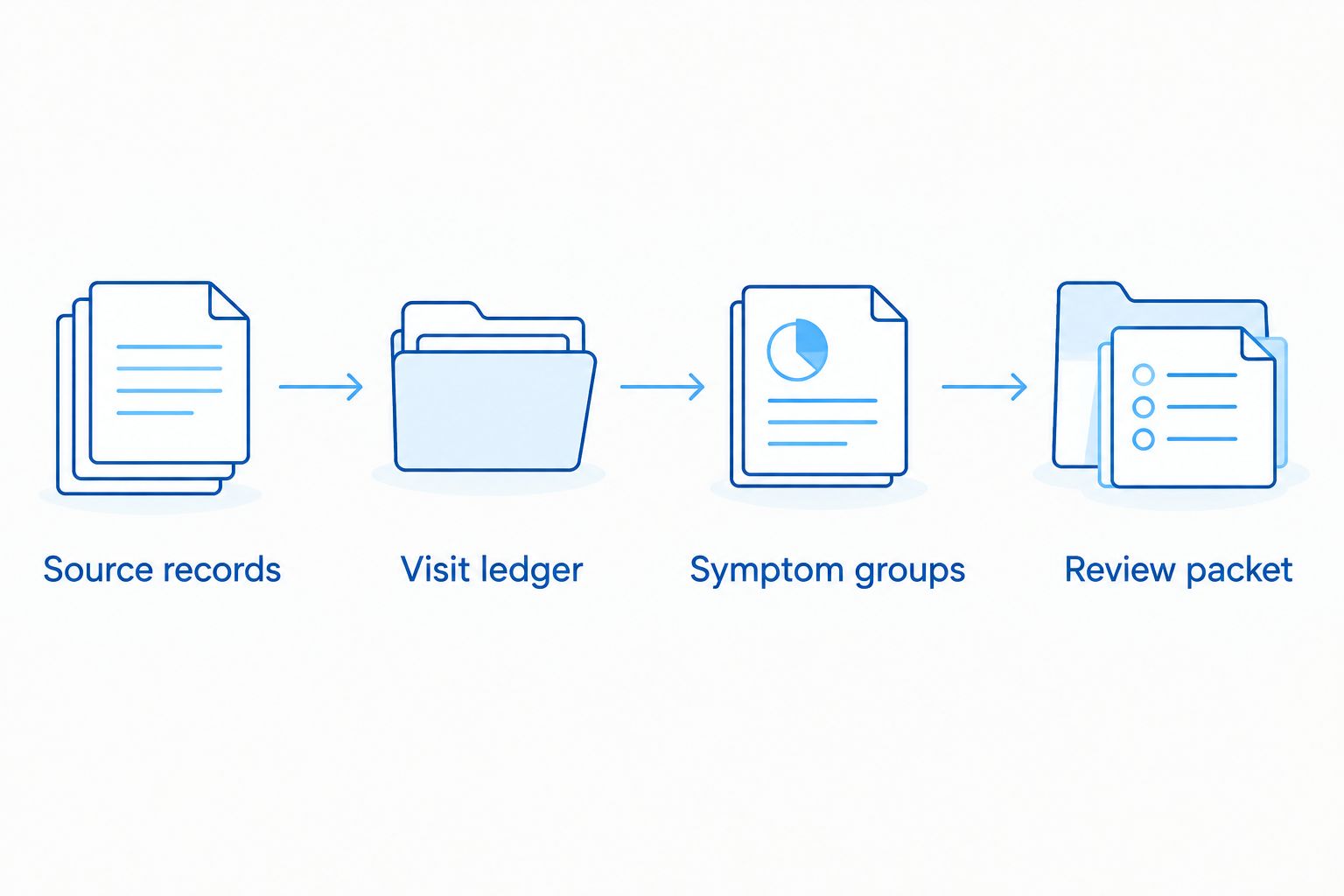
The sequence stays simple: preserve the source, record the visit, connect recurring symptoms, and prepare the review packet. Each stage depends on the previous one being accurate.
Claim-review packet
Check what the history actually supports
- Create a short summary identifying the vehicle, purchase or lease circumstances, applicable warranty, recurring symptoms, and current condition.
- List disputed or incomplete facts separately. Examples include an unconfirmed return date, a missing final order, or a complaint omitted from the dealer’s paperwork.
- Attach the ledger and source records. Include manufacturer case identifiers and correspondence so the reviewer can assess notice and repair opportunities.
- Request review of eligibility, deadlines, and the proper claim procedure before sending a demand or accepting an offer.
Expected result: Your packet supports a legal assessment rather than asserting that a repair count guarantees a buyback.
Understand the presumption without treating it as a checklist
For a 2026 review, California Civil Code section 1793.22 provides a rebuttable presumption concerning reasonable repair opportunities when specified conditions occur within 18 months after delivery or 18,000 miles, whichever occurs first. One statutory route concerns more than 30 calendar days cumulatively out of service for repairs to covered nonconformities, subject to statutory conditions and exceptions.
Those figures are not universal claim deadlines, and the presumption is not the only way to establish reasonable repair opportunities. Notice requirements, the nature of the problem, repair circumstances, and the applicable warranty matter. Do not wait for a numerical threshold before asking about your rights.
For a used vehicle, identify the actual warranty and transaction rather than assuming remaining factory coverage automatically establishes the same manufacturer claim as a new-vehicle purchase.
Buyback-request tracking
Record the demand and response
- Have the applicable procedure reviewed, including the recipient, required notice, supporting documents, and filing deadlines. Do not assume every manufacturer or transaction follows an identical process.
- Preserve the demand exactly as sent, along with delivery confirmation and attachments. Record subsequent communications in a Manufacturer response log.
- Review any proposed remedy against the agreement, payment records, and governing law. A buyback proposal requires more scrutiny than checking that the manufacturer used the word buyback.
- Before signing, review releases, deductions, payoff handling, vehicle-return requirements, and unresolved obligations. Retain the signed agreement and completion records.
Expected result: You can document what was requested, what the manufacturer offered, and what remains unresolved. A submitted demand is not a completed repurchase.
Choose the right support
Khachikyanlawfirm’s lemon law representation is best suited to drivers seeking legal help with a vehicle warranty dispute. You still need to supply accurate records; representation does not replace evidence or establish eligibility by itself.
| Approach | Best for | Advantage | Limitation |
|---|---|---|---|
| Self-organized evidence packet | Drivers collecting and checking their own records | Keeps the source history accessible and updateable | Does not resolve legal eligibility, deadlines, or settlement terms |
| Attorney-assisted claim review | Drivers seeking advice on a warranty dispute and proposed remedy | Adds legal assessment to the repair history | Still depends on the available documents and case-specific facts |
These approaches work together. Organize the evidence yourself, then obtain legal advice on the decisions the spreadsheet cannot make.
Discuss your repair history
Ask Khachikyanlawfirm about lemon law representation for your vehicle warranty dispute.
Update the history after every new repair
Use the same workflow whenever another repair order arrives. An updated record is more useful than repeatedly rebuilding the claim from memory.
- Save the new order in Source records, then add or update its visit row. If it closes an existing visit, do not create another repair attempt.
- Compare the complaint with earlier Symptom group entries. Record a recurrence only when the symptom actually returned.
- Update custody dates and manufacturer correspondence. Keep uncertain dates visibly unresolved until you obtain confirmation.
- Send the revised packet to your attorney when represented. Preserve the prior version so changes remain traceable.
Expected result: Your 2026 claim packet reflects the latest repair outcome without losing earlier evidence. A later successful repair belongs in the history too; omitting it makes the packet incomplete.
For an intermittent problem, keep a separate symptom log between visits. Record the circumstances accurately, and do not recreate a dangerous malfunction to obtain footage.
Troubleshooting
The repair order says no problem found
Keep the order and record whether the symptom continued afterward. At the next visit, describe what happened, the driving conditions, and any warning messages; safely obtained evidence can help explain an intermittent complaint.
Do not rewrite the technician’s finding. The claim history needs both your report and the dealer’s response.
The dealer omitted your complaint
Ask the dealership to correct or supplement its record in writing. Preserve your request and any response alongside the original order.
If the dealer does not revise the document, retain contemporaneous appointment messages or other evidence of what you reported. Keep your account clearly separate from dealer-authored text.
Several orders cover one visit
Group the documents under one visit entry and identify each order. Parts paperwork, diagnostic records, and a revised final invoice do not automatically establish separate opportunities to repair.
Explain genuine return visits separately. The distinction is physical visits and repair opportunities, not how many PDFs you received.
Days out of service do not reconcile
Compare actual drop-off and return dates with messages and vehicle-custody records. Separate overlapping intervals and identify dates involving routine maintenance or unrelated work.
Ask your attorney which periods count under the applicable legal standard. Spreadsheet totals describe your records; they do not decide the statutory calculation.
The manufacturer requests more documents
Identify the specific request and respond through the agreed channel. Save the response, attachments, and delivery evidence rather than merely marking the task complete.
Do not send an inaccurate substitute because the requested record is missing. Explain the gap and preserve the request you made to obtain it.
Customize your workflow
Add a correspondence tab when calls and messages become hard to follow. Record the date, participant, case identifier, subject, and associated document; distinguish your call notes from a written manufacturer statement.
For a leased vehicle, include the lease agreement and relevant account records. For a financed vehicle, preserve the finance documents and payoff correspondence without assuming that a proposed buyback automatically closes the account.
Your 2026 folder should also contain a Questions for counsel list. Ask about warranty coverage, deadline calculation, further repair opportunities, required notices, and the meaning of any proposed release. Expand the evidence, not the conclusions you draw from it.
FAQ
How do I use repair order history for a lemon law claim in California?
Organize each repair visit by date, mileage, complaint, dealer findings, work performed, and time without the vehicle. Preserve the original orders and have the history reviewed alongside the warranty and purchase or lease documents.
Does a repair history automatically qualify my car for a buyback?
No, repair history alone does not establish buyback eligibility. Warranty coverage, substantial impairment, reasonable repair opportunities, and the applicable legal requirements also matter.
What if the dealership cannot reproduce the problem?
Keep the repair order and document any later recurrence accurately. A no-problem-found entry records the dealer’s result, while contemporaneous messages or safely obtained footage can help explain your reported symptom.
Do I need to wait until my car has been in the shop for 30 days?
No, you do not need to wait for 30 days before seeking legal advice. California’s repair-opportunity presumption has specific conditions, and a claim assessment is not limited to that presumption.
Can I use this workflow for a used vehicle?
Yes, the document workflow works for a used vehicle, but eligibility requires a separate assessment of the transaction and applicable warranty. Do not assume remaining factory warranty coverage creates the same manufacturer claim as a new-vehicle purchase.
What should I check before accepting a lemon law buyback?
Review the written terms, deductions, releases, payoff handling, and vehicle-return requirements before accepting. A manufacturer’s description of an offer as a buyback does not replace review of the agreement.
Can Khachikyanlawfirm help with a California lemon law dispute?
Khachikyanlawfirm provides lemon law legal representation. Prepare your repair orders, warranty, transaction documents, and manufacturer correspondence for a case-specific discussion.
One last thing
The first reported symptom can matter more than the first replaced part. A replacement documents a repair action; the earlier complaint can help establish when you first presented the problem for repair.
Keep both in your 2026 timeline. Never replace the customer’s complaint with the technician’s diagnosis, even when the diagnosis sounds more precise.