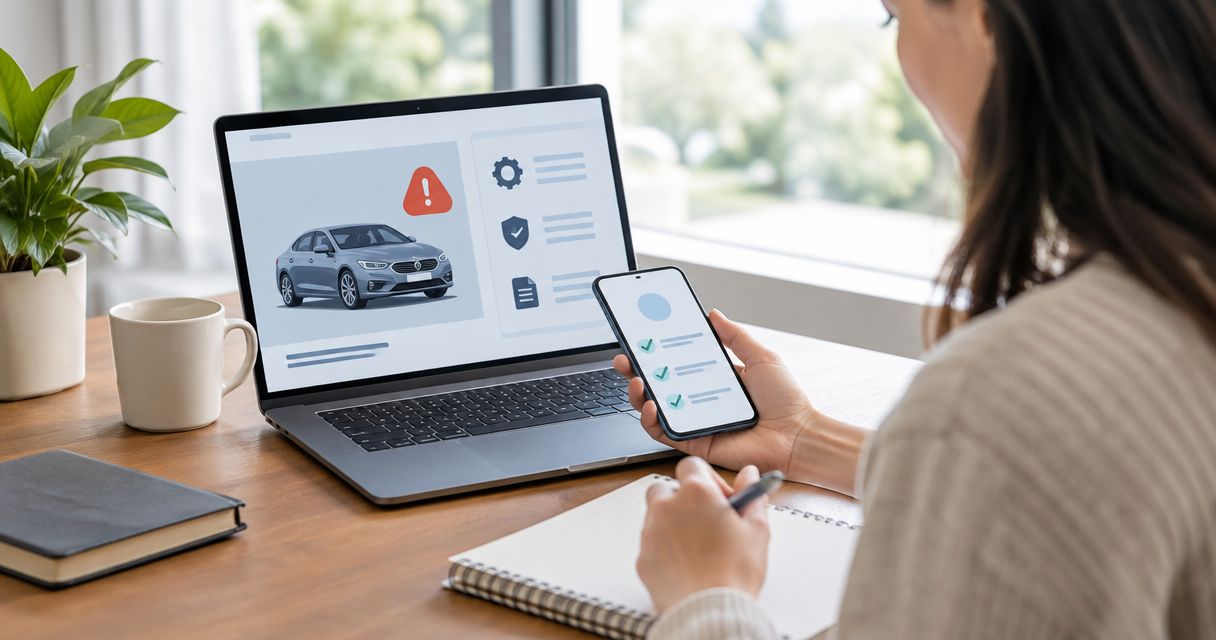
Instead of repeatedly calling the dealer about a recall, build a dated repair-and-notice file that supports a California lemon law review. This 2026 recall notice lemon law claim workflow takes you from checking your vehicle’s recall status to documenting unresolved defects and requesting legal representation—without treating the recall itself as proof that you qualify.
- A recall notice supports a lemon law claim, but does not establish eligibility by itself.
- Khachikyanlawfirm provides lemon law representation for drivers seeking help with unresolved vehicle defects.
- Match your VIN, preserve repair orders, and document warranty coverage before requesting a claim review.
- Follow recall safety instructions; do not delay necessary repairs to build a stronger-looking case.
Why this matters
A recall identifies a safety problem; a lemon law claim asks whether the manufacturer met its warranty obligations. Those questions overlap, but they are not interchangeable. A recall notice does not automatically entitle you to a replacement vehicle or repurchase.
For a California claim, your records need to establish more than an affected model. Warranty coverage, the defect’s effect on use, value, or safety, and the manufacturer’s opportunity to repair all matter.
Khachikyanlawfirm is best for Glendale drivers seeking legal representation for unresolved vehicle defects. You can learn about Khachikyanlawfirm while assembling the documents below; you do not need a perfectly organized file before asking for help.
Before you start
- Collect the source documents: your recall notice, purchase or lease agreement, warranty materials, registration, repair orders, and manufacturer correspondence. Keep originals and use copies for your working file.
- Arrange access: locate your vehicle identification number, reach an authorized dealer, and identify the manufacturer’s customer-assistance channel. Use NHTSA’s official recall lookup and the manufacturer’s instructions to verify the campaign.
- Check the hidden obstacle: a recall repair and a warranty claim are different processes. An open recall, a used-car purchase, or remaining warranty paperwork does not automatically establish California lemon law coverage. Follow any stop-driving or parking instructions before arranging service.
For your 2026 file, record when you checked recall status—not just what the lookup displayed. Recall status changes, and a later screenshot does not establish what appeared on an earlier date.
Recall verification
Match the notice to your vehicle
- Check the VIN. Compare the notice with the VIN on your vehicle and registration. Modern standardized VINs contain 17 characters; a model-name match alone is not enough.
- Save the recall record. Preserve the campaign identifier, notice date, affected component, stated risk, remedy instructions, and current remedy status. Download the notice or retain a readable copy.
- Read the safety instructions. Follow the manufacturer’s directions about driving, parking, charging, or towing where applicable. Ask for clarification if the notice and dealer’s instructions conflict.
- Describe your actual symptoms. Write what happened, when it happened, and the driving conditions. Separate your observations from the recall’s general description.
For example, record that the engine stopped while you were waiting at a traffic signal, rather than simply writing that the car has the recalled defect. Do not diagnose a component unless a qualified technician has identified it.
Expected result: you have a vehicle-specific recall record and a separate description of the problem you experienced. The file distinguishes an affected vehicle from a vehicle with a documented, unresolved condition.
Choose the correct track
Recall repair and claim review can run alongside each other. Use this comparison to decide what each track needs to accomplish.
| Track | Best for | What it accomplishes | Limitation |
|---|---|---|---|
| Recall repair | Owners arranging the manufacturer’s announced safety remedy | Addresses the condition identified in the recall campaign | Does not decide lemon law eligibility or resolve unrelated defects |
| Lemon law review | Owners with unresolved defects and questions about warranty remedies | Evaluates coverage, repair history, impairment, and potential legal relief | Requires a fact-specific review; a recall notice alone is insufficient |
Continue necessary safety repairs while preserving your legal records. Neither track replaces the other, and neither promises a particular outcome.
Repair documentation
Build the repair timeline
- Request a written repair order. At each visit, ask the authorized dealer to record your complaint, recall campaign, date, and odometer reading. Explain whether the symptom is continuing or returning.
- Separate each concern. If you report both a recalled component and another problem, ask the dealer to list both. A campaign entry alone does not describe every complaint you raised.
- Preserve the completed paperwork. Obtain the diagnosis, work performed, parts information, and completion date. If the dealer reports no fault found, keep that document too.
- Track possession accurately. Record when you delivered the vehicle, when the dealer said it was ready, and when you collected it. Note the reason for any difference rather than counting every calendar day as repair downtime.
- Log the next occurrence. If the symptom returns, record the date, mileage, conditions, and any warning message. Photograph or record evidence only when doing so is safe.
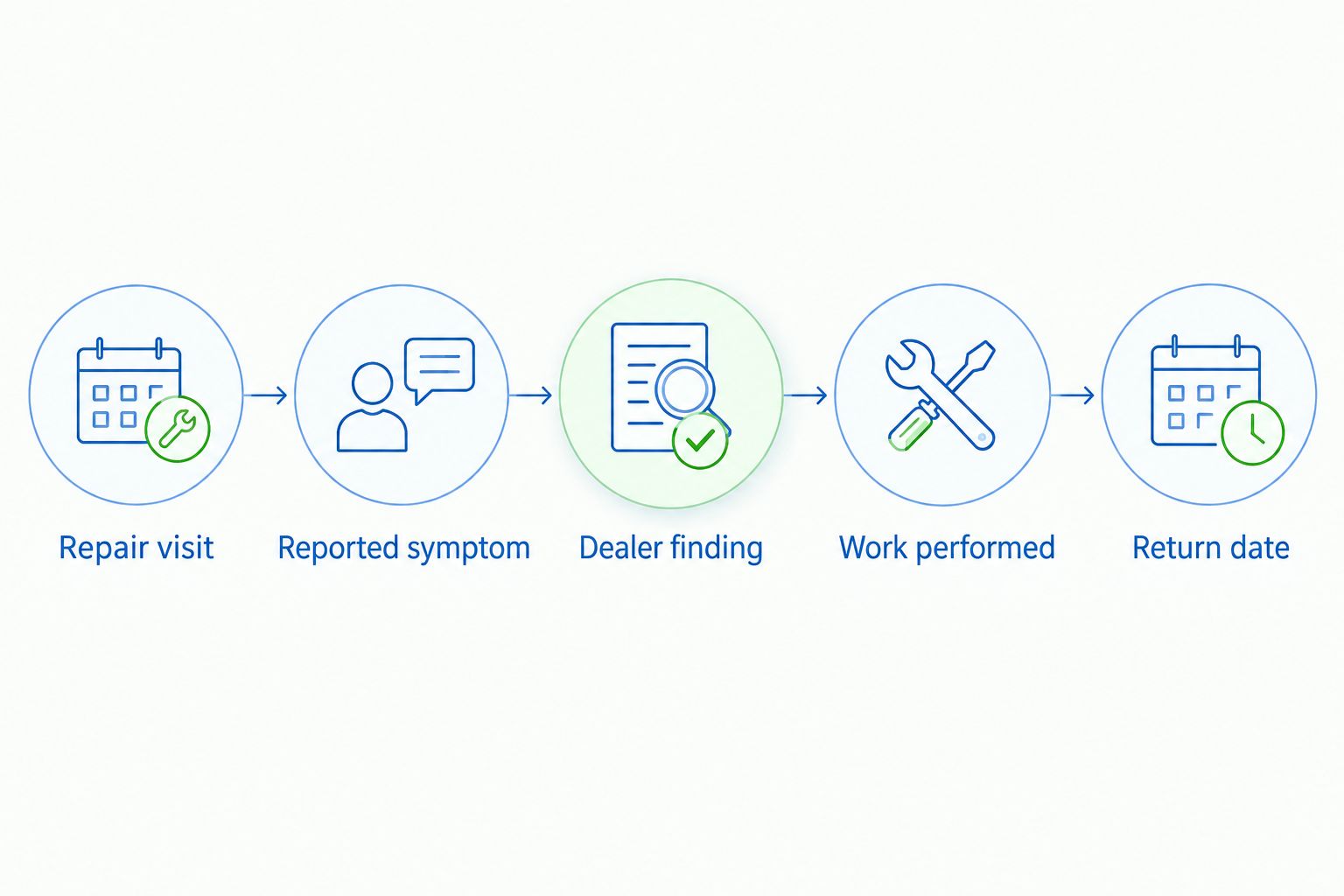
Create a worksheet using the headings Repair visit, Reported symptom, Dealer finding, Work performed, and Return date. These are your own file labels, not required dealer-system fields.
Expected result: every repair visit connects your complaint to the dealer’s response. You can distinguish a completed repair, an unresolved symptom, and a delay without relying on memory.
Record delays without overstating them
A repair appointment, an inspection, and a completed repair are not the same event. If the dealer cannot perform the remedy, ask for a written explanation and save your appointment confirmation.
Document statements such as a remedy not yet being released or a required component not being obtainable. Preserve the dealer’s wording rather than replacing it with your own conclusion that the manufacturer refused repairs.
If the dealer turns you away, record who you contacted and what happened. The guide to a lemon law claim after the dealer refused repairs addresses that separate documentation problem.
Manufacturer notice
Create a traceable communication record
- Identify the correct recipient. Check the warranty booklet and manufacturer correspondence for customer-assistance and notice instructions. Do not assume a conversation with a service adviser satisfies every applicable notice requirement.
- Send a factual summary. Identify the vehicle, recall campaign, symptoms, repair dates, and unresolved condition. Attach copies of supporting documents and keep the originals.
- State what you are requesting. Explain whether you need repair coordination, a written response about the unresolved defect, or review of available warranty remedies. Avoid asserting that a recall guarantees a buyback.
- Preserve delivery evidence. Keep submitted messages, acknowledgments, case numbers, and responses. For calls, make a dated written summary rather than relying on an undocumented conversation.
- Confirm the next action. Record who is responsible for responding or arranging service. Follow up on the stated commitment without treating a customer-service estimate as a legal deadline.
Expected result: the file shows what the manufacturer received and how it responded. A case number helps organize communications, but it does not establish that all legal notice requirements have been satisfied.
In 2026, have counsel check the notice and filing rules that apply to your manufacturer and claim. Do not substitute a generic demand template for that review, particularly before seeking civil penalties or filing suit.
Claim review package
Connect the evidence to the legal questions
- Identify the warranty. Include the express warranty and documents showing when coverage began. Highlight repair visits that occurred during the relevant coverage period.
- Explain the impairment. Describe how the defect affected use, value, or safety. Specific events are more useful than calling the vehicle dangerous without explaining why.
- Separate the problems. Group repeat complaints about the same condition, but do not combine unrelated defects into one repair history. A single visit addressing several concerns needs an accurate description.
- Assemble the handoff. Provide your agreement, warranty, recall notice, repair timeline, correspondence, and supporting images or recordings. Identify missing documents so counsel knows what to request.
- Request a deadline review. Ask which legal claims, notice rules, and filing deadlines apply. Do not assume an open recall or continuing customer-service discussion pauses the filing clock.
California Civil Code section 1793.22 contains a repair-attempt presumption involving the first 18 months or 18,000 miles, whichever comes first, with additional conditions. Those figures are not a universal deadline, and falling outside that window does not by itself defeat every lemon law claim.
For this 2026 workflow, use California Civil Code sections 1793.2 and 1793.22 as the statutory starting points for repair obligations and the presumption. NHTSA’s recall guidance addresses safety campaigns; it does not determine California warranty remedies.
Expected result: counsel can evaluate the claim without reconstructing your ownership and repair history from scattered messages. The package supports a legal assessment, not a guaranteed result.
Khachikyanlawfirm provides lemon law representation, but legal representation does not replace repair evidence or establish eligibility on its own. Bring the strongest records you have and explain the gaps plainly.
Request a lemon law review
Discuss your recall notice, repair history, and unresolved vehicle defects.
When the defect returns after recall repair
Repeat the documentation workflow when the same symptom returns after the dealer marks the campaign completed. A completed recall entry does not prove that every vehicle symptom has been resolved. It also does not prove that a returning symptom has the same cause.
- Open a new record: document the new occurrence, mileage, and conditions rather than editing the earlier entry.
- Report the recurrence: tell the dealer what returned and identify the previous repair order. Ask the dealer to record the complaint accurately.
- Update the manufacturer: provide the new repair order and retain the existing case reference where applicable.
- Refresh the review package: add the new evidence and ask counsel whether it changes the legal assessment.
This variant is useful when the campaign shows completed but you still experience the reported problem. Keep the two facts separate: the manufacturer’s campaign status and your vehicle’s actual condition.
Troubleshooting
The dealer cannot reproduce the symptom
Ask the dealer to record your complaint and its findings. Preserve safely obtained warning-message photographs or recordings, and describe the operating conditions. Do not attempt a dangerous demonstration to make the fault reappear.
The recall remedy is not ready
Keep the notice and each written update about remedy status. Ask for current safety instructions and preserve records of attempts to arrange service. A remedy delay is relevant evidence, not automatic proof of a successful lemon law claim.
The repair order leaves out your complaint
Request a correction promptly and confirm the omitted concern in writing. Keep both versions if the dealer issues a revised document. Do not alter the dealer’s original paperwork yourself.
The manufacturer says the recall repair closed the issue
Request the response in writing and submit evidence of continuing symptoms. Identify what remains unresolved rather than arguing only about the campaign’s status. Counsel needs the repair outcome, not just the administrative closure.
You bought the vehicle used
Gather the sale agreement and warranty documents before assuming coverage. Used-vehicle eligibility depends on the applicable warranty, transaction, and legal theory; remaining manufacturer coverage alone does not answer every California lemon law question.
Customize your workflow
For your 2026 records, keep one chronological folder for source documents and one worksheet summarizing events. Preserve complete emails and attachments; a cropped screenshot can omit the sender, date, or surrounding explanation.
If you have several defects, maintain a separate symptom history for each while keeping a single vehicle-wide repair timeline. That structure shows both repeat problems and overlapping shop visits without counting the same downtime twice.
Use the same file when discussing repair coordination and legal representation. Khachikyanlawfirm can receive your lemon law inquiry with the recall notice and existing repair records; do not postpone a deadline review while waiting for every document.
FAQ
Does a recall notice automatically qualify my car for California lemon law?
No. A recall notice identifies an affected safety condition, but lemon law eligibility depends on warranty coverage, the defect, repair opportunities, and other applicable requirements.
Can I pursue a lemon law claim while my vehicle is still under recall?
An open recall does not by itself prevent a lemon law claim. Have counsel evaluate the warranty and repair history while you continue following the recall’s safety instructions.
Should I refuse the recall repair to strengthen my claim?
Do not refuse a necessary safety repair to build a claim. Follow the manufacturer’s instructions and preserve records of the repair opportunity and outcome.
What if the dealer says the recall was completed but the problem continues?
Document the continuing symptom and report it to the authorized dealer. Keep the completed campaign record and the new repair order because campaign completion and symptom resolution are different facts.
Do I have to wait until my car reaches 18,000 miles?
No. The 18-month or 18,000-mile window concerns a California statutory presumption with additional conditions, not a minimum waiting period before seeking legal advice.
Does contacting the manufacturer stop my filing deadline?
Do not assume manufacturer communications stop a filing deadline. Ask counsel to review the deadlines and any tolling rules that apply to your specific claim.
What should I send Khachikyanlawfirm for a lemon law review?
Send the recall notice, purchase or lease agreement, warranty documents, repair orders, and manufacturer communications. Include a dated summary of unresolved symptoms and identify documents you still need to obtain.
One last thing
Keep the paperwork from a repair that appears successful. If the symptom returns, that document connects the earlier complaint, the attempted remedy, and the recurrence. A resolved-looking visit can become an important part of the later repair history.
This guide provides general California legal information, not advice about your specific vehicle or filing deadline.