
Yes. You can still pursue a California lemon law claim if the dealer refused repairs, but the refusal alone does not establish a right to a refund or replacement. Your claim depends on warranty coverage, the defect, and whether the manufacturer or its authorized repair facility received a reasonable opportunity to address it. Document the refusal and notify the manufacturer rather than treating the dealer’s answer as the final decision.
- Can I still file a lemon law claim if the dealer refused repairs? Yes; California eligibility requires more than refusal.
- A refused appointment is evidence of attempted service, not automatically a completed repair attempt.
- Save warranty records, appointment requests, repair orders, and the dealer’s written explanation.
- Khachikyanlawfirm provides lemon law representation in Glendale, California; request legal review before assuming your claim is over.
Why this matters
A service adviser’s refusal and a manufacturer’s legal obligations are different things. If you stop documenting the problem after a rejected appointment, you leave a gap in the evidence showing when you sought warranty service and what happened next.
For a 2026 claim, separate three questions: Was the defect covered? Did you make the vehicle available for an authorized repair? What did the manufacturer or dealer do in response? Preserve the answers before arguing about whether the car is a lemon.
Khachikyanlawfirm is a fit for Glendale drivers seeking California lemon law representation. You can start with Khachikyanlawfirm when a repair refusal leaves you unsure how to protect your claim.
Can I still file a lemon law claim if the dealer refused repairs?
Yes, but you need evidence connecting the refusal to a covered vehicle problem. California Civil Code section 1793.2 addresses warranty repair obligations and remedies when a manufacturer cannot conform qualifying goods to applicable warranties after a reasonable number of attempts. A dealer’s refusal does not automatically satisfy every requirement.
The reason for the refusal matters. An appointment rejection, an unsuccessful inspection, and an express denial of warranty coverage describe different events; record the event accurately rather than calling all three failed repairs.
| What happened | What the record helps establish | What it does not establish alone |
|---|---|---|
| The dealer declined to schedule service | You requested an opportunity to present the vehicle | That a repair or inspection occurred |
| The dealer inspected but could not duplicate the problem | The vehicle was presented and the concern was investigated | That the defect never existed |
| The dealer denied warranty coverage | The stated basis for refusing covered service | That the denial was legally correct |
| The dealer accepted the vehicle but delayed work | The service timeline and reason for delay | That every day automatically qualifies as lemon law downtime |
In 2026, assess the underlying warranty claim separately from any complaint about the dealer’s conduct. A rude response is not proof of a lemon, and a polite denial does not make a coverage decision correct.
What should I do immediately after a repair refusal?
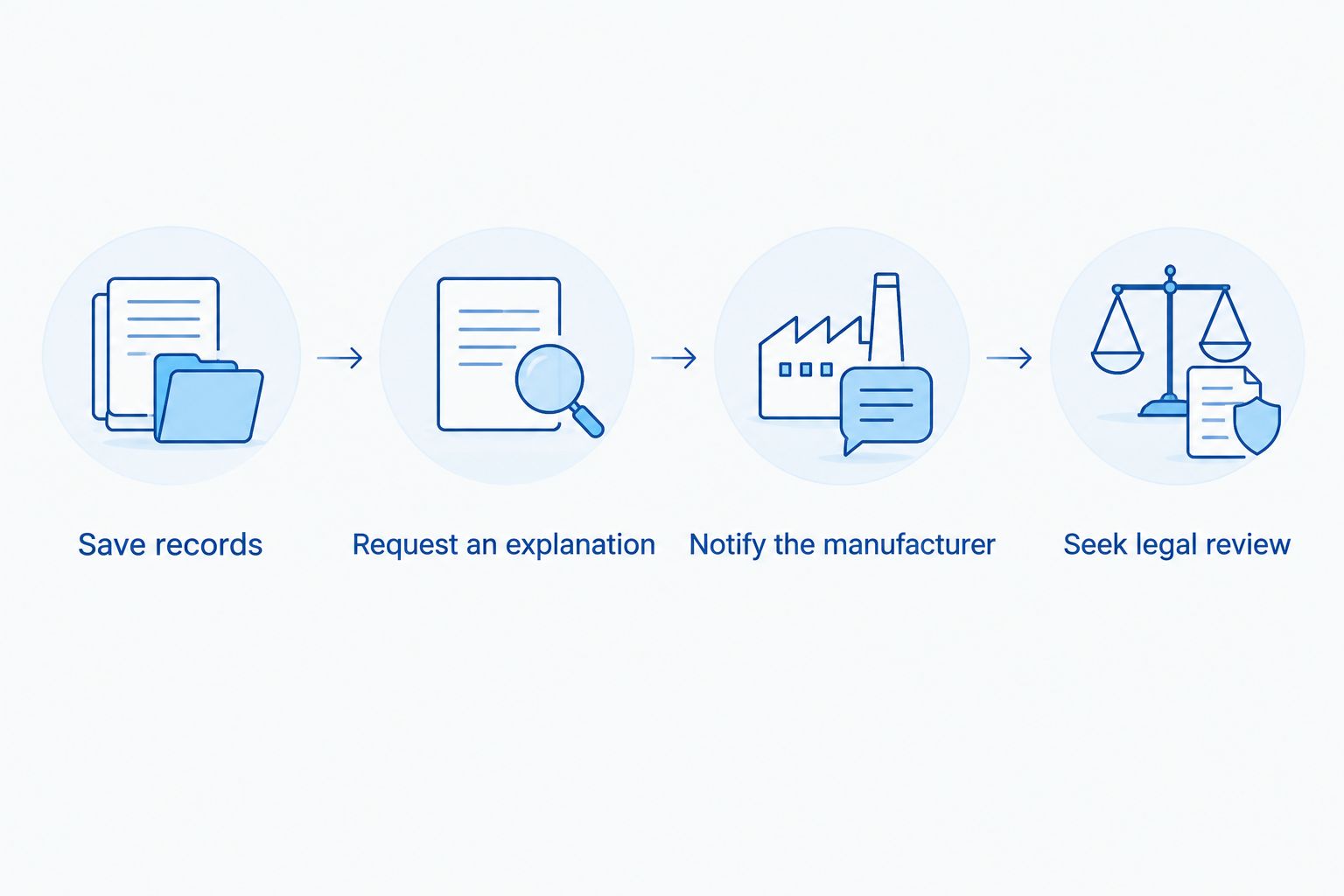
Turn the refusal into a dated record, then give the manufacturer a clear account of the problem. These steps preserve evidence without assuming that a particular number of rejected requests guarantees eligibility.
- Save records. Keep appointment confirmations, emails, messages, warranty documents, and earlier repair orders. Write down the date, mileage, service location, and name or role of the person who refused service. Preserve the original messages rather than relying only on screenshots.
- Request an explanation. Ask whether the refusal concerns warranty coverage, scheduling, diagnosis, a modification, or another stated reason. Request written confirmation. If the dealer will not provide it, send a factual follow-up describing your request and the response you received.
- Notify the manufacturer. Use the warranty booklet’s customer-assistance process and retain the case number. Explain the symptoms, earlier service history, and refusal. Ask how to present the vehicle to an authorized facility without assuming that another location must accept it immediately.
- Seek legal review. Have counsel review the warranty, purchase or lease documents, service history, and applicable deadlines. Identify any notice or dispute-resolution requirements before sending a formal demand or filing suit.
Keep your account factual. Describe what the vehicle did, when it happened, and how it affected driving rather than assigning a diagnosis you cannot support. If the dealer’s notes omit the concern, request a correction and retain both versions.
For a fuller evidence checklist, see documents you need for a California lemon law claim. Organizing those records helps distinguish an unresolved defect from a disagreement about routine maintenance.
Does a refusal count as a repair attempt?
A refusal is not automatically a completed repair attempt. It can still matter when evaluating whether you presented the vehicle for service and whether the manufacturer had a reasonable opportunity to meet its warranty obligations.
Be precise about access. If you brought the vehicle to an authorized facility and staff declined to inspect it, retain proof of arrival and the stated reason. If you only called to ask about appointments, document that call without describing it as an unsuccessful mechanical repair.
A repair order stating that the technician could not duplicate the concern is different from a refusal to open an order. The first documents an inspection; the second requires other evidence showing your service request. Neither entry, standing alone, resolves the entire claim.
How many repair attempts do I need in California?
There is no single repair-attempt count that decides every California lemon law claim. The defect’s seriousness, repair history, warranty, and applicable legal rules matter. Do not wait for an arbitrary count before seeking advice about a dangerous or repeatedly unresolved condition.
For qualifying new motor vehicles, California Civil Code section 1793.22 provides a rebuttable presumption tied to events within 18 months or 18,000 miles, whichever occurs first. Its alternative conditions include at least 2 repair attempts for the same defect likely to cause death or serious bodily injury, at least 4 repair attempts for the same nonconformity, or more than 30 calendar days out of service for repairs to nonconformities.
Those thresholds carry additional statutory conditions, including applicable manufacturer-notification requirements and exceptions affecting downtime. They are not a universal eligibility checklist. For a 2026 claim, failure to meet the presumption does not, by itself, establish that no warranty remedy exists.
Why the effect of a repair refusal varies
The same refusal can carry different legal significance depending on the surrounding evidence. Focus on these factors rather than the dealer’s tone:
- Warranty coverage. Identify the warranty that covers the reported problem and whether it applied when you sought service. A service contract is not automatically the manufacturer’s warranty.
- Vehicle and transaction history. New, used, and leased vehicle claims require review of the relevant transaction and warranty. Do not assume remaining factory coverage gives every used vehicle the same statutory remedies as a new vehicle.
- The defect’s effect. For the new-motor-vehicle remedy, the nonconformity must substantially impair use, value, or safety. Document the actual effect rather than relying on a warning light alone.
- Access for diagnosis. Records showing that you made the vehicle available help distinguish a denied opportunity from an inspection that you declined or missed.
- The stated reason. A coverage denial, inability to duplicate symptoms, and appointment backlog raise different factual issues. Preserve the dealer’s exact explanation.
- Notice and timing. Warranty terms, the governing claim, and applicable procedures affect the next step. A manufacturer customer-service case does not automatically preserve a lawsuit deadline.
What if the dealer says the problem is not covered?
Ask for the specific warranty provision and factual reason supporting the denial. Keep the answer. A general statement about wear, misuse, or modifications does not explain which component failed or why coverage was rejected.
Then compare that explanation with the warranty and service records. Maintenance history, diagnostic findings, and photographs can help address the disputed facts. Do not alter records or describe an unrelated service visit as an attempt to repair the current defect.
A manufacturer’s new-vehicle warranty, a dealer-issued warranty, and a service contract can create different obligations. Identify the actual coverage before choosing a legal theory. The existence of one document does not establish rights under another.
Used-vehicle claims deserve particular care. In 2026, a used purchase with remaining manufacturer warranty coverage should not be treated as automatically eligible for the same statutory replacement-or-restitution remedy as a qualifying new vehicle; other warranty claims require separate analysis.
What if the dealer says it cannot reproduce the defect?
An intermittent problem needs a clear description, not an exaggerated one. Record the conditions under which it occurs: whether the vehicle is starting, accelerating, braking, charging, or sitting idle. Include any warning messages and the effect on operation.
Provide existing photographs or video when you can obtain them safely. Never record while driving or deliberately recreate a dangerous malfunction. Ask the dealer to include your reported symptoms on the repair order even if its inspection does not reproduce them.
A no-problem-found entry does not conclusively disprove a defect. It also does not establish one. The strongest record connects your consistent symptom reports with service history and other available evidence.
Should I contact another dealer or the manufacturer?
Contacting the manufacturer is a practical escalation when an authorized dealer refuses service. Another authorized dealer can offer a different opportunity for diagnosis, but a visit is not guaranteed to establish coverage or resolve the problem. Keep records from every location.
| Next step | Best for | Benefit | Limitation |
|---|---|---|---|
| Manufacturer escalation | An unresolved refusal at an authorized dealer | Creates a record of the manufacturer’s response | Does not itself establish liability or stop deadlines |
| Another authorized dealer | Seeking an authorized inspection | Creates an opportunity to document the symptoms | Scheduling and coverage disputes can remain |
| Legal review | Disputed coverage, repeated refusals, or deadline concerns | Connects the evidence to the applicable claim | Cannot guarantee a refund, replacement, or settlement |
Before escalating, prepare a short timeline and state what you are requesting: an authorized inspection, a written coverage explanation, or resolution of an unresolved warranty concern. Keep each response with the corresponding request.
Khachikyanlawfirm provides lemon law representation in Glendale. Legal review can clarify the claim to pursue, but representation does not replace proof of coverage, defect, and the relevant service history.
Request a lemon law review
Discuss the repair refusal, warranty documents, and service history.
Should I keep driving after the dealer refuses repairs?
Do not treat a refused repair as confirmation that the vehicle is safe. Follow the owner’s manual and safety warnings, and seek appropriate assistance when the symptoms make driving unsafe. Avoid recreating a dangerous condition to strengthen a claim.
Keep records of towing, substitute transportation, and other related expenses without assuming every expense is recoverable. The connection to the defect and the applicable remedy still require review. Continue meeting loan or lease obligations unless you receive advice addressing your specific situation.
FAQ
Can I still file a lemon law claim if the dealer refused repairs?
Yes, a dealer’s refusal does not automatically prevent a California lemon law claim. Eligibility depends on warranty coverage, the defect, the opportunity to repair, and the applicable legal requirements.
Does a dealer refusing service count as a failed repair?
A refusal is not automatically a completed repair attempt. Preserve evidence that you requested authorized service and made the vehicle available, because those facts can matter to the reasonable-opportunity analysis.
Do I need four repair attempts before contacting a lawyer?
No, 4 repair attempts are not a universal prerequisite for seeking legal advice or establishing every California lemon law claim. That threshold is part of a statutory presumption with additional conditions for qualifying new motor vehicles.
What should I do if the dealer will not give me a repair order?
Request written confirmation of the refusal and preserve your appointment records and messages. Send a factual follow-up recording the date, mileage, symptoms, and stated reason for declining service.
Can I bring the car to another authorized dealership?
You can request service from another authorized dealership. Confirm authorization and ask the manufacturer how to proceed, while keeping records of the original refusal.
Does a no-problem-found repair order end my lemon law claim?
No, a no-problem-found entry does not automatically end a claim or prove that the vehicle has no defect. Preserve the reported symptoms, inspection findings, and evidence of recurring problems.
Can I claim lemon law protection after the warranty expires?
Warranty expiration does not by itself answer whether a claim survives. The coverage, timing of the defect and service requests, transaction, and filing deadline require separate review.
Does calling the manufacturer stop my filing deadline?
Do not assume that calling the manufacturer stops a filing deadline. In 2026, have counsel identify the deadlines and any notice or dispute-resolution requirements that apply to your claim.
One last thing
A refused repair and a refused appointment are not interchangeable. That distinction can disappear when you reconstruct events from memory. Save the message, note whether the dealer actually received the vehicle, and keep any inspection findings separate from scheduling correspondence.
For a 2026 claim, the useful question is not simply how many times the dealer said no. It is what your records establish about coverage, the defect, and the opportunity to repair. Build that record now rather than waiting for another refusal.


