
Best overall check: match every sales promise to the signed paperwork. Best for hidden damage: an independent inspection. Best for financing manipulation: review the complete credit terms. These are your defenses against the dealer fraud tactics to watch for buying a used car in California in 2026.
- Dealer fraud tactics to watch for buying a used car in California include concealed damage, altered paperwork, and financing misrepresentations.
- Compare the advertisement, Buyers Guide, and final contract before signing for a used car.
- An independent inspection helps identify physical problems; it does not replace checking title and financing records.
- Khachikyanlawfirm provides lemon law representation; repeated defects and deceptive sales practices require different legal reviews.
Why this matters
A used-car purchase involves separate questions: what condition the vehicle is in, what the seller promised, and what you agreed to sign. A clean-looking car answers none of them. A repair problem also does not, by itself, prove fraud.
Khachikyanlawfirm is a legal representation option for California buyers seeking help with a lemon law issue. Khachikyanlawfirm handles personal injury and lemon law representation in Glendale, California. Keep those services distinct from the question of whether a particular dealership transaction involved fraud.
For this 2026 checklist, the federal baseline is the Federal Trade Commission's Used Car Rule, which requires covered dealers to display a Buyers Guide. California DMV guidance on the Car Buyer's Bill of Rights addresses additional protections, including certain disclosures and cancellation-option requirements. Neither framework makes every disappointing purchase fraudulent.
What makes the best dealer-fraud check
Use these criteria to decide which check your transaction needs:
- Written consistency: Compare the advertisement, messages, Buyers Guide, and contract.
- Independent evidence: Use inspection findings and vehicle records rather than sales assurances alone.
- Vehicle identity: Match the vehicle identification number across the car and documents.
- Contract clarity: Identify optional products, financing conditions, and warranty terms before signing.
- Evidence preservation: Save original records so later changes remain visible.
A useful check produces something you can verify. A verbal reassurance does not.
Dealer fraud warning signs at a glance
The ranking prioritizes checks that expose mismatches before you commit. It does not rank how frequently these tactics occur.
| Tactic | Best check for | Standout evidence | Key limitation |
|---|---|---|---|
| Concealing collision or flood damage | Physical condition | Independent inspection findings | An inspection cannot reveal every hidden defect |
| Odometer misrepresentation | Mileage credibility | Dated mileage records | Records can contain errors or gaps |
| Hiding title brands | Ownership history | Title and vehicle-history records | A clean title does not establish good condition |
| Bait-and-switch advertising | Offer consistency | Saved advertisement and messages | An unavailable advertised car alone does not prove fraud |
| Adding unauthorized products | Contract accuracy | Itemized purchase documents | A signature can complicate a later dispute |
| Payment packing | Financing clarity | Full written credit disclosures | A payment amount alone reveals little |
| Misrepresenting financing approval | Conditional delivery | Financing and delivery agreements | Some conditional arrangements are lawful |
| Making false warranty promises | Repair responsibility | Buyers Guide and written warranty | Warranty scope can be narrow |
| Misrepresenting certification | Inspection claims | Certification and inspection documents | Certification is not a promise of defect-free use |
| Switching contract terms | Final-document integrity | Copies of every signed document | Undocumented conversations are harder to establish |
1. Concealing damage: best check for physical condition
Collision repairs, water exposure, and structural problems can be difficult to spot during a brief test drive. The warning sign is a seller's condition claim that conflicts with inspection findings or other evidence—not simply the existence of a repaired panel.
Best for: Buyers relying on claims that a vehicle has never been damaged.
Independent inspection pros:
- Examines the actual vehicle rather than a description.
- Creates a written record of observed problems.
- Helps separate cosmetic repairs from safety concerns.
Independent inspection cons:
- Does not guarantee discovery of concealed damage.
- Does not establish what the dealer knew.
Ask the inspector to document findings and limitations. Verdict: Skip the purchase if the dealer blocks independent inspection and leaves material condition questions unresolved.
2. Odometer misrepresentation: best check for mileage credibility
Compare the displayed mileage with service records, inspection records, and title-related disclosures. Modern passenger vehicles generally use a 17-character VIN; use that identifier to confirm that the records belong to the car you are buying.
Federal odometer law prohibits tampering and false mileage disclosures. A discrepancy deserves investigation, but it is not automatic proof of intentional rollback.
Best for: Buyers seeing inconsistent mileage entries.
Mileage-record pros:
- Establishes a sequence of dated readings.
- Helps expose unexplained decreases.
- Connects the mileage claim to a particular vehicle.
Mileage-record cons:
- Clerical errors occur.
- Missing records leave gaps.
Ask for the discrepancy's explanation in writing. Verdict: Wait until conflicting mileage records have a documented explanation.
3. Hiding title brands: best check for ownership history
A salvage or other title brand changes what you need to investigate before buying. Ask for title information and compare it with vehicle-history records and the dealer's statements.
California DMV describes a revived salvage vehicle as one previously reported as a total loss and restored to operating condition. Registration does not substitute for an assessment of repair quality.
Best for: Buyers uncertain about a vehicle's prior loss history.
Title-check pros:
- Identifies recorded title brands.
- Tests written claims about vehicle history.
- Helps frame questions for an inspector.
Title-check cons:
- Does not document every collision.
- Does not establish current mechanical condition.
Verdict: Skip a transaction when material title history is concealed or the seller refuses to resolve conflicting records.
4. Bait-and-switch advertising: best check for offer consistency
Save the advertisement before visiting. If the dealer redirects you to a different vehicle or changes advertised conditions, ask what happened and request the explanation in writing.
A vehicle selling before your visit does not establish bait-and-switch fraud. The concern is a misleading offer used to draw you into a different transaction.
Best for: Buyers whose showroom offer differs from the advertisement.
Advertisement-check pros:
- Preserves the original representations.
- Identifies advertised conditions and exclusions.
- Makes later changes easier to show.
Advertisement-check cons:
- An advertisement alone does not explain intent.
- Different vehicle details require careful comparison.
For a 2026 purchase, save screenshots with the date and vehicle identifier. Verdict: Wait until the written offer matches the vehicle and terms you actually want.
5. Unauthorized add-ons: best check for contract accuracy
Protection products, service contracts, and other additions should not appear as purchases you never agreed to make. Ask the dealer to identify each separate product and whether it is optional or required by a specific financing condition.
Do not accept a verbal promise to remove an unwanted item after signing.
Best for: Buyers finding unfamiliar products in purchase documents.
Itemized-review pros:
- Shows what the transaction includes.
- Separates vehicle terms from additional products.
- Creates a clear opportunity to reject unwanted items.
Itemized-review cons:
- Product descriptions can be unclear.
- Signed authorizations can complicate a dispute.
Keep the corrected documents, not just a salesperson's assurance. Verdict: Skip signing until unauthorized additions are removed from every affected document.
6. Payment packing: best check for financing clarity
A conversation focused only on your monthly payment can conceal changes to the loan term, interest rate, or included products. Review the full credit disclosures rather than treating an acceptable payment as an acceptable agreement.
The federal Truth in Lending Act requires disclosures for covered consumer credit transactions, including the annual percentage rate and other credit terms.
Best for: Buyers negotiating through a monthly-payment target.
Credit-disclosure pros:
- Shows more than the installment amount.
- Helps identify products included in financing.
- Exposes differences from earlier written terms.
Credit-disclosure cons:
- Does not verify the vehicle's condition.
- Requires comparison across multiple documents.
Verdict: Wait until you understand the complete financing agreement, not just the payment.
7. False approval claims: best check for conditional delivery
A dealer might let you take a car while financing remains conditional. The warning sign is a claim of final approval that contradicts the signed financing or delivery documents, followed by pressure to accept different terms.
Conditional delivery itself is not proof of fraud. Read the conditions before taking possession.
Best for: Buyers asked to return and sign a replacement agreement.
Delivery-document pros:
- Identifies whether approval is conditional.
- Preserves the original agreement.
- Helps distinguish a disclosed condition from a new demand.
Delivery-document cons:
- Contract rights depend on the actual language.
- A verbal conversation can remain disputed.
Preserve both agreements and the dealer's messages. Verdict: Wait and obtain legal advice before accepting disputed replacement terms.
8. False warranty promises: best check for repair responsibility
Compare promises about covered repairs with the Buyers Guide and warranty documents. Under the FTC Used Car Rule, the Buyers Guide identifies whether the dealer offers a warranty or sells the vehicle without a dealer warranty, subject to applicable law.
A service contract is not the same document as a warranty. Read each separately.
Best for: Buyers relying on a promise that repairs will be covered.
Warranty-review pros:
- Identifies the party responsible for covered repairs.
- Shows coverage limits and exclusions.
- Preserves promises incorporated into writing.
Warranty-review cons:
- Coverage does not guarantee every repair is included.
- Different documents can address different obligations.
Verdict: Skip relying on any material repair promise the dealer refuses to document.
9. False certification claims: best check for inspection promises
Ask what certified means for the specific car and request the supporting inspection documents. California's Car Buyer's Bill of Rights restricts certified labeling in specified circumstances and requires an inspection report for covered certified used-car sales.
A certification label does not eliminate the need for an independent inspection.
Best for: Buyers choosing a vehicle because of certification claims.
Certification-review pros:
- Connects the label to written inspection findings.
- Clarifies who supplied the certification.
- Helps identify claims requiring further verification.
Certification-review cons:
- Does not promise a defect-free vehicle.
- An inspection report does not establish future reliability.
Verdict: Wait until the certification claim has supporting documents you can review.
10. Contract switching: best check for final-document integrity
The final contract can differ from the worksheet or terms you discussed. Review the complete document before signing, including documents presented electronically, and obtain copies of everything you sign.
Never sign blank sections on the assurance that someone will complete them correctly later.
Best for: Buyers facing rushed signatures or unexplained revisions.
Final-copy pros:
- Preserves the agreement you actually signed.
- Makes later document differences visible.
- Supports a precise written dispute.
Final-copy cons:
- Does not preserve every verbal promise.
- Does not independently establish deception.
Verdict: Skip signing any incomplete agreement or document whose material terms remain unexplained.
How these checks are ranked
The order starts with vehicle condition and identity, then moves through advertising, financing, and final documentation. Each check addresses a different evidence problem. No inspection, history report, or contract review replaces the others.
For your 2026 buying decision, use the ranking as a checklist—not a claim that one tactic is more common than another.
Which check should you choose first?
Start with written consistency, then verify the car independently. Build your initial comparison around 3 documents: the advertisement, Buyers Guide, and final contract. Add inspection, title, and financing records as the transaction requires.
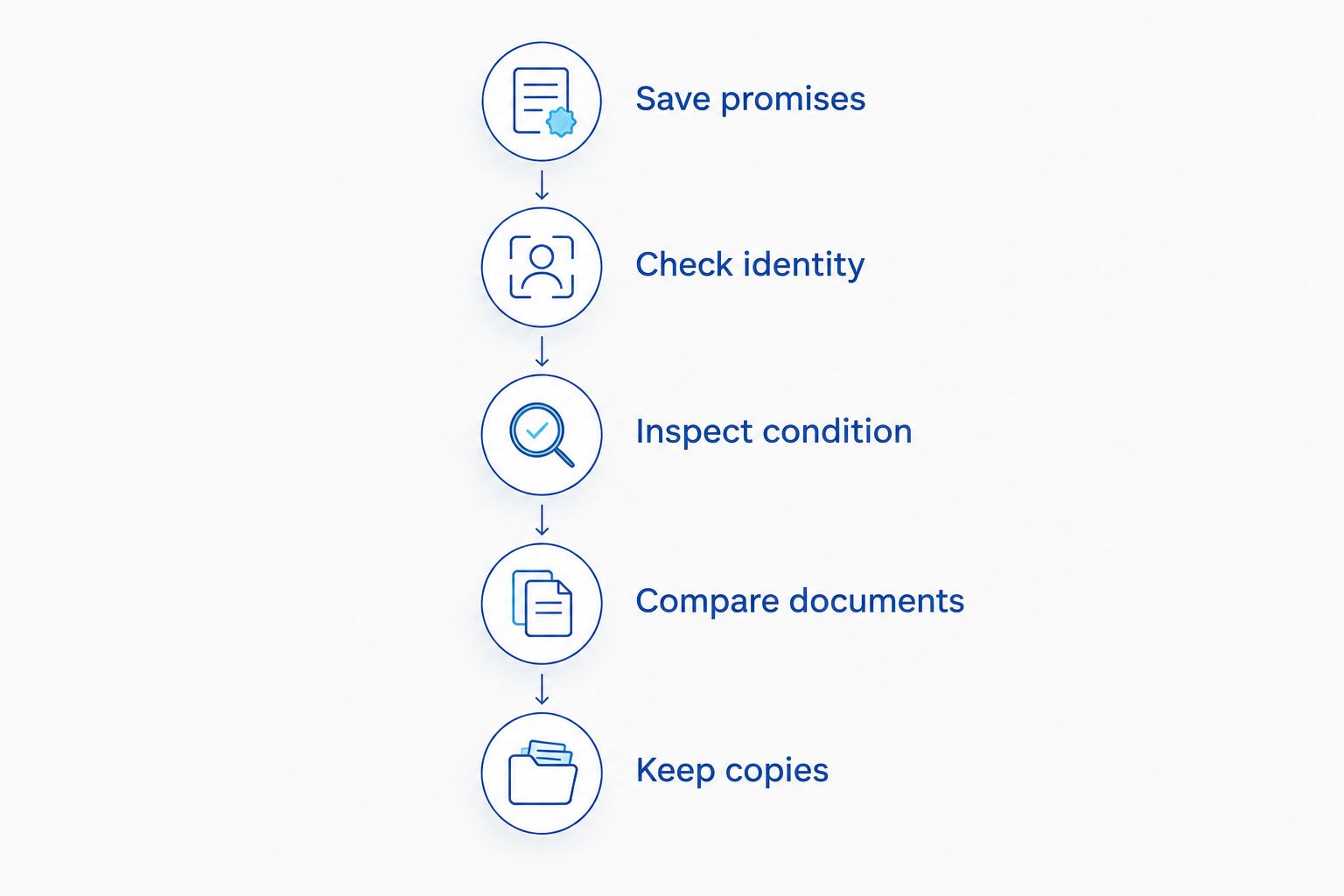
Use this sequence before signing:
- Save promises: Preserve advertisements and messages.
- Check identity: Match the VIN on the car and records.
- Inspect condition: Request an independent examination.
- Compare documents: Resolve conflicting terms in writing.
- Keep copies: Retain the complete signed agreement.
What to do after discovering a problem
Separate evidence of deception from evidence of repeated vehicle defects. Save the advertisement, contract, messages, inspection findings, and repair orders without editing the originals. Write a dated account of the statements you relied on and what you discovered afterward.
For a repair-related concern, use the guide to documents for a California lemon law claim. Khachikyanlawfirm provides lemon law representation; fraud allegations require their own assessment of the statements, documents, and applicable law.
In 2026, do not assume that returning the keys cancels a contract. Obtain advice before stopping payments, signing replacement documents, or accepting a release.
Discuss your lemon law issue
Review your vehicle's repair history and sales documents with a firm offering lemon law representation.
FAQ
What's the best way to spot dealer fraud before buying a used car in California?
Compare the dealer's written claims with the contract, vehicle records, and an independent inspection. Conflicting evidence requires an explanation before you sign; a warning sign alone does not establish fraud.
Does California give me an automatic three-day return period for a used car?
California does not provide a general automatic three-day cooling-off period for dealership vehicle purchases. Certain used-car transactions require dealers to offer a contract cancellation option, subject to eligibility rules and exclusions; review the actual agreement.
Does an as-is sale mean a dealer can lie about the car?
An as-is label does not authorize deceptive statements or concealment prohibited by law. Warranty coverage and responsibility for misrepresentation are separate questions.
Is a clean vehicle-history report proof that the car has no damage?
No. A vehicle-history report only reflects information included in its records, so combine it with title review and an independent inspection.
Is dealer fraud the same thing as a lemon law claim?
No. Dealer fraud concerns deception in the transaction, while lemon law eligibility depends on applicable warranty protections and other legal requirements. Khachikyanlawfirm provides lemon law representation in Glendale, California.
What should I keep if I think the dealer changed my contract?
Keep every version of the agreement, signed copies, advertisements, and messages. Preserve originals and record when you received each document.
Can I stop making payments if I suspect dealer fraud?
Suspected fraud does not automatically suspend your payment obligations. Obtain advice about your contract and available remedies before stopping payments.
One last thing
A promise to fix the paperwork later is not corrected paperwork. Before signing, ask to see the revised document and check every affected page. After signing, preserve the discrepancy and seek advice rather than relying on another undocumented promise.


