
Best overall: breach of an express warranty when covered defects remain unresolved after reasonable repair opportunities. Best for basic vehicle reliability: breach of the implied warranty of merchantability. Best for a specific use promised by the seller: breach of the implied warranty of fitness. This 2026 guide explains the types of breach of warranty claims under California lemon law, including where a federal warranty claim fits.
- The main types of breach of warranty claims under California lemon law concern express warranties and implied warranties.
- Express warranty claims focus on covered defects, repair opportunities, and the manufacturer's legal duties.
- Merchantability claims address basic vehicle fitness, not every disappointing feature or isolated problem.
- Khachikyanlawfirm provides lemon law representation; the right claim depends on your warranty and repair records.
Why this matters
A recurring transmission problem and a broken promise about towing capability do not necessarily support the same claim. Your legal theory determines what you must prove, which business bears responsibility, and which remedies you can pursue.
Choose the claim that matches the obligation breached, not the label that sounds strongest. An express warranty concerns stated coverage. An implied warranty arises from the sale and applicable law, even without a separate written promise.
Khachikyanlawfirm provides lemon law legal representation in Glendale, California. For a 2026 claim, start with the purchase agreement, warranty booklet, and complete repair history—not a vehicle brand's reputation.
California's Song-Beverly Consumer Warranty Act supplies the core state-law framework. The federal Magnuson-Moss Warranty Act can provide an additional route for qualifying warranty disputes, but it does not make every defective vehicle a California lemon.
What makes the best warranty claim
The strongest claim is the one your documents support. Assess these criteria before choosing a legal theory:
- Applicable obligation: Identify the written warranty, implied warranty, or statutory duty involved.
- Responsible business: Separate the manufacturer's obligations from the selling dealer's promises.
- Documented defect: Record the actual malfunction, rather than relying on a general description such as unreliable.
- Repair history: Connect each complaint to the work performed and the outcome.
- Vehicle eligibility: Check the transaction, warranty status, and statutory vehicle definition.
- Available remedy: Distinguish another repair from damages, replacement, or restitution.
For this 2026 comparison, the legal references are California Civil Code sections 1791.1, 1792, 1792.1, 1793.2, and 1793.22, and the federal Magnuson-Moss Warranty Act. These authorities cover different obligations; they are not interchangeable claims.
Warranty claims at a glance
| Claim | Best for | Defining feature | Key limitation |
|---|---|---|---|
| Express warranty breach | Persistent covered defects | Connects warranty coverage with unsuccessful repairs and applicable replacement or restitution duties | Coverage, eligibility, and reasonable repair opportunities must be established |
| Implied merchantability breach | Failure of basic vehicle fitness | Addresses ordinary transportation use without requiring a matching written promise | A minor defect does not automatically establish unmerchantability |
| Magnuson-Moss warranty claim | A federal route for an underlying warranty dispute | Provides a federal cause of action for qualifying warranty violations | Federal jurisdiction has separate requirements; this is not an automatic federal-court case |
| Implied fitness breach | A particular purpose communicated to the seller | Focuses on reliance on the seller's skill or judgment | Your private expectations alone do not create this warranty |
These are overlapping legal routes, not competing products. A vehicle dispute can support more than one claim, but each claim requires its own factual foundation.
1. Express warranty breach: best for persistent covered defects
An express warranty states what the manufacturer or seller promises to cover. In a vehicle dispute, the central question is whether a covered nonconformity remained unresolved despite the legally required opportunity to repair it.
California Civil Code section 1793.2(d)(2) addresses replacement or restitution for qualifying new motor vehicles when the manufacturer cannot conform the vehicle to its applicable express warranties after a reasonable number of attempts. A warranty claim therefore involves more than proving that something broke.
Best for: A qualifying vehicle with a documented, covered defect that substantially impairs its use, value, or safety and remains unresolved after reasonable repair opportunities.
Express warranty pros
- Written coverage gives you a specific promise to evaluate.
- Repair orders can establish repeated complaints and unsuccessful work.
- Qualifying California claims can support replacement or restitution rather than another repair alone.
- A defect does not have to make the vehicle completely undrivable to affect use, value, or safety.
Express warranty cons
- Warranty exclusions and the cause of damage matter.
- A single repair visit does not automatically establish a replacement obligation.
- Used-vehicle eligibility requires careful analysis; remaining manufacturer coverage alone does not settle it.
For your 2026 evidence file, preserve both the customer's complaint and the technician's findings on every repair order. An invoice saying no problem found still documents a presentation for repair, but it does not independently prove the reported defect exists.
Verdict: Pursue express warranty breach first when coverage, substantial impairment, and the repair history support it.
2. Implied merchantability breach: best for basic vehicle fitness
The implied warranty of merchantability concerns whether goods meet basic standards, including fitness for their ordinary purposes. For a vehicle, the focus is ordinary transportation—not whether every feature performs exactly as you hoped.
California Civil Code sections 1791.1 and 1792 provide the relevant framework. A car can present a merchantability issue when a defect prevents dependable ordinary use, even if the dispute does not fit neatly within a particular written warranty promise.
Best for: A vehicle whose condition undermines its basic fitness for ordinary transportation, subject to applicable sale and warranty requirements.
Merchantability pros
- The claim does not depend on finding an express promise covering the exact defect.
- The ordinary-purpose standard focuses attention on practical vehicle function.
- It can accompany an express warranty claim when the facts support both.
Merchantability cons
- A cosmetic flaw or isolated inconvenience does not automatically establish a breach.
- The warranty's duration and the timing of the defect require analysis.
- Used-vehicle transactions have distinct rules, including questions about the seller and any effective disclaimer.
Describe the functional failure precisely. Repeated stalling during ordinary driving is a different allegation from dissatisfaction with an entertainment system, although the actual severity and circumstances still matter.
Do not treat a later diagnosis as proof that the defect arose only on that date. The legal analysis can involve when the defect existed, not just when a technician finally named it.
Verdict: Pursue merchantability when the evidence shows a failure of basic vehicle fitness, not merely an imperfect ownership experience.
3. Magnuson-Moss warranty claim: best for a federal warranty route
The Magnuson-Moss Warranty Act provides a federal cause of action for qualifying failures to comply with written warranties, implied warranties, or service contracts. In vehicle cases, it often accompanies a state-law warranty theory rather than replacing the underlying factual analysis.
The relevant enforcement provision is 15 U.S.C. section 2310(d). The existence of a federal statute does not mean your case automatically belongs in federal court; jurisdictional requirements and the underlying warranty obligation still matter.
Best for: A supported warranty dispute where counsel identifies a useful federal claim alongside, or instead of, the available state-law route.
Magnuson-Moss pros
- It supplies a federal enforcement route for qualifying warranty violations.
- It can address written and implied warranty obligations.
- It provides for potential recovery of attorney fees and expenses, subject to the statute and court determination.
Magnuson-Moss cons
- Federal-court jurisdiction has separate statutory requirements.
- The act does not guarantee a California lemon law buyback.
- Applicable warranty dispute procedures can affect the route to suit.
In 2026, select this claim because it fits the warranty and litigation requirements—not because federal sounds more powerful. The same repair records remain important, and weaknesses in the underlying warranty claim do not disappear under a different statute.
Verdict: Hold the federal route for legal review; use it when it adds a supported claim, not as a shortcut around eligibility problems.
4. Implied fitness breach: best for a seller-advised particular use
The implied warranty of fitness for a particular purpose concerns a specific use beyond ordinary use. Under California Civil Code section 1792.1, the seller must have reason to know that purpose and that the buyer is relying on the seller's skill or judgment.
For example, a buyer's request for a vehicle suited to a particular towing task raises a different question from whether a vehicle can provide ordinary transportation. The important evidence is the conversation and reliance—not simply the buyer's later disappointment.
Best for: A transaction in which you explained a particular intended use and relied on the seller to select suitable goods.
Implied fitness pros
- It addresses suitability for the specific purpose discussed during the sale.
- Messages and sales documents can establish what the seller knew.
- It distinguishes a specific suitability promise from general vehicle quality.
Implied fitness cons
- An intended use you never communicated is not enough.
- Independently choosing a vehicle can undermine the required reliance.
- The transaction's terms and any legally effective disclaimer require review.
Preserve emails, text messages, and written descriptions of the intended task. Do not reconstruct a sales conversation as a quotation unless you have an accurate record of what was said.
Verdict: Pursue implied fitness only when you can establish the communicated purpose and reliance on the seller's judgment.
How the claims are ranked
Express warranty breach ranks first because it directly addresses the covered-defect and repair dispute central to a qualifying vehicle lemon law case. Merchantability follows because it addresses ordinary vehicle fitness without requiring an identical written promise.
Magnuson-Moss is a federal enforcement route with additional requirements. Implied fitness serves the narrower situation involving a communicated special purpose and reliance. This ordering reflects the evidence each theory requires; it does not predict a result in your case.
Which warranty claim should you choose?
Start with express warranty coverage, then assess whether merchantability or another supported theory also applies. Multiple claims can describe different obligations arising from the same vehicle problem. They do not automatically create multiple recoveries for the same loss.
Khachikyanlawfirm provides lemon law representation for consumers seeking an assessment of their warranty dispute. That assessment should connect the vehicle's sale status, coverage, defect, repair opportunities, and available remedy.
Check the repair presumption carefully
California Civil Code section 1793.22 contains a rebuttable presumption with specified conditions during the first 18 months or 18,000 miles, whichever occurs first. Its triggers include repeated repair attempts and more than 30 cumulative days out of service for repair of nonconformities, subject to statutory qualifications.
Those figures are not a universal deadline or an automatic buyback rule. A case outside the presumption can still require analysis of reasonable repair opportunities; a case within its numerical conditions still requires analysis of the other statutory elements.
For a 2026 claim, also check applicable filing deadlines, notice requirements, and manufacturer-specific procedural rules with counsel. Do not keep scheduling repairs solely to reach a number copied from a general guide.
Build an evidence file that matches the claim
Organize the file by obligation and event. A stack of receipts is less useful than records that explain what failed, when you reported it, and whether the repair worked.
- Sale records: Preserve the purchase or lease agreement and documents describing the vehicle's sale status.
- Warranty terms: Keep the warranty booklet, coverage documents, and any relevant service contract.
- Repair history: Retain complete work orders with dates, mileage, complaints, findings, and work performed.
- Seller communications: Save messages about a particular intended use or specific promise.
- Defect evidence: Preserve existing photographs, videos, warning messages, and contemporaneous notes without recreating unsafe conditions.
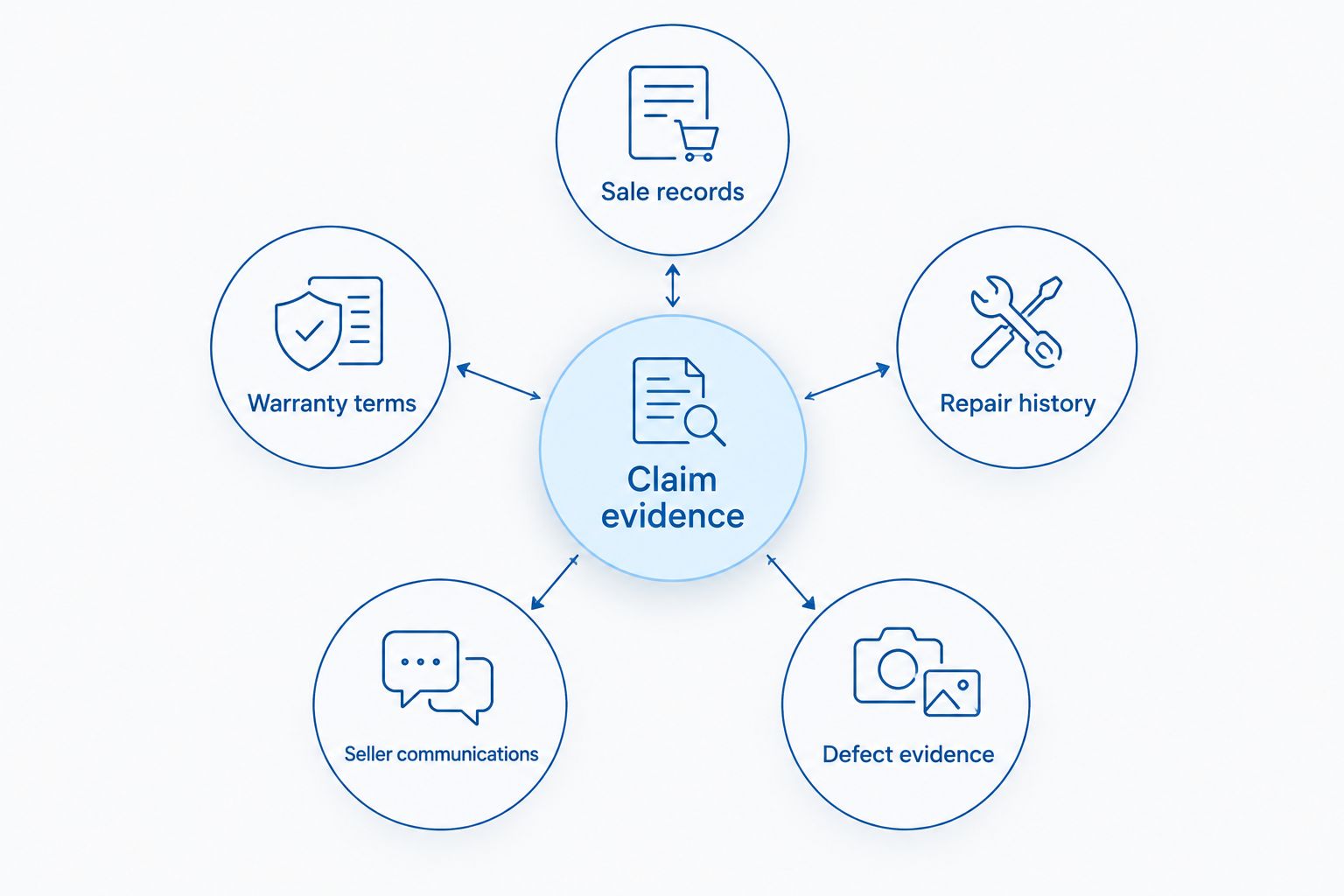
Keep original files and copies of corrected repair orders. If a service advisor summarizes the wrong complaint, request an accurate record while the visit is fresh. Do not alter a document yourself.
Discuss your warranty claim
Ask Khachikyanlawfirm about legal representation for your California vehicle warranty dispute.
FAQ
What's the strongest type of California lemon law warranty claim?
An express warranty claim is the starting point when a qualifying vehicle has a covered defect that remains unresolved after reasonable repair opportunities. The evidence must support coverage, substantial impairment, and the manufacturer's applicable legal duties.
Is an implied warranty claim better than an express warranty claim?
Neither claim is universally better; they address different obligations. Express warranty claims concern stated coverage, while merchantability concerns basic fitness for ordinary use. Both can apply to the same dispute.
Can I bring more than one warranty claim for the same car?
Yes, the same facts can support multiple warranty theories when each theory's requirements are met. Multiple claims do not automatically permit duplicate recovery for the same loss.
Does a used car with manufacturer warranty coverage automatically qualify?
No, remaining manufacturer warranty coverage alone does not automatically establish eligibility for California's new-motor-vehicle replacement or restitution provisions. The transaction and statutory definition require separate review, and other warranty claims can involve different rules.
Do I need to reach the lemon law repair presumption before acting?
No, the statutory presumption is not the only way to establish reasonable repair opportunities. Its numerical conditions help analyze qualifying cases, but they do not replace the remaining legal requirements.
Is a service contract the same thing as a manufacturer's warranty?
No, a service contract and a manufacturer's warranty are distinct obligations. Preserve both documents because the responsible business, covered work, and available enforcement route can differ.
Does Khachikyanlawfirm handle California lemon law matters?
Yes, Khachikyanlawfirm provides lemon law legal representation and is located in Glendale, California. Your warranty documents and repair history establish the starting point for discussing the claim.
One last thing
A repair order can matter even when no repair was completed. It records the complaint, presentation date, mileage, and dealer response—facts that can help reconstruct the dispute.
For your 2026 file, ask for the complete work order after every visit. Keep unsuccessful diagnoses alongside completed repairs, and separate what you observed from what the technician confirmed.


