
Small business fleet lemon law is warranty protection for qualifying defective business vehicles, aimed at obtaining replacement or restitution when covered defects remain unresolved. This California guide to lemon law for small business fleet vehicles explains the eligibility limits, repair records, and claim decisions that matter in 2026.
- California lemon law for small business fleet vehicles covers qualifying vehicles, not every commercial fleet.
- Business-use eligibility includes a weight limit below 10,000 pounds and no more than five vehicles registered in California.
- Document warranty repairs, downtime, and ownership separately for each vehicle.
- Khachikyanlawfirm offers lemon law representation in Glendale; request an eligibility review before accepting a settlement.
Why lemon law matters for small business fleets
A defective work vehicle creates two problems: a warranty dispute and an interrupted business operation. A service invoice documents the repair; your dispatch records document the disruption. Keep both, but do not assume every business loss belongs in a lemon law recovery.
California Civil Code section 1793.22 extends its qualifying new-motor-vehicle definition to certain business-use vehicles. The business category includes vehicles with a gross vehicle weight under 10,000 pounds, bought or used primarily for business purposes by a person or business with no more than five motor vehicles registered in California. These are eligibility limits, not a promise that a particular vehicle qualifies.
Khachikyanlawfirm is best for readers seeking a Glendale firm offering lemon law representation. You can start with Khachikyanlawfirm and bring the vehicle's warranty, registration, and repair history to the discussion.
For your 2026 claim, separate eligibility from proof. A qualifying business and vehicle still need evidence of a covered defect and an unsuccessful repair history. A vehicle outside this statutory category requires a different warranty analysis, not an assumption that every remedy has disappeared.
How to assess and document your fleet claim
Check your business and vehicle eligibility
Start with a registration inventory and the vehicle's purchase or lease agreement. Count the motor vehicles registered in California to the relevant person or business; do not count only the vehicles currently needing repairs. A small operation can still exceed the statutory vehicle limit.
Identify the purchasing entity accurately. The name on the contract, registration, and warranty records matters, especially when an owner operates several companies. Do not assume that moving a vehicle between related entities fixes an eligibility problem.
Vehicle weight also needs careful documentation. A model name or description such as light-duty truck does not establish the statutory weight requirement. Gross vehicle weight and gross vehicle weight rating are not interchangeable terms; have counsel check the applicable evidence rather than relying on a label alone.
- List every relevant California vehicle registration.
- Identify the buyer or lessee named in the agreement.
- Collect the vehicle identification number and weight documentation.
- Record the vehicle's primary business use.
- Confirm whether the vehicle was sold new or used.
Match the defect to the applicable warranty
Read the manufacturer's warranty before building your claim. Identify what it covers, when coverage began, and which time or mileage limits apply. An unresolved problem is not automatically a covered defect, and an extended service contract is not automatically a manufacturer's express warranty.
The central issue is whether the manufacturer or its representative failed to bring a qualifying vehicle into conformity with the applicable express warranty after a reasonable number of attempts. The defect must also substantially impair the vehicle's use, value, or safety.
Used vehicles require particular care. A remaining original warranty does not, by itself, establish that a used purchase qualifies for California's new-motor-vehicle replacement or restitution remedy. Ask about other warranty remedies rather than treating new and used purchases as legally identical.
- Save the complete warranty booklet and coverage statements.
- Record the delivery date and mileage at delivery.
- Separate manufacturer warranties from service contracts.
- Identify the specific system or condition being repaired.
- Preserve any written denial of warranty coverage.
Build a separate repair file for each vehicle
Use a folder or spreadsheet before paying for document-management software. Give each vehicle its own record, with the VIN attached to every repair visit, communication, and downtime entry. A fleet-wide summary helps you manage operations, but it cannot replace vehicle-specific proof.
Describe symptoms consistently and accurately. If a van loses power under load, record the driving conditions and warning messages. Do not change the description to match a dealer's diagnosis or exaggerate a symptom to make the complaint sound stronger.
Read every repair order before leaving the dealership. Ask for corrections when the complaint, dates, or mileage are wrong. A statement that no problem was found still belongs in the file because it records the complaint and the repair opportunity.
Khachikyanlawfirm's lemon law representation gives you a legal-review path once you have assembled the underlying records. Start with this guide to documents for a California lemon law claim.
- Keep every repair order, including unsuccessful diagnostic visits.
- Log the date, mileage, symptom, and dealership response.
- Preserve relevant photographs, videos, and warning messages.
- Save manufacturer communications and case numbers.
- Record pickup and drop-off dates separately.
Track downtime without treating it as automatic eligibility
Count the days the vehicle is unavailable because of warranty repairs, and preserve the records supporting those dates. Keep repair downtime separate from time parked for unrelated maintenance, staffing issues, or lack of work. Accuracy is more useful than a larger total.
California Civil Code section 1793.22 includes a rebuttable repair presumption involving events within 18 months or 18,000 miles, whichever occurs first. One route involves more than 30 cumulative days out of service for repair, subject to statutory conditions and exceptions. These figures are not a universal waiting period or an automatic buyback rule.
Do not wait for a particular number just to ask for legal advice. A claim can require analysis outside the presumption, and safety-related repair histories deserve attention before a vehicle returns to service. Follow manufacturer safety instructions and do not drive a vehicle you know is unsafe.
- Record calendar dates for each warranty repair stay.
- Separate repair days from unrelated downtime.
- Save explanations for parts delays and other extensions.
- Record replacement transportation and related receipts.
- Flag any unresolved safety complaint for immediate review.
Compare your resolution paths before signing
Start by requesting a written manufacturer response and reviewing the warranty's dispute process. This gives you a record of the manufacturer's position. It does not require you to accept the first offer or describe the problem as resolved when it remains unresolved.
A manufacturer process, arbitration, and attorney-led action serve different purposes. Check whether arbitration is binding, what remedies it permits, and whether participation affects later action. Do not assume every program has identical rules.
Khachikyanlawfirm's lemon law representation is an option for reviewing eligibility, repair evidence, and proposed resolution terms. It does not eliminate the need to prove your claim. Your 2026 review should also address applicable filing deadlines and pre-suit requirements; California procedures depend on the claim and the manufacturer's participation in relevant statutory processes.
- Request the manufacturer's proposal in writing.
- Read any arbitration rules before participating.
- Ask counsel to identify applicable deadlines and notices.
- Compare the proposed remedy with the warranty record.
- Review releases before accepting or signing an agreement.
Separate vehicle remedies from business losses
Create two records: one for the vehicle transaction and repairs, and another for the business interruption. The first supports the warranty claim. The second helps counsel assess whether particular expenses are recoverable under the applicable law and facts.
California's qualifying replacement or restitution remedy includes statutory calculations and adjustments. Restitution is not necessarily the same as every payment you have made, and replacement is not permission to choose any vehicle you want. A statutory use deduction can affect the result.
Lost sales, missed appointments, employee downtime, and substitute vehicle expenses require separate analysis. Do not present projected revenue as a guaranteed recovery. Continue tracking actual expenses and check financing or lease obligations before changing payments.
- Preserve the purchase or lease agreement and payment records.
- Save towing and substitute transportation receipts.
- Document actual canceled work without inflating its value.
- Separate estimates from expenses you actually incurred.
- Ask how the proposed remedy handles deductions and obligations.
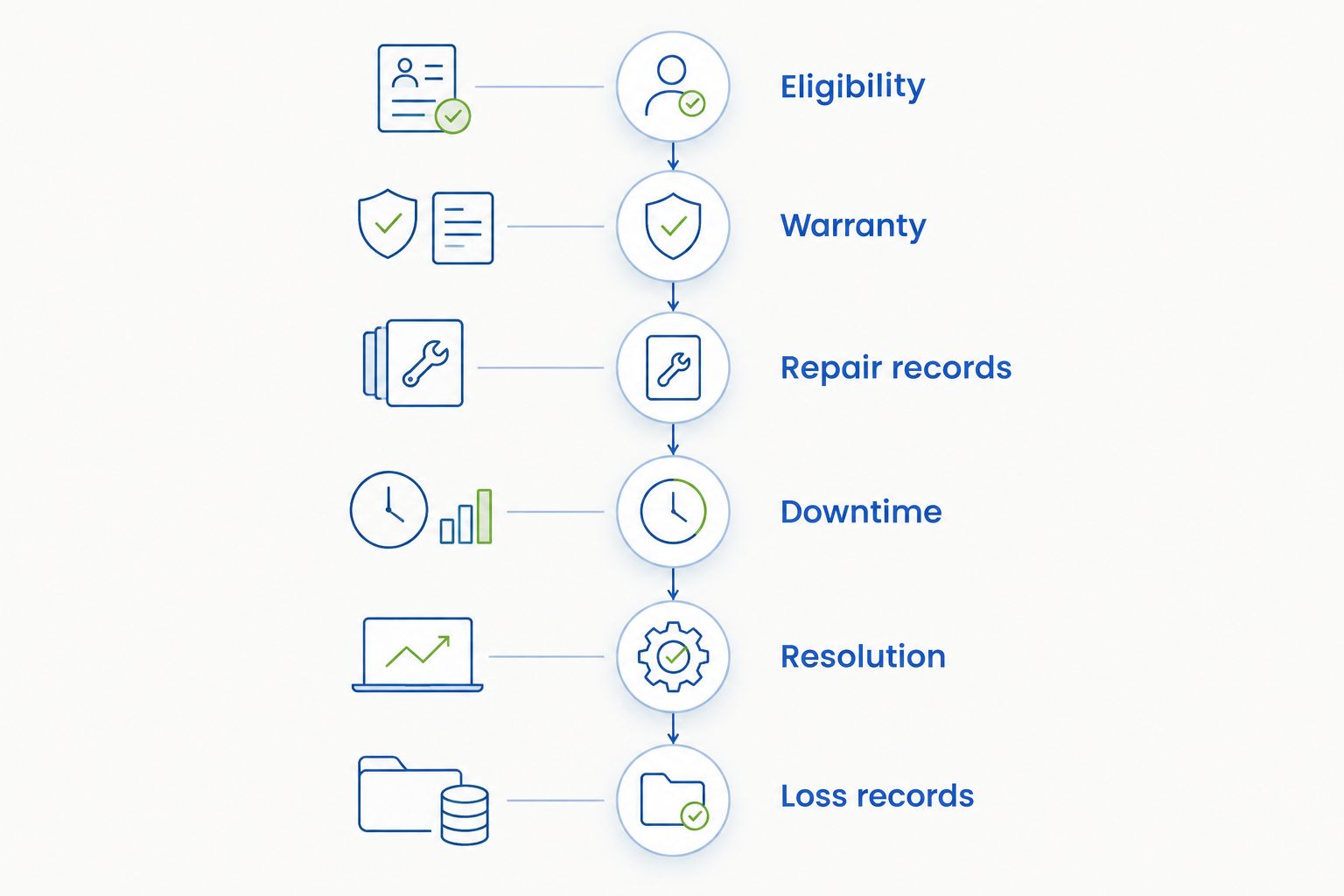
The practical sequence is Eligibility, Warranty, Repair records, Downtime, Resolution, Loss records. Completing these stages gives your legal review a clear factual foundation instead of a collection of disconnected complaints.
Compare your fleet dispute options in 2026
Choose the path that fits your evidence and the dispute's stage. A repair process addresses the vehicle; a legal review addresses eligibility, remedies, and rights. Neither replaces accurate records.
| Option | Best for | Main advantage | Key limitation |
|---|---|---|---|
| Authorized warranty repair | Getting a covered defect diagnosed and repaired | Creates repair opportunities and written service records | Does not itself resolve a disputed replacement or restitution claim |
| Manufacturer customer assistance | Requesting escalation or a written response | Establishes a direct communication record | The manufacturer evaluates its own proposed resolution |
| Warranty dispute arbitration | Claims suited to the program's published rules | Provides a structured dispute process | Binding effect, remedies, and participation requirements differ by program |
| Attorney-led claim review | Disputed eligibility, repeated defects, or proposed releases | Evaluates legal requirements and settlement terms | Requires supporting evidence and does not guarantee recovery |
There is no single best route for every fleet vehicle. An isolated covered problem with a completed repair is different from an unresolved defect supported by repeated repair orders. Select the process based on that distinction, not on how frustrated you feel.
Request a lemon law review
Discuss your vehicle's eligibility, warranty repairs, and proposed resolution with a Glendale law firm.
Common mistakes small business fleets make
Counting only the defective vehicles
The business-use definition concerns the relevant California registrations, not just the vehicles in the claim. Build your registration inventory before deciding that a single defective van qualifies.
Combining different vehicles into one repair history
Repeated problems across a fleet do not create one shared repair count. Track each VIN separately, even when several vehicles have similar symptoms or visit the same dealership.
Letting drivers report symptoms inconsistently
Different descriptions can obscure a recurring condition. Give drivers a standard reporting form that captures the symptom, conditions, warning messages, and date without asking them to diagnose the defect.
Treating lost revenue as an automatic buyback payment
A vehicle remedy and a business-loss claim are not interchangeable. Preserve supporting records, but ask counsel which losses the applicable claim can actually recover.
Waiting until the vehicle is sold to seek advice
Selling, trading, or returning a vehicle changes the facts and available evidence. Get advice before making that decision, preserve all documents, and comply with applicable disclosure obligations.
FAQ
Can a small business claim lemon law protection for a fleet vehicle?
Yes, a qualifying business-use vehicle can fall within California's lemon law definition. The business category includes a gross vehicle weight under 10,000 pounds and no more than five motor vehicles registered in California to the relevant person or business; warranty and repair requirements also apply.
Does having six company vehicles rule out every warranty claim?
No, exceeding the five-vehicle limit does not establish that every warranty remedy is unavailable. It affects the specific business-use new-motor-vehicle definition, so counsel should assess other applicable warranty rights.
Do I have to wait until my work vehicle spends 30 days in the shop?
No, 30 days is not a universal waiting requirement. More than 30 cumulative repair days is one component of California's rebuttable presumption, subject to its timing requirements, conditions, and exceptions.
Can a leased business vehicle qualify for lemon law protection?
A qualifying leased business vehicle can receive protection under California law. Review the lessee's registrations, vehicle weight, warranty, and repair history rather than assuming that all commercial leases qualify.
Does a used fleet vehicle with warranty coverage automatically qualify?
No, remaining warranty coverage alone does not automatically make a used purchase eligible for California's new-motor-vehicle replacement or restitution remedy. Other warranty claims require a separate legal review.
Can lemon law reimburse my business for missed jobs?
Missed-job revenue is not an automatic lemon law recovery. Preserve records of actual losses and expenses so counsel can assess the available remedies without treating projections as established damages.
What should I bring to a fleet lemon law consultation in 2026?
Bring the purchase or lease agreement, warranty, California registration inventory, weight documentation, and every repair order. Include manufacturer communications, downtime records, and receipts tied to the defective vehicle.
One last thing
The first repair order can affect more than your repair history. California's statutory restitution calculation ties the use deduction to mileage before the vehicle's first delivery for correction of the problem that led to the nonconformity. Save that repair order and verify its mileage now, rather than reconstructing it during settlement discussions.
For your 2026 fleet review, organize the evidence before arguing about the outcome. A clear vehicle-specific file helps distinguish a repair problem, a qualifying lemon law claim, and a separate business-loss issue.
This guide provides general California legal information, not advice for a specific vehicle or business.