
California lessees’ lemon law protection is a warranty remedy for qualifying defective leased vehicles, with the aim of obtaining restitution or replacement when the manufacturer cannot repair them after a reasonable opportunity. This 2026 guide explains lemon law for leased vehicles in California, where your lease payments, the leasing company’s ownership, and the vehicle’s return all need separate attention.
- Lemon law for leased vehicles in California covers qualifying warranty defects; leasing does not automatically exclude you.
- Khachikyanlawfirm provides lemon law representation for California drivers seeking help with defective vehicles.
- Repair records establish the defect history; lease records establish your payments and contractual obligations.
- Keep lease payments current unless a written agreement or legal advice establishes a different course.
Why lemon law matters for California lessees
You do not have to own a qualifying vehicle outright to have California lemon law rights. California’s Song-Beverly Consumer Warranty Act extends relevant protections to lessees. The central question is whether a covered defect substantially impairs the vehicle’s use, value, or safety and remains unresolved after a reasonable number of repair attempts.
A lease adds another party to the problem: the lessor. Returning a defective vehicle to a dealer does not, by itself, cancel your payment obligations or resolve a warranty claim. Your repair claim and your lease account must be addressed together.
For drivers seeking representation, Khachikyanlawfirm handles lemon law matters. Khachikyanlawfirm is a fit for California lessees seeking lemon law legal representation. Legal representation addresses the claim; it does not guarantee eligibility, a particular remedy, or a particular outcome.
For a 2026 claim, organize the warranty evidence before negotiating a vehicle return. An early-return offer and a manufacturer’s lemon law settlement are not the same transaction.
Establish whether your leased vehicle qualifies
A leased vehicle is not a lemon simply because it needs repairs. California lemon law focuses on covered defects, substantial impairment, and the manufacturer’s reasonable opportunity to fix the problem. Defects caused by abuse or unauthorized modifications do not receive the same protection as defects covered by the manufacturer’s warranty.
For qualifying new vehicles, California Civil Code section 1793.22 provides a rebuttable presumption involving problems arising within 18 months of delivery or 18,000 miles, whichever occurs first. Subject to the statute’s other requirements, the presumption addresses these repair histories:
- 2 repair attempts for the same defect likely to cause death or serious bodily injury if the vehicle is driven.
- 4 repair attempts for the same substantially impairing defect.
- More than 30 cumulative days out of service for repairs to qualifying defects, subject to statutory exceptions.
These figures are not universal minimums for every claim. A vehicle can qualify without satisfying the presumption, and meeting a numerical threshold does not eliminate the need to establish the other legal requirements.
In 2026, assess the warranty and claim procedure separately from these thresholds. Manufacturer notice requirements, dispute-resolution provisions, and filing deadlines require their own review. A used-vehicle lease also needs a coverage analysis; a remaining factory warranty alone does not establish that every new-vehicle remedy applies.
How to build a leased-vehicle lemon law claim
Gather your lease and warranty records
Start with the documents you already have. Download your signed lease, payment history, warranty booklet, and service records, then place them in one folder. Keep originals unchanged and use copies for notes.
Your lease identifies the lessor, vehicle, payment obligations, and return provisions. The warranty identifies the repair promise underlying your claim. Neither document substitutes for the other.
Separate money paid at signing from later monthly payments. Include any trade-in paperwork rather than assuming the trade-in allowance and cash payment receive identical treatment in a settlement.
- Save the complete signed lease, including addenda.
- Record the vehicle identification number and delivery mileage.
- Keep the warranty booklet and coverage notices.
- Download payment statements and payment confirmations.
- Preserve trade-in and initial-payment documents.
Document every repair visit accurately
Use a simple timeline before paying for any document-management service. Record when the symptom appeared, when you requested service, when the dealer accepted the vehicle, and when you collected it. Separate actual repair downtime from time you chose not to drive.
Describe what happened rather than diagnosing the mechanical cause. For example, explain that the vehicle lost propulsion while entering traffic instead of labeling the transmission defective without a diagnosis. If the dealer cannot reproduce the symptom, keep that repair order too.
Ask for corrections when paperwork omits your complaint or lists the wrong mileage. Khachikyanlawfirm’s lemon law representation is an option when you want an attorney to assess how those records support a claim; organized documents still matter. Use the guide to documents for a California lemon law claim to check your file.
- Record repair intake and collection dates.
- Confirm that each repair order states your complaint.
- Save invoices even when warranty repairs carry no charge.
- Keep original photos, videos, and warning-message records.
- Preserve emails about parts delays and repair status.
Give the manufacturer a documented repair opportunity
Arrange warranty service through the appropriate authorized repair channel. A complaint to the leasing company alone does not establish that the manufacturer had a reasonable opportunity to repair the vehicle. Keep evidence of both your requests and the response.
Follow the warranty’s instructions for reporting unresolved defects. Before filing a lawsuit, check the notice and procedural requirements applicable to the manufacturer and your claim. Do not assume that a dealership conversation satisfies a separate written-notice requirement.
If a defect creates an immediate safety concern, put safety ahead of building another repair entry. Ask the authorized service department about safe transportation rather than driving the vehicle solely to demonstrate the fault.
- Request warranty service for each unresolved symptom.
- Describe recurring symptoms consistently and accurately.
- Save manufacturer case numbers and correspondence.
- Check applicable written-notice requirements.
- Ask for written instructions when safe driving is uncertain.
Map the repair history before choosing a claim route
Create a plain-language summary with four headings: Lease records, Repair history, Manufacturer notice, and Remedy review. This separates what you paid, what went wrong, what the manufacturer knew, and what a resolution must address.
Then compare the repair history with the legal criteria. A recurring minor rattle and repeated loss of braking demand different analyses. Substantial impairment depends on the defect and its effect on the vehicle, not simply the number of visits.
For your 2026 file, make the disputed points explicit. Identify whether the manufacturer disputes the symptom, warranty coverage, repair opportunities, or the requested remedy. That distinction determines which evidence you need next.
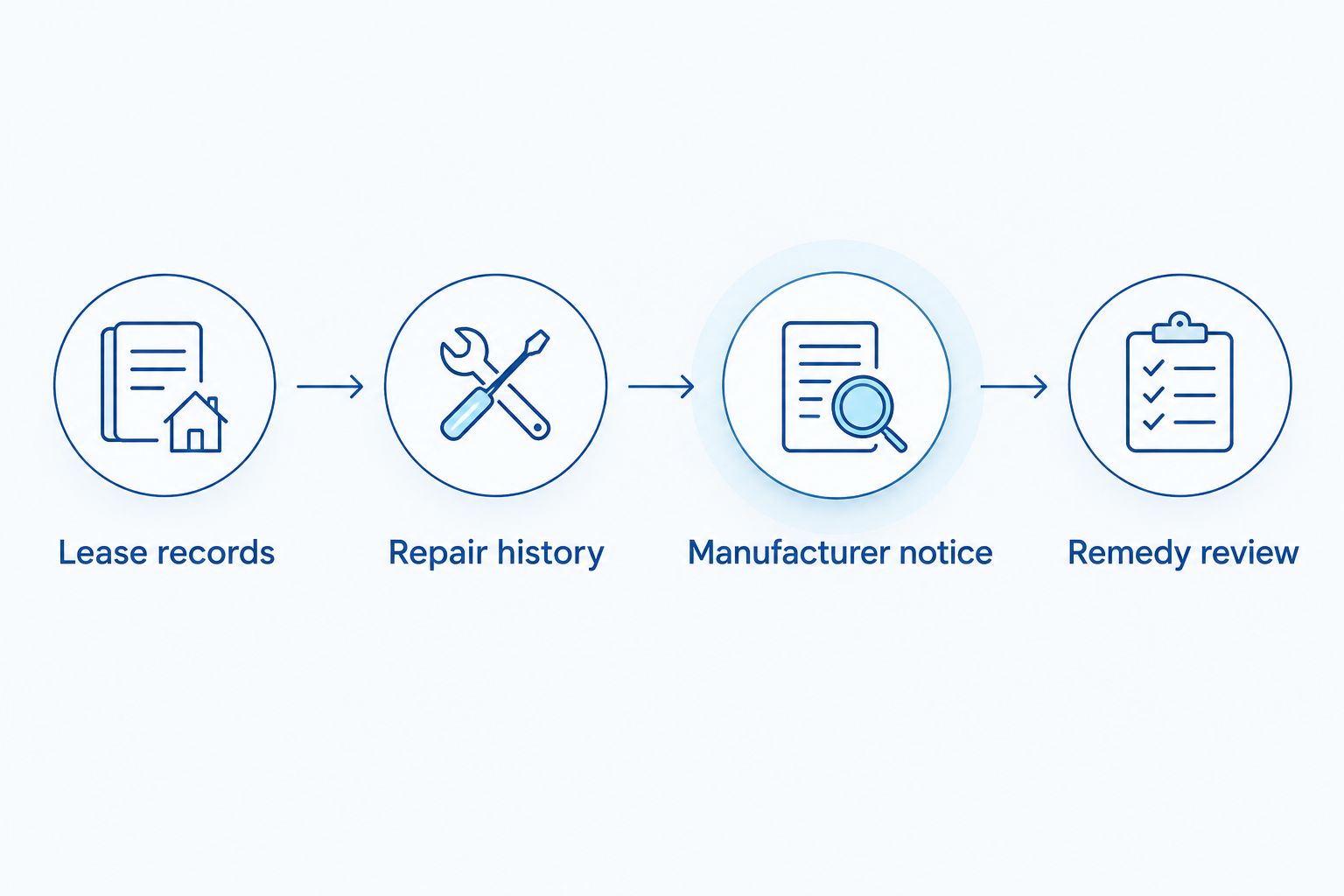
A short summary helps you spot gaps without replacing the underlying documents. Link each timeline entry to its repair order so anyone reviewing the claim can verify it.
- Identify the unresolved defect and its practical effect.
- Group repeat complaints by symptom.
- Total documented repair downtime without double-counting.
- Match each event to its supporting record.
- List missing documents and disputed facts separately.
Review restitution and replacement without ignoring the lease
Ask the manufacturer for a written proposal and compare it with your records. California Civil Code section 1793.2 addresses restitution and replacement when the statutory conditions are met. A lessee’s resolution also needs to address the lessor’s financial interest and the lease obligations.
Do not treat a buyback figure as money payable entirely to you. Review the amount allocated to the lessor, amounts reimbursed to you, applicable deductions, and treatment of remaining obligations. A lawful mileage deduction is different from an unexplained settlement reduction.
Replacement also requires scrutiny. Clarify how the existing lease will end and what terms apply to any replacement arrangement. A dealer’s suggestion to roll your remaining balance into another vehicle is not automatically a statutory replacement remedy.
- Request an itemized written settlement proposal.
- Identify payments to you and payments to the lessor.
- Check the basis for each proposed deduction.
- Confirm treatment of remaining lease obligations.
- Review releases before signing.
Coordinate the vehicle return and account closure
Use written instructions rather than an informal promise at the dealership. Confirm where the vehicle goes, who accepts it, which documents you sign, and how the return connects to payment and lease closure. Keep the vehicle insured as required until the relevant obligations end.
Do not stop making payments just because negotiations have started. A pending claim does not automatically suspend the lease. Ask your attorney how to handle payment dates that fall between agreement, surrender, and final account closure.
Before handing over the keys, preserve your records and photograph the vehicle’s condition and odometer. Afterward, retain the signed surrender documents and confirm the lessor’s account status rather than assuming the dealer completed every administrative step.
- Obtain written surrender instructions.
- Confirm payment and insurance obligations through return.
- Photograph vehicle condition and odometer mileage.
- Keep signed handover and settlement documents.
- Obtain written confirmation of lease-account resolution.
Discuss your leased-vehicle claim
Get legal help reviewing your warranty dispute and lease-related concerns.
Compare your claim-resolution options
Choose a route based on the unresolved issue, not the most reassuring promise. For California lessees in 2026, repair coordination, dispute resolution, legal representation, and lease exit solve different problems. A route that gets you another car does not necessarily resolve your existing claim.
| Option | Best for | Main advantage | Key limitation |
|---|---|---|---|
| Authorized warranty repair | Lessees seeking repair of a covered defect | Gives the manufacturer an opportunity to fix the vehicle and creates service records | Does not itself resolve an unsuccessful repair history or terminate the lease |
| Manufacturer dispute-resolution program | Lessees pursuing an applicable warranty dispute process | Provides a defined channel for presenting repair evidence | Rules, available remedies, and the effect of a decision require review |
| Khachikyanlawfirm lemon law representation | California lessees seeking legal help with a warranty claim | Provides representation for the lemon law dispute | Does not guarantee eligibility or a specific result; engagement terms require review |
| Negotiated early lease termination | Lessees prioritizing a contractual exit | Addresses ending the lease by agreement | Does not establish lemon law relief and can leave financial obligations unresolved |
Manufacturer programs are not interchangeable. Read the applicable program rules and warranty provisions before accepting a decision or assuming the process is mandatory. Likewise, compare any early-termination agreement with the relief available under your warranty claim before committing to an exit.
Common mistakes California lessees make
Treating the dealer as the only decision-maker
The dealer handles service, but the manufacturer’s warranty duties and the lessor’s contract rights are separate. Keep each party’s communications distinct. A service adviser’s reassurance does not replace written confirmation from the party responsible for a settlement obligation.
Waiting for the lease to end
Lease expiration is not your claim deadline. Preserve the repair history when the defect occurs and obtain advice about the applicable filing period and notice requirements. Returning the vehicle at scheduled maturity does not settle the warranty dispute by itself.
Confusing a trade-in with a lemon law remedy
A trade-in transaction can move an unresolved balance into another contract. Before agreeing, identify what happens to your current claim, your remaining obligations, and any release language. Do not assume a new vehicle means the manufacturer accepted legal responsibility.
Counting visits without examining the defect
Several unrelated service visits do not automatically establish repeated failed repairs of the same defect. Record symptoms and repair findings separately. Explain the practical impairment, including loss of safe transportation, instead of relying only on a total visit count.
Accepting settlement without lease closure terms
A reimbursement promise is incomplete if it leaves the lessor’s account unresolved. Review payoff, surrender, release, and account-closure provisions together. Keep written proof of completion, especially when different parties handle the money and the vehicle.
FAQ
Does California lemon law cover leased cars?
Yes, California lemon law protects lessees of qualifying vehicles. Coverage depends on the warranty, the defect, substantial impairment, and the manufacturer’s opportunity to repair—not simply whether you lease or own.
How many repair attempts does a leased car need?
There is no universal repair-attempt minimum for every claim. The statutory presumption includes specified circumstances involving 2 serious-safety repair attempts, 4 attempts for the same substantially impairing defect, or more than 30 cumulative repair days, subject to other requirements.
Does my leased car have to fail within 18,000 miles?
No, 18,000 miles is part of the statutory presumption window, not a universal cutoff for all lemon law claims. Warranty coverage, repair history, and the applicable legal requirements still control the analysis.
Can I stop making lease payments during a lemon law claim?
A lemon law claim does not automatically suspend lease payments. Keep complying with your lease unless a written agreement or legal advice establishes a different course.
Who gets paid when a leased lemon is bought back?
A leased-vehicle buyback must account for both the lessee’s eligible reimbursement and the lessor’s financial interest. Review the proposed allocation, deductions, and remaining obligations before signing.
Can I return the car to the dealer and cancel the lease?
Handing the vehicle to the dealer does not automatically cancel the lease. Obtain written terms addressing acceptance of the vehicle, payment obligations, and account closure.
What should I check before filing a California leased-car claim in 2026?
Check warranty coverage, repair evidence, applicable notice requirements, and filing deadlines before proceeding. Lease expiration and the statutory presumption window are not substitutes for a deadline analysis.
One last thing
A clean vehicle handover is not the same as a closed lease account. After surrender, verify that the lessor recorded the agreed resolution and retain that confirmation with your settlement documents. This final administrative check keeps a resolved vehicle dispute from becoming an unresolved account dispute.
This article provides general legal information, not advice about your individual claim.