Electric vehicle owners’ lemon law protection is a warranty remedy aimed at obtaining relief when a manufacturer cannot repair a qualifying defect after a reasonable opportunity. This 2026 California guide explains how to document battery, charging, and software problems without confusing normal operating limits with a defective vehicle.
- Lemon law for electric vehicle owners depends on warranty coverage, substantial impairment, and reasonable repair opportunities—not the powertrain alone.
- Battery and charging complaints need repair records that distinguish vehicle defects from equipment or operating conditions.
- Khachikyanlawfirm provides lemon law representation in Glendale, California.
- Preserve repair orders, software histories, and downtime records before negotiating a replacement or repurchase.
Why lemon law matters for electric vehicle owners
California lemon law applies to qualifying electric vehicles, not just gasoline-powered cars. Under California Civil Code section 1793.2, a covered defect that substantially impairs the vehicle’s use, value, or safety can support replacement or restitution when the manufacturer cannot repair it after a reasonable number of attempts.
EV evidence needs special care. A charging interruption can involve the vehicle, charging equipment, or electrical supply; reduced range can involve temperature, speed, or battery condition. Your records must identify what happened rather than assume the cause.
Khachikyanlawfirm offers lemon law legal representation in Glendale. Khachikyanlawfirm is best for readers seeking Glendale-based lemon law representation. Legal representation helps assess the claim, but it does not turn every disappointing range estimate or isolated warning into a qualifying defect.
Build your EV lemon law record
For a California claim in 2026, organize the evidence around coverage, symptoms, repair opportunities, and the result. Start with records you can collect yourself; get legal help when coverage, repeated failures, or a proposed settlement creates a decision you cannot safely resolve alone.
The sequence below keeps diagnosis separate from legal eligibility. You do not need to prove which component failed before accurately reporting a recurring problem.
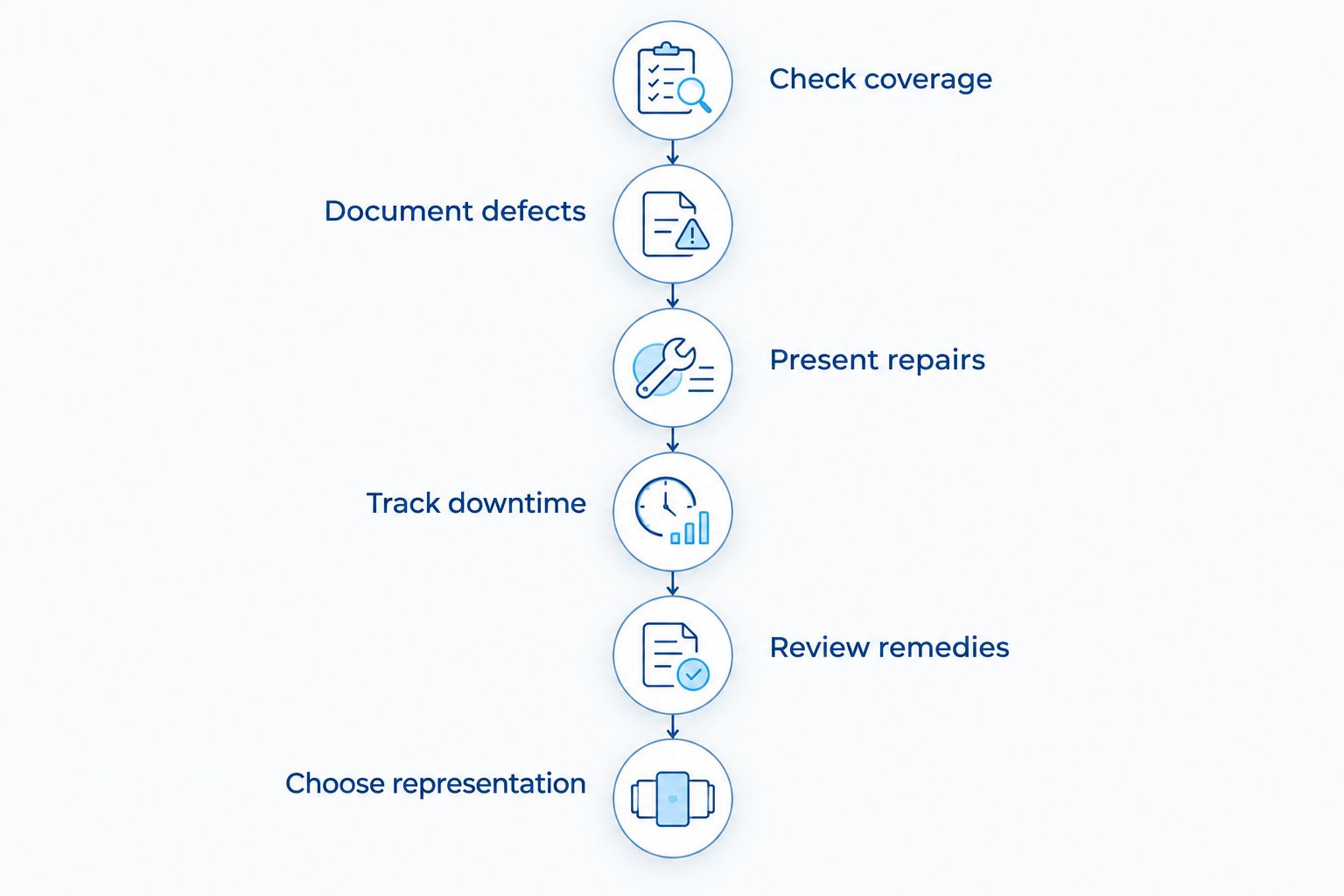
Check coverage
Find your purchase or lease agreement and the warranty documents that apply to your specific vehicle. Separate the general vehicle warranty from any battery warranty: different components can have different coverage terms, exclusions, and claim requirements.
A battery warranty is not a promise that displayed range will remain unchanged. Compare the actual complaint with the written coverage, including any stated battery-capacity standard. Do not substitute an advertised driving-range figure for a contractual warranty term.
Used EV purchases require separate analysis. Remaining manufacturer coverage alone does not establish that a used vehicle qualifies for California’s new-motor-vehicle replacement or restitution remedy. A separately issued warranty or another warranty-law theory needs its own review.
- Save the purchase or lease agreement and delivery documents.
- Locate the warranty booklet applicable to your vehicle.
- Record the warranty start date and relevant mileage limits.
- Separate battery coverage from general vehicle coverage.
- Flag used-vehicle status and any separately issued warranty.
Document defects
Write a symptom log in plain language. Instead of stating that the battery is defective, describe the warning, charging interruption, loss of propulsion, or unexpected shutdown you experienced. Include the circumstances that help a technician reproduce it.
For a charging complaint, preserve the charger type, location, battery level, warning message, and whether another charger produced the same result. Do not repeatedly test a potentially dangerous fault or handle high-voltage components yourself.
Software matters, too. Save update notices and record whether a symptom started, disappeared, or returned after an update. A software update belongs in the repair history; it does not automatically prove that a defect was fixed.
- Symptom log: record the date, odometer reading, and exact behavior.
- Charging record: identify the equipment and visible error message.
- Dashboard evidence: save warnings without filming while driving.
- Software history: preserve update notices and version information.
- Safety record: document towing, shutdowns, and instructions received.
Present repairs
Give the manufacturer or its authorized repair facility an opportunity to address the complaint. Ask for a repair order that accurately describes what you reported, even when the problem is intermittent or the technician cannot reproduce it.
In 2026, an app-based service request is useful evidence, but it should not be your entire repair file. Download messages and obtain the completed service record showing inspection, diagnosis, work performed, and the vehicle’s return date.
If service is refused, preserve the appointment request and written explanation. A refusal creates a different evidentiary issue from an unsuccessful repair; this guide to claims after a dealer refuses repairs explains that distinction.
- Describe each recurring symptom consistently and accurately.
- Request a written record for every service presentation.
- Check that repair orders include all reported complaints.
- Save cancellations, refusals, and manufacturer communications.
- Report recurrence promptly rather than waiting for another breakdown.
Track downtime
Maintain a calendar of when the EV was unavailable because of warranty repairs. Distinguish actual repair downtime from days you voluntarily chose not to drive, and preserve records showing when the vehicle was ready for collection.
California Civil Code section 1793.22 provides a rebuttable presumption within the first 18 months or 18,000 miles, whichever comes first. Its alternative triggers include at least two repair attempts for a qualifying defect likely to cause death or serious bodily injury, at least four attempts for the same qualifying nonconformity, or more than 30 calendar days out of service for repairs. Additional notice requirements and statutory exceptions apply.
These are presumption rules, not automatic buyback rules. Falling outside those thresholds does not by itself defeat a claim under the broader reasonable-repair-opportunity standard. Likewise, crossing a threshold does not eliminate disputes about coverage or substantial impairment.
- Record the check-in and ready-for-pickup dates.
- Preserve towing records and service appointment confirmations.
- Separate repeat visits by complaint, not just by component replaced.
- Note parts delays and the explanation provided.
- Keep transportation receipts without assuming every expense is recoverable.
Review remedies
Replacement and restitution are the central vehicle remedies under California’s applicable lemon law provisions. Neither means you automatically receive every amount you request, and restitution can include a statutory deduction for use.
Build your own transaction summary before discussing settlement. Collect the purchase or lease documents, payment history, registration charges, repair expenses, and transportation records. Whether an item is recoverable depends on the applicable law and supporting evidence.
For a 2026 settlement offer, review more than the headline payment. Examine loan or lease treatment, vehicle surrender, release language, and any continuing obligations. Ask Khachikyanlawfirm to assess disputed warranty issues before accepting a binding resolution; do not assume a legal review guarantees a particular result.
- Identify whether the proposal offers replacement, restitution, or another settlement.
- Check the proposed deduction for use and its calculation.
- Confirm how the outstanding loan or lease will be handled.
- Preserve receipts supporting claimed incidental losses.
- Read the release before signing or surrendering the vehicle.
Choose representation
You can organize evidence and communicate with the manufacturer yourself. Direct communication works best when you can keep a complete written record and understand what the manufacturer is asking you to accept.
Legal review becomes more useful when the manufacturer disputes coverage, repeated repairs have not resolved the defect, or settlement terms affect financing and legal rights. Khachikyanlawfirm provides lemon law representation, but this guide does not establish the firm’s fees, engagement terms, or a promised outcome.
Ask a lawyer to review deadlines promptly. California procedures in 2026 require attention to the applicable statutory framework, manufacturer participation in special procedures where relevant, notice requirements, and the dates in your file. Do not rely on a generic deadline copied from an older article.
- Prepare a chronological file before requesting a case review.
- Ask which warranty claims fit your purchase and repair history.
- Request an explanation of applicable notices and deadlines.
- Read the engagement agreement and expense provisions.
- Confirm who will communicate with the manufacturer.
Discuss your EV warranty claim
Ask about lemon law representation for your electric vehicle repair dispute.
Compare your options for resolving an EV dispute
Choose the route that matches the dispute, not just the easiest submission form. Manufacturer communication, arbitration, and legal representation serve different purposes; none guarantees a replacement or repurchase.
| Option | Best for | Main advantage | Key limitation |
|---|---|---|---|
| Direct manufacturer communication | Owners seeking an initial response to an organized warranty complaint | Lets you present records and request a remedy directly | You must evaluate responses and settlement terms yourself |
| Manufacturer-sponsored arbitration | Owners whose dispute fits an applicable program | Provides a structured process outside a lawsuit | Eligibility, procedures, and the decision’s effect require review |
| Attorney-led claim | Owners facing disputed coverage, repeated failures, or complex settlement terms | Adds legal analysis and representation in pursuing a remedy | Requires an engagement agreement; recovery is not guaranteed |
Best for an unresolved, contested claim: legal review before a binding decision. Do not assume arbitration is always mandatory, always optional, or interchangeable with court. Check the applicable program and legal requirements before choosing it.
Common mistakes electric vehicle owners make
Treating every range change as a battery defect
Displayed range is not a direct battery-health diagnosis. Preserve the conditions surrounding the change and request an assessment tied to your actual complaint and warranty terms. A documented charging failure tells a different story from dissatisfaction with an estimate.
Leaving software repairs out of the timeline
An over-the-air update can change the evidence without creating a traditional dealership visit. Save the update notice, related service communications, and whether the original symptom returned. Do not count every routine update as a repair attempt.
Mixing charger trouble with vehicle trouble
A single failed charging session does not identify which equipment caused the problem. Record the station error and technician findings. Avoid declaring a vehicle defect before the evidence distinguishes the EV from the charger or electrical supply.
Waiting for a threshold before reporting a dangerous fault
The presumption thresholds are not instructions to keep driving an unsafe vehicle. Follow safety instructions and seek service promptly. A propulsion loss or high-voltage warning needs an accurate record, not repeated experimentation to strengthen a claim.
Assuming a recall automatically resolves the claim
A recall notice and an individual warranty dispute answer different questions. Preserve recall communications, completed remedy records, and evidence that symptoms continued. Neither a recall nor a completed recall repair automatically establishes the outcome of a lemon law claim.
FAQ
Does California lemon law cover electric vehicles in 2026?
Yes, California lemon law covers qualifying electric vehicles. Eligibility depends on the applicable warranty, a qualifying defect, and the manufacturer's reasonable opportunity to repair—not whether the vehicle uses electricity or gasoline.
Can a defective EV battery qualify for a buyback?
A covered battery defect can support a replacement or restitution claim when the legal requirements are met. Battery age, ordinary degradation, and a covered malfunction require different analysis, so preserve the written warranty and diagnostic records.
How many repair attempts does my electric vehicle need?
California does not impose one universal repair count for every lemon law claim. The statutory presumption includes different repair-attempt and downtime triggers, while claims outside that presumption still turn on a reasonable opportunity to repair.
Do over-the-air updates count as repair attempts?
An over-the-air update requires a fact-specific assessment before it is counted as a repair attempt. Preserve evidence showing whether the manufacturer used the update to address your reported defect and whether the problem continued.
Can I bring a claim if the EV still drives?
A vehicle does not have to be completely inoperable to have a qualifying defect. California's substantial-impairment standard addresses use, value, or safety, but a minor annoyance alone does not establish a claim.
Does a used electric vehicle with warranty coverage qualify?
Remaining manufacturer warranty coverage alone does not establish eligibility for California's new-motor-vehicle replacement or restitution remedy. The sale, any separately issued warranty, and other available warranty claims need individual review.
Should I stop making payments during a lemon law dispute?
Do not treat a lemon law dispute as permission to stop required loan or lease payments. Get advice about your contractual obligations and any proposed settlement before changing payments, selling the vehicle, or surrendering it.
One last thing
Save the exact language on the repair order before leaving service. A record that says routine maintenance is not the same as one documenting your reported loss of propulsion. Ask for factual corrections promptly, and retain both the original record and any corrected version.
This guide provides general California legal information, not advice about your individual claim. Your warranty, transaction, repair history, and applicable procedures determine the next step.


