
No—California lemon law generally does not require you to complete manufacturer-sponsored arbitration before filing a lawsuit. A qualifying arbitration program can affect your use of California’s lemon law presumption, and an enforceable arbitration agreement can change where your dispute is heard. Before filing in 2026, check the warranty, any signed arbitration clause, and the notice or mediation requirements that apply to your claim.
- Is arbitration required before filing a lemon law lawsuit? Generally no in California, but contracts and claim-specific procedures matter.
- California’s certified arbitration programs can affect the lemon law presumption without eliminating the underlying warranty claim.
- Khachikyan Law Firm provides lemon law representation for drivers seeking legal help in Glendale.
- Review arbitration clauses, repair records, and filing deadlines before accepting an award or starting a lawsuit.
Is arbitration required before filing a lemon law lawsuit?
Manufacturer-sponsored arbitration is not a universal prerequisite to a California lemon law lawsuit. California Civil Code section 1793.22 distinguishes access to a statutory presumption from the underlying right to pursue a warranty claim. A separate contractual arbitration agreement raises a different question: whether the dispute belongs in court at all.
For help applying those distinctions to your documents, Khachikyan Law Firm provides personal injury and lemon law legal representation in Glendale.
| Process | Is it required before a lawsuit? | Best for | Benefit | Limitation |
|---|---|---|---|---|
| Manufacturer-sponsored arbitration | Not universally; a qualifying program can affect the statutory presumption | Consumers evaluating an informal warranty-dispute process | Offers a route to a decision outside court | Program rules and acceptance terms need review |
| Contractual binding arbitration | An enforceable agreement can require covered disputes to proceed there | Determining the forum required by a signed agreement | Establishes a private decision-making process | Can restrict court access and review of an award |
| Mediation | Certain California claims have applicable statutory procedures | Parties seeking a negotiated resolution | Lets parties agree on settlement terms | Does not produce a settlement without agreement |
| Civil lawsuit | Available subject to applicable prerequisites and enforceable agreements | Consumers pursuing judicial resolution of warranty claims | Provides court procedures for developing and deciding a claim | Requires compliance with filing and procedural rules |
These processes are not interchangeable. A request to use an informal program is not the same as a court order compelling binding arbitration.
Why this matters
The wrong question is whether the manufacturer uses the word arbitration. The useful question is what legal consequence follows if you participate, decline, or accept the result.
For a California claim in 2026, distinguish a requirement affecting an evidentiary presumption from a requirement affecting the forum. Also distinguish both from a pre-suit notice or mediation obligation. Completing one process does not automatically satisfy another.
A warranty booklet, purchase contract, and program invitation can describe different obligations. Read them together before choosing your next step.
Manufacturer-sponsored arbitration: check the program’s legal effect
A manufacturer’s warranty-dispute program gives you a process outside court for presenting repair records and requesting relief. Do not assume every program has the same rules or California certification status.
Under California Civil Code section 1793.22, a qualifying dispute-resolution process can matter when you want to rely on the statutory presumption that the manufacturer received a reasonable number of repair opportunities. Where the statute’s conditions apply, initially resorting to the process affects access to that presumption.
Losing access to a presumption is not the same as losing the right to prove a claim. Without the presumption, you still need evidence establishing the elements of the applicable warranty claim.
Before participating, identify:
- Whether the program is certified under California’s applicable standards.
- What notice the manufacturer gave you about the program.
- Whether the decision binds you, the manufacturer, or both.
- What accepting an award requires you to sign.
- How participation affects applicable deadlines.
For a 2026 claim, use the program documents that apply to your vehicle and dispute. Do not substitute another owner’s experience for the actual rules.
Contractual arbitration: check what you signed
A signed arbitration agreement is separate from a manufacturer’s informal warranty program. It can appear in purchase, lease, or other transaction documents and can be raised after you file a lawsuit.
If an enforceable agreement covers the dispute and the party seeking arbitration can enforce it, a court can require arbitration. That does not establish that the vehicle is or is not a lemon. It determines the forum for resolving the covered claim.
Review the agreement for:
- Covered parties: who signed it and who claims the right to enforce it.
- Covered disputes: which claims the language includes or excludes.
- Opt-out provisions: whether the agreement provided a way to decline arbitration.
- Decision-making authority: whether enforceability questions are assigned to the court or arbitrator.
- Procedural terms: the named administrator and applicable rules.
Do not assume that a dealership agreement automatically permits the manufacturer to compel arbitration. Do not assume the opposite, either. Enforcement depends on the agreement, the parties, and controlling law.
California’s lemon law presumption is not the entire claim
California Civil Code section 1793.22 provides a rebuttable presumption tied to specified repair circumstances occurring within 18 months after delivery or 18,000 miles on the odometer, whichever comes first. The statute includes separate repair-attempt and out-of-service conditions, along with notice-related requirements.
One statutory condition concerns a vehicle being out of service for repairs for a cumulative total of more than 30 calendar days, subject to statutory qualifications. That condition must be read with the rest of the law, not treated as an automatic buyback instruction.
These figures explain why arbitration and the presumption get discussed together. They do not establish a universal lawsuit deadline or require every consumer to fit the presumption.
Missing the presumption’s window does not, by itself, defeat a lemon law claim. You still need to establish coverage, the qualifying defect, repair opportunities, and the other elements relevant to your case. A claim outside the presumption requires its own evidence analysis.
Keep the delivery date, mileage at each repair visit, and time out of service in the same timeline. Those facts serve different purposes, but you need to see them together.
Why arbitration requirements vary
The answer varies because different documents and laws govern different parts of the dispute. For your 2026 filing decision, focus on these factors:
- The claim asserted. California warranty claims and federal warranty claims do not necessarily carry identical prerequisites.
- The program’s qualifications. A qualifying manufacturer process has different consequences from a general customer-service complaint channel.
- The agreement’s language. A signed arbitration clause can govern the forum independently of an informal program.
- The party seeking enforcement. The seller and manufacturer do not automatically have identical contractual rights.
- The applicable California procedure. Manufacturer-specific statutory procedures can require notice and mediation steps for covered claims.
- Your use of the presumption. Seeking the statutory presumption raises questions that differ from proving the claim without it.
A federal Magnuson-Moss Warranty Act claim requires separate attention. Under that law and the Federal Trade Commission’s informal dispute-settlement rules, resort to a qualifying mechanism can be a prerequisite when the applicable requirements are satisfied. Do not apply California’s general answer to every federal warranty claim.
What should you do before choosing arbitration or court?
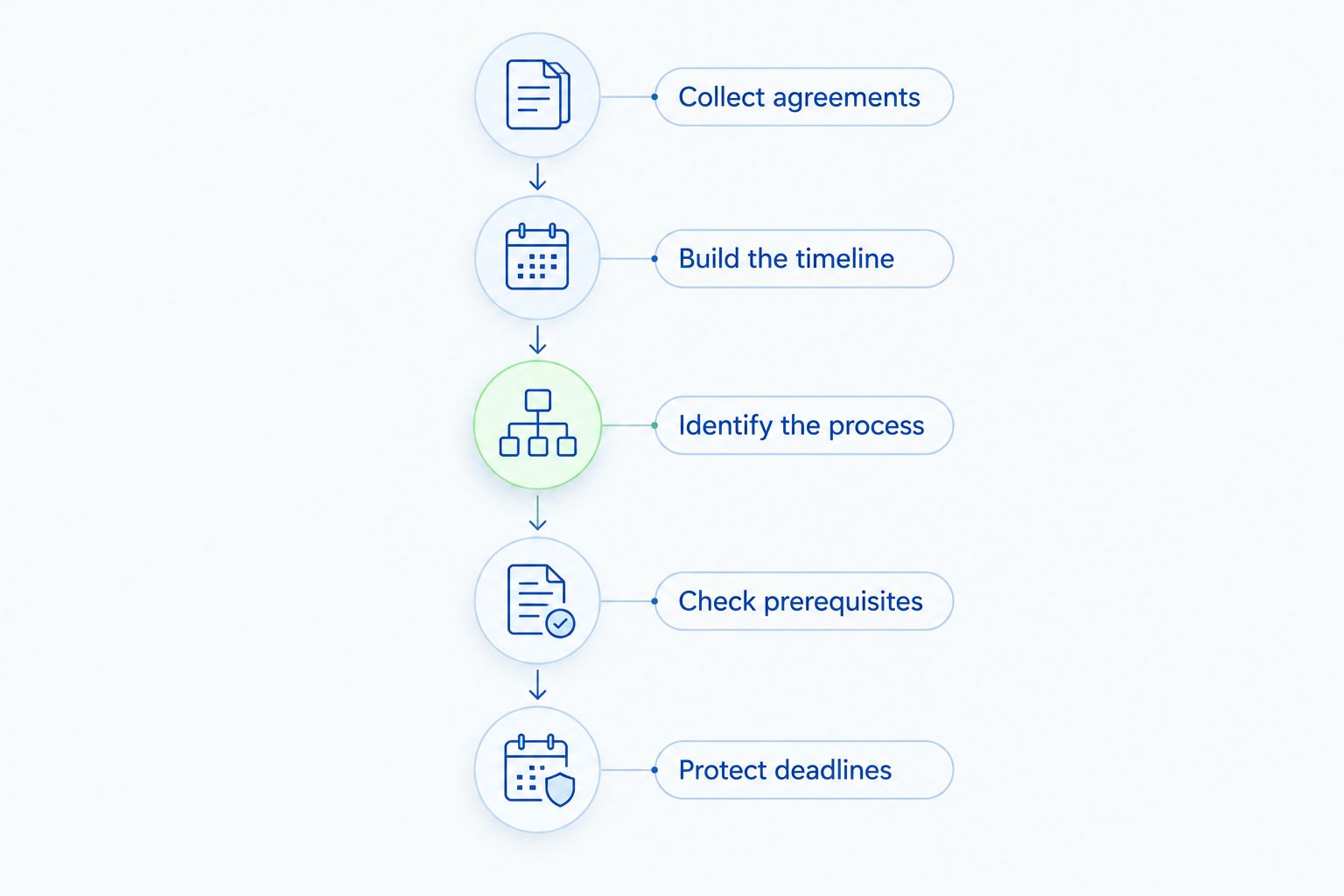
Start with your documents, not the manufacturer’s preferred label for the process. Use this sequence to identify the route your claim requires.
- Collect agreements. Gather the purchase or lease contract, warranty booklet, arbitration provisions, and any opt-out documentation. Keep complete copies, including attachments.
- Build the timeline. List the delivery date, repair visits, mileage, reported symptoms, and days out of service. Preserve communications showing when the manufacturer received notice.
- Identify the process. Determine whether the request concerns an informal warranty program, binding contractual arbitration, mediation, or a settlement discussion.
- Check prerequisites. Review the claims, manufacturer, applicable law, and required notices before submitting a demand or complaint.
- Protect deadlines. Calculate applicable deadlines separately from the repair history. Do not assume that negotiations or a pending arbitration request stop the filing clock.
Khachikyan Law Firm is a fit for Glendale drivers seeking lemon law legal representation. Bring the actual agreement and program notice to the review; a summary of what the dealership said is not a substitute.
Discuss your lemon law claim
Review your arbitration questions and next steps with a Glendale lemon law firm.
Can I sue if the arbitrator denies my lemon law claim?
A denial in a nonbinding manufacturer-sponsored program does not automatically prevent a lawsuit. Preserve the decision, submissions, exhibits, and program rules so the next review addresses exactly what happened.
A binding contractual award is different. Courts have limited grounds for reviewing or setting aside arbitration awards, and short procedural deadlines can apply. Identify the type of award before treating the denial as permission to start over.
The guide to moving from an arbitration denial to a civil lemon law lawsuit addresses that transition.
Can I reject a manufacturer arbitration award?
Your right to reject an award depends on the process and its rules. A consumer’s choices under a qualifying informal warranty program differ from the consequences of binding contractual arbitration.
Read the acceptance language before signing. A settlement agreement, release, or accepted award can affect later claims even when participation in the original program did not require surrendering court access.
Is mediation the same as arbitration?
Mediation seeks an agreement; arbitration asks a decision-maker to resolve a dispute. A mediator does not impose a settlement simply because you attend a session.
For California claims in 2026, check whether applicable statutory procedures require pre-suit notice or mediation. A general statement that manufacturer arbitration is optional does not excuse a separate procedural obligation.
FAQ
Do I have to use the manufacturer’s arbitration program before suing in California?
Not as a universal rule. A qualifying program can affect California’s statutory lemon law presumption, while contractual provisions and claim-specific prerequisites require separate review.
Does signing an arbitration agreement mean I cannot bring a lemon law claim?
Signing an arbitration agreement does not automatically eliminate the underlying lemon law claim. An enforceable agreement can require covered claims to be resolved in arbitration rather than court.
Can a dealership force me to arbitrate a claim against the manufacturer?
A dealership’s arbitration clause does not automatically resolve whether the manufacturer can enforce it. The agreement, the parties, the claims, and controlling law determine that question.
Is the 18-month lemon law period my deadline to sue?
The 18-month period in California’s statutory presumption is not a universal lawsuit deadline. Filing deadlines require a separate analysis of the claim and applicable law.
Does my car automatically qualify after more than 30 calendar days in the shop?
More than 30 calendar days out of service is one condition addressed by California’s statutory presumption, not an automatic entitlement to relief. Coverage, timing, repair circumstances, and statutory qualifications still matter.
Should I stop making vehicle payments during arbitration?
Do not treat arbitration as permission to stop making required vehicle payments. The dispute itself does not automatically suspend your loan or lease obligations.
Will arbitration pause my deadline to file a lawsuit?
Do not assume arbitration pauses your filing deadline. Confirm whether a statute, agreement, or other applicable rule changes the deadline for your specific claim.
One last thing
Save the envelope, email header, and delivery confirmation—not just the letter. When notice or a response deadline matters, proof of when a document was sent or received can matter alongside its contents.
For your 2026 claim, keep the arbitration invitation and every version of the proposed acceptance or release. Ask Khachikyan Law Firm to assess the process before you sign away rights you intended to preserve. This page provides general California legal information, not advice about your individual claim.


