
California personal injury settlements have no fixed completion time in 2026: the timeline depends on your medical recovery, the evidence, insurance coverage, and whether the parties agree on compensation. Reaching an agreement is not the same as receiving your money; releases, payment processing, and medical reimbursement claims can still require attention. Ask for a case-specific timeline tied to the next unfinished step, not a promised settlement date.
- How long does a personal injury settlement take in California? Medical evidence, disputed fault, and negotiations determine the timeline.
- California generally allows two years to file a personal injury lawsuit; settlement negotiations do not automatically extend that deadline.
- An accepted settlement still requires attention to release terms, payment, and outstanding reimbursement claims.
- Khachikyan Law Firm provides personal injury representation for people seeking legal help in Glendale, California.
How long does a personal injury settlement take in California?
There is no statewide deadline requiring every California personal injury claim to settle within a particular period. Your claim moves toward settlement when the parties have enough information to evaluate responsibility, injuries, and compensation—and agree on the terms.
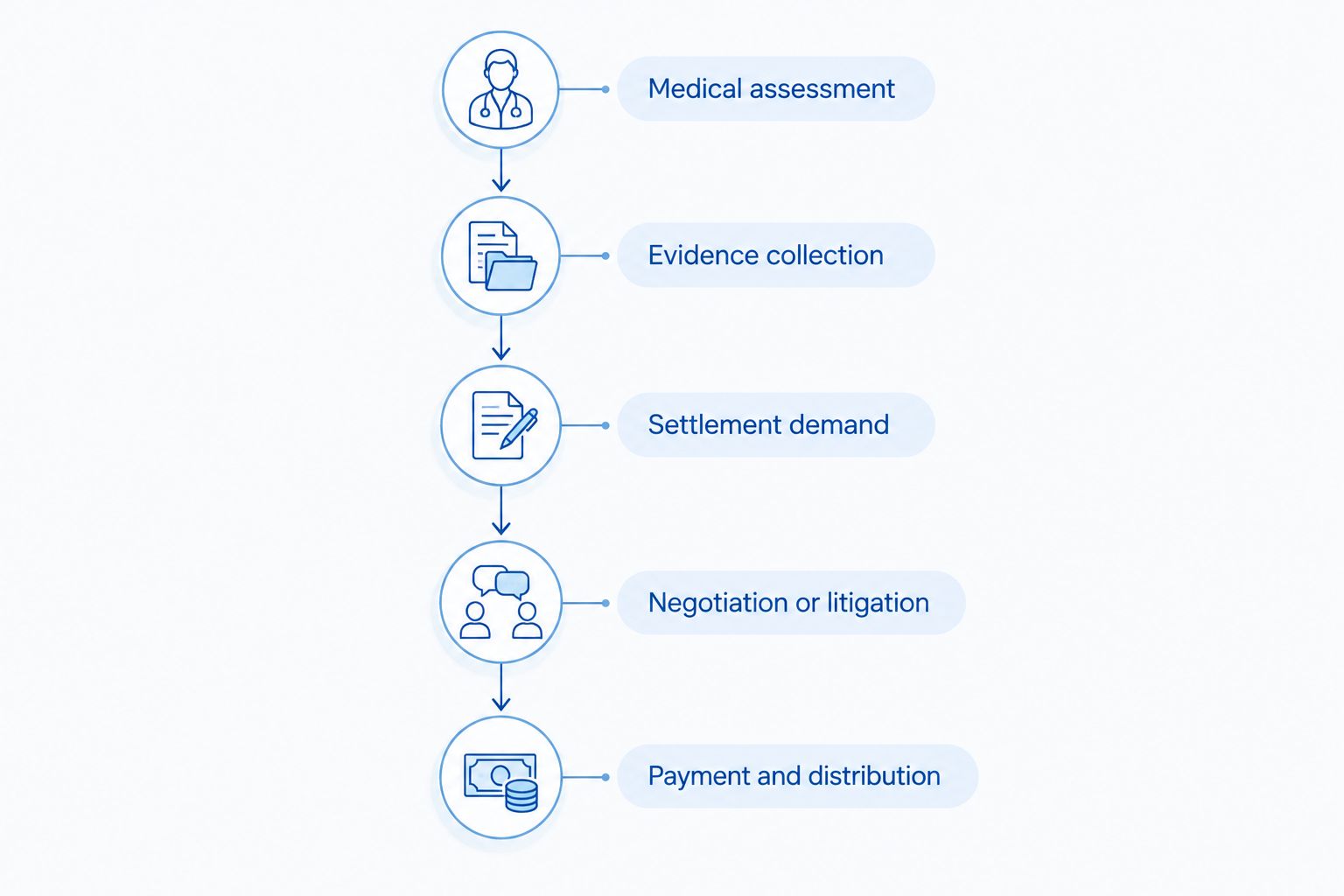
The useful timeline is a sequence of milestones, not a countdown from the accident:
- Medical assessment: Your providers document your injuries, treatment, and expected recovery. Unresolved medical questions make future needs harder to evaluate.
- Evidence collection: Records, bills, wage information, photographs, and witness accounts establish what happened and what you lost.
- Settlement demand: Your claim presents the supporting evidence and requested resolution. The medical records to injury demand letter workflow explains how those documents support negotiations.
- Negotiation or litigation: The parties address disagreements over fault, causation, coverage, and damages. A lawsuit adds court procedures but does not prevent settlement.
- Payment and distribution: The signed agreement, insurer payment, and any required deductions determine when money reaches you.
These stages sometimes overlap. Collecting records while you receive treatment, for example, does not require waiting until every appointment ends.
Why this matters
The settlement date affects your financial planning, but speed alone does not tell you whether an offer addresses your injuries. Once you sign a release, its terms can prevent you from seeking additional compensation for the same claim.
For a claim you are handling in 2026, separate the question of when to settle from when to protect your right to sue. Waiting for a better medical picture does not automatically pause a filing deadline.
Khachikyan Law Firm is a fit for Glendale residents seeking personal injury legal representation. You can review Khachikyan Law Firm when deciding whom to contact about your claim; the firm's location and practice area do not establish a guaranteed settlement schedule.
Why a California personal injury settlement timeline varies
The same accident date does not produce the same settlement date. These factors determine what still needs to happen:
- Medical outlook: An unresolved diagnosis, proposed procedure, or uncertain recovery leaves questions about future treatment and limitations. Ask what your providers can currently document.
- Responsibility for the accident: Conflicting accounts, missing video, or disputed fault require evidence before the parties can meaningfully address liability.
- Connection between the accident and injuries: An insurer can dispute whether the incident caused the condition or the treatment claimed. Medical history and provider explanations matter.
- Documentation of losses: Missing wage records, incomplete bills, and outstanding medical records leave gaps in the demand. Identify exactly which documents remain outstanding.
- Insurance coverage: Questions about the applicable policy, insured parties, or available coverage affect negotiations independently of medical recovery.
- Court procedures: Filing, service, discovery, motions, and court scheduling add procedural steps when informal negotiations do not resolve the dispute.
Ask which factor is currently blocking progress. A useful status update identifies the missing item, who controls it, and the next action—not simply that the claim is pending.
Should you settle before treatment ends?
You do not automatically have to finish every medical appointment before negotiating. The important question is whether the evidence supports a reliable assessment of your injuries, future care, and other losses.
A documented long-term treatment plan is different from an unexplained symptom that still needs evaluation. Your lawyer and medical providers have different roles: providers address your condition, while counsel evaluates how the available evidence affects the claim.
Do not treat an early offer as proof that your medical losses are fully understood. Before signing, ask whether the release covers future claims arising from the accident and how unresolved treatment needs were considered.
Waiting also has a trade-off. More documentation does not excuse missing a lawsuit deadline, and delay without a specific evidence-gathering purpose does not resolve a dispute.
Is negotiation or a lawsuit the better next step?
Negotiation and litigation are not mutually exclusive. You can continue discussing settlement after a lawsuit begins, including during discovery or mediation.
| Approach | Best for | Main benefit | Main limitation |
|---|---|---|---|
| Pre-lawsuit negotiation | Claims with enough evidence for meaningful settlement discussions | Allows the parties to negotiate without first completing court procedures | Does not itself preserve the lawsuit deadline or compel discovery |
| Filing a lawsuit | Claims needing court procedures or protection against an approaching filing deadline | Provides a formal process for pursuing the claim and obtaining evidence | Adds procedural requirements and court scheduling |
| Mediation | Parties prepared to discuss a negotiated resolution with a neutral mediator | Creates a structured setting to address disputed issues | Does not guarantee agreement; the mediator generally does not impose a settlement |
Choose the next step based on the unresolved issue. If a particular record is missing, obtain it; if the parties dispute responsibility despite available evidence, another demand alone does not necessarily resolve that disagreement.
Filing suit is not the same as committing to a trial. Ask what filing accomplishes in your case and what additional information would support settlement afterward.
What deadlines apply while you are negotiating?
California's settlement process and its filing deadlines are separate. For 2026 planning, identify the applicable deadline before assuming negotiations can continue indefinitely.
Most personal injury lawsuits: two years
California Code of Civil Procedure section 335.1 generally gives you two years to file a personal injury lawsuit. Accrual rules, exceptions, and the identity of the defendant can change the analysis.
An open insurance claim does not automatically satisfy that requirement. Neither does sending a demand letter or continuing settlement discussions.
Claims against public entities: generally six months
California Government Code section 911.2 generally requires presenting a claim involving personal injury to the appropriate public entity within six months after accrual. This administrative claim is distinct from filing a lawsuit.
Public-entity cases have additional requirements and exceptions. Identify government involvement promptly rather than applying the ordinary personal injury lawsuit deadline by default.
Public-entity claim review: generally 45 days
Under Government Code section 912.4, a public entity generally has 45 days after presentation to act on a claim, unless the period is extended by agreement. That review period is not a promise of settlement or payment.
Government Code section 945.6 governs the subsequent lawsuit deadline; a qualifying written rejection generally starts a six-month filing period. Have the actual notice and delivery circumstances reviewed before calculating your deadline.
What happens after you accept a settlement?
Accepting an offer resolves the amount only if the parties have agreed on the necessary terms. The release and payment obligations still matter.
For a settlement reached in 2026, request a written explanation of what happens next:
- Release terms: Confirm which people, entities, and claims the document covers before signing.
- Payment conditions: Identify what the payer requires and what the agreement says about payment.
- Reimbursement claims: Determine whether health insurers, medical providers, or public benefit programs assert repayment rights.
- Settlement accounting: Review the gross recovery, authorized fees and expenses, applicable repayments, and expected net distribution.
- Fund availability: Ask when the received funds will be available for distribution and whether any unresolved issue requires money to remain held.
Not every claim has every deduction. Your accounting should identify the items that actually apply rather than treating a settlement amount as the amount you will receive.
Ask two separate questions: when will the payer send funds, and when can your share be distributed? They address different parts of the process.
How can you keep your claim moving?
Focus on tasks you control without rushing medical decisions or signing away rights. A complete file helps the people evaluating your claim understand it.
- Keep treatment records organized. Save provider information, discharge instructions, referrals, and documentation of work restrictions. Follow medical advice and explain interruptions in care accurately.
- Document missed work. Keep relevant employer communications and wage records. Distinguish time already missed from future limitations supported by medical evidence.
- Preserve accident evidence. Keep photographs, witness details, and correspondence in their original form. Tell counsel promptly about video or other evidence that someone else controls.
- Answer specific information requests. Ask why an item is needed and how to provide it securely. An unanswered request can leave an otherwise ready demand incomplete.
- Request milestone-based updates. Ask what happened since the last update, what remains outstanding, and what action comes next. Confirm who is responsible for that action.
Khachikyan Law Firm's personal injury representation is relevant when you need legal help evaluating these decisions. Ask about the filing deadline, the current obstacle, and the consequences of accepting or rejecting an offer.
Discuss your injury claim
Ask about your filing deadline, outstanding evidence, and the next step in your personal injury claim.
Can I get a settlement timeline before my medical prognosis is clear?
You can get a milestone-based assessment before your prognosis is clear, but an exact completion date is not a reliable promise. Ask which medical questions affect the claim and whether any filing deadline requires action before those questions are resolved.
Does rejecting the first offer mean I have to go to trial?
Rejecting the first offer does not require a trial. Further negotiation, additional evidence, mediation, or litigation can follow, depending on the dispute and applicable deadlines.
Will filing a lawsuit stop settlement negotiations?
Filing a lawsuit does not stop settlement negotiations. It adds a court process while leaving the parties able to reach an agreement before trial.
FAQ
How long does a personal injury settlement take in California?
California has no fixed completion time for every personal injury settlement. Medical evidence, disputed responsibility, insurance issues, and the parties' willingness to agree determine the timeline; payment and distribution follow the agreement.
What is the deadline to sue for a personal injury in California?
Two years is the general personal injury lawsuit deadline under California Code of Civil Procedure section 335.1. Exceptions and different accrual rules apply, and claims involving public entities require separate attention.
Does negotiating with insurance extend my filing deadline?
Negotiating with insurance does not automatically extend your filing deadline. An open claim or an outstanding settlement demand is not a substitute for timely filing the required legal action.
Can I settle while I am still getting medical treatment?
You can negotiate while receiving medical treatment, but unresolved medical needs affect how you evaluate an offer. Review whether the available evidence accounts for future care and what rights the release gives up.
Why haven't I received money after signing a settlement?
Signing a settlement does not necessarily complete payment and distribution. Ask whether the payer has received the required documents, whether funds have arrived, and whether reimbursement claims or other accounting issues remain unresolved.
Do California government injury claims have a shorter deadline?
Six months is generally the deadline to present a personal injury claim to a California public entity under Government Code section 911.2. Additional rules govern exceptions, rejection notices, and the later lawsuit deadline.
What should I ask my personal injury lawyer about delays?
Ask which specific issue is preventing the next milestone, who controls it, and what action is scheduled. Also confirm the applicable filing deadline and whether waiting changes your legal options.
One last thing
The most useful settlement question in 2026 is not simply how much longer you must wait. Ask: What must happen before the next decision, and what deadline cannot wait?
That separates necessary evidence gathering from an unexplained delay. Keep the answer in writing with your claim records so your next update starts with a concrete task rather than the same unanswered question.
This article provides general California legal information, not legal advice for your circumstances. Deadlines and settlement decisions require an individual review.