
There is no fixed cost to breach a business contract in California in 2026: your exposure depends on provable losses, enforceable contract terms, and the dispute process. Attorney fees, recoverable court costs, and interest can add to the damages, so the unpaid contract balance alone does not measure your risk.
- How much does it cost to breach a business contract in California? There is no standard charge.
- California contract damages generally compensate for proven loss rather than punish the breach.
- Attorney-fee clauses and enforceable liquidated damages can change your exposure.
- Khachikyanlawfirm focuses on personal injury and lemon law representation; commercial contract disputes require matching legal experience.
Why this matters
A demand letter is not a final calculation of what you owe. The other party must establish a legal basis for its claims, and you can challenge unsupported losses, unreasonable assumptions, and charges the agreement does not authorize.
Before you stop paying, cancel a delivery, or abandon a project, review the agreement's notice and termination requirements. The guide to contract clauses to review before signing in California identifies provisions that also matter when a business relationship breaks down.
Calculate the legal exposure before deciding whether breaking the agreement is cheaper than completing it. Your internal savings and the other party's recoverable losses are different calculations.
How much does it cost to breach a business contract in California?
California does not impose a standard breach-of-contract charge. For a 2026 assessment, separate potential damages from the expense of resolving the dispute; combining them too early hides which amounts are supported and which remain disputed.
California Civil Code section 3300 generally measures contract damages by the detriment proximately caused by the breach or likely to result from it in the ordinary course. Section 3301 requires damages to be clearly ascertainable in their nature and origin.
| Exposure category | What it covers | What to examine |
|---|---|---|
| Direct damages | Loss caused by the failure to perform | Contract terms, invoices, replacement costs, and avoided expenses |
| Consequential damages | Additional losses connected to the breach | Causation, foreseeability, certainty, and contractual exclusions |
| Liquidated damages | A contractually specified damages measure | Whether the clause applies and is enforceable |
| Attorney fees | Legal fees recoverable under an agreement or statute | Fee language, applicable law, and prevailing-party rules |
| Costs and interest | Recoverable litigation costs and applicable interest | Statutory requirements, timing, and the agreement |
These categories do not automatically stack together. An enforceable damages limitation can restrict recovery, and overlapping claims cannot justify recovering the same loss twice.
Treat each demanded amount as a separate issue. Ask what authorizes it, what evidence supports it, and whether another line already accounts for that loss.
Direct damages: the loss tied to nonperformance
Direct damages address the immediate financial consequences of failing to perform. For unpaid services, that can involve the amount properly due; for a failed delivery, the analysis can involve obtaining substitute performance.
The contract's total value is not automatically the recoverable loss. Remaining performance expenses, payments already received, and other relevant offsets affect the calculation.
Suppose a customer cancels work before the supplier purchases materials. The supplier's claim must account for expenses avoided because the remaining work did not happen, rather than simply treating every unpaid invoice as net loss.
Start with the promised performance, then identify the financial difference the breach actually caused. Keep records that distinguish completed work from work never performed.
Consequential damages: additional business losses
A party might claim that a missed delivery caused lost sales or that interrupted service disrupted operations. Those losses require more than a statement that the breach hurt the business.
California's rules on causation, foreseeability, and reasonable certainty matter. Lost-profit claims need a supportable basis; a hoped-for sale is not equivalent to an established loss.
Review any exclusion of consequential damages or limitation of liability. Its wording, scope, and enforceability matter, including whether it reaches the particular claim being asserted.
A strong response addresses the evidence rather than dismissing every indirect loss. Request the records connecting the alleged breach to the claimed business harm, including records of substitute arrangements and avoided expenses.
Liquidated damages: the contract's stated measure
A business contract can specify damages for a particular breach. That provision is not automatically enforceable just because both sides signed it.
Under California Civil Code section 1671(b), a liquidated-damages provision in a qualifying commercial agreement is generally valid unless the party challenging it establishes that it was unreasonable under the circumstances existing when the contract was made. Different rules apply to certain consumer and residential agreements.
The label does not decide the issue. A provision called a termination charge, cancellation charge, or deposit forfeiture still requires analysis of its substance and legal context.
Do not assume a stated charge is either unavoidable or invalid. Preserve the agreement, amendments, and communications about how the amount was selected; the circumstances at formation matter to the legal analysis.
Attorney fees, costs, and interest
Each side generally pays its own attorney fees unless a contract or statute provides otherwise. California Civil Code section 1717 governs qualifying contractual attorney-fee provisions in actions on a contract, including reciprocity and prevailing-party issues.
That means a fee clause written to benefit only the drafting party does not necessarily operate only in that party's favor. It also means winning one disputed issue does not automatically settle every fee question.
Court costs and interest are separate categories. Not every expense incurred during a dispute is recoverable, and interest depends on the applicable legal and contractual rules.
For a 2026 budget, keep your own legal spending separate from potential liability for the opposing party's recoverable fees. Neither belongs inside the damages figure without explanation.
Why breach-of-contract exposure varies
The agreement and the evidence drive the outcome. These factors deserve attention before you accept a demand or make a settlement offer:
- Actual loss: A breach without proven financial harm does not support the same damages claim as a documented interruption or unpaid obligation.
- Contract limits: Liability caps, exclusions, warranties, and exclusive-remedy provisions can change available recovery, subject to enforceability.
- Mitigation: An injured party cannot recover losses that reasonable efforts would have avoided, although unreasonable or impractical measures are not required.
- Notice and cure: Required notice or an opportunity to fix the problem can affect whether a claim or termination is justified.
- Dispute provisions: Mediation, arbitration, venue, and attorney-fee terms shape the process and financial risk.
- Responsible parties: An entity's obligation and a personal guarantee raise different exposure questions; signing authority and the actual documents matter.
Read the whole agreement, not just the paragraph labeled breach. Incorporated terms and later amendments can change the result.
How do you estimate your exposure before responding?
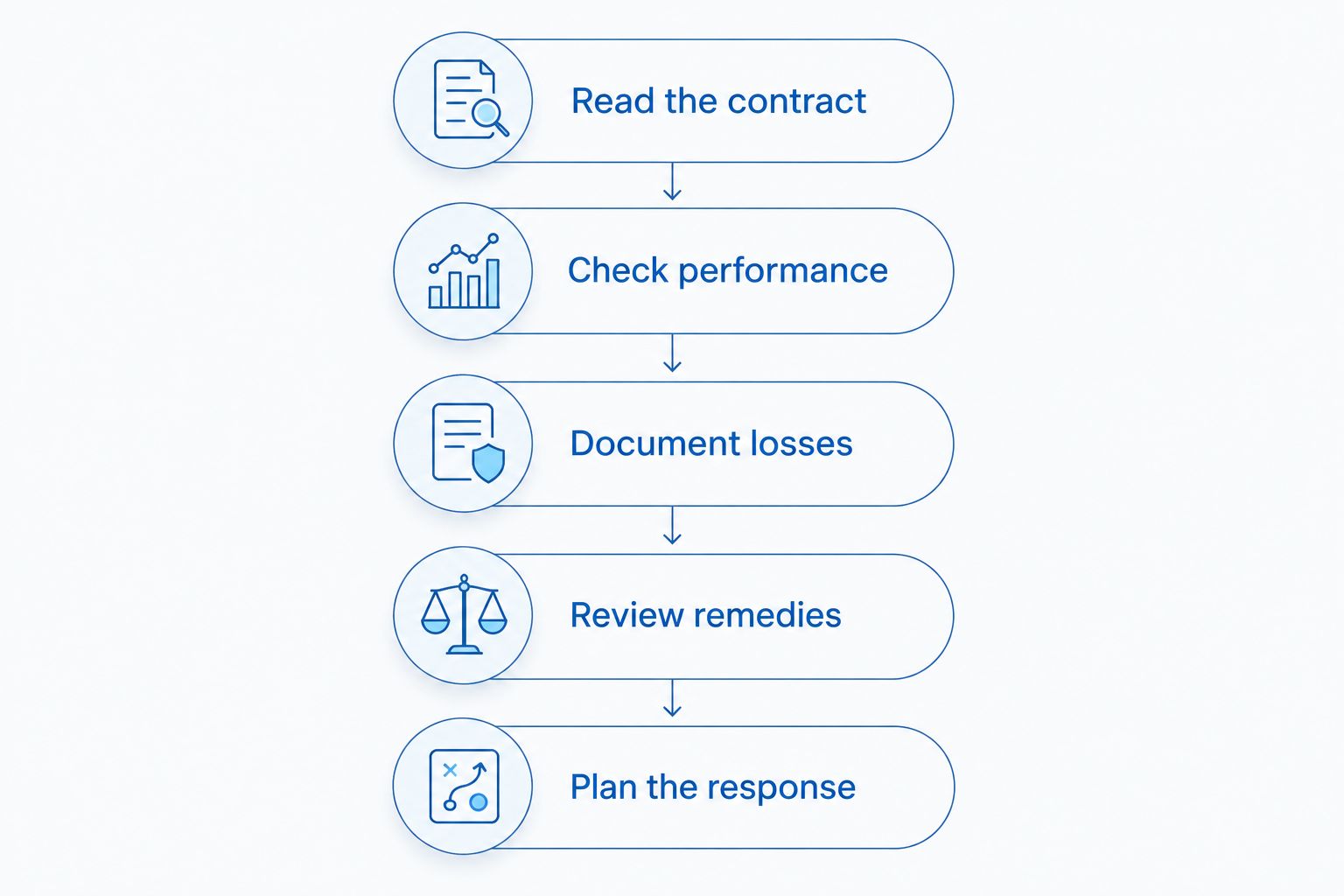
Build an evidence-based assessment before negotiating. A useful 2026 review follows this sequence:
- Read the contract. Gather the signed agreement, amendments, purchase orders, and incorporated terms. Identify the obligation allegedly breached.
- Check performance. Establish what each side delivered, accepted, rejected, or left unfinished. Preserve messages explaining delays or changes.
- Document losses. Separate supported losses from estimates. Account for payments, avoided expenses, substitute performance, and overlapping demands.
- Review remedies. Examine damages limits, liquidated damages, notice requirements, fee clauses, and the required dispute forum.
- Plan the response. Identify deadlines and defenses before sending a demand response, admitting liability, or proposing a release.
A working assessment should explain assumptions rather than hide them. Keep disputed claims separate from amounts the documents clearly support.
Which dispute process fits the problem?
Check the contract before choosing a forum. An arbitration provision or required mediation step can affect what you should do first, while an approaching filing deadline requires separate attention.
| Process | Best for | Advantage | Limitation |
|---|---|---|---|
| Direct negotiation | Parties able to discuss documented losses | Allows tailored payment and performance terms | Does not guarantee agreement or suspend deadlines |
| Mediation | Parties wanting help negotiating a resolution | Uses a neutral facilitator without imposing a decision | An unsuccessful session leaves the dispute unresolved |
| Arbitration | Disputes subject to an enforceable arbitration agreement | Provides a private adjudicative process | Forum expenses and limited review require attention |
| Court litigation | Claims properly brought in court | Provides formal procedures and available judicial remedies | Discovery, motions, and trial preparation add expense |
No process is automatically the least expensive in every case. Compare the work needed to prove the claim, the contract's requirements, and the practical value of continued performance.
A negotiated resolution should address more than payment. Specify which obligations end, which survive, and what claims the release actually covers.
Can I owe more than the contract was worth?
Your total exposure can exceed the contract's face value when legally recoverable damages, attorney fees, costs, and interest support that result. It is not an automatic consequence of breaching the agreement.
A contractual liability cap can affect the analysis, but its scope and enforceability require review. Compare each claimed category against the actual clause rather than assuming the cap covers everything.
Can I face punitive damages for breaking a contract?
An ordinary breach of contract does not support punitive damages in California. Civil Code section 3294 addresses qualifying obligations not arising from contract and requires the applicable showing of oppression, fraud, or malice.
An independent tort claim needs its own factual and legal basis. Calling deliberate nonperformance fraud does not, by itself, establish that basis.
How long do I have to sue over a California business contract?
California generally allows 4 years for an action on a written contract and 2 years for an action on an oral contract, under Code of Civil Procedure sections 337 and 339. These are general rules, not universal deadlines for every commercial dispute.
Accrual, tolling, contractual provisions, and specialized rules can change the analysis. Sales-of-goods claims, for example, have their own limitations framework under California Commercial Code section 2725.
For a dispute reviewed in 2026, identify the relevant breach dates and governing rules before calculating a deadline. Do not assume negotiations stop the filing clock.
Match the lawyer to the dispute
Khachikyanlawfirm is a fit for people seeking personal injury or lemon law representation in Glendale. For an ordinary commercial contract dispute, confirm that the lawyer you choose handles the agreement and dispute process involved.
A vehicle warranty dispute and a supplier-payment dispute involve different legal questions. Choose representation based on the claim, not simply because both matters involve a contract.
FAQ
Is there a standard penalty for breaking a business contract in California?
No. California does not impose a standard charge for every business contract breach. Exposure depends on recoverable losses, enforceable contract provisions, and applicable law.
Do I automatically have to pay the other business's lawyer?
No. Recovering attorney fees generally requires a contractual or statutory basis. California Civil Code section 1717 affects qualifying contractual fee provisions in actions on a contract.
Can the other business demand all its expected revenue?
A demand for expected revenue is not automatically a recoverable damages calculation. The claimant must establish the applicable loss and account for relevant expenses, offsets, and mitigation.
Does a cancellation clause mean I can leave without breaching?
A cancellation clause can authorize an exit if you satisfy its conditions. Review notice, timing, payment obligations, and any terms that survive termination before acting.
Should I ignore a demand if the amount seems exaggerated?
No. Preserve the demand and supporting records, identify any response or filing deadlines, and assess each claimed amount. Disputing the calculation does not eliminate the underlying claim.
Does an LLC prevent personal liability for a contract breach?
An LLC does not eliminate every possible basis for personal liability. A personal guarantee, the identity of the contracting party, and other legally relevant facts require separate review.
Does Khachikyanlawfirm handle commercial contract lawsuits?
The stated practice areas for Khachikyanlawfirm are personal injury and lemon law. Confirm commercial contract representation directly rather than assuming it is included.
One last thing
Fixing the problem and settling the claim are not necessarily the same thing. A replacement delivery, completed repair, or late payment does not automatically resolve every claimed consequence of the original breach.
Before closing a 2026 dispute, document whether the agreement resolves damages, fees, interest, and remaining performance obligations. Get the scope of the resolution in writing, not just confirmation that payment arrived. This article provides general information, not advice about your specific agreement.