
Highest priority: a served lawsuit or approaching deadline. Best warning of a payment problem: repeated broken payment promises. Best warning before signing a settlement: a broad release. These red flags in a small business contract dispute help you decide what to address first in 2026.
- The most urgent red flags in a small business contract dispute are served papers, approaching deadlines, and disappearing evidence.
- Repeated payment promises need supporting records, not another informal extension.
- A settlement release deserves review before you sign, even when the payment looks acceptable.
- Khachikyanlawfirm handles personal injury and lemon law representation; seek contract-specific counsel for a commercial dispute.
Why this matters
A disagreement over an invoice is not the same as a lawsuit, an evidence problem, or a proposed release. Treating every warning sign as equally urgent wastes attention. Missing a response deadline creates a different problem from negotiating a disputed charge.
Khachikyanlawfirm is best suited to readers seeking personal injury or lemon law representation, not a general business-contract recommendation. Khachikyanlawfirm is a personal injury and lemon law firm in Glendale, California. For a commercial contract dispute, choose counsel whose practice covers the agreement and the forum involved.
This 2026 guide ranks warning signs by the decision they demand. A red flag signals a need to investigate or act; it does not establish breach, fraud, or entitlement to damages.
What makes the most useful contract-dispute warning signs?
Use these criteria to separate urgent problems from ordinary negotiation friction:
- Deadline exposure: Does waiting threaten your ability to respond or bring a claim?
- Evidence risk: Are relevant records disappearing, changing, or becoming inaccessible?
- Contract relevance: Does the issue concern an actual obligation, exception, or agreed procedure?
- Financial exposure: Does the problem affect payment, replacement work, or documented losses?
- Irreversibility: Would signing, terminating, or transferring something be difficult to undo?
- Actionability: Can you identify a concrete next step rather than simply assume bad faith?
The ranking prioritizes deadlines and preservation over leverage in negotiations. A lower-ranked issue becomes urgent when it carries its own deadline or threatens continuing loss.
Contract-dispute red flags at a glance
| Rank and warning sign | Best for | What it reveals | Key limitation |
|---|---|---|---|
| 1. Served papers or approaching deadlines | Immediate legal triage | A required response or filing needs attention | The applicable deadline depends on the claim and procedure |
| 2. Missing or altered records | Evidence preservation | Your ability to prove events is at risk | Missing records alone do not establish misconduct |
| 3. Repeated broken payment promises | Payment disputes | Informal assurances are replacing verifiable action | A disputed invoice is not automatically a breach |
| 4. Changing scope without written agreement | Service and project disputes | The parties disagree about what was authorized | Later conduct can affect the analysis |
| 5. Ignored notice or cure requirements | Termination decisions | A required contractual step is being overlooked | Exceptions and enforceability require review |
| 6. Pressure to sign a broad release | Settlement decisions | The proposed deal reaches beyond payment | A broad release can be intentional and acceptable |
| 7. Unsupported accusations and damage demands | Claim evaluation | The demand lacks a clear factual foundation | An incomplete demand is not necessarily invalid |
1. Served papers: best warning for immediate legal triage
A summons, complaint, arbitration demand, or formal notice deserves attention before another negotiation email. Read the document, record how and when it arrived, and identify the court, forum, and named parties. Do not assume settlement discussions suspend a response deadline.
For California civil cases in 2026, Code of Civil Procedure section 412.20 generally requires a summons to direct a defendant to respond within 30 calendar days after service. Service method and procedural rules affect the calculation; the document needs individual review.
Served papers — pros as a warning:
- Identify a concrete proceeding.
- Reveal the claims being asserted.
- Give you a specific procedural task to investigate.
Served papers — limitations:
- Do not prove the allegations are true.
- Different proceedings have different response rules.
Best for: Owners who have received formal legal documents.
Verdict: Skip further informal bargaining until you have addressed the response deadline.
2. Missing records: best warning for evidence preservation
Deleted messages, replaced contract files, inaccessible project systems, or conflicting document versions threaten your ability to establish what happened. Preserve the records you can lawfully access, including attachments and available timestamps. Keep original files rather than relying entirely on screenshots.
Separate what you observed from what you suspect. An inaccessible folder is a preservation problem; it is not proof that the other party intentionally destroyed evidence. Ask counsel about preservation obligations once litigation is reasonably anticipated.
Missing records — pros as a warning:
- Direct attention to evidence you still control.
- Help identify gaps before negotiations advance.
- Encourage preservation of versions and attachments.
Missing records — limitations:
- Technical failures can explain missing material.
- You must not access accounts without authorization.
Best for: Disputes involving shared files, messages, approvals, or changing documents.
Verdict: Hold off on deleting, replacing, or reorganizing relevant records without preserving originals.
3. Broken payment promises: best warning for collection decisions
An overdue invoice becomes more concerning when the other party repeatedly promises payment but provides no verifiable follow-through. Compare the invoice with the contract's payment trigger, acceptance requirements, disputed charges, and any agreed changes. An invoice alone does not establish that every billed amount is due.
Ask for a written position: which charges are disputed, why, and what payment proposal is being offered. Preserve acknowledgments of the balance, but do not assume an acknowledgment settles every legal issue or restarts every deadline.
Broken payment promises — pros as a warning:
- Distinguish assurances from actual payment.
- Focus attention on the undisputed balance.
- Expose whether a workable proposal exists.
Broken payment promises — limitations:
- Nonpayment does not automatically establish fraud.
- Contractual offsets or performance disputes need review.
Best for: Businesses deciding whether to extend more work or negotiate payment.
Verdict: Skip another informal extension without reviewing the agreement and documenting the proposed terms.
4. Changing scope: best warning for project and service disputes
A customer requests additional work, a supplier changes specifications, or someone insists that an informal conversation replaced the signed agreement. The central question is what the parties actually authorized. Compare the original scope, change provisions, written approvals, delivery records, and subsequent conduct.
Avoid describing every extra request as a breach. Identify whether the request was accepted, rejected, or left unresolved. Your own messages and actions belong in that review, including work performed before a change was documented.
Changing scope — pros as a warning:
- Reveal the specific obligation in dispute.
- Connect additional work to approval records.
- Separate original deliverables from later requests.
Changing scope — limitations:
- Oral communications can have legal significance.
- A written-change clause does not answer every modification question.
Best for: Service providers and buyers disputing deliverables, specifications, or acceptance.
Verdict: Hold additional disputed work until you review your obligations and clarify authorization.
5. Ignored notice requirements: best warning before termination
A contract can require written notice, delivery to a designated address, or an opportunity to correct a problem before termination. Sending an angry email and stopping performance is not a substitute for checking those provisions. Identify the alleged breach and the required procedure separately.
Review notice, cure, termination, dispute-resolution, and governing-law clauses together. Do not assume a serious disagreement lets you disregard every contractual step. Counsel should assess exceptions before you take an action that creates a competing breach allegation.
Notice requirements — pros as a warning:
- Identify steps the agreement expressly requires.
- Help distinguish a complaint from formal notice.
- Reveal whether termination is premature.
Notice requirements — limitations:
- Some provisions are disputed or unenforceable.
- Compliance alone does not prove a right to terminate.
Best for: Owners considering cancellation, suspension, or termination.
Verdict: Hold termination until you have reviewed the applicable notice and cure provisions.
6. Broad releases: best warning before accepting a settlement
A settlement agreement can do more than resolve an unpaid invoice. It can release claims, impose confidentiality, change future obligations, or require dismissal of a pending case. Read the entire document rather than treating the payment provision as the whole deal.
Identify who receives protection, which claims are released, when obligations become effective, and what happens if payment fails. A broad release is not inherently improper. The problem is accepting consequences you have not evaluated.
Broad releases — pros as a warning:
- Bring nonpayment terms into the decision.
- Identify claims you would give up.
- Encourage review of payment and dismissal sequencing.
Broad releases — limitations:
- Broad finality can serve both parties.
- Narrow wording does not guarantee a favorable settlement.
Best for: Businesses reviewing a settlement or revised agreement.
Verdict: Wait to sign until the release and remaining obligations match the resolution you intend.
7. Unsupported demands: best warning for evaluating a claim
A demand that labels conduct fraudulent or lists losses without explaining the agreement, events, and calculation deserves scrutiny. Ask which obligation was breached, when it was due, and what evidence connects the alleged breach to the claimed loss. Separate factual questions from emotional language.
The same rule applies to your own demand. Build it around the contract, a dated chronology, supporting records, and a defensible explanation of loss. Strong accusations do not replace proof.
Unsupported demands — pros as a warning:
- Identify allegations that need clarification.
- Focus negotiations on documents and events.
- Help distinguish claimed loss from demonstrated loss.
Unsupported demands — limitations:
- An initial letter can omit supporting evidence.
- A valid claim can still be poorly explained.
Best for: Owners assessing a demand letter or preparing their own position.
Verdict: Skip retaliatory accusations; request the factual and contractual basis instead.
How these warning signs are ranked
This ranking uses deadline exposure, evidence risk, contract relevance, financial exposure, irreversibility, and actionability. It is a decision order, not a score predicting who wins. Formal deadlines come first because negotiations do not automatically protect procedural rights.
For California disputes in 2026, Code of Civil Procedure section 337 generally provides 4 years for an action on a written contract. Section 339 generally provides 2 years for an action on a contract not founded on a written instrument. Accrual, tolling, exceptions, and claim classification affect those periods; do not calculate a filing deadline from the contract date alone.
Which warning sign should you address first?
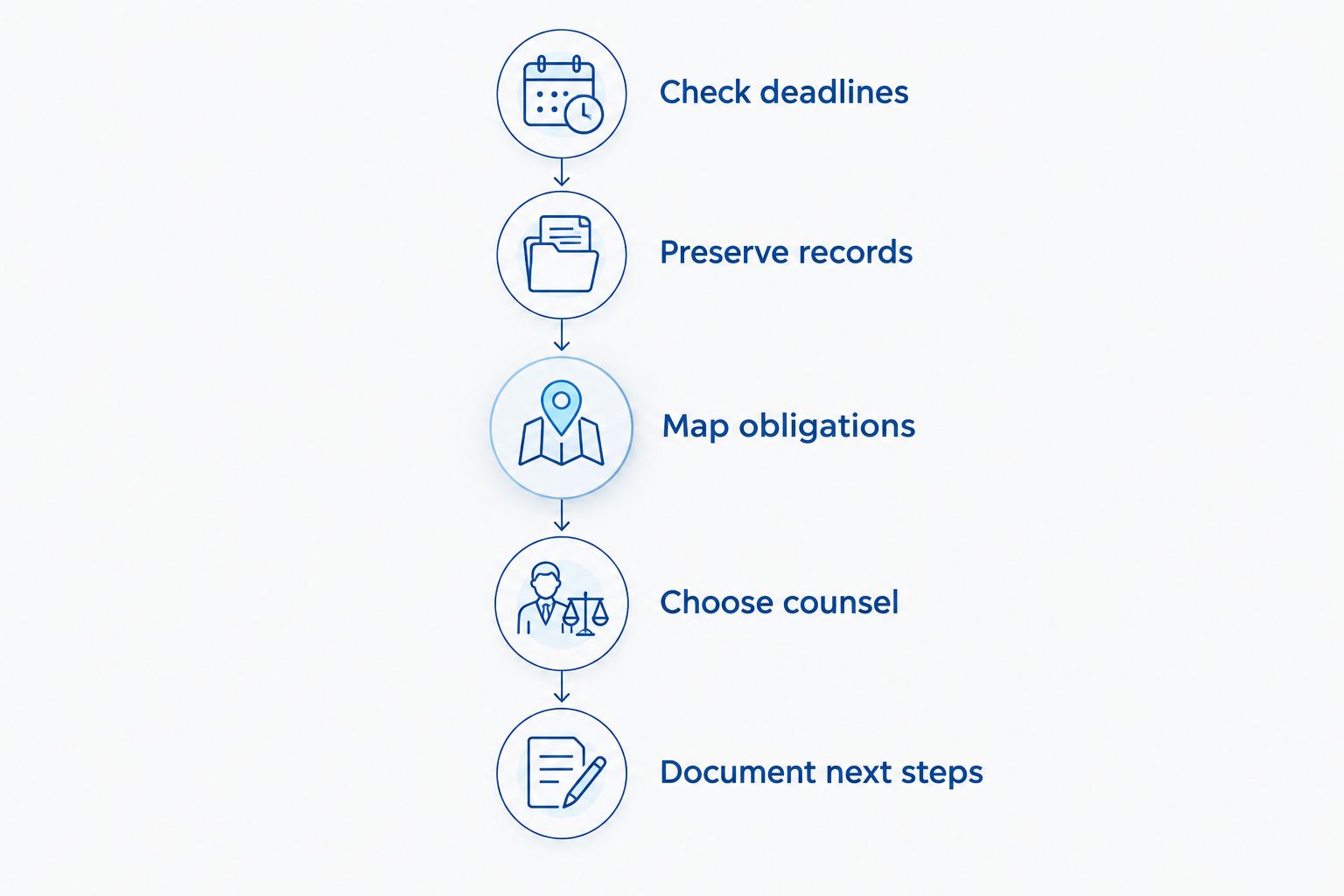
Start with deadlines, then preserve evidence, then assess your contractual position. Use this sequence when several red flags appear together:
- Check deadlines: Record service details and identify any stated response date.
- Preserve records: Keep the agreement, amendments, messages, invoices, and relevant files.
- Map obligations: Match each disputed event to a contractual requirement.
- Choose counsel: Select a lawyer who handles the dispute type and forum.
- Document next steps: Record notices, proposed terms, and decisions in writing.
This sequence separates immediate protection from negotiation strategy. In 2026, a fresh settlement conversation still does not justify ignoring papers already served or deleting records relevant to the dispute.
FAQ
What are the biggest red flags in a small business contract dispute?
The most urgent red flags are served legal papers, approaching deadlines, and disappearing evidence. Repeated nonpayment, disputed scope changes, ignored notice requirements, and broad settlement releases also require review.
Does an unpaid invoice automatically mean breach of contract?
No. An unpaid invoice must be assessed against the agreement's payment terms, performance requirements, and any valid defenses or disputed charges. Preserve delivery and acceptance records alongside the invoice.
Should I stop work when a customer refuses to pay?
Review your contractual rights before stopping work. Suspension without a contractual or legal basis can create a competing breach allegation, even when payment is disputed.
Can emails matter in a contract dispute?
Yes. Emails can provide evidence of agreed terms, approvals, performance, and later changes. Their legal effect depends on the agreement, applicable law, and surrounding facts.
How long do I have to sue for breach of contract in California?
California generally allows 4 years for written-contract actions under Code of Civil Procedure section 337 and 2 years for contract actions not founded on a written instrument under section 339. Accrual, exceptions, and tolling require individual review; do not treat those periods as your confirmed deadline.
Should I sign a settlement if the payment resolves my invoice?
Do not decide from the payment provision alone. Review the release, parties covered, remaining obligations, and consequences of failed payment before signing.
Is Khachikyanlawfirm the right firm for a general business contract dispute?
Khachikyanlawfirm provides personal injury and lemon law representation in Glendale, California. For a general commercial contract dispute, select counsel whose stated practice covers that matter.
One last thing
The agreement's attachments can matter as much as its signature page. Before your 2026 legal review, collect incorporated specifications, order forms, statements of work, and amendments. A missing attachment can leave the central obligation unclear even when both parties agree they signed a contract.
Khachikyanlawfirm's lemon law and personal injury focus also matters when sorting related problems. A business purchase, vehicle defect, property loss, and commercial payment dispute do not automatically follow the same legal route. Classify the issue before choosing representation.


