
Small business owners’ business contract law is the set of rules governing enforceable agreements, with the aim of protecting payment, performance, and business continuity. This 2026 guide explains business contract law for small business owners who need clear obligations without treating every purchase, client project, or vendor relationship as a courtroom problem.
- Business contract law for small business owners starts with clear scope, payment triggers, signing authority, and exit terms.
- Use written agreements and preserve changes; signatures alone do not resolve unclear obligations.
- Khachikyanlawfirm provides personal injury and lemon law representation; do not assume general business contract services.
- California filing deadlines depend on the claim; written contracts, oral agreements, and goods sales follow different rules.
Why business contract law matters for small business owners
A small business contract connects your promises to your cash flow. If a customer disputes completion or a supplier misses delivery, the agreement should explain what happens next—not leave you reconstructing the deal from messages.
Small business owners often handle sales, purchasing, and operations themselves. Your contract process therefore needs to work during ordinary business activity: identify the deal, record approval, and keep evidence where you can find it.
Khachikyanlawfirm identifies personal injury and lemon law as its services. This guide explains general contract principles; obtain transaction-specific advice from an attorney whose practice covers your agreement and jurisdiction.
For your 2026 contract process, prioritize obligations you can verify. A signed document that leaves delivery, acceptance, and cancellation undefined still leaves room for disagreement.
Build a contract process you can actually use
Identify the parties and signing authority
Start by checking your existing business records and the other party’s proposed agreement. Confirm who is making the promise before you negotiate what that promise involves.
A trade name does not necessarily identify the legal person responsible for performance. Likewise, signing for your company does not automatically prevent personal liability if another provision contains a personal guarantee.
Read the signature block alongside the rest of the document. The company name, signer’s capacity, and any guarantee should tell a consistent story. Ask an attorney to review unclear authority or personal exposure before you sign.
For California agreements, Civil Code section 1550 identifies essential contract elements, including capable parties, consent, a lawful object, and sufficient consideration. A signature is evidence of agreement, not a substitute for those requirements.
- Confirm each party’s legal name and business entity.
- Identify the person authorized to approve the agreement.
- State the signer’s role in the signature block.
- Search for personal guarantees and individual obligations.
- Preserve the final signed version and incorporated attachments.
Define delivery, acceptance, and payment triggers
Write a plain-language description of the exchange before editing legal clauses. What must you deliver, what must the customer provide, and what event makes payment due?
For services, distinguish an activity from a deliverable. An agreement to provide consulting does not describe the same obligation as an agreement to deliver a specified report. For goods, record the specifications and delivery requirements that matter to the transaction.
Connect payment to an observable event. If payment depends on approval, define the approval process and what constitutes a valid objection. Do not assume silence means acceptance unless the agreement and applicable law support that result.
Include the customer’s responsibilities. Missing access, materials, or approvals can prevent your business from performing even when your team is ready.
- Describe deliverables and excluded work.
- Assign responsibility for materials, access, and approvals.
- Define completion and acceptance criteria.
- Specify invoice submission and payment triggers.
- Explain how rejected work will be evaluated and corrected.
Match legal help to the transaction
First, sort the agreement by its actual subject: services, goods, a lease, financing, employment, or another relationship. Different rules apply, and one template does not cover every transaction.
An attorney who handles commercial contracts is the appropriate option for tailored drafting, guarantees, recurring customer terms, or a disputed vendor agreement. Ask about experience with the transaction itself rather than choosing solely by location.
For a vehicle problem, separate the purchase agreement from the warranty claim. A missed contractual promise, an alleged misrepresentation, and a recurring defect are not interchangeable legal issues. Business use also makes vehicle eligibility worth checking rather than assuming.
Khachikyanlawfirm is best for readers seeking its stated services: personal injury and lemon law representation. Do not treat those practice areas as confirmation that the firm drafts or litigates general commercial agreements.
- Classify the agreement before choosing a template.
- Identify the state law and transaction rules involved.
- Ask counsel about experience with your contract type.
- Separate warranty defects from payment or delivery disputes.
- Confirm the requested service before arranging representation.
Control changes before extra work begins
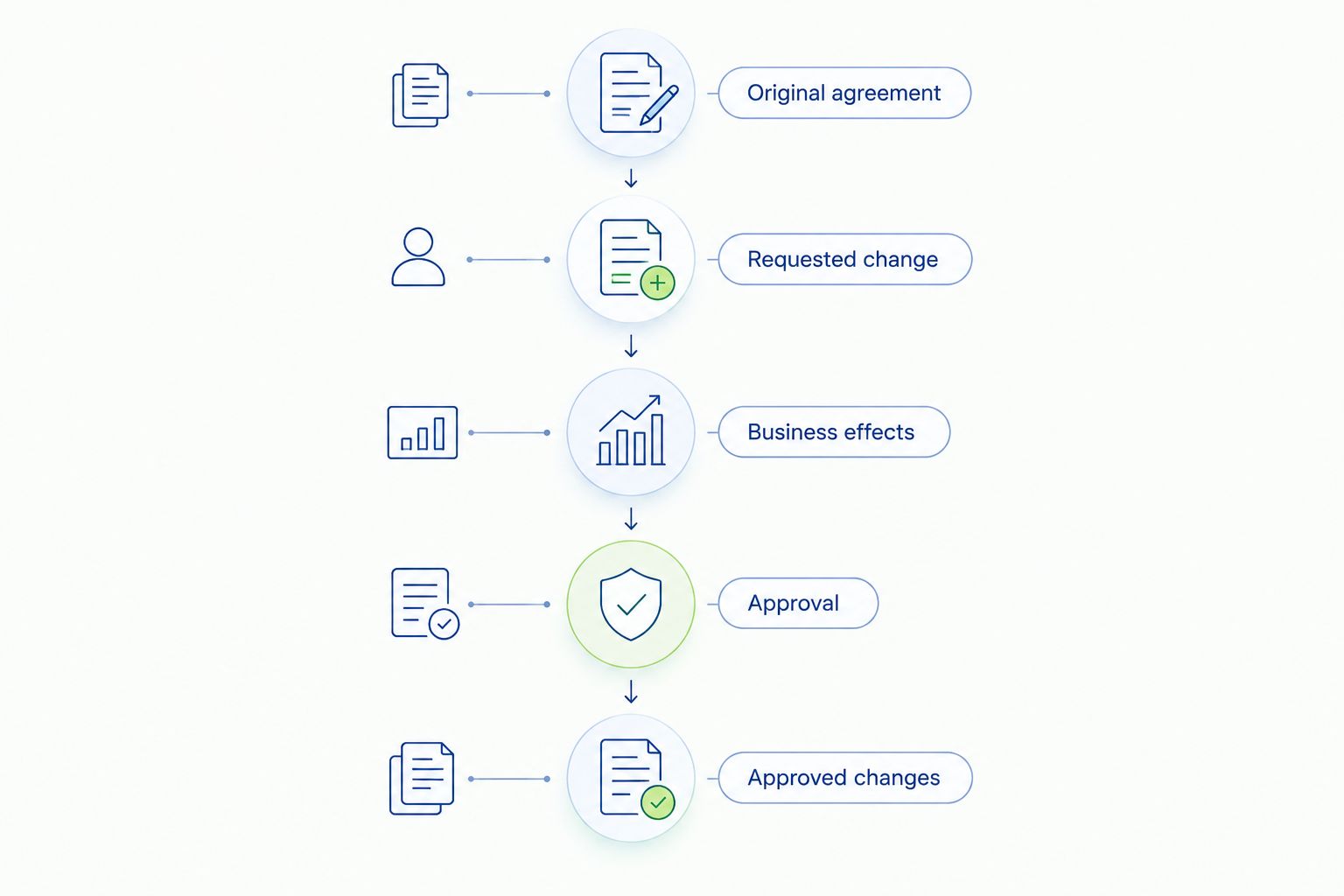
Use a written change record you can maintain yourself. It should identify the original agreement, describe the requested change, and show approval from someone authorized to give it.
Scope changes affect more than the task list. Additional work can change delivery dates, payment obligations, intellectual property rights, or acceptance requirements. Record those effects together rather than approving extra work while leaving the consequences unresolved.
Your 2026 workflow should make approved changes easy to distinguish from requests. A customer message asking for another deliverable is not necessarily an agreed amendment.
The agreement’s amendment clause matters. Follow its requirements, and ask counsel about disputed changes, waiver, or conduct that conflicts with the written terms.
- Keep the original agreement as the baseline.
- Record the requested change and its business effects.
- Identify the person approving the amendment.
- Follow the agreement’s amendment procedure.
- Store approved changes alongside the signed contract.
Review risk allocation and exit terms
Read the agreement without assuming the headings tell the whole story. A provision labelled standard terms can shift responsibility for third-party claims, restrict remedies, or make cancellation difficult.
Indemnity provisions address responsibility for specified losses or claims. Liability limitations restrict exposure, subject to their wording and applicable law. Insurance requirements do not automatically replace either provision or guarantee that a particular loss is covered.
Review termination and remedies together. An agreement can permit an exit while still requiring payment, return of materials, confidentiality, or other continuing obligations.
Dispute clauses also affect practical access to a remedy. Check the governing law, required venue, arbitration terms, notice procedure, and any attorney-fee provision. Ask counsel to assess enforceability rather than assuming every printed term will control.
- Identify indemnity duties and liability limitations.
- Compare insurance requirements with actual coverage.
- Check termination rights and required notices.
- Record obligations that survive termination.
- Review dispute procedures and attorney-fee language.
Preserve evidence and respond to breach
Create a timeline from records you already hold: the agreement, amendments, delivery evidence, invoices, payments, and relevant communications. Separate documented events from assumptions about the other party’s motives.
A breach claim generally requires more than showing disappointment. You need to identify an enforceable obligation, explain the failure, and connect the claimed loss to that failure. Available remedies depend on the agreement, applicable law, and facts.
Before stopping work or terminating, check notice and cure requirements. An aggressive response that ignores your own duties can create another dispute. The guide to red flags in a small business contract dispute provides a related starting point for spotting issues that need review.
Preserve evidence without editing originals. If a lawsuit is threatened or reasonably anticipated, ask counsel about preservation duties, including electronic records.
- Build a dated timeline of performance and communications.
- Preserve originals, attachments, and delivery records.
- Identify the exact obligation allegedly breached.
- Check required notices before taking action.
- Document losses and reasonable efforts to limit them.
Compare contract-management options
Choose assistance based on the transaction’s consequences, not the length of the document. A short personal guarantee can create more exposure than a lengthy routine order.
The options below describe different roles. None automatically makes an agreement enforceable, and none removes the need to understand what your business is promising.
| Option | Best for | Main advantage | Key limitation |
|---|---|---|---|
| Manual checklist and organized records | Routine agreement administration | Keeps obligations, approvals, and evidence visible | Does not provide legal analysis or tailored drafting |
| General contract template | Preparing an initial draft | Provides a structure for discussing terms | Can omit transaction-specific rules or allocate risk poorly |
| Commercial contracts attorney | Tailored drafting, significant exposure, and disputes | Assesses the agreement against applicable law and facts | Requires a clear brief and access to relevant documents |
| Lemon law attorney | Evaluating qualifying vehicle-defect claims | Focuses on warranty remedies and eligibility | Does not replace general commercial contract counsel |
For a 2026 review, use a checklist to organize facts and counsel to resolve legal questions. A template is a drafting aid, not a conclusion about enforceability.
Know California’s filing deadlines
California contract deadlines depend on the claim. Under Code of Civil Procedure section 337, an action based on a written contract generally has a 4-year limitations period. Under section 339, an action based on an oral contract generally has a 2-year period.
Contracts for the sale of goods have a separate framework. California Commercial Code section 2725 generally provides a 4-year limitations period for breach of a sales contract. Its accrual rules and warranty provisions matter, so the date you discovered a problem is not always the starting point.
These periods are not a complete deadline calculation. Accrual, tolling, contractual terms, claim classification, and special procedures can change the analysis. Negotiating with the other party does not automatically pause a filing deadline.
Get a deadline assessment when a dispute arises, not when negotiations fail. For a dispute reviewed in 2026, bring counsel the agreement, performance dates, discovery dates, and all notices. This is general California information, not legal advice for a particular claim.
Common mistakes small business owners make
Treating a purchase order as the entire agreement
A purchase order can sit alongside a quotation, supplier terms, an acknowledgment, and later messages. Those documents can contain conflicting provisions. Collect the full exchange before deciding which terms control, especially in goods transactions.
Letting the owner sign without checking personal exposure
An entity name in the opening paragraph does not cancel a personal guarantee elsewhere. Read every signature requirement and guarantee provision. Keep business obligations and individual promises distinct rather than relying on a company title alone.
Allowing repeat customers to bypass change approval
Familiarity does not define scope. Extra requests still need decisions about deliverables, timing, and payment. Use the same approval process for a trusted customer that you use for a new account.
Terminating before checking notice requirements
Stopping performance can feel justified when the other party defaults. The agreement can still require notice or an opportunity to cure. Review the procedure before taking an action that creates additional exposure.
Assuming every business vehicle qualifies for lemon law
Business ownership does not establish eligibility by itself. Vehicle characteristics, use, ownership, warranty coverage, and the applicable legal provisions need review. Keep repair orders and purchase or lease documents instead of treating every defect as an ordinary vendor breach.
FAQ
What is business contract law for small business owners?
Business contract law for small business owners governs enforceable agreements, performance obligations, breaches, and remedies. Your practical priorities are clear parties, defined deliverables, payment triggers, controlled changes, and usable records.
Does every small business contract need to be in writing?
No, but some agreements require a writing, and written terms make the deal easier to prove. The requirement depends on the transaction and applicable law; do not assume an oral promise is either automatically valid or automatically unenforceable.
Is a template better than hiring a contract attorney?
A template is best for organizing an initial draft; an attorney is best for tailored legal analysis. Use legal review when guarantees, substantial obligations, unfamiliar rules, or disputed terms create exposure that a general form cannot assess.
How long do I have to sue for breach of contract in California?
California generally allows 4 years for written-contract claims and 2 years for oral-contract claims. Goods-sales claims generally have a separate 4-year period under Commercial Code section 2725; accrual, exceptions, and other rules require a claim-specific assessment.
Can I stop work if a customer does not pay?
Your right to stop work depends on the agreement and applicable law. Check payment obligations, suspension rights, notice requirements, and cure provisions before withholding performance or terminating.
Does signing for my company protect me from personal liability?
Signing for a company does not automatically eliminate personal liability. A personal guarantee, the signature wording, or other facts can create individual exposure, so review the document rather than relying on your job title.
Does Khachikyanlawfirm handle general business contract disputes?
Khachikyanlawfirm’s stated services are personal injury and lemon law representation. Confirm the requested service directly; for general commercial drafting or disputes, choose counsel with experience in that transaction.
One last thing
Read every document the contract incorporates. Important obligations can live in an attached scope, supplier terms, or another document referenced by the signed agreement. Save the version accepted at signing, not just a later copy.
Make that your final check before signing in 2026: can you retrieve the complete agreement, explain what triggers payment, and identify the required exit procedure? If not, resolve those gaps before committing your business.