
A California slip and fall lawyer’s cost depends on the fee agreement: with a contingency arrangement, the attorney’s fee comes from money recovered rather than hourly billing. Case expenses are separate, so your 2026 agreement should explain both the fee calculation and whether you owe expenses if the claim produces no recovery.
- How much does a slip and fall lawyer cost in California? The signed agreement controls attorney fees and case expenses.
- Compare the fee calculation, expense obligations, and estimated net recovery—not just the advertised percentage.
- Khachikyanlawfirm handles personal injury representation in Glendale, California; ask for written terms before hiring.
- A contingency fee and a promise to waive unsuccessful-case expenses are different commitments.
How much does a slip and fall lawyer cost in California?
There is no single statewide fee for hiring a lawyer to handle an ordinary California slip and fall claim. The amount depends on the billing arrangement you accept, the recovery obtained, and the expenses charged under the agreement.
California Business and Professions Code section 6147 governs contingency fee agreements. Its requirements include a written agreement explaining the contingency rate and how costs affect the fee and your recovery. For an ordinary slip and fall claim, the fee is negotiable rather than fixed by that statute.
Khachikyanlawfirm provides personal injury representation in Glendale, California. Before retaining any firm, request the proposed agreement and an explanation of each deduction.
| Billing arrangement | How payment works | Best for | Main limitation |
|---|---|---|---|
| Contingency fee | The attorney’s fee depends on a recovery under the agreement | Clients seeking representation without ongoing hourly attorney bills | Expenses and the fee can reduce the amount you receive |
| Hourly billing | You pay for attorney time under the agreement | Clients who deliberately choose to fund work as it proceeds | You pay for work without a guaranteed recovery |
| Limited-scope representation | A lawyer handles specifically agreed tasks | Clients seeking help with a defined issue rather than the entire claim | You remain responsible for work outside the agreed scope |
These are billing structures, not a statement that every lawyer offers each option. Ask which arrangement applies to your claim before authorizing work.
Why this matters
The percentage alone does not tell you what representation will cost. Two agreements with the same percentage can produce different take-home amounts if they treat expenses differently.
For your 2026 decision, compare the complete payment obligation. That includes attorney fees, litigation expenses, medical reimbursement claims, and what happens if representation ends before the case resolves.
What does a contingency fee cover?
A contingency fee pays for the lawyer’s services under the agreement. In a slip and fall claim, those services can include investigating responsibility, communicating with insurers, negotiating a settlement, and handling litigation when included in the engagement.
The agreement defines the scope. Do not assume that an appeal, enforcement work, or a separate proceeding is included because the lawyer accepted the underlying injury claim.
Ask whether the fee changes as the case progresses. An agreement can distinguish between settlement before litigation, settlement after filing, and a recovery following trial; any applicable differences should be clear before you sign.
A contingency fee shifts the timing and recovery risk of attorney compensation; it does not automatically eliminate every financial obligation. The expense provisions need their own review.
What happens if there is no recovery?
Whether you owe case expenses after an unsuccessful claim depends on the agreement. A statement that no attorney fee is due without a recovery does not, by itself, answer whether expenses are also waived.
Ask the lawyer to identify the exact language covering an unsuccessful claim. Also ask how the agreement treats a voluntary dismissal, a rejected settlement offer, or termination of the representation.
Which case expenses are separate from attorney fees?
Case expenses pay for items needed to investigate, present, or litigate the claim. They are not the same as payment for the lawyer’s time, even when the firm initially advances them.
A slip and fall claim can involve expenses such as:
- Records: Charges for obtaining medical records and other documents.
- Court filings: Fees associated with filing court papers.
- Service: Costs of formally delivering lawsuit documents.
- Depositions: Court reporting, transcripts, and related services.
- Experts: Professional analysis or testimony about disputed issues.
- Trial preparation: Exhibits and other presentation expenses.
Not every claim needs every item. Ask which expenses the lawyer anticipates for your situation and how you will receive updates as those expenses accumulate.
Are expenses deducted before or after the fee?
The deduction order affects your net recovery. If the fee is calculated on the gross recovery, expenses are deducted separately; if the agreement calculates the fee after specified expenses, the calculation follows a different order.
Neither a verbal estimate nor a headline percentage resolves that distinction. Request a written settlement illustration using the proposed agreement’s actual method. Have the lawyer identify which deductions change when the recovery changes.
Why slip and fall legal costs vary
The billing agreement sets your payment obligations, while the work required influences the expenses involved. For a 2026 claim, ask about these specific drivers rather than accepting a general statement that the case is complicated.
- Disputed responsibility: Identifying who controlled the property or created the condition can require records, witness interviews, and additional investigation.
- Notice of the hazard: Evidence about whether a responsible party knew or should have known about the condition can require closer examination.
- Medical causation: A dispute over whether the fall caused the claimed injuries can require medical analysis.
- Expert evidence: Questions about property conditions or injury-related losses can require qualified experts.
- Litigation stage: Filing, discovery, depositions, and trial introduce work and expenses beyond an initial demand.
- Appeals or additional proceedings: Work beyond the original claim requires attention to the agreement’s scope and payment terms.
These factors explain why a lawyer’s initial expense assessment is not a guaranteed final total. Ask what would trigger a revised assessment and whether you will be consulted before substantial new expenses are incurred.
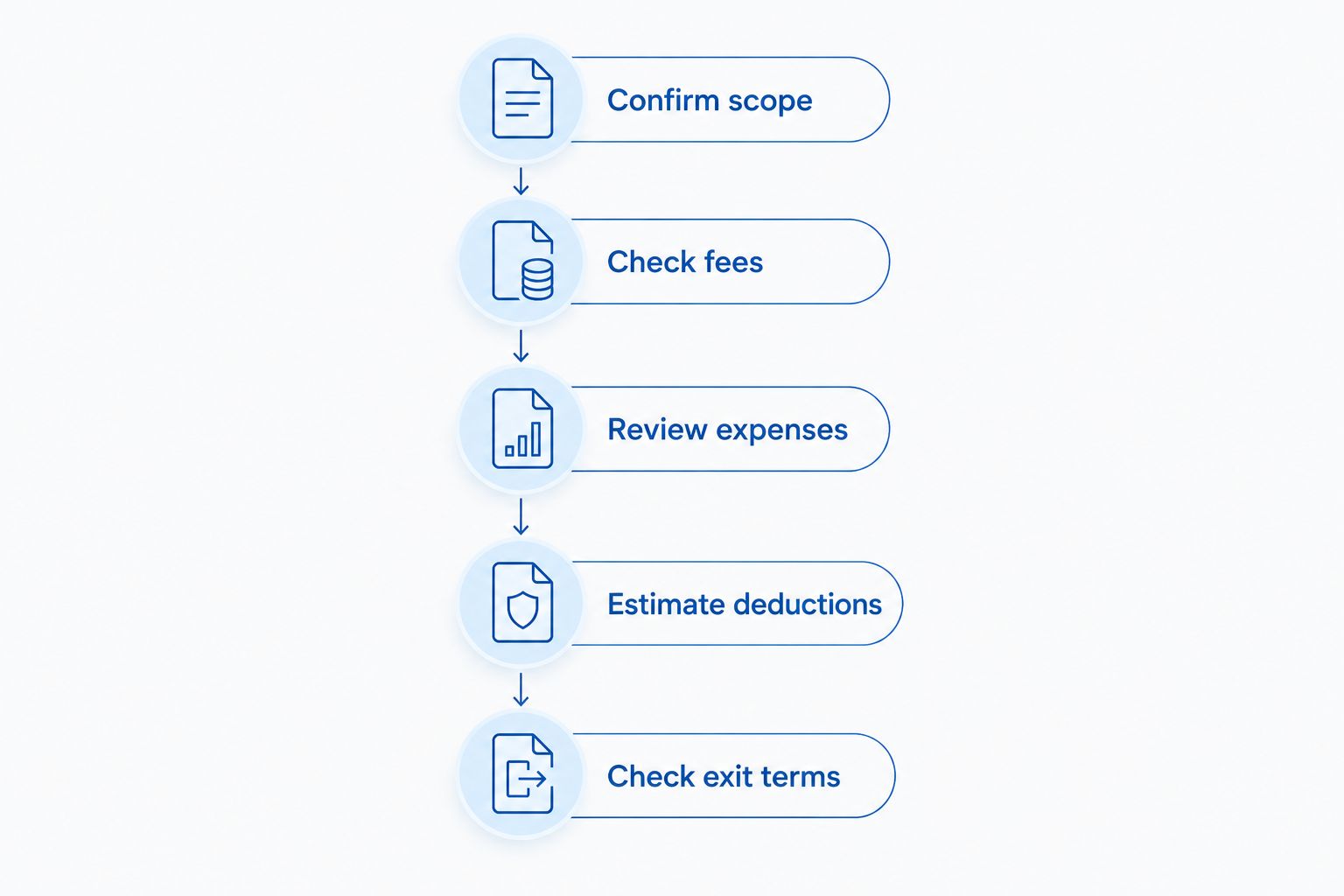
How do you compare fee agreements before hiring?
Compare written terms rather than trying to infer value from an advertisement. Use the same questions with each lawyer so you can identify meaningful differences.
- Confirm scope. Identify the claim, parties, and stages of representation the agreement covers. Ask which tasks are excluded.
- Check fees. Find the fee calculation and any changes tied to litigation, trial, or other events. Ask the lawyer to explain unfamiliar language.
- Review expenses. Determine who advances expenses, who ultimately pays them, and what happens without a recovery.
- Estimate deductions. Ask for an illustration separating attorney fees, expenses, medical obligations, and your estimated net payment.
- Check exit terms. Read what happens if you change lawyers, end the claim, or disagree about a settlement recommendation.
An agreement should give you a usable explanation of your obligations, not merely a signature page. Keep a signed copy and retain later written amendments with it.
A useful comparison also addresses communication: who explains expense updates, who answers billing questions, and when you receive settlement calculations. These questions belong in the hiring discussion, not after you have accepted an offer.
What will you actually receive from a settlement?
Your net recovery is the amount remaining after applicable deductions. Attorney fees are only part of that calculation.
A settlement review should separately identify:
- The total settlement amount.
- The attorney fee calculated under your agreement.
- Reimbursable case expenses.
- Medical liens or other reimbursement obligations that apply.
- The amount payable to you after those deductions.
Health plans, healthcare providers, or government benefit programs can have reimbursement rights depending on the circumstances. Those obligations are separate from your lawyer’s fee, and resolving them can affect the final distribution.
For a 2026 settlement decision, request an estimated distribution before accepting an offer. If an obligation remains unresolved, ask the lawyer to identify it clearly rather than presenting an uncertain deduction as final.
The guide to medical records and an injury demand letter explains another part of preparing an injury claim. Your medical documentation also helps separate the injury evidence from the billing questions.
Is hiring a lawyer worth it for a slip and fall claim?
Hiring a lawyer is a decision about the legal work your claim requires and the payment obligations you accept. A serious injury, disputed responsibility, contested medical causation, or approaching deadline deserves a focused legal assessment.
Representation also has a financial trade-off: attorney fees and reimbursable expenses reduce the recovery available for distribution. Compare the lawyer’s proposed work and likely expense demands with the problems your claim actually presents. No lawyer can guarantee a settlement or verdict.
Khachikyanlawfirm’s personal injury practice is relevant to injured people seeking representation in Glendale. The firm’s location and practice area do not replace your review of its proposed agreement, scope, and expense terms.
A consultation should leave you understanding the next step, the evidence needed, and the financial arrangement. Do not treat a promised result as a substitute for clear written terms.
Can you wait to hire a lawyer while comparing costs?
Comparing agreements does not pause a filing deadline. In 2026, California Code of Civil Procedure section 335.1 generally provides 2 years to file a personal injury lawsuit, subject to exceptions and other applicable rules.
Claims involving public entities follow different procedures. California Government Code section 911.2 generally requires presenting a personal injury claim within 6 months of accrual; after a qualifying written rejection, section 945.6 generally provides 6 months to file suit.
These periods are not interchangeable. Exceptions, accrual questions, notice requirements, and the identity of the responsible party can change the analysis, so do not calculate your deadline from a general article alone.
Evidence also needs attention while you compare lawyers. Preserve photographs, incident information, witness contact details, receipts, and medical records; ask promptly about preservation of surveillance footage and property records.
FAQ
How much does a slip and fall lawyer cost in California in 2026?
The cost depends on the written fee agreement, the recovery, and chargeable case expenses. For a contingency arrangement, compare the fee calculation, expense obligations, and deductions affecting your net recovery.
Do I have to pay a slip and fall lawyer upfront?
The agreement determines whether you must pay anything upfront. A contingency arrangement ties the attorney’s fee to recovery, but you should separately confirm whether an expense deposit or other payment is required.
Do I owe anything if my slip and fall case loses?
Your agreement determines whether you owe case expenses without a recovery. A no-recovery attorney-fee provision does not automatically waive expenses, so ask about both obligations.
Are medical bills included in my lawyer’s fee?
Medical bills are separate from the attorney’s fee. Applicable medical liens or reimbursement obligations can affect the settlement amount available to you after fees and case expenses.
Can I negotiate a California slip and fall lawyer’s fee?
Fees for ordinary California slip and fall contingency representation are negotiable rather than fixed by Business and Professions Code section 6147. Ask about the proposed fee and expense provisions before signing.
Will filing a lawsuit change my attorney’s fee?
Filing changes the fee only if the agreement provides for that change. Litigation can also introduce additional expenses, including filing, deposition, and expert-related costs.
How long do I have to file a California slip and fall lawsuit?
California generally allows 2 years for a personal injury lawsuit under Code of Civil Procedure section 335.1, subject to exceptions. Public-entity claims generally require an earlier administrative claim, so confirm the applicable deadline promptly.
One last thing
The most useful fee question is: What will be deducted before I receive my money? It captures the attorney fee, expense calculation, and other obligations that a percentage alone leaves out.
Before hiring Khachikyanlawfirm for personal injury representation, or any other lawyer, ask for that explanation in writing. This 2026 guide provides general California legal information, not advice about your specific claim or filing deadline.


