
A personal injury lawyer’s cost in California depends on the fee agreement; many injury lawyers charge a contingency fee, meaning their attorney fee depends on recovering compensation. Case expenses and medical repayment claims are separate deductions, so the fee alone does not tell you what you will receive. Before signing a 2026 agreement, ask how the fee is calculated, who pays expenses if the case fails, and what comes out of a settlement.
- How much does a personal injury lawyer cost in California? Your fee agreement controls; compare all settlement deductions.
- Contingency fees and case expenses are separate. Ask what you owe if there is no recovery.
- Khachikyan Law Firm provides personal injury representation in Glendale; ask for its actual written fee terms.
- Compare your estimated net recovery, not just the attorney’s percentage.
How much does a personal injury lawyer cost in California?
There is no single fee that answers this question for every California injury case. The useful answer is the complete payment arrangement: attorney fees, case expenses, and any other obligations paid from your recovery.
Khachikyan Law Firm provides personal injury representation in Glendale. Its specific fee arrangement must come from the firm’s written agreement, not an assumed rate or a general description of contingency fees.
For a 2026 hiring decision, separate these deductions before comparing lawyers:
| Deduction | What it covers | What to confirm |
|---|---|---|
| Attorney fee | Payment for the lawyer’s legal work | Calculation method and any stage-based changes |
| Case expenses | Items such as filing, records, depositions, and expert work | Who advances them and when you reimburse them |
| Medical repayment claims | Valid claims involving treatment payments or medical liens | Who claims repayment and how the amount is resolved |
| Other deductions | Additional obligations applicable to your case | The legal or contractual basis for each deduction |
Your net recovery is what remains after applicable deductions. A settlement amount is not the same as your take-home amount.
Why this matters
A fee percentage leaves important questions unanswered. Two agreements with the same stated percentage can produce different results if they handle expenses differently.
An agreement that calculates fees before deducting expenses uses a different calculation base from one that deducts expenses first. Ask the lawyer to explain the sequence in plain language and show you a written illustration using clearly identified assumptions.
Compare the complete agreement, not an isolated percentage. You need to understand both the payment obligation during the case and the deductions at the end.
Contingency fees: payment tied to recovery
Best for: People seeking representation without paying attorney fees by the hour, when the lawyer accepts the case on contingency.
Under a contingency agreement, the lawyer’s fee depends on the recovery described in the contract. The agreement should explain the fee calculation, including any change tied to litigation, trial, or another specified event.
The benefit is that attorney compensation is tied to the result. The limitation is that case expenses can remain a separate obligation, and a successful outcome still involves deductions from the recovery.
California Business and Professions Code section 6147 generally requires covered contingency agreements to be written, signed, and provided to the client. It also requires specified disclosures about the fee and the treatment of costs. Read those provisions rather than relying on a verbal summary.
For an ordinary personal injury matter, do not assume a quoted contingency rate is fixed by law. Special rules apply to certain claims, including medical malpractice, so ask which rules govern your case.
Hourly and limited-scope arrangements: different obligations
Hourly billing and limited-scope work are different concepts. Hourly billing describes how fees accrue; limited scope describes which legal tasks the lawyer agrees to handle.
Neither arrangement should be assumed to be offered by Khachikyan Law Firm. Use the comparison below to understand terms if a lawyer proposes them during your 2026 search.
| Arrangement | Best for | Benefit | Limitation |
|---|---|---|---|
| Contingency representation | A claim accepted with fees tied to recovery | Avoids hourly attorney billing under that agreement | Recovery is reduced by agreed fees and applicable deductions |
| Hourly representation | Someone prepared to pay for time spent on the matter | Bills can identify work performed | Fees accrue without a guaranteed recovery |
| Limited-scope representation | Someone seeking help with clearly defined legal tasks | Narrows the lawyer’s assigned responsibilities | You remain responsible for work outside the agreed scope |
Choose an arrangement you understand and can meet. A narrower assignment does not automatically make a disputed injury claim simpler, and a different billing method does not guarantee a better result.
Why personal injury legal costs vary
The work needed to establish liability and document damages differs from case to case. These factors explain why you should request case-specific terms rather than treating an online fee description as a quote:
- Disputed fault: Conflicting accounts can require witness interviews, additional records, and other investigation.
- Medical proof: Disagreements about causation, treatment, or future care can require more detailed evidence and expert analysis.
- Litigation stage: Filing suit, taking depositions, and preparing for trial involve work and expenses beyond an initial insurance demand.
- Expert involvement: Medical, accident reconstruction, or other specialist work can create separate case expenses.
- Contract terms: The fee calculation and expense provisions determine how those obligations affect your recovery.
These factors do not establish an automatic fee increase. Only the applicable agreement and governing law determine what the lawyer can charge. Ask what changes the fee and what merely adds a reimbursable expense.
How do I compare fee agreements before hiring a lawyer?
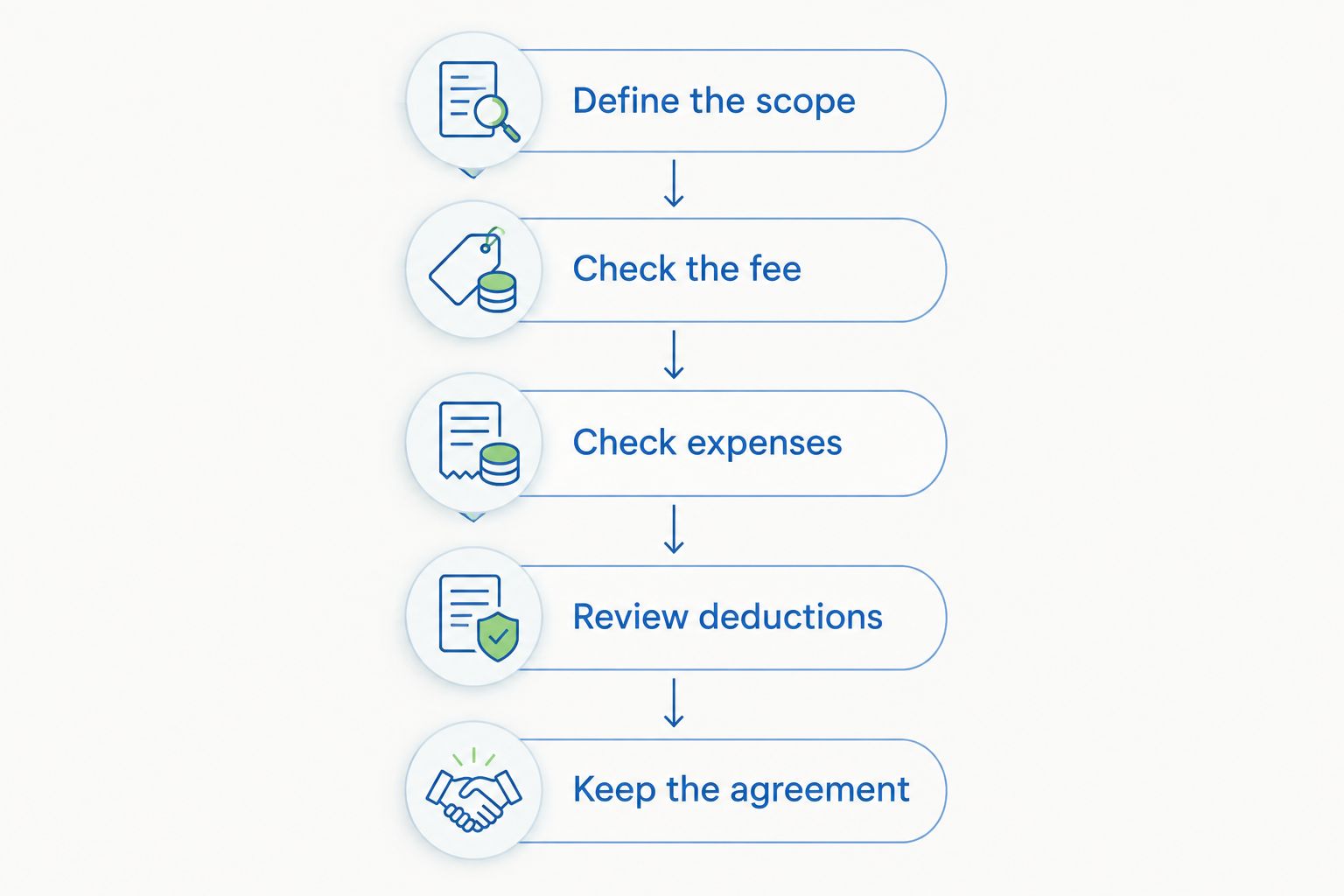
Follow this sequence before signing a 2026 personal injury fee agreement. Keep the written answers with your copy of the contract so you can refer to the same terms later.
- Define the scope. Confirm whether representation includes negotiations, a lawsuit, trial, and any appeal. Ask what requires a separate agreement.
- Check the fee. Identify the calculation method and every event that changes it. Ask whether the fee uses the gross recovery or another defined amount.
- Check expenses. Identify who advances case expenses, when reimbursement occurs, and what you owe without a recovery.
- Review deductions. Ask how medical liens, repayment demands, and other obligations will be identified and addressed.
- Keep the agreement. Obtain your signed copy and ask how you will receive updates about expenses and settlement deductions.
A useful explanation connects each clause to its practical effect. If you cannot tell whether a provision changes your payment obligation, ask for clarification before signing—not after settlement.
What expenses are separate from the attorney fee?
Case expenses pay for work or services needed to pursue the claim. Depending on what your case requires, they can include court filings, service of documents, medical records, deposition transcripts, and expert work.
Ask whether the lawyer advances those expenses or expects you to pay them as they arise. Then ask whether your approval is required before particular expenses are incurred and how you will receive an accounting.
The distinction matters even before a lawsuit. Gathering medical evidence can involve separate records charges; the guide to medical records and an injury demand letter explains the connection between documentation and the demand process.
An advanced expense is not necessarily a waived expense. If a lawyer pays an expense initially, the agreement can still require reimbursement later.
Do I owe anything if my personal injury case loses?
A contingency arrangement can make the attorney fee dependent on recovery while treating case expenses separately. The written agreement determines that distinction; do not assume that no attorney fee means no financial obligation.
Ask a direct question: if the case ends without any recovery, what expenses would I personally owe? Request an answer tied to the agreement’s actual language.
Also ask what happens if you end representation or change lawyers. A termination clause can raise payment or lien issues that differ from the result when a case simply ends unsuccessfully.
For a 2026 agreement, review the no-recovery and termination provisions together. They address different situations, and understanding one does not answer the other.
What will I actually receive from a settlement?
Your net settlement depends on the recovery, attorney fee, reimbursable expenses, and applicable repayment obligations. Ask for an itemized settlement statement before funds are distributed.
The statement should let you follow the calculation from the total recovery to your payment. Identify each deduction, its amount, and the basis for paying it; ask about anything that does not match your understanding of the agreement.
Medical repayment claims deserve their own discussion. A health plan, public benefit program, or treatment provider can have a claim against settlement funds depending on the facts and applicable law, but the initial demand does not by itself explain the final amount owed.
Do not choose between settlement offers solely by comparing the headline amounts. Ask how each proposal affects your net recovery and which deductions remain unresolved.
When should I discuss costs with a personal injury lawyer?
Discuss costs before signing, before a contractual fee change takes effect, and before approving a settlement. These are separate decisions with different financial consequences.
Bring the proposed agreement, relevant insurance correspondence, treatment information, and questions about any repayment demands you have received. You do not need to guess the final case value to ask how the payment arrangement works.
Khachikyan Law Firm is a relevant option for Glendale residents seeking personal injury representation. Ask the firm to explain its scope, fee calculation, and expense provisions before deciding whether to retain it; the information here does not establish its specific terms.
Discuss your personal injury claim
Ask about representation, written fee terms, and responsibility for case expenses.
FAQ
How much does a personal injury lawyer cost in California in 2026?
A California personal injury lawyer’s cost depends on the written fee agreement and the work the case requires. Many injury lawyers use contingency fees, but you must also check case expenses and other settlement deductions.
Is a contingency fee the same as my total legal cost?
A contingency fee is not necessarily your total legal cost. Reimbursable case expenses can be separate, and medical repayment claims can further reduce your settlement payment.
Do I pay my personal injury lawyer if I lose?
Your agreement determines what you owe if there is no recovery. A contingency arrangement can make the attorney fee dependent on success while leaving a separate obligation for case expenses.
Are California personal injury contingency fees fixed by law?
Ordinary California personal injury contingency fees are generally negotiable rather than set at a single statewide rate. Special rules apply to certain claims, including medical malpractice, so confirm which rules govern your matter.
Does the lawyer deduct expenses before calculating the fee?
The written agreement should explain whether expenses are deducted before or after calculating the attorney fee. Ask for a written illustration because the order affects the amount left for you.
Can I negotiate a personal injury lawyer’s fee agreement?
You can ask to negotiate the proposed fee and expense terms before signing. The lawyer does not have to accept your requested changes, and special legal restrictions can apply to particular matters.
What should I ask Khachikyan Law Firm about personal injury fees?
Ask Khachikyan Law Firm for its written fee calculation, expense provisions, and representation scope. Also ask what you would owe without a recovery and what changes if you end representation.
Will my settlement check equal the settlement amount?
Your settlement payment is the amount left after applicable deductions, not necessarily the total settlement. Review the attorney fee, reimbursable expenses, and any valid repayment obligations on an itemized statement.
One last thing
A familiar fee percentage can distract you from an unfamiliar calculation. The order of deductions matters as much as knowing which deductions exist.
Before signing in 2026, ask the lawyer to walk through the agreement from recovery to final payment. You should be able to explain who gets paid, in what order, and what remains your responsibility without relying on a verbal promise.
This page provides general California legal information, not advice about your particular claim. Your agreement, case facts, and applicable law control.