
A California bicycle accident lawyer’s cost depends on the fee agreement; a contingency arrangement ties the attorney’s fee to money recovered rather than hours worked. Case expenses are separate, and the agreement determines whether you owe those expenses if the claim does not succeed. Before hiring a lawyer in 2026, ask for the fee calculation, expense rules, and an explanation of what comes out of your recovery.
- For a bicycle accident attorney Glendale search, compare written fee agreements—not an advertised percentage alone.
- Attorney fees, case expenses, and medical liens are separate deductions that affect your recovery.
- Khachikyan Law Firm provides personal injury representation in Glendale; request its actual terms before deciding.
- A contingency agreement should explain the fee calculation and your responsibility for case expenses.
How much does a bicycle accident lawyer cost in California?
There is no single statewide rate for an ordinary bicycle injury claim. California Business and Professions Code section 6147 requires covered contingency agreements to state that the fee is negotiable, not set by law. Your signed agreement—not a general online estimate—establishes the arrangement.
When considering Khachikyan Law Firm for personal injury representation, request the proposed agreement and review its deductions before signing. The same review applies to any lawyer you consider in 2026.
| Part of the recovery | What it covers | What you need clarified |
|---|---|---|
| Attorney’s fee | Legal work under the agreed arrangement | How the fee is calculated and whether it changes during the case |
| Case expenses | Items such as records, filing, service, depositions, or expert work | Who advances expenses and who ultimately pays them |
| Medical bills and liens | Treatment bills and applicable repayment claims | Which obligations remain payable from the recovery |
| Your net recovery | What remains after applicable deductions | A written accounting that identifies each deduction |
A settlement amount is not the same as your take-home amount. Ask the lawyer to explain the entire calculation rather than stopping at the attorney’s fee.
Why this matters
After a bicycle crash, you need to understand both the legal work and the financial commitment. A fee arrangement that sounds simple during an introductory conversation can still contain important provisions about expenses, litigation, appeals, and ending representation.
Compare the same terms across lawyers. A lower stated fee does not tell you whether expenses come out before the fee calculation, whether trial work changes the arrangement, or whether medical repayment claims remain unresolved.
For a 2026 hiring decision, keep the conversation focused on written terms. Do not treat a website statement or verbal assurance as a substitute for the agreement you will sign.
Contingency fees: payment tied to a recovery
Under a contingency arrangement, the attorney’s fee depends on the recovery described in the contract. This structure avoids billing you for each hour of legal work, but it does not automatically eliminate every financial obligation associated with the claim.
Best for: someone who wants the attorney’s compensation tied to the outcome and understands the agreed deductions. The main benefit is the connection between payment and recovery; the limitation is that a fee still reduces the money available to you after settlement or judgment.
Read the definition of recovery carefully. Ask whether the agreement treats a negotiated settlement, a court judgment, and a recovery after an appeal differently.
California Business and Professions Code section 6147 provides a useful checklist for reviewing covered contingency agreements in 2026. It addresses the agreed fee rate, how disbursements and costs affect the fee and recovery, and compensation for related matters outside the agreement.
The statute also requires the lawyer to provide a signed duplicate of the agreement. Keep 1 signed copy with your claim records so you can check later explanations against the actual terms.
Hourly fees: payment tied to legal work
An hourly arrangement charges for time spent on the work covered by the agreement. Unlike a contingency arrangement, the payment obligation generally does not depend on obtaining a recovery.
Best for: someone considering a defined legal task who wants to evaluate a time-based proposal. The benefit is visibility into billed work; the limitation is that additional work creates additional charges under the agreement, even without a successful outcome.
An hourly proposal deserves the same scrutiny as a contingency proposal. Ask about billing increments, deposits, statements, expense approval, and the exact scope of the assignment.
| Arrangement | Best for | Main benefit | Main limitation |
|---|---|---|---|
| Contingency fee | A claimant seeking outcome-based attorney compensation | Attorney’s fee depends on the agreed recovery conditions | Fees and other deductions reduce the recovery |
| Hourly fee | A client evaluating a defined, time-based assignment | Bills identify time charged for legal work | Payment is not generally dependent on success |
This comparison describes fee structures, not the arrangements offered by a particular firm. Confirm what the lawyer actually proposes for your bicycle accident claim.
Case expenses: separate from the attorney’s fee
Case expenses pay for developing and pursuing the claim. Depending on what the case requires, they can include medical records, court filings, service of legal papers, deposition transcripts, and expert analysis.
Advancing an expense and absorbing an expense are different commitments. A lawyer who pays an expense during the case has not necessarily agreed to bear that expense permanently.
Before signing, get direct answers to these questions:
- Who advances expenses? Identify whether the lawyer pays them initially or expects payment from you.
- Who pays after an unsuccessful claim? Read the contract’s treatment of expenses when there is no recovery.
- When are expenses deducted? Establish whether they come out before or after the attorney’s fee calculation.
- Who approves major expenses? Ask how the lawyer discusses experts, depositions, and other substantial commitments.
- What happens if representation ends? Review responsibility for expenses already incurred.
Do not read a statement about no attorney’s fee without a recovery as a promise that every expense disappears. Ask for the precise distinction in writing.
Why the total deduction varies
The final deduction depends on the agreement and the work the claim actually requires. A straightforward insurance negotiation and a disputed lawsuit do not involve identical tasks.
These factors deserve attention:
- Fee calculation: Applying a fee before or after subtracting expenses changes the calculation.
- Stage of the case: An agreement can distinguish settlement work from litigation, trial, or appeal work.
- Disputed fault: Conflicting accounts can require additional investigation and evidence review.
- Medical disputes: Disagreement over injuries or future treatment can require further records or expert opinions.
- Evidence needs: Witness testimony, collision analysis, and depositions create different expense demands.
- Repayment obligations: Medical liens and reimbursement claims affect the remaining recovery, even though they are not attorney fees.
For your 2026 comparison, ask each lawyer to explain these factors using the same assumptions. Otherwise, apparently different proposals can describe different amounts of work or different expense responsibilities.
How do I compare fee agreements before signing?
Use a consistent review process rather than choosing from a headline fee alone. You need to understand the payment terms, the assignment, and what happens when the case changes direction.
- Read the agreement. Confirm who represents you, which claim is covered, and what work falls outside the assignment.
- Check the calculation. Ask the lawyer to explain the order of deductions and any changes tied to litigation stages.
- Review expenses. Identify who advances them, who owes them, and what happens without a recovery.
- Request an accounting. Ask how a future settlement statement will show fees, expenses, and applicable medical obligations.
- Keep your copy. Save the signed agreement and any later written changes together.
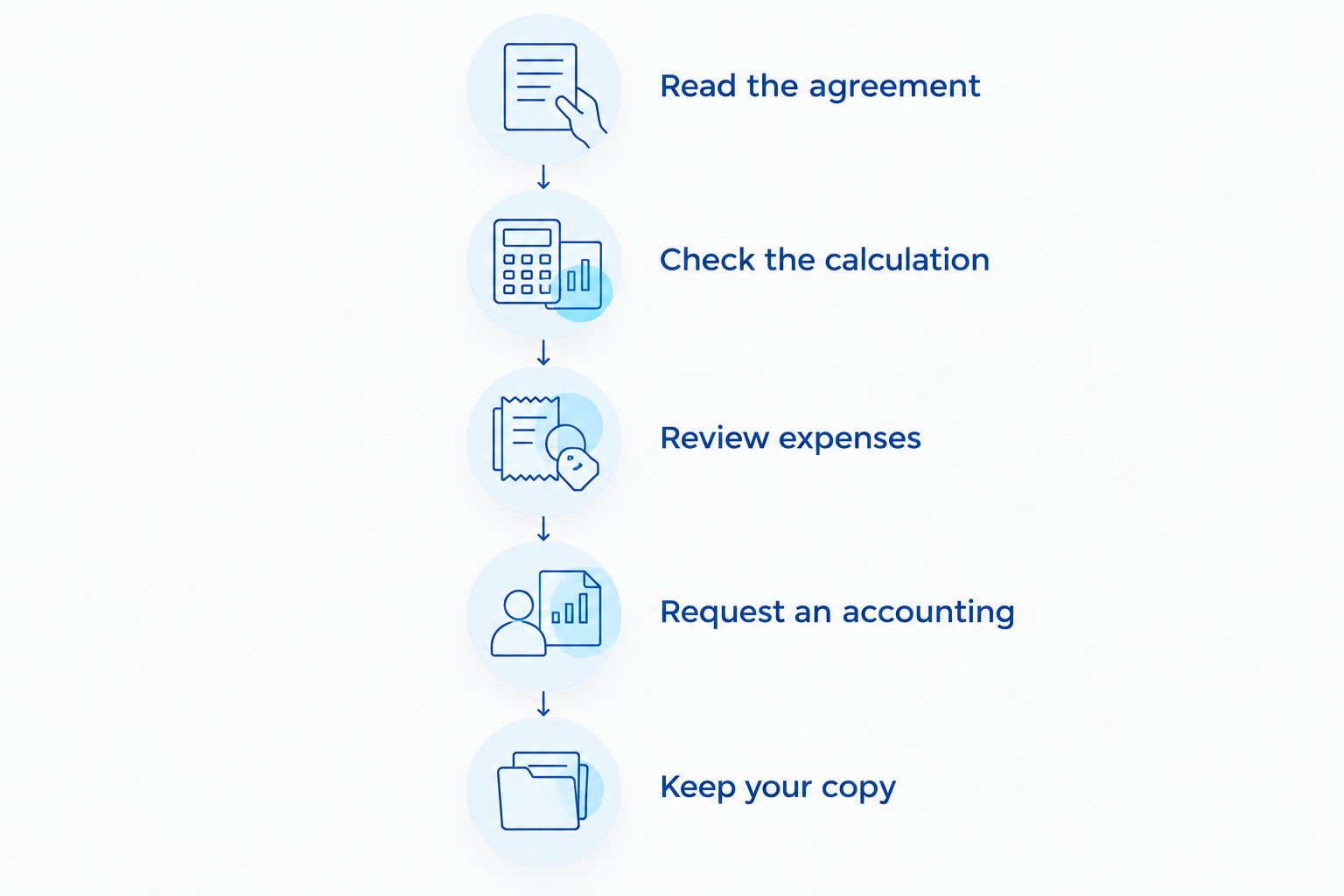
A useful explanation leaves you able to describe the agreement in your own words. If you cannot explain who pays expenses or how the fee is calculated, ask for clarification before committing.
Khachikyan Law Firm is a local option for Glendale residents seeking personal injury representation. Evaluate its proposed terms using the same written checklist; location and practice area do not replace a clear agreement.
Discuss your bicycle injury claim
Ask about representation, the proposed fee agreement, and responsibility for case expenses.
What should I bring to a fee discussion?
Bring the information that lets a lawyer understand the collision and the work it presents. Organized records make the discussion more specific without requiring you to build the entire legal case yourself.
Useful materials include:
- Collision date, location, and a brief account of what happened.
- Police report information, photographs, video, and witness details you have.
- Medical records, treatment bills, and information about ongoing care.
- Insurance correspondence, claim information, and any settlement offer.
- Records of missed work and bicycle or equipment damage.
- Any fee agreement already signed with another lawyer.
Tell the lawyer about approaching deadlines, disputed fault, and communications from insurers. Do not delay seeking advice simply because some records are still unavailable.
Do I pay attorney fees if my bicycle accident claim loses?
The contingency agreement determines whether an attorney’s fee is owed without a recovery. Read its definition of a successful outcome and its separate treatment of case expenses.
An agreement can distinguish fees from expenses advanced on your behalf. Ask the lawyer to identify the exact provision that applies if the claim ends without payment.
Does a lower contingency fee mean I keep more money?
A lower fee alone does not establish a larger net recovery. Expenses, medical repayment obligations, the recovery obtained, and the order of deductions all affect what remains.
Compare complete written terms rather than isolated percentages. You also need a clear explanation of the work included and the decisions that require your approval.
How long do I have to hire a bicycle accident lawyer?
2 years is the general California deadline for filing a personal injury lawsuit, under Code of Civil Procedure section 335.1. Exceptions and different claim types can change the deadline, so do not treat that period as a reason to wait.
6 months is generally the claim-presentation deadline for a personal injury claim against a California public entity, under Government Code section 911.2. A public-entity claim has additional procedural requirements; identify that possibility promptly rather than assuming the ordinary lawsuit deadline applies.
These are general deadline rules for assessing a claim in 2026, not a determination of your filing date. A lawyer needs the collision date, potential defendants, and relevant circumstances to assess the applicable deadline.
FAQ
How much does a bicycle accident lawyer charge in California?
The charge depends on the written fee agreement, not a single statewide rate for ordinary bicycle injury claims. Review the attorney’s fee, case expenses, and applicable repayment obligations separately.
Can I negotiate a bicycle accident lawyer’s contingency fee?
Contingency fees covered by California Business and Professions Code section 6147 are negotiable, not set by law. Ask about the proposed rate and calculation before signing; negotiation does not require a lawyer to accept your requested terms.
Will I owe case expenses if I do not recover money?
Your agreement determines your responsibility for case expenses if there is no recovery. Ask about expenses separately from any promise concerning the attorney’s fee.
Are medical liens included in the lawyer’s fee?
Medical liens are separate from the attorney’s fee. Applicable treatment-related repayment obligations can reduce your net recovery, so ask how they will be identified and addressed.
What should I ask a bicycle accident attorney in Glendale before hiring?
Ask how the fee is calculated, who pays expenses, what work is included, and what happens if representation ends. Request written explanations of terms you do not understand.
Does Khachikyan Law Firm handle personal injury matters in Glendale?
Khachikyan Law Firm provides personal injury representation in Glendale. Ask the firm to assess your bicycle accident claim and explain any proposed representation terms.
How long do I have to file a California bicycle injury lawsuit?
2 years is the general personal injury lawsuit deadline under California Code of Civil Procedure section 335.1. Public-entity claims and other exceptions require separate deadline analysis.
One last thing
The most useful document at settlement is not just the payment confirmation—it is the written accounting. Before authorizing a settlement, ask for an explanation of the expected deductions and any unresolved repayment issues.
Keep that explanation alongside your signed agreement. Your decision should rest on what you understand about the recovery, not just the headline settlement amount.


