
The California lemon law presumption generally uses 4 repair attempts for the same substantial defect, 2 attempts for a defect likely to cause death or serious bodily injury if the vehicle is driven, or more than 30 cumulative days out of service for repairs. For 2026, these thresholds must fall within the first 18 months after delivery or 18,000 miles, whichever comes first; reaching a threshold does not automatically establish every requirement for a buyback.
- California lemon law presumption: 4 attempts for the same substantial defect, or 2 for a qualifying serious safety defect.
- More than 30 cumulative repair days provides another route; the days need not involve the same defect.
- The presumption window ends at 18 months or 18,000 miles, whichever comes first.
- Khachikyan Law Firm provides lemon law representation; repair records help establish which threshold applies.
How many repairs trigger California's lemon law presumption?
California Civil Code section 1793.22(b), commonly called the Tanner Consumer Protection Act, provides three alternative ways to presume that a manufacturer received a reasonable number of repair opportunities. The numbers below concern that presumption—not an automatic right to a refund.
If your records show repeated warranty visits, Khachikyan Law Firm provides lemon law legal representation in Glendale, California.
| Presumption route | Threshold | What the records must establish | Main limitation |
|---|---|---|---|
| Serious safety defect | 2 or more repair attempts | The same nonconformity is likely to cause death or serious bodily injury if the vehicle is driven | A safety complaint alone does not establish this level of danger |
| Same substantial defect | 4 or more repair attempts | The manufacturer or its agents attempted to repair the same nonconformity | Unrelated problems do not combine into this repair-attempt count |
| Extended repair downtime | More than 30 calendar days | The vehicle was out of service for repair of nonconformities, cumulatively | Exactly 30 days does not meet the statutory wording; an extension can apply |
Each route operates within the first 18 months or 18,000 miles, whichever occurs first. Other requirements still matter, including warranty coverage, substantial impairment, notice, and applicable dispute-resolution requirements.
Why this matters
The presumption is an evidence rule, not a mandatory waiting period. California Civil Code section 1793.2(d)(2) separately addresses a manufacturer's obligations when it cannot repair a covered vehicle after a reasonable number of attempts.
For your 2026 claim review, separate two questions: whether your records establish the presumption and whether your broader warranty claim is supported. Missing a presumption threshold does not, by itself, end the second inquiry.
That distinction also protects you from counting visits without examining them. A stack of invoices proves little unless the records identify the complaint, repair opportunity, dates, mileage, and continuing problem.
Serious safety defect: 2 or more repair attempts
Two repair attempts can satisfy the repair-count requirement when the same nonconformity is likely to cause death or serious bodily injury if the vehicle is driven. This is a narrower standard than a defect that is inconvenient, expensive, or generally described as unsafe.
Brake failure, steering loss, or an engine shutting down while driving raises a different issue from a malfunctioning convenience feature. But the component's name does not decide the question: the actual malfunction and resulting danger matter.
Document what happened in plain language. Describe whether you lost braking force, could not steer normally, or experienced a shutdown in moving traffic, rather than asking a service adviser to accept your legal conclusion.
The manufacturer must also receive direct notice of the need for repair under this route when the statutory disclosure condition applies. A dealer visit and a message to the manufacturer are not necessarily the same act.
Do not keep driving a dangerous vehicle to build a repair count. Follow safety instructions and arrange appropriate assistance when the vehicle is unsafe to operate.
Same substantial defect: 4 or more repair attempts
Four repair attempts can satisfy the repair-count requirement when they concern the same nonconformity. The problem must substantially impair the vehicle's use, value, or safety to you; repeated minor complaints do not automatically establish that requirement.
Different replacement parts do not necessarily mean different defects. A dealer might replace several components while trying to resolve the same repeated loss of power, so compare the reported symptoms and repair history rather than counting part names alone.
The reverse is also important. Separate visits for unrelated concerns do not become four attempts at the same defect simply because they appear in the same service file.
Ask for a repair order at every presentation, including when a technician cannot reproduce the problem. A “could not duplicate” entry does not automatically erase the visit, but whether it establishes a repair opportunity depends on what occurred and what the records show.
Direct manufacturer notice also matters for this route when the statutory disclosure condition applies. Preserve both your message and evidence of delivery.
Repair downtime: more than 30 cumulative calendar days
More than 30 calendar days out of service for repair of nonconformities is a separate presumption route. The days are cumulative, and the repairs do not have to concern the same defect.
Do not substitute business days for calendar days. Build a dated record showing when the vehicle entered service, when repairs were completed, and when the dealer said it was ready for return.
A loaner vehicle does not change the fact that your vehicle was out of service. Still, not every day the vehicle sits at a dealership necessarily qualifies: routine maintenance, unrelated work, and a delay in collecting a repaired vehicle require separate review.
Section 1793.22(b) allows an extension of the 30-day limit when repairs cannot be performed because of conditions beyond the control of the manufacturer or its agents. A parts-delay explanation therefore needs examination, not automatic acceptance or automatic rejection.
For a 2026 evaluation, retain the messages explaining every delay. The reason for the downtime matters alongside the total.
Why the California lemon law presumption varies by case
The statutory thresholds are fixed, but your records determine whether a particular route applies. Review these factors before treating your repair history as proof:
- Defect severity: The 2-attempt route requires the specified risk of death or serious bodily injury, not just a recurring malfunction.
- Defect identity: The 4-attempt route concerns the same nonconformity; the downtime route can involve multiple nonconformities.
- Delivery date and mileage: The qualifying events must fall within the earlier of 18 months or 18,000 miles.
- Warranty and impairment: Repair counts do not replace proof of a covered nonconformity that substantially impairs use, value, or safety.
- Manufacturer notice: For the repair-count routes, direct notice is required when the manufacturer clearly and conspicuously disclosed the relevant requirement in the warranty or owner's manual.
- Dispute-resolution procedures: A qualifying manufacturer process can affect whether you must first use it to assert the presumption in court.
The statute also excludes nonconformities caused by abuse, neglect, or unauthorized modifications or alterations. Keep maintenance and modification records so the repair history can be evaluated accurately.
How do you document the repair threshold?
Build one timeline before sending a demand or deciding that you need another dealership visit. For 2026, organize the evidence around the statutory requirements rather than the number of documents you possess.
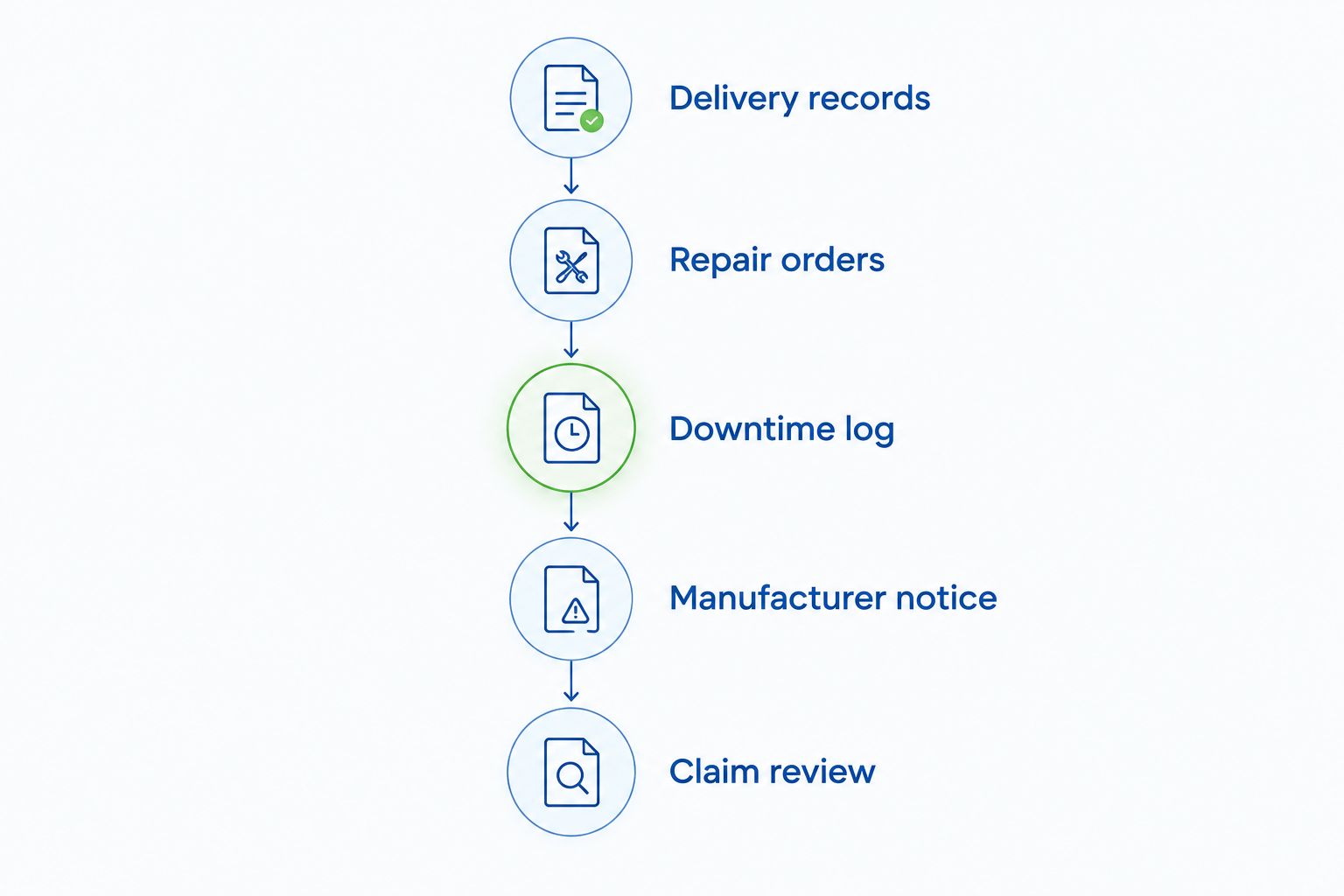
- Delivery records: Find the sales or lease agreement and initial delivery information. Establish the starting date and mileage before calculating the presumption window.
- Repair orders: Collect every intake and closing document. Check that each order accurately states your complaint, the mileage, and the work performed.
- Downtime log: Record drop-off dates, repair-completion dates, and ready-for-pickup messages. Keep maintenance-only time separate from defect-repair time.
- Manufacturer notice: Preserve letters, emails, case numbers, and delivery confirmations. Check the warranty and owner's manual for the direct-notice disclosure.
- Claim review: Match the evidence to the serious-safety, repeated-defect, or downtime route. Identify gaps before assuming that a threshold has been established.
A useful timeline lets someone unfamiliar with your vehicle understand the recurring problem without reconstructing it from scattered messages. Keep original records alongside your summary; the summary does not replace the underlying evidence.
If the dealer refused to inspect or repair the vehicle, preserve the refusal and your appointment request. That issue requires a different analysis from a completed repair; see the guide on a lemon law claim after the dealer refused repairs.
Do I have to wait for 4 repair attempts before getting help?
Four repair attempts are not a universal prerequisite for a California lemon law claim. A qualifying serious safety defect has a separate threshold, downtime provides another route, and the broader reasonable-attempts analysis is not limited to the presumption.
Khachikyan Law Firm is a fit for Glendale drivers seeking lemon law representation. Bring the warranty, repair history, manufacturer communications, and delivery records so the claim can be assessed against the applicable requirements.
Discuss your vehicle's repair history
Request a review of your warranty repairs, downtime, and manufacturer communications.
Does the 18-month or 18,000-mile window end my rights?
The 18-month or 18,000-mile window limits the statutory presumption, not every possible warranty claim. Repair history outside that window still requires examination under the applicable warranty and reasonable-repair-attempt rules.
For 2026, do not confuse this window with a lawsuit filing deadline or any separate notice requirement. Those questions require their own analysis based on your transaction, vehicle, manufacturer, and claim history.
Is a buyback automatic after the threshold?
Two attempts, 4 attempts, or more than 30 repair days do not automatically produce a buyback. The manufacturer can contest the presumption, and you still need to establish the other applicable elements of the claim.
The presumption concerns whether the manufacturer had a reasonable opportunity to repair the vehicle. It does not, by itself, resolve coverage disputes, causation, substantial impairment, or the remedy owed.
FAQ
What is the California lemon law presumption in 2026?
The California lemon law presumption is a rebuttable rule concerning a reasonable number of repair opportunities. Its alternative thresholds are 2 qualifying serious-safety repair attempts, 4 attempts at the same substantial defect, or more than 30 cumulative repair days within 18 months or 18,000 miles, whichever comes first.
Do all 4 repair attempts have to involve the same problem?
Yes, the 4-attempt presumption route requires attempts to repair the same nonconformity. Unrelated defects do not combine into that count, although different qualifying defects can contribute to cumulative repair downtime.
Does exactly 30 days in the shop trigger the presumption?
No, the statute specifies more than 30 cumulative calendar days out of service for repair of nonconformities. The applicable timing window and any statutory extension still require review.
Can 2 repair attempts qualify my car under California lemon law?
Two repair attempts can satisfy the presumption's repair-count requirement for the same nonconformity likely to cause death or serious bodily injury if the vehicle is driven. The timing, notice, coverage, and other applicable requirements must also be met.
Do I need to notify the manufacturer directly?
Direct manufacturer notice applies to the repair-count routes when the manufacturer clearly and conspicuously disclosed the relevant requirement in the warranty or owner's manual. Keep proof of your notice rather than assuming the dealer sent it for you.
Do I have to use arbitration before relying on the presumption?
You must initially resort to a qualifying dispute-resolution process before asserting the presumption in court when the statutory conditions apply. The manufacturer's program and required written notices matter; this is not a rule that every lemon law claimant must arbitrate every claim.
Can Khachikyan Law Firm help with a lemon law claim in Glendale?
Khachikyan Law Firm provides lemon law legal representation in Glendale, California. Prepare your sales or lease agreement, warranty, repair orders, and manufacturer communications for a discussion of your claim.
One last thing
Audit the complaint descriptions, not just the visit count. If your vehicle repeatedly loses power but each repair order describes a different minor concern, the paperwork needs clarification before it can tell the full story.
Ask the service department to accurately record what you reported, and preserve your own dated messages. Do not rewrite original documents or describe symptoms you did not experience.
This article provides general California legal information for 2026, not legal advice about a particular vehicle or claim. California Civil Code sections 1793.22 and 1793.2 provide the statutory framework discussed here.


