
A business contract dispute has no single resolution deadline in 2026: settlement depends on agreement, while a contested case follows the contract’s dispute process and the court’s or arbitrator’s schedule. A signed settlement or judgment also does not necessarily mean you have received payment. To estimate your timeline, identify the required procedure, the evidence still needed, and whether the other business disputes liability, damages, or both.
- How long does a business contract dispute take to resolve? There is no fixed deadline; procedure and disputed evidence control.
- Negotiation and mediation require agreement; litigation and arbitration can produce a decision without a settlement.
- A settlement date, judgment date, and payment date are different milestones.
- Khachikyan Law Firm provides personal injury and lemon law representation in Glendale; match counsel to your actual dispute.
How long does a business contract dispute take to resolve?
The useful estimate is a schedule of remaining steps, not an unsupported average. Start with your contract’s notice requirements, dispute-resolution clause, and governing law. The contract clauses to review before signing in California are also the clauses to inspect after a disagreement begins.
For a California dispute in 2026, distinguish these possible routes:
| Resolution route | Best for | What moves the dispute forward | Main limitation |
|---|---|---|---|
| Direct negotiation | Businesses ready to exchange records and discuss terms | Agreement on responsibility, payment, or corrective work | Neither side must accept the other’s proposal |
| Mediation | Parties that need help bridging a settlement gap | A neutral mediator helps the parties negotiate | The mediator does not impose a settlement |
| Arbitration | Disputes covered by an enforceable arbitration agreement | A decision-maker applies the agreed process and applicable law | Scheduling, evidence disputes, and award enforcement still take time |
| Civil litigation | Claims that require a court decision or court-ordered relief | Pleadings, evidence exchange, motions, and potentially trial | Procedural disputes and court scheduling affect the timeline |
These routes can overlap. You can negotiate while a lawsuit is pending, and mediation does not require abandoning a court case. Check whether your contract requires a particular sequence before choosing a route.
Why this matters
A dispute can interrupt cash flow, unfinished work, and business relationships before anyone files a lawsuit. Your plan should address both the legal claim and the operational problem: what needs to happen now, what evidence you need to preserve, and what outcome would actually end the disagreement.
For 2026 planning, keep separate dates for the next legal deadline, the next settlement opportunity, and expected performance under any agreement. Winning the argument and collecting the result are different tasks. A resolution plan that ignores payment or delivery leaves the business problem unfinished.
Direct negotiation: agreement controls the finish date
Direct negotiation avoids waiting for a hearing, but it works only when someone with settlement authority participates. A detailed demand is more useful than repeated requests to resolve the matter because it identifies the promise, the alleged failure, and the requested remedy.
Before making a proposal, assemble the signed contract, amendments, invoices, payment records, and communications about performance. Separate the amount supported by those records from assumptions about future losses. That distinction gives the other business something concrete to evaluate.
A demand letter’s response date is not automatically a court deadline. Likewise, ongoing discussions do not automatically extend the deadline to sue. Have counsel confirm whether a written tolling agreement or another protective step is needed while negotiations continue.
Best for: businesses with accessible records and decision-makers willing to discuss a specific solution. The limitation is straightforward: an unanswered demand does not produce an enforceable judgment.
Mediation: preparation matters more than attendance
Mediation gives the parties a structured setting to negotiate with a neutral person. It does not turn an unwilling participant into a willing payer, and attendance alone does not resolve the case.
Before the session, identify the disputed contract language, exchange the records needed to evaluate the claim, and confirm who can approve settlement terms. An unresolved question about who has authority can prevent an otherwise workable agreement.
Your settlement proposal should address more than the disputed amount. Consider payment timing, unfinished deliverables, releases, confidentiality where appropriate, and what happens after a missed obligation. Counsel should document the agreement in an enforceable form rather than leave essential terms for later.
Best for: parties that understand the evidence but disagree about an acceptable outcome. The limitation is that mediation ends without a resolution unless the parties agree.
Arbitration: a private process is not an instant decision
An arbitration clause can determine where the dispute must proceed and which procedural rules apply. Review the clause before filing in court or assuming that arbitration is optional.
The schedule depends on issues such as selecting the arbitrator, defining the claims, exchanging evidence, and arranging the hearing. Disputes about whether arbitration is required can add another procedural step before the underlying contract issue is decided.
An award also raises a separate question: what must happen to obtain payment? If the losing party does not comply voluntarily, court proceedings to confirm or enforce the award can follow. Do not treat the hearing date as the expected collection date.
Best for: disputes that belong in arbitration under an enforceable agreement or the parties’ later agreement. The limitation is that a private forum still needs a workable schedule and an enforceable outcome.
Civil litigation: each stage has its own clock
A lawsuit does not begin with a trial. The complaint must be filed and served, the defendant must respond, and the parties must address evidence and procedural issues before a contested trial can occur.
California Code of Civil Procedure section 412.20 generally provides a defendant personally served with a civil summons and complaint 30 days to respond. Different service methods and case circumstances can change the calculation, and an extension or court order can affect the response date. That deadline is not a promise that the dispute will be resolved in 30 days.
The evidence stage can include document requests, written questions, and depositions. A disagreement over missing records can require additional correspondence or a motion, while a dispute involving several contracts or parties requires more factual coordination.
Best for: claims that need a court judgment or appropriate court-ordered relief. The limitation is that a trial date does not eliminate the possibility of further proceedings, an appeal, or enforcement work.
Why business contract dispute timelines vary
These factors explain more than a general average:
- Contract requirements: Notice, an opportunity to fix a breach, mediation, or arbitration provisions can determine what happens before the next step.
- Disputed issues: A disagreement about an unpaid invoice differs from a dispute over defective work, contract interpretation, and competing damage claims.
- Evidence readiness: Complete records let each side evaluate the claim; missing communications or inconsistent accounting create work before meaningful negotiations.
- Participants and authority: Multiple parties, counterclaims, or an absent settlement decision-maker complicate scheduling and agreement.
- Forum scheduling: Court calendars, arbitrator selection, mediator availability, and contested motions affect when events occur.
- Compliance and collection: A settlement, judgment, or award does not itself guarantee that payment or corrective work will follow.
For your 2026 estimate, ask counsel which factor currently blocks progress. A useful answer identifies a task, an owner, and the next event—not just a predicted finish date.
How can you build a useful resolution timeline?
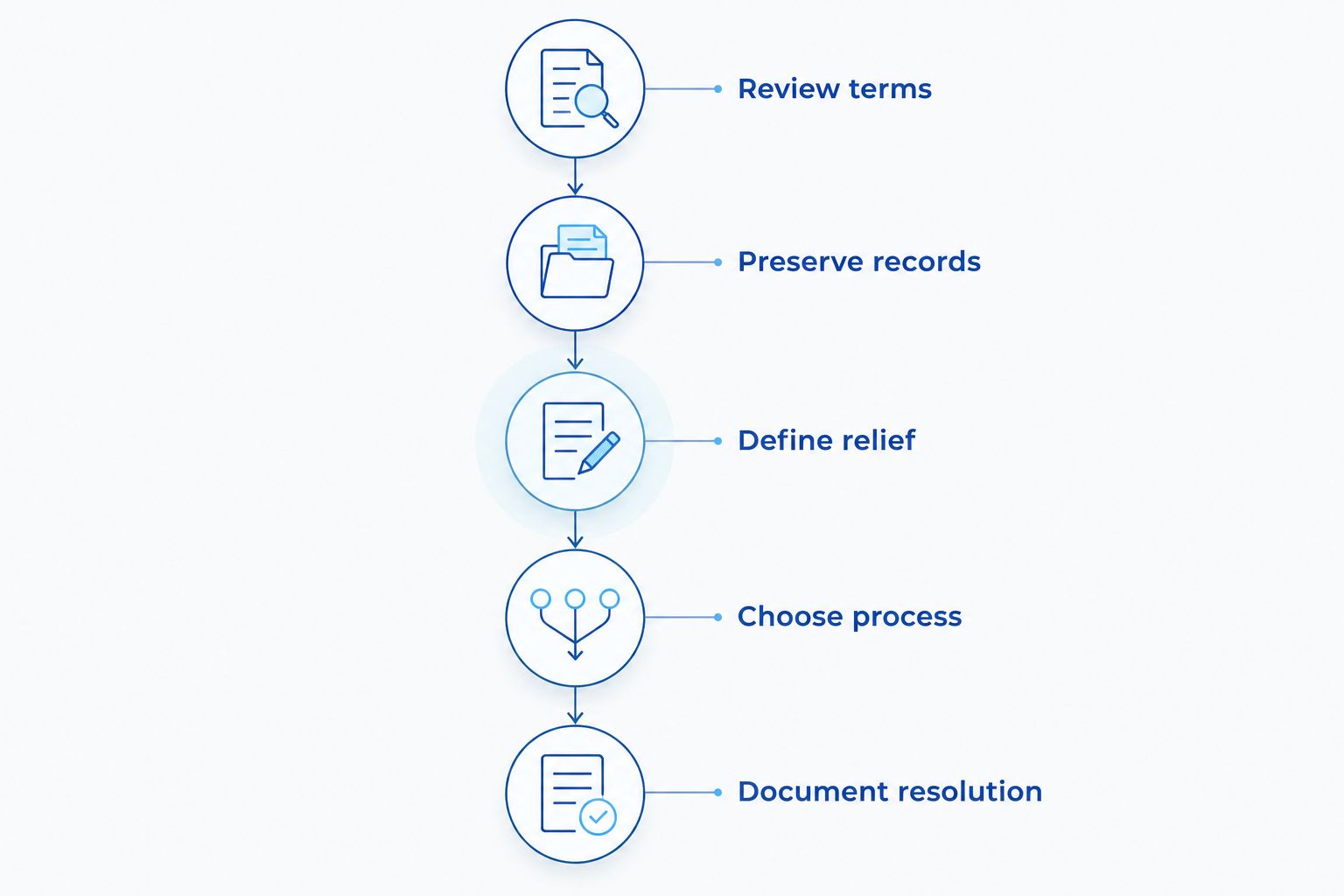
Build your timeline around milestones you can verify. Use the following sequence to organize the discussion with counsel, then revise it when the contract or procedural rules require a different order.
- Review terms. Identify the parties, governing law, notice provisions, and required dispute process. Confirm that you have the final agreement and amendments.
- Preserve records. Keep relevant emails, messages, invoices, delivery records, and accounting data. Preserve original files rather than relying only on screenshots or summaries.
- Define relief. State whether you need payment, completion of work, termination, or another legally available remedy. Separate the business objective from the legal theory.
- Choose process. Decide whether the next step is a demand, mediation, arbitration, or a court filing. Confirm deadlines before waiting for another response.
- Document resolution. Record the settlement or decision and identify what must happen next. Track performance and enforcement separately from the agreement date.
This sequence helps you distinguish preparation from actual delay. If the other side requests an invoice you already hold, supplying it is a concrete next step; if the dispute concerns contract interpretation, another copy of the invoice will not resolve that issue.
Ask for an updated schedule after a significant event, such as receiving the opposing party’s response or completing mediation. An estimate based on the actual response is more useful than one that assumes cooperation before the other business has engaged.
How long do you have to sue over a California contract?
4 years is the general California filing period for a claim based on a written contract, subject to the applicable accrual rules and exceptions. California Code of Civil Procedure section 337 provides that general period; section 339 generally provides 2 years for an oral-contract claim.
Those periods concern when to file, not how long resolution takes. The date a claim accrues, the legal theory, tolling, and other circumstances require individual review. A contract’s choice-of-law provision can also require further analysis.
For a dispute reviewed in 2026, do not calculate the deadline solely from the date you first complained. Give counsel the contract, performance dates, alleged breach dates, and any later promises or payments. Waiting for negotiations to finish is not a substitute for checking the filing deadline.
Does settling end the dispute immediately?
A settlement ends the dispute only to the extent its terms address the remaining obligations. Signing a release, receiving payment, completing work, and dismissing a pending lawsuit can occur at different points.
Before signing, identify who must do what, when performance is due, and what happens after a default. Coordinate dismissal and release terms with counsel rather than assuming that a signed document means every obligation has already been performed.
Which legal help fits your claim?
Khachikyan Law Firm is a fit for people seeking personal injury or lemon law representation in Glendale. A general business contract dispute calls for counsel whose practice covers commercial contract claims and the required forum.
The distinction matters when a vehicle warranty problem looks like an ordinary contract disagreement. If your issue concerns a defective vehicle or an injury rather than a supplier or customer contract, review Khachikyan Law Firm in that context. Do not assume that every firm handling a contract-based warranty claim also handles general commercial litigation.
FAQ
How long does a business contract dispute take to resolve in 2026?
A business contract dispute has no single resolution deadline in 2026. The contract, disputed evidence, required forum, settlement decisions, and enforcement steps determine the schedule.
Does the other business have to answer my demand letter?
A demand letter does not automatically create a court response deadline. Contractual notice requirements and applicable law need separate review, and silence does not itself produce a judgment.
Can I negotiate after filing a contract lawsuit?
Yes, you can negotiate while a contract lawsuit is pending. Continue meeting court deadlines unless a valid agreement, applicable rule, or court order changes your obligations.
Is mediation faster than going to trial?
Mediation can resolve a dispute without completing a trial, but only if the parties agree. An unsuccessful session leaves the underlying claim unresolved, so prepare the evidence and settlement authority beforehand.
How long does a defendant have to respond to a California contract lawsuit?
30 days is the general response period after personal service of a California civil summons and complaint under Code of Civil Procedure section 412.20. Service method, extensions, and case circumstances can change the calculation.
How long do I have to sue for breach of contract in California?
4 years generally applies to written-contract claims, while 2 years generally applies to oral-contract claims under California Code of Civil Procedure sections 337 and 339. Accrual rules, exceptions, and the applicable legal theory require review before relying on either period.
Does winning a contract case mean I get paid immediately?
No, a judgment or arbitration award does not guarantee immediate payment. Voluntary compliance, further proceedings, and enforcement determine what happens next.
Does Khachikyan Law Firm handle general business contract disputes?
Khachikyan Law Firm’s stated services are personal injury and lemon law representation in Glendale. Confirm the firm’s practice fit before assuming it accepts a general business contract dispute.
One last thing
Ask for a resolution plan, not just a finish date. The most useful plan identifies the next required step, the evidence needed to complete it, and the action to take if the other side does not cooperate. It should also explain how you move from an agreement or decision to actual performance.
This article provides general California legal information, not advice for a particular contract or deadline.


