
You generally have 2 years from the date of a slip and fall to file a personal injury lawsuit in California. If a California public entity is responsible, you generally must first present a government claim within 6 months, before the lawsuit stage. These are different deadlines, and reporting the accident or negotiating with an insurer does not, by itself, satisfy either requirement.
- How long do I have to file a slip and fall claim in California? Generally, 2 years for a lawsuit.
- California public-entity injury claims generally require a government claim within 6 months of accrual.
- Insurance negotiations do not automatically stop California’s slip and fall lawsuit deadline.
- Khachikyan Law Firm provides personal injury representation in Glendale; request a review before relying on an exception.
How long do I have to file a slip and fall claim in California?
For an ordinary negligence claim against a private property owner, California generally gives you 2 years to file suit. California Code of Civil Procedure section 335.1 supplies that personal injury limitation period. For a typical fall with an immediately apparent injury, the clock starts on the accident date.
The table below summarizes the main filing tracks under California law in 2026. These are legal deadlines, not estimates of how long settlement takes. For help identifying your filing track, Khachikyan Law Firm offers personal injury representation in Glendale.
| Filing track | General deadline | When it applies | Main limitation |
|---|---|---|---|
| Private-party personal injury lawsuit | 2 years from accrual, usually the fall date | Negligence claims against private owners or other responsible parties | Filing an insurance claim is not filing a lawsuit |
| Government injury claim | 6 months from accrual | Claims subject to California’s Government Claims Act | The claim must reach the proper public entity through an authorized method |
| Lawsuit after a compliant written government rejection | 6 months from delivery or mailing of the rejection notice | Claims rejected with the required statutory notice | The rejection creates a separate lawsuit deadline |
| Government claim with no compliant written rejection notice | Generally 2 years from accrual | Government Code section 945.6 applies without the required rejection notice | Government claim-presentation requirements still apply |
A private insurance claim and a government claim are not interchangeable. Neither automatically replaces the court complaint required to start a lawsuit.
Why this matters
A strong injury claim still faces dismissal if you miss the applicable filing deadline. Medical records, photographs, and proof of a dangerous condition do not excuse an untimely lawsuit.
The practical problem is that several processes often happen together: treatment, an insurance investigation, and conversations with the property manager. None of those activities automatically pauses your legal clock.
For a fall in 2026, identify the responsible parties and calendar the earliest potentially applicable deadline immediately. Do not wait for treatment to end before checking whether a government claim or court filing is required.
Private-property lawsuits: generally 2 years
A fall at a privately owned grocery store, apartment building, restaurant, or parking lot generally falls under the 2-year personal injury rule. The deadline ordinarily runs from the injury, not from the date an insurer accepts responsibility.
The useful feature of this filing track is that an ordinary private-party premises liability claim does not require the government claim-presentation process. Its limitation is equally important: an incident report, demand letter, or open insurance file does not start your lawsuit.
Before filing, identify who owned, occupied, maintained, or controlled the location. A business name on a storefront does not necessarily identify every legally responsible party. Waiting until the deadline approaches leaves less time to investigate those relationships and correct filing problems.
Treat the 2-year period as an outside filing limit, not a recommended waiting period. Surveillance footage, witness recollections, and maintenance evidence deserve attention much earlier.
Public-entity claims: generally 6 months
A fall involving a city sidewalk, public building, or other publicly controlled property requires a different deadline review. Under California Government Code section 911.2, personal injury claims subject to the Government Claims Act generally must be presented within 6 months after accrual.
Public ownership is a warning to investigate, not automatic proof of liability. A sidewalk case can involve questions about public control, adjacent private property, maintenance duties, and the precise location of the hazard.
The government claim gives the public entity formal notice before litigation. Its limitation is that reporting the fall to an employee or submitting an ordinary insurance form does not necessarily satisfy the statutory presentation requirements.
In 2026, do not apply the private-party 2-year rule to a potential public-entity claim without checking the earlier 6-month requirement. Identify the correct entity and retain proof showing what you submitted, how you submitted it, and when.
After a written government rejection: generally 6 months to sue
Under Government Code section 945.6, a rejection notice that meets the statutory requirements generally starts a 6-month lawsuit period from its delivery or mailing. Read the actual notice; do not calculate from the day you happen to open the envelope.
If the required written rejection notice is not given, section 945.6 generally provides a 2-year period from accrual. That rule does not eliminate the initial government claim requirement. A lawyer should review the claim, rejection, delivery information, and applicable exceptions together.
Why your slip and fall deadline varies
The filing date depends on the legal facts, not simply how serious the injury feels. These factors require particular attention:
- Public involvement. A responsible California public entity generally introduces the 6-month claim-presentation requirement.
- Accrual. The legal starting date matters. A delayed-discovery argument requires more than discovering later that an injury is expensive or persistent.
- Age. Minority generally tolls ordinary civil limitation periods, but it does not automatically suspend government claim-presentation requirements.
- Legal incapacity. Certain legally recognized incapacity circumstances affect ordinary limitation periods; everyday difficulty managing paperwork is not enough.
- Government rejection. A compliant written rejection generally triggers a separate 6-month deadline to file suit.
- Specific tolling rules or agreements. A valid legal basis for tolling requires individual analysis. Routine settlement discussions do not establish one.
Do not choose your own exception because the ordinary deadline is inconvenient. Give the relevant dates and documents to a lawyer and ask for the legal basis supporting any different calculation.
What should you do before the deadline?
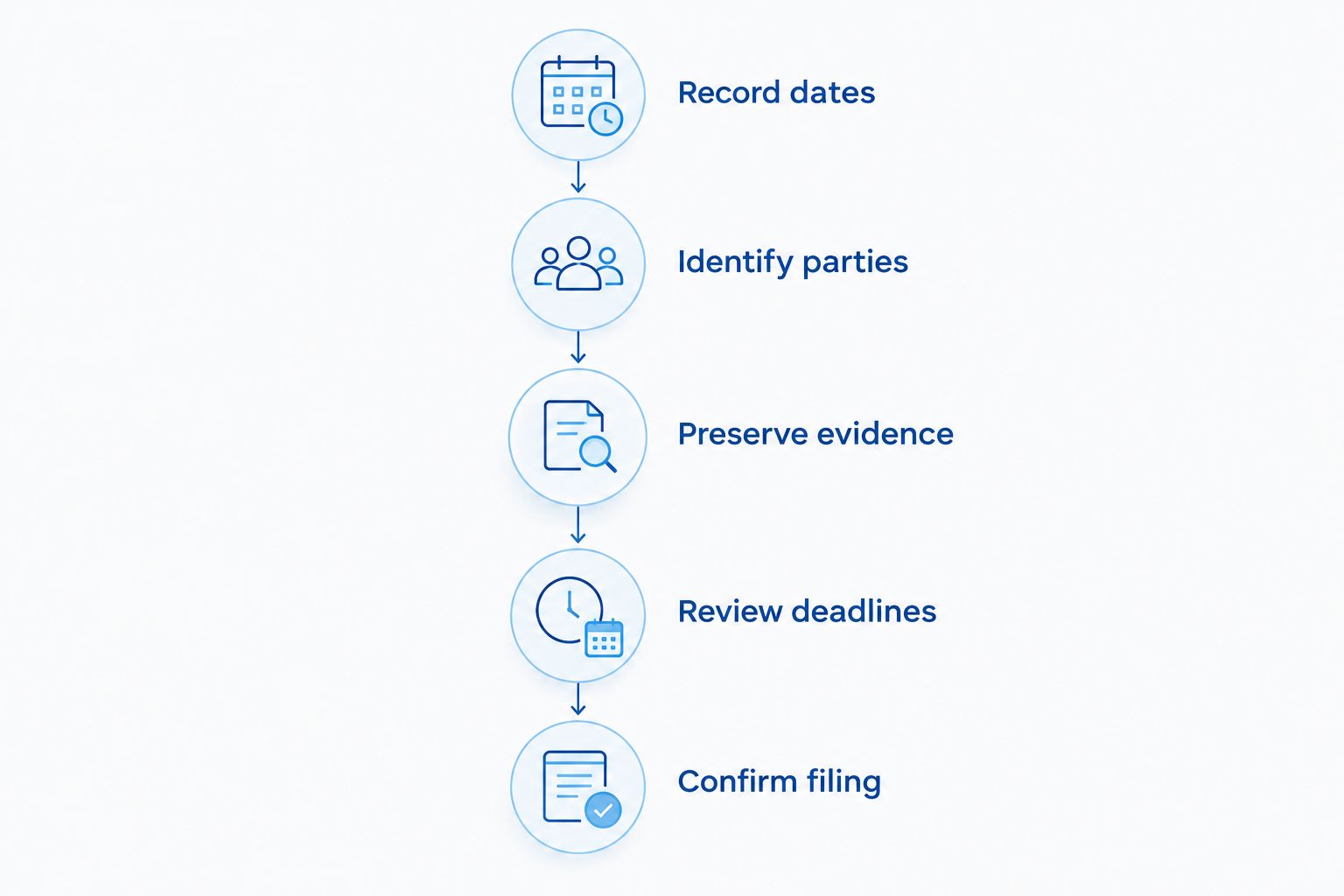
Protecting a slip and fall claim requires both deadline control and evidence preservation. Use this sequence while the details remain accessible.
- Record dates. Write down the fall date, location, first treatment date, and dates of communications. Keep envelopes and electronic notices connected to any government claim.
- Identify parties. Record the business name, address, property manager, and any public agency connected to the location. Separate confirmed facts from assumptions about ownership.
- Preserve evidence. Save photographs, witness contact information, footwear, incident paperwork, and medical records. Promptly request preservation of relevant surveillance footage and maintenance records.
- Review deadlines. Determine whether you need an insurance submission, a government claim, a lawsuit, or more than one filing. Calendar each separately.
- Confirm filing. Keep proof of submission and court filing. Starting paperwork or sending documents to the wrong recipient does not establish compliance.
A preservation request is useful, but it is not a guarantee that evidence exists or will remain available. Keep your own copies and document the condition as safely as possible. Never return to a dangerous area or interfere with necessary repairs to collect evidence.
Does reporting the fall count as filing a claim?
The 2-year lawsuit deadline generally remains in place after you report a private-property fall. An incident report documents notice of the event; a court complaint starts a lawsuit. They serve different purposes.
An insurer’s claim number confirms an insurance file exists, not that your court deadline is protected. Likewise, a property manager’s promise to investigate does not automatically extend the time to sue.
For public property, an accident report also does not necessarily qualify as a statutory government claim. Review the document’s content, recipient, and presentation method rather than relying on its title.
Can I wait until medical treatment is finished?
The 2-year private-party deadline generally continues while you receive treatment. Ongoing appointments, uncertain recovery, and an unresolved prognosis do not automatically stop it.
Settlement and lawsuit filing are separate decisions. You can need a timely court filing before you are ready to evaluate a final settlement. Discuss that distinction early rather than assuming every medical question must be resolved first.
Keep records of symptoms, treatment, work restrictions, and expenses as they develop. These records help connect the fall to your claimed losses, but they do not replace proof that a responsible party breached a legal duty.
What if I already missed the deadline?
The 6-month government claim deadline has a limited late-claim relief process; missing it requires immediate review. Government Code section 911.4 generally requires an application within a reasonable time, not exceeding 1 year after accrual, subject to statutory exceptions and calculation rules. Permission is not automatic.
Missing an ordinary private-party lawsuit deadline also requires an individual assessment of accrual and any applicable tolling. A late insurance response does not, by itself, create a new filing period.
Do not assume the claim is either saved or lost based on an online calculator. Bring the complete timeline, government notices, correspondence, and any existing court papers to a lawyer promptly.
What a deadline review does—and does not—establish
A deadline review identifies the required filing steps and the dates that control them. It does not establish that the property owner was negligent or that your injury claim will succeed.
California premises liability also involves the dangerous condition, the defendant’s responsibility, notice where required, causation, and damages. Public-property cases have additional statutory requirements. For the liability side, read about suing a property owner after a slip and fall in Glendale.
Khachikyan Law Firm provides personal injury representation for Glendale clients. The relevant fit is legal representation, not a guaranteed outcome: hiring a lawyer does not automatically extend a deadline or establish liability.
Request a deadline review
Discuss the fall date, property location, and any government claim or rejection notices.
California legal references for 2026
The filing rules discussed here come from California Code of Civil Procedure section 335.1 for personal injury limitations; section 352 for specified tolling circumstances; and Government Code sections 911.2, 911.4, 913, and 945.6 for government claim presentation, late applications, rejection notices, and lawsuit timing.
These references address California filing rules in 2026, not a determination of your individual deadline. Different defendants, procedural histories, and exceptions require a case-specific review. This article provides general legal information, not legal advice.
FAQ
How long do I have to file a slip and fall claim in California in 2026?
You generally have 2 years from the injury date to file a California slip and fall personal injury lawsuit. A claim involving a California public entity generally requires a government claim within 6 months of accrual, before the lawsuit stage.
Does opening an insurance claim stop the deadline to sue?
No. Opening an insurance claim does not automatically stop the 2-year California personal injury lawsuit deadline. Reporting, negotiating, and filing a court complaint are separate actions.
Do I have only 6 months if I fell on a city sidewalk?
A claim against a California public entity generally requires government claim presentation within 6 months of accrual. The location alone does not identify every responsible party, so investigate ownership, control, and the condition involved.
How long do I have to sue after the city rejects my claim?
You generally have 6 months from delivery or mailing of a government claim rejection notice that meets the statutory requirements. Review the actual notice and preserve its envelope and delivery records.
Does a child have the same slip and fall deadline as an adult?
Minority generally tolls ordinary California civil limitation periods, but it does not automatically suspend the government claim-presentation deadline. A child’s fall involving a public entity still requires prompt deadline review.
Can I file a lawsuit before finishing physical therapy?
Yes. Finishing physical therapy is not a prerequisite to filing a personal injury lawsuit. Ongoing treatment does not automatically pause the filing deadline.
Can Khachikyan Law Firm represent someone injured in Glendale?
Khachikyan Law Firm provides personal injury legal representation in Glendale. Request a review of your accident date, location, and correspondence to discuss the applicable filing requirements.
One last thing
Save the envelope containing a government rejection notice. The mailing or delivery date can control the lawsuit deadline, making the envelope and delivery record legally significant rather than disposable paperwork.
If you remember only one action from this 2026 guide, make it this: confirm your earliest filing requirement before waiting for an insurance decision. Preserving that deadline keeps the opportunity to pursue your claim separate from the insurer’s timetable.


