
Yes, you can sue a property owner after a slip and fall in Glendale if negligent property maintenance or another breach of duty caused your injury. Falling on someone else's property does not automatically establish liability; you must connect the unsafe condition, the responsible party's failure to use reasonable care, and your resulting losses.
- Can I sue a property owner after a slip and fall in Glendale? Yes, when negligence caused your injury.
- California premises liability claims require evidence of responsibility, negligence, causation, and harm—not just proof that you fell.
- Private-party injury lawsuits generally have a two-year deadline; public-property claims generally require earlier claim presentation.
- Khachikyan Law Firm provides personal injury representation in Glendale; preserve evidence before pursuing a slip-and-fall claim.
Why this matters
The strongest next move is to preserve the evidence that explains why you fell. A photograph of your injury documents harm, but it does not establish who caused the hazard or how long it existed. You need both sides of that story.
Khachikyan Law Firm is a Glendale firm for people seeking personal injury representation. You can contact Khachikyan Law Firm about representation while keeping your immediate focus on medical care, the accident location, and available records.
Can I sue a property owner after a slip and fall in Glendale?
Yes, if the evidence establishes the elements of a California premises liability claim. California Civil Code section 1714 and Judicial Council civil jury instructions CACI 1000 and 1003 provide the general framework relevant to this 2026 guide: responsibility for the premises, negligent care, injury, and a causal connection.
Work through these questions before assuming the owner owes compensation:
- Who controlled the property? Identify the owner, tenant, operator, or other party responsible for the area where you fell.
- What made the area unsafe? Describe the actual condition, such as spilled liquid, a damaged stair, or an obstruction.
- Why was the response unreasonable? Establish that the responsible party created the condition, knew about it, or should have discovered it through reasonable care.
- Did that condition cause your injury? Connect the mechanics of the fall to the hazard and your medical evidence.
- What losses resulted? Document treatment, lost earnings, pain, and other legally recoverable harm.
A dangerous condition and a documented injury are not enough by themselves. The missing link is often evidence of notice or unreasonable maintenance.
Who should you pursue after a fall?
Ownership is only the starting point. Responsibility can involve more than one party, depending on possession, control, maintenance duties, and the conduct that caused the injury.
| Location or circumstance | Parties to investigate | Evidence that matters | Main complication |
|---|---|---|---|
| Store aisle | Store operator, owner, or maintenance contractor | Inspection records, video, incident reports | Establishing who created or knew about the spill |
| Rental-property stairway | Landlord, property manager, or another responsible party | Repair requests, photographs, maintenance records | Determining control over the stairway |
| Shared commercial walkway | Owner, tenant, or property manager | Maintenance agreements, inspection records | Divided maintenance responsibilities |
| Public-property walkway | Responsible public entity and potentially other parties | Ownership records, condition evidence, notice records | Government claim requirements and separate liability rules |
An address alone does not identify the correct defendant. Establish who controlled the specific area, not merely whose name appears on the building.
Private-property injury lawsuits: generally 2 years
For a typical California personal injury lawsuit against a private defendant, Code of Civil Procedure section 335.1 generally provides 2 years from the injury to file suit. That is the general rule applicable in 2026, not a substitute for checking your specific deadline.
Exceptions and different claims can change the calculation. Do not assume an insurance claim, ongoing treatment, or settlement discussions extend the filing period.
Reporting the fall to a store is not the same as filing a lawsuit. Likewise, an insurer's claim number does not prove that your court deadline has been protected.
Have the deadline checked early, even if you are still receiving treatment. You can preserve your legal position without pretending your medical outcome is already clear.
Public-property injuries: generally 6 months to present a claim
If a public entity is responsible, California Government Code section 911.2 generally requires you to present an injury claim within 6 months after the claim accrues. A government claim is a separate procedural step, not simply a letter to an insurance company.
Government Code section 912.4 generally gives the public entity 45 days to act on a presented claim, subject to applicable extensions. Under section 945.6, a written rejection that satisfies the statutory requirements generally starts a separate 6-month period to file suit, measured from personal delivery or mailing of the notice.
These are distinct deadlines under the general 2026 framework. Do not treat the private-party two-year rule as permission to wait on a public-property injury.
Public-property liability also involves separate requirements under Government Code section 835, including a dangerous condition and the required connection to public-employee conduct or notice. A sidewalk's location outside a private business does not, by itself, settle who is responsible.
What should I do after a slip and fall?
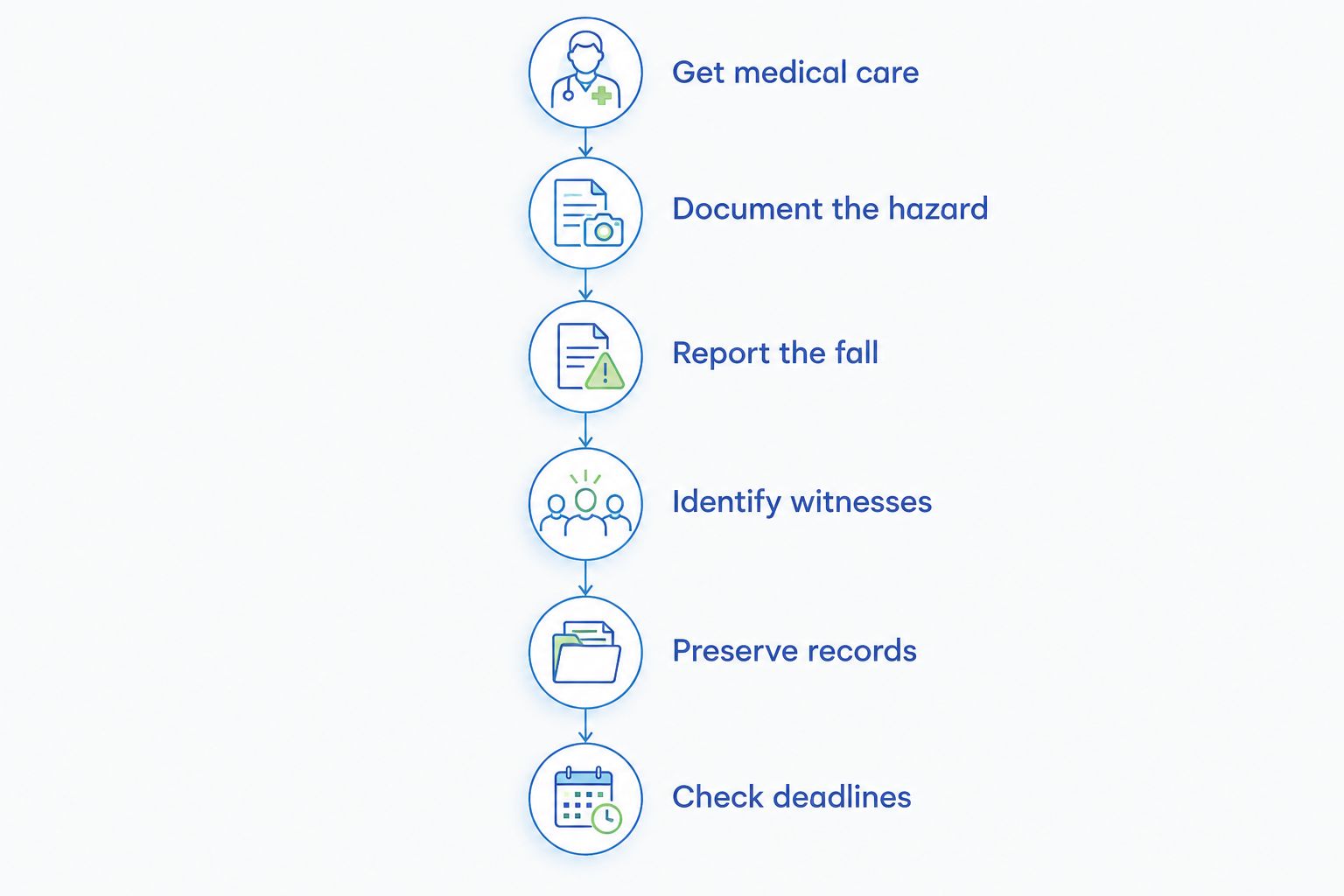
Start with your health, then preserve evidence without putting yourself at further risk. Use this sequence to organize the claim rather than relying on memory later.
- Get medical care. Describe how you fell and which symptoms followed. Follow treatment instructions and keep records of referrals, restrictions, and appointments.
- Document the hazard. Photograph the condition, the surrounding area, lighting, warning signs, and your approach to the location. Keep original files.
- Report the fall. Notify the appropriate manager, owner, or public entity. Ask how to obtain the incident report and retain your own written account.
- Identify witnesses. Save names and contact details for people who saw the fall or the condition beforehand. Keep their observations separate from your assumptions.
- Preserve records. Keep footwear, clothing, receipts, messages, wage records, and medical documents. Request preservation of relevant surveillance footage and maintenance records promptly.
- Check deadlines. Identify the potentially responsible parties and determine whether government claim rules apply before relying on the ordinary lawsuit deadline.
An incident report records that an event was reported; it does not automatically establish liability. Review any statement for accuracy, avoid guessing, and do not sign a release without understanding what claims it resolves.
A preservation request does not guarantee that footage exists or that the recipient will voluntarily provide it. Identify the location, approximate incident time, and relevant area clearly so the request addresses the evidence you need.
Why slip-and-fall liability varies
The legal question is not simply whether the floor was slippery. Liability turns on the condition, the responsible party's conduct, and how the injury happened.
- Control: A tenant, owner, or contractor can have different responsibilities for the same property. Investigate the specific area and maintenance duties.
- Notice: Prior complaints, employee observations, inspection records, and the condition's appearance can help establish actual or constructive notice.
- Reasonable precautions: Repairs, inspections, barriers, and warnings matter when evaluating whether the response met the duty of reasonable care.
- Visibility and circumstances: Lighting, sight lines, distractions created by the property, and the condition's obviousness affect the analysis.
- Causation: Evidence must connect the unsafe condition to the fall and the claimed injury, rather than merely showing that both existed.
- Shared responsibility: Your actions and the conduct of other parties can affect how fault is allocated.
A warning sign is relevant evidence, not an automatic defense. Its placement, visibility, wording, and relationship to the hazard still matter.
An obvious hazard also does not automatically end every case. California's premises liability analysis can still consider whether reasonable care required additional precautions under the circumstances.
What evidence shows the owner knew about the hazard?
You can establish notice through direct evidence or circumstances supporting what the responsible party should have discovered. The evidence must address the condition that caused your fall, not unrelated maintenance complaints.
Useful records include:
- Earlier complaints about the same leak, damaged step, or walkway defect.
- Repair requests showing when the problem was reported and whether it was addressed.
- Employee statements about seeing the condition before the incident.
- Inspection and cleaning records for the relevant area.
- Video showing when a spill appeared and what happened before your fall.
- Photographs showing wear, deterioration, or other features relevant to how long a condition existed.
There is no universal number of minutes that makes every spill actionable. Reasonable inspection and response depend on the circumstances. Avoid substituting a guessed timeline for evidence.
A witness who saw the spill before you fell can provide different information from a witness who only helped afterward. Preserve both accounts, but describe accurately what each person actually observed.
Can I still sue if I was partly at fault?
Yes. California's pure comparative negligence rule allows fault to be divided, and your recoverable damages are reduced by your share of responsibility.
The 2026 Judicial Council framework in CACI 405 addresses this reduction. Looking at your phone, choosing a route, or failing to notice a condition can become disputed facts, but none automatically determines the entire case.
Do not turn an immediate reaction into a legal conclusion. State what happened accurately and let the evidence establish whether your conduct contributed to the injury.
Can I sue if there was a warning sign?
Yes, a warning sign does not automatically bar a premises liability lawsuit. The question is whether the responsible party used reasonable care under the circumstances.
Photograph where the sign stood in relation to the hazard and your route. A photograph showing only the sign, without the surrounding area, leaves out information needed to evaluate the warning.
Do I need a broken bone to bring a claim?
No, a fracture is not required to establish a personal injury claim. You still need evidence of actual harm caused by the fall.
Medical records, treatment history, work restrictions, and changes in daily activities help document that harm. Report symptoms accurately; do not exaggerate them or omit relevant prior conditions.
What compensation can a slip-and-fall claim include?
A supported California personal injury claim can include economic losses and noneconomic harm. Recovery depends on proving liability, causation, and the damages claimed—not merely listing categories.
Economic losses can include reasonable medical expenses, lost earnings, and supported future losses. Noneconomic harm can include physical pain, emotional distress, and loss of enjoyment of life where supported by the evidence.
Keep bills and wage records, but also document practical limitations accurately: missed work duties, difficulty walking, interrupted sleep, or activities your condition prevents. A dated account helps distinguish actual effects from a later general description.
Do not treat a settlement offer as a diagnosis or a complete accounting of future needs. Review any release carefully because settling can end your ability to seek additional recovery for the same claim.
FAQ
Can I sue a Glendale property owner if I slipped but nobody saw it?
Yes, an eyewitness is not required to bring a premises liability claim. Photographs, video, medical records, maintenance records, and other evidence can help establish what happened and why the responsible party was negligent.
How long do I have to sue after a slip and fall in Glendale?
A private-party California personal injury lawsuit generally must be filed within 2 years of the injury. Public-entity claims generally require claim presentation within 6 months of accrual, and exceptions can change the applicable deadlines.
What if the property owner says they did not know the floor was wet?
A denial of actual knowledge does not resolve whether the responsible party should have discovered the condition through reasonable care. Inspection records, video, witness accounts, and evidence about how long the condition existed can matter.
Can I sue my landlord after falling on apartment stairs?
Yes, if a responsible landlord's negligence caused your injury. Control of the stairs, repair obligations, notice of the defect, and the connection between the defect and your fall must be evaluated.
Does filing an insurance claim stop the lawsuit deadline?
Filing an insurance claim does not, by itself, stop the lawsuit deadline. Do not assume claim discussions or ongoing treatment extend your time to file.
Should I keep the shoes I wore when I fell?
Yes, preserve the footwear in its existing condition because it can become relevant evidence. Avoid discarding or altering items connected to the incident.
Can Khachikyan Law Firm help with a Glendale personal injury matter?
Khachikyan Law Firm provides personal injury legal representation in Glendale. Ask about representation for your circumstances and bring your incident details, medical records, photographs, and correspondence.
One last thing
Photograph the route you took, not just the spot where you landed. The approach can show lighting, obstructions, warning placement, and sight lines that a close-up misses.
Keep your claim grounded in what you can establish. A clear account, preserved records, and an early deadline check give you a sound basis for deciding what to do next.