
You generally have 2 years from the accident date to file a pedestrian injury lawsuit in California in 2026, under Code of Civil Procedure section 335.1. If a public agency is involved, you generally must first present a government claim within 6 months; opening an insurance claim does not satisfy either requirement.
- Pedestrian accident claim deadline California: generally 2 years to sue a private defendant for personal injuries.
- Government injury claims generally require presentation within 6 months, before a lawsuit.
- Insurance negotiations do not automatically pause California's statute of limitations.
- Khachikyanlawfirm provides personal injury representation in Glendale; request a review before assuming which deadline applies.
How long do I have to file a pedestrian accident claim in California?
For a typical pedestrian injury claim against a private driver, California Code of Civil Procedure section 335.1 gives you 2 years to file a lawsuit. The clock generally starts when the collision injures you, not when you finish treatment or receive the insurer's final offer.
The word claim creates confusion. An insurance claim, a government claim, and a court lawsuit are different filings with different consequences.
| Filing or situation | General deadline | What it accomplishes | Main limitation |
|---|---|---|---|
| Injury lawsuit against a private defendant | 2 years from injury | Starts a court case seeking compensation | Reporting the accident to an insurer does not file the lawsuit |
| Government claim for personal injury | 6 months from accrual | Satisfies an initial requirement for pursuing a public entity | Presenting the claim does not itself start a lawsuit |
| Lawsuit after a compliant written government rejection | Generally 6 months from personal delivery or mailing | Starts the court case after rejection | The rejection notice and delivery details matter |
| Insurance claim | Policy-specific notice requirements | Requests coverage or payment | Does not automatically preserve your court deadline |
For the broader distinction between reporting an accident and suing, see how long after a car accident you can file a lawsuit in California.
Why this matters
A valid injury claim can fail if you miss the filing deadline. Evidence of fault and medical bills does not excuse an untimely lawsuit.
You also need time to identify the right defendants. A pedestrian collision can involve a driver, an employer, or a public entity responsible for an allegedly dangerous road condition. Different defendants can bring different filing requirements into the same case.
Treat the deadline as the outside limit, not your target date. Starting early gives you time to obtain records, preserve evidence, and address filing problems before they become emergencies.
Private-driver injury lawsuits: generally 2 years
Under California Code of Civil Procedure section 335.1, the ordinary personal injury filing period is 2 years. For a pedestrian struck and injured by a private driver, the accident date is generally the starting point.
That rule concerns filing a complaint in court. It does not mean you must finish treatment, complete negotiations, or receive compensation within that period.
For a 2026 collision, record the exact accident date and have the corresponding filing deadline checked. Weekends, court holidays, accrual rules, and applicable exceptions can affect the final calculation; do not calculate it from an approximate month.
What this deadline lets you do—and what it does not
The filing period gives you time to investigate responsibility and document your injuries. Its limit is straightforward: an open insurance file is not a pending lawsuit.
A police report, demand letter, medical authorization, or settlement discussion does not substitute for filing a complaint. If negotiations remain unresolved near the deadline, you need a decision about filing—not another assumption that the adjuster is handling it.
Government injury claims: generally 6 months
California Government Code section 911.2 generally requires a personal injury claim against a public entity to be presented within 6 months after accrual. This requirement can matter when a public employee caused the collision or a dangerous public property condition contributed to it.
A city-owned vehicle, public bus, or alleged roadway defect should trigger an immediate public-entity review. Government ownership or involvement does not establish liability by itself, but it changes the deadline analysis.
For government-related pedestrian injuries in 2026, identify the potentially responsible agency before relying on the ordinary private-driver timeline. Government Code section 945.4 generally requires claim presentation and action on that claim, or deemed rejection, before you sue a public entity for damages.
What government claim presentation does—and does not do
Presenting a government claim gives the public entity a formal opportunity to consider it before litigation. It is not the same as filing a court complaint.
A police report or complaint to a city department does not automatically satisfy the Government Claims Act. The recipient, contents, and presentation method matter, so keep a complete copy and proof of delivery.
After a government rejection: generally 6 months to sue
Under Government Code section 945.6, a compliant written rejection generally starts a 6-month lawsuit deadline from the date the notice is personally delivered or deposited in the mail. Do not assume the clock starts when you open the envelope.
Preserve the rejection letter and envelope together. The notice's wording, mailing date, and compliance with Government Code section 913 affect the analysis.
If compliant written rejection notice is not given, section 945.6 generally provides a different outside period: 2 years from accrual. That rule does not erase the separate claim-presentation requirement or make it safe to ignore correspondence.
Have every rejection notice reviewed promptly. A letter denying a government claim is a deadline document, not just an explanation of the agency's position.
Why the pedestrian accident filing deadline varies
The ordinary deadline is only the starting point. These factors determine which rules need review:
- Defendant identity: A private driver and a public entity do not follow the same pre-lawsuit process. Investigate ownership, employment, and agency involvement.
- Age at injury: California Code of Civil Procedure section 352 generally tolls ordinary limitations periods during minority. Government claim-presentation deadlines require separate analysis.
- Claim accrual: The date a cause of action accrues controls the clock. Delayed discovery is a legal exception, not an automatic extension for later treatment.
- Death resulting from injuries: A wrongful death claim has its own accrual analysis, generally measured from death under section 335.1 rather than simply copying the injury date.
- Rejection and tolling documents: Government notices, qualifying statutory tolling, and enforceable tolling agreements can change the calculation. Settlement conversations alone do not establish an extension.
These are reasons to check the deadline, not reasons to postpone action. Use the earliest potentially applicable deadline until a lawyer confirms otherwise.
What should I do now to protect my filing deadline?
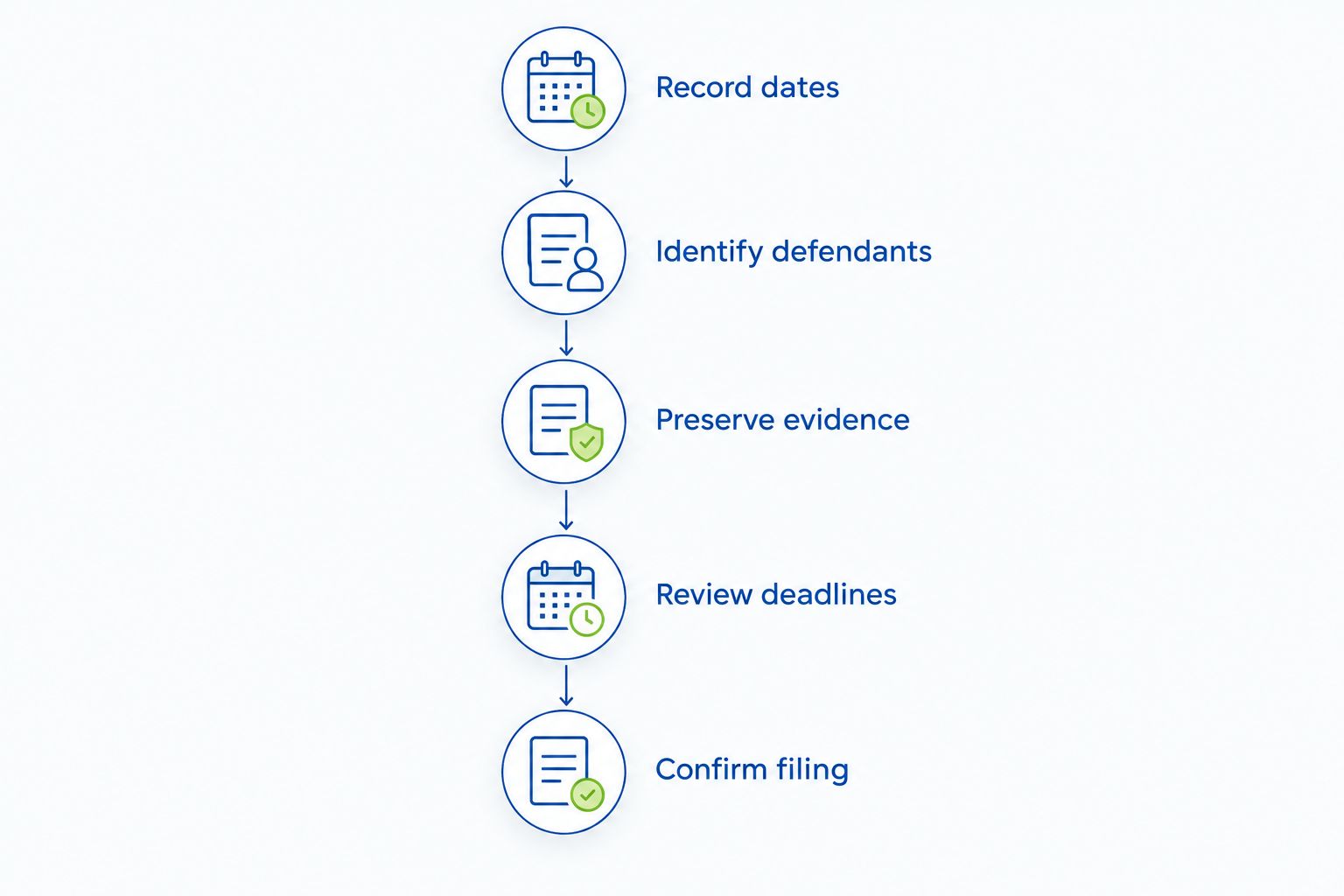
Build a deadline file before collecting a large stack of unrelated paperwork. In 2026, the essential task remains the same: connect each potential defendant to the filing rule that applies.
- Record dates. Write down the collision date, initial treatment date, and dates on every claim notice or rejection. Keep the original documents.
- Identify defendants. Collect driver information, vehicle ownership details, employer information, and any facts suggesting public-agency involvement.
- Preserve evidence. Save photographs, witness contacts, medical records, insurance correspondence, and available video. Ask promptly about footage before it is overwritten.
- Review deadlines. Separate insurer notice requirements, government claim presentation, and court filing. Record each applicable date rather than using one general reminder.
- Confirm filing. Keep proof of government claim presentation and court filing when applicable. A drafted document or an email asking for help is not proof that a required filing occurred.
The sequence matters: identifying a government defendant after months of private-insurer negotiations can expose a deadline problem that earlier investigation would have revealed.
Khachikyanlawfirm is a fit for injured pedestrians seeking personal injury representation in Glendale. A legal review can address which defendants and filing requirements your facts raise; hiring counsel does not itself extend a deadline.
Use the contact page to request a review. Bring the accident date, available reports, and any government correspondence rather than waiting for every medical bill.
Does talking to an insurance adjuster stop the deadline?
The 2-year ordinary injury lawsuit deadline does not automatically stop during insurance negotiations. An adjuster's request for more records, a pending offer, or continued communication does not substitute for filing suit.
Keep negotiations and deadline protection on separate tracks. If someone claims you have an extension, have the actual legal basis or written agreement reviewed before relying on it.
Does a child have the same pedestrian injury deadline?
The 2-year ordinary limitations period is generally tolled while an injured child is under 18 years old, under Code of Civil Procedure section 352. That general rule concerns the child's ordinary personal injury limitations period; it is not a universal extension for every related claim.
Public-entity claims require special attention because minority does not generally suspend the initial government claim-presentation requirement. A parent's separate claim also needs its own deadline analysis.
What if I already missed the government claim deadline?
The 6-month government claim deadline requires immediate review if it has passed. Government Code section 911.4 provides a procedure for requesting permission to present a late claim, subject to eligibility requirements and time limits.
An application generally must be made within a reasonable time, not exceeding 1 year after accrual, subject to statutory rules and exceptions. Approval is not automatic, and denial can create additional court deadlines; do not treat the late-claim process as extra time available to everyone.
FAQ
What's the pedestrian accident claim deadline in California?
The ordinary California pedestrian injury lawsuit deadline is 2 years from injury under Code of Civil Procedure section 335.1. Claims involving public entities generally require government claim presentation within 6 months, so identify the defendant before choosing a deadline.
Does filing an insurance claim count as filing a lawsuit?
No. Opening an insurance claim does not file a court lawsuit or automatically stop the statute of limitations. Keep insurance notice requirements separate from the court filing deadline.
Do I have to finish medical treatment before I sue?
No. You do not have to finish treatment before filing a pedestrian injury lawsuit. Continuing treatment does not automatically extend the filing deadline, so discuss unresolved medical issues before the deadline approaches.
How long do I have if a city bus hit me?
A personal injury claim against a public transit entity generally must be presented within 6 months after accrual. The operator's identity and the responsible entity must be checked because public and private transportation defendants can follow different rules.
Can I still bring a claim if I was partly at fault?
Partial fault does not automatically bar a California pedestrian injury claim. California's comparative fault rules can reduce compensation based on your share of responsibility, but they do not automatically extend the filing deadline.
What should I bring to a pedestrian accident deadline review?
Bring the accident date, police report information, driver and insurance details, and any government claim or rejection documents. Khachikyanlawfirm provides personal injury representation in Glendale; include correspondence that could affect the filing timeline.
Does filing on time guarantee compensation?
No. Timely filing preserves an opportunity to pursue the case, not a guaranteed recovery. You still need to establish the applicable elements of liability and prove your damages.
One last thing
The most useful deadline document might be an envelope. For a government rejection, the mailing date can matter even if you read the letter later. Save the envelope, scan both sides, and keep it with the notice.
For your 2026 deadline review, give Khachikyanlawfirm the full timeline—not just the accident date. Include government submissions, rejection letters, insurance communications, and any agreement said to extend time.
This page provides general California legal information, not legal advice for your specific case. Exact deadlines depend on the facts, defendants, notices, and applicable exceptions.


